
A stereo microscope with a camera can make fine inspection work easier to document, share, and repeat. The right model combines a comfortable binocular view with useful magnification, stable mechanics, dependable lighting, and a camera suited to your display or recording setup.
We selected 10 trinocular stereo microscopes and related camera-equipped options for different needs, from electronics repair and soldering to laboratory inspection and professional imaging. Use the guide below to compare specifications before choosing.
Best 10 Stereo Microscopes with Cameras Picks for 2026
Flexible High-Magnification Pick
Professional Trinocular Stereo Zoom Microscope

- 3.5X–90X range with auxiliary lenses
- Camera- and eyepiece-ready trinocular port
- Boom stand with dimmable 56-LED ring light
Best For: Flexible inspection setups needing broad magnification
Best Complete Camera Bundle
AmScope 18MP Trinocular Stereo Microscope

- Included 18MP USB 3.0 camera
- 3.5X–90X zoom with simul-focal viewing
- 144-LED ring light and Windows software
Best For: Computer-based imaging, editing, and measurement
Laboratory Compound Option
Trinocular Microscope with HD USB Camera

- Claimed 40X–5000X magnification
- HD USB camera and trinocular head
- Mechanical stage and laboratory accessory kit
Best For: Biological education and high-power specimen viewing
Practical Inspection Choice
AmScope 5MP Digital Stereo Zoom

- 5MP camera with USB 2.0 output
- Long-working-distance boom stand
- Adjustable 54-bulb LED ring light
Best For: Circuit-board and larger-object bench inspection
Professional Choice
SWIFT Trinocular Stereo Zoom Microscope
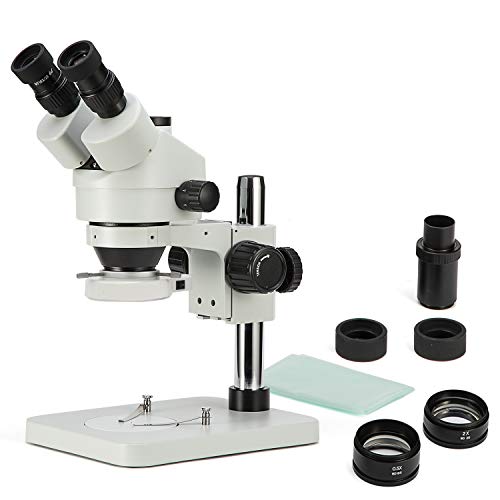
- 3.5X-90X range with extra objectives
- Trinocular port for camera attachment
- 56-bulb cool LED ring light
Best For: Detailed inspection, research, and electronics work
Electronics Workbench Pick
Kaisi Trinocular Soldering Microscope

- 7X-50X continuous zoom magnification
- Camera-friendly trinocular viewing design
- Includes fan, mat, light, and parts trays
Best For: Soldering and electronics repair
Camera-Ready Value
ZTEEERS Trinocular Stereo Microscope

- 6X-45X continuous zoom range
- Includes 0.5X CTV camera adapter
- 56-bulb LED ring illumination
Best For: General inspection and specimen documentation
Industrial Value Pick
Trinocular Stereo Zoom Microscope

- Camera-ready trinocular head with 360-degree rotation
- 3.5X-90X range with included auxiliary lenses
- Long-reach boom stand and adjustable 144-LED ring light
Best For: Laboratory and industrial inspection with flexible camera connectivity
Best Integrated Camera Setup
TX-350E 4K Trinocular Microscope

- Included 4K smart camera with multiple recording modes
- 7X-50X zoom for repair and inspection tasks
- Large work floor with fume extractor and LED lighting
Best For: Soldering, electronics, and watch repair with built-in imaging
Best Lighting Flexibility
Swift S7-TGL-CA05 Trinocular Microscope

- 7X-45X zoom with a 100mm working distance
- Gooseneck and transmitted LED lighting options
- Camera-compatible trinocular head with ergonomic rotation
Best For: Hands-on inspection needing directional and transmitted lighting
Flexible High-Magnification Pick – Professional Trinocular Stereo Zoom Microscope
If you need stereo microscopes with cameras for varied inspection tasks, this trinocular zoom model offers a broad 3.5X–90X range when its auxiliary lenses are used. Its camera-ready trinocular port, boom stand, and adjustable ring light make it a flexible setup for detailed viewing and documentation.
Best For: Users who want flexible magnification, long-reach positioning, and the option to connect a digital camera or electronic eyepiece.
Pros:
- Wide 3.5X–90X magnification range with included 0.5X and 2.0X auxiliary lenses.
- Trinocular head supports electronic eyepiece and digital-camera connections.
- Heavy-duty steel base, boom stand, and 56-LED dimmable ring light provide a stable, adjustable setup.
Cons:
- The large professional stand has a substantial footprint and weighs 18 pounds at the base.
- The listing does not specify a camera included in the package.
This is a strong choice when flexibility matters more than an all-in-one camera bundle. Confirm camera compatibility and available workspace before buying.
Best Complete Camera Bundle – AmScope 18MP Trinocular Stereo Microscope
Among stereo microscopes with cameras, this AmScope package stands out for including an 18MP USB 3.0 camera and Windows editing and measuring software. It pairs simultaneous eyepiece-and-camera viewing with 3.5X–90X zoom, an extended working distance, and a bright 144-LED ring light.
Best For: Buyers seeking a complete, high-resolution camera setup for computer viewing, image capture, editing, and measurement.
Pros:
- Includes an 18MP CMOS camera with USB 3.0 connectivity and Windows software.
- Simul-focal trinocular design allows viewing through the eyepieces and camera port at the same time.
- Offers up to an 8-inch working distance, a wide field of view, and a dimmable 144-LED ring light.
Cons:
- At 65 pounds, the complete system is relatively heavy.
- The supplied camera software is specified for Windows operating systems.
Choose this model if image capture and measurement are central to your workflow. Its included camera and software reduce the need to assemble a separate imaging system.
Laboratory Compound Option – Trinocular Microscope with HD USB Camera
This model differs from typical stereo microscopes with cameras because it is a compound, laboratory-oriented microscope rather than a stereo zoom system. It combines a trinocular head, HD USB camera, achromatic objectives, mechanical stage, and claimed 40X–5000X magnification for biological and educational work.
Best For: Biology learners, school laboratories, and users needing high-power compound microscopy with camera connectivity and included specimen supplies.
Pros:
- Includes a trinocular configuration with an electronic eyepiece and HD USB camera.
- Provides a dual mechanical stage, coaxial coarse and fine focusing, and LED illumination.
- Includes slides, coverslips, specimens, tools, and other laboratory accessories.
Cons:
- It is a compound microscope, so it is not the right choice for large objects or low-magnification stereo inspection.
- The advertised 40X–5000X range is substantially higher than the ranges of the stereo models in this roundup.
If your priority is biological specimen work rather than circuit boards or three-dimensional objects, this camera-equipped compound design offers the more suitable platform. Verify that its included camera meets your preferred imaging workflow.
Practical Inspection Choice – AmScope 5MP Digital Stereo Zoom
For stereo microscopes with cameras aimed at hands-on inspection, this AmScope combines a 5MP camera, USB 2.0 output, and a long-working-distance boom stand. Its 7X–45X listed magnification range and removable 54-bulb LED ring light suit larger items such as circuit boards and dental appliances.
Best For: Electronics, repair, and bench inspection where users need camera display or image capture while manipulating larger objects.
Pros:
- Includes a 5MP camera, 0.5X reduction lens, and USB 2.0 output for a computer or projector.
- Long-working-distance boom stand provides 8 inches of vertical clearance and adjustable X/Y positioning.
- Rheostat-controlled 54-bulb LED ring light offers adjustable intensity and cool illumination.
Cons:
- Its 5MP camera and USB 2.0 connection are less specified than the 18MP USB 3.0 bundle in this roundup.
- The maximum listed magnification is 45X, below the higher-power options included here.
This is a sensible bench microscope when working distance and physical access are more important than maximum magnification. Its included reduction lens and camera make it ready for basic computer or projector viewing.
Professional Choice – SWIFT Trinocular Stereo Zoom Microscope
For shoppers comparing stereo microscopes with cameras, the SWIFT S7-TP520-EA10-56 stands out for its trinocular port, broad magnification range, and stable metal construction. It supports camera attachment while providing 3.5X-90X magnification with the included objectives, making it adaptable for detailed inspection and documentation.
Best For: Researchers, gemologists, engravers, collectors, and electronics or semiconductor work requiring flexible magnification and camera connectivity.
Pros:
- Trinocular port supports camera attachment and specimen documentation.
- Wide 3.5X-90X range with included 0.5X and 2.0X additional objectives.
- 56-bulb LED ring light provides bright, shadow-free, relatively cool illumination.
- Sturdy metal base and 100 mm working distance support precision work.
Cons:
- The setup is corded electric and specified for 230 volts.
- Camera is not included.
This is a versatile choice when you want one microscope for low-power viewing, higher-magnification inspection, and camera-based records. Its extra objectives add flexibility, while the ergonomic head and ring light help support longer sessions.
Electronics Workbench Pick – Kaisi Trinocular Soldering Microscope
The Kaisi TX is a practical option among stereo microscopes with cameras for soldering and electronics repair. Its trinocular design accommodates camera use without removing the left eyepiece, while the included work surface, silicone mat, smoke-extraction fan, and LED ring light create a workstation-focused setup.
Best For: Electronics repair, soldering, hot-air rework, and users who want an integrated work area around the microscope.
Pros:
- 7X-50X continuous zoom range suits many electronics-repair tasks.
- Trinocular upgrade is designed to preserve the viewing experience when using a camera.
- Wide-field WF10x23 eyepieces can help reduce viewing fatigue.
- Includes a soldering exhaust fan, LED ring light, silicone mat, and parts trays.
Cons:
- Camera is not included.
- Working distance varies by lens configuration and must be set correctly for focus.
- The product is specified for 120-volt operation.
Choose this model if your priority is a ready-to-use electronics bench rather than a general-purpose laboratory stand. The built-in accessories are especially useful for soldering, though users should pay attention to the lens position and working-distance instructions.
Camera-Ready Value – ZTEEERS Trinocular Stereo Microscope
The ZTEEERS 6045 is a straightforward option for shoppers seeking stereo microscopes with cameras and a broad viewing field. It combines a trinocular head with a 0.5X CTV adapter, 6X-45X zoom magnification, and a 56-bulb LED ring light for inspection and image documentation.
Best For: Users who want a stable, camera-compatible stereo microscope for general specimen inspection and documentation.
Pros:
- Trinocular head supports binocular observation and camera attachment.
- 6X-45X zoom range provides continuous variable magnification.
- Included 0.5X CTV adapter is intended to provide a larger, clearer field of view.
- 56-bulb LED ring light delivers bright, uniform illumination.
Cons:
- Camera is not included.
- Maximum magnification is lower than some alternatives in this roundup.
- The supplied information does not specify a working-distance measurement.
This model makes sense for buyers who value a camera-ready trinocular layout and a larger field of view without stepping up to the highest magnification. Its aluminum-alloy frame and pillar stand provide a stable platform for routine viewing and documentation.
Industrial Value Pick – Trinocular Stereo Zoom Microscope
For shoppers comparing stereo microscopes with cameras, the Vision Scientific VS-3FZ-IFR07 stands out as a flexible trinocular platform. Its camera-ready port, broad 3.5X-90X range, long-reach boom stand, and adjustable LED illumination suit detailed inspection across larger work areas.
Best For: Laboratory, industrial, and repair work where a camera-ready trinocular head and wide magnification range are priorities.
Pros:
- Trinocular head supports a digital camera or HD touch screen and rotates 360 degrees.
- Included 0.5X and 2X auxiliary lenses expand the standard range to 3.5X-90X.
- Long, flexible boom stand and 65mm field of view accommodate larger specimens.
- 144-LED ring light provides cool white illumination with adjustable intensity.
Cons:
- At 38 pounds, the metal microscope is comparatively heavy for a tabletop setup.
- A camera is not included, so imaging adds a separate purchase.
Its robust stand, parfocal optical design, and heavy-duty focusing mechanism make this a practical choice for users who want camera compatibility without giving up working distance or inspection flexibility.
Best Integrated Camera Setup – TX-350E 4K Trinocular Microscope
The HengTianMei TX-350E is a strong option among stereo microscopes with cameras because it includes a 4K smart camera rather than requiring a separate imaging purchase. Its 7X-50X zoom, generous work floor, ring light, and fume extractor are tailored to electronics, soldering, and watch repair.
Best For: Repair benches and soldering work where integrated 4K recording, hands-on workspace, and fume extraction are useful.
Pros:
- Included 4K, 40-megapixel smart camera records 4K at 30 fps or 1080p at 60 fps.
- 7X-50X magnification provides adjustable viewing for different repair tasks.
- 14.7-by-9.6-inch working floor offers room for larger repair items.
- Includes a solder-fume extractor and touch LED illuminator.
Cons:
- The product recommends an HDMI connection for the camera, which may affect setup choices.
- Its maximum magnification is 50X, below the 90X maximum of some industrial alternatives.
With the camera and repair-focused accessories included, the TX-350E is a convenient all-in-one package for users who want to document or display detailed repair work with minimal additional equipment.
Best Lighting Flexibility – Swift S7-TGL-CA05 Trinocular Microscope
The Swift S7-TGL-CA05 combines a camera-compatible trinocular design with a 7X-45X zoom range and flexible specimen lighting. For shoppers seeking stereo microscopes with cameras, its 45-degree viewing angle, 100mm working distance, and dual LED system make it well suited to comfortable, hands-on observation.
Best For: Users who need adaptable top and transmitted lighting for repair, inspection, or temperature-sensitive specimens.
Pros:
- Trinocular head supports camera, smartphone, tablet, computer, laptop, or television compatibility.
- 7X-45X magnification and 100mm working distance provide room for hands-on work.
- Upper dual-gooseneck and transmitted LED lights offer directional, shadowless illumination.
- 45-degree, 360-degree rotating head helps support comfortable viewing from different angles.
Cons:
- The listed 45X maximum is lower than some broader-range stereo microscopes.
- A camera is not included in the supplied product details.
The S7-TGL-CA05 is especially appealing when lighting control matters as much as magnification. Its sturdy metal stand, cool LED illumination, and camera-ready trinocular head create a versatile inspection workstation.
How We Picked These Stereo Microscopes with Cameras
We focused on the features that most affect real-world inspection: trinocular optical design, usable zoom range, camera resolution, illumination, stand stability, working distance, and compatibility with computer displays. We also considered whether each microscope is better suited to hands-on bench work, teaching, documentation, or higher-detail imaging.
Advertised magnification can vary significantly depending on eyepieces and auxiliary lenses, so a very high number is not automatically better. Optical clarity, smooth focusing, a broad field of view, and enough room beneath the objective often matter more.
Quick Comparison
| Best For | What to Prioritize | Useful Features |
|---|---|---|
| Electronics and soldering | Long working distance and stable stand | Ring light, boom or pillar stand, smooth zoom |
| Professional documentation | Camera quality and optical compatibility | Trinocular port, high-resolution sensor, USB output |
| Laboratory inspection | Broad magnification range and mechanical control | Fine focus, robust stage, adjustable illumination |
| Teaching and shared viewing | Simple imaging and comfortable eyepieces | Large display support, easy camera controls |
Key Buying Factors for Stereo Microscopes with Cameras
Optics and Magnification
Choose a zoom range that matches your work rather than chasing the highest stated power. Lower magnification is helpful for locating components and working with tools, while higher magnification supports small defects, fibers, and surface details. Auxiliary lenses can change both magnification and working distance.
Camera Resolution and Connectivity
Camera resolution affects how much detail appears on a monitor, but sensor quality, frame rate, software support, and lighting are equally important. Confirm whether the camera connects through USB, HDMI, or another interface, and check operating-system compatibility before buying.
Lighting and Working Distance
LED ring lights provide even, shadow-reducing illumination for many bench tasks. Gooseneck lights offer more directional control, while transmitted lighting is useful for translucent specimens. A longer working distance makes it easier to solder, manipulate samples, or position tools under the lens.
Stand, Focus, and Ergonomics
A heavy base and rigid column help prevent vibration during high-magnification viewing. Look for smooth coarse and fine focus, comfortable eyepieces, and a stand that fits your workspace. Trinocular models let you view through the eyepieces while the camera records independently.
Who Should Buy Which Stereo Microscopes with Cameras?
Choose a compact trinocular model with strong LED lighting if you mainly repair electronics, solder, or inspect circuit boards. For professional records, demonstrations, or remote collaboration, prioritize a model with a high-resolution camera and reliable computer connectivity. Laboratory users should favor stable mechanical controls, flexible illumination, and a useful optical range over extreme advertised magnification. If several people will use the microscope, select comfortable eyepieces, straightforward camera software, and a stand with easy height adjustment.