
Wide-field astrophotography rewards careful tracking, but you do not need a full observatory setup to capture sharp Milky Way scenes, constellations, and deep-sky vistas. The right star tracker can improve exposure times while keeping your kit portable.
This roundup compares 10 options across camera mounts, smart telescopes, and computerized equatorial systems, with an emphasis on portability, alignment, automation, and upgrade potential.
Best 10 Star Trackers for Wide Field Imaging Picks for 2026
Best Modular Tracker
Sky-Watcher Star Adventurer 2i Pro Pack
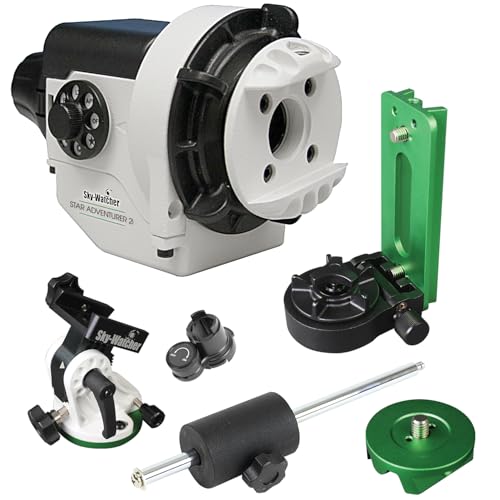
- Portable platform for Milky Way and nightscape photography
- Wi-Fi smartphone control via SAM Console
- Modular design supports tripod and telescope use
Best For: Flexible wide-field astrophotography setups
Best Ultra-Portable Smart Option
DWARFLAB Dwarf Mini Smart Telescope

- Weighs about 1.85 pounds for easy travel
- App control with Auto GOTO and 360-degree pivoting
- EQ mode enables exposures up to 90 seconds
Best For: Beginner-friendly portable digital astronomy
Best Compact Camera Mount
iOptron SkyTracker Pro Camera Mount

- 6.6-pound payload capacity
- Multiple speeds for sidereal, landscape, solar, and lunar work
- Polar scope and padded bag included
Best For: Portable camera and cellphone tracking
Best Advanced Imaging System
Celestron Advanced VX EdgeHD 8-inch

- 8-inch EdgeHD optics with a flat-field design
- Multiple focal-ratio imaging configurations
- Computerized GEM with PPEC and autoguider support
Best For: Dedicated telescope-based astrophotography
Open-Source Flexibility

- Custom stellar, moon, and rotation speeds
- Northern- and southern-hemisphere support
- Power-bank compatible; no app required
Best For: DIY astrophotography and time-lapse photography
Automated Smart Imaging
Vaonis Vespera Pro Smart Telescope

- Automatic pointing, tracking, and focusing
- Starvis 2 sensor with live panorama capture
- App control with Expert Mode and dark calibration
Best For: Automated stargazing and high-resolution imaging
Portable Alignment Value
OrionU Single-Axis Star Tracker
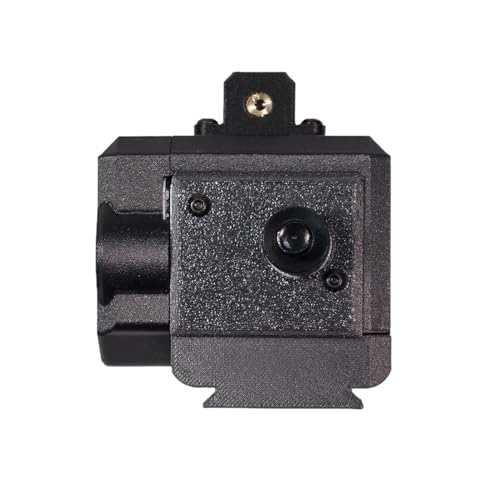
- 4 kg axial load support for camera setups
- Cold-condition alignment pointer
- 500 g carbon-reinforced portable body
Best For: Beginners shooting long exposures and time-lapses
Best Smart Telescope Bundle
Seestar S30 Pro with EQ-Ready Tripod

- App-controlled GoTo and automatic tracking
- EQ-ready TH10 head and TC20 tripod
- Portable, urban-friendly wide-field imaging
Best For: Beginners wanting an integrated astrophotography setup
Best Adjustable EQ Base
Aluminum Alloy Star Adventurer Latitude Base

- Precise 90-degree latitude adjustment
- Standard 3/8-inch tripod thread
- Works with compatible cameras and trackers
Best For: Portable tracking and nightscape rigs
Best App-Controlled Imaging
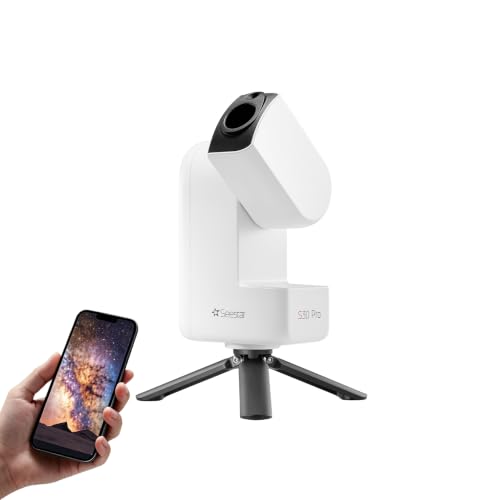
- 4.6-degree field of view for broad sky scenes
- Automatic GoTo, tracking, and mosaic stitching
- AI processing with dual-camera 4K imaging
Best For: Easy app-guided wide-field and deep-sky capture
Best Modular Tracker – Sky-Watcher Star Adventurer 2i Pro Pack
For photographers comparing star trackers for wide field imaging, the Sky-Watcher Star Adventurer 2i Pro Pack offers a portable, modular platform for nightscapes, Milky Way photography, eclipses, time-lapse video, and compatible telescopic use. Its Wi-Fi control and included equatorial base add convenience during setup and alignment.
Best For: Photographers who want a flexible wide-field tracker that works with an existing tripod and supports smartphone control.
Pros:
- Designed for portable nightscape and wide-field astrophotography.
- Compatible with existing photographic tripods through its modular design.
- Includes Wi-Fi and smartphone control through the free SAM Console app.
- Deluxe equatorial base helps position the tracker for polar alignment.
Cons:
- At 7 pounds, it is less lightweight than the smallest camera trackers.
- Its modular setup may require more assembly and alignment than an all-in-one system.
The Star Adventurer 2i is a strong choice when portability matters but you still want room to expand beyond basic wide-field camera work. The included base and Wi-Fi features make it more capable, though its multi-part design favors users comfortable with a traditional tracking setup.
Best Ultra-Portable Smart Option – DWARFLAB Dwarf Mini Smart Telescope
The DWARFLAB Dwarf Mini takes a different approach to star trackers for wide field imaging by combining a compact telescope, automated pointing, and app control in one battery-powered unit. At about 1.85 pounds, it is built for travel, while EQ mode supports longer exposures and the built-in filter helps with light pollution.
Best For: Beginners, families, and travelers who want app-guided imaging with minimal equipment.
Pros:
- Pocket-sized design weighs about 1.85 pounds.
- App control, built-in sky atlas, Auto GOTO, and 360-degree pivoting simplify operation.
- EQ mode supports single-frame exposures up to 90 seconds.
- Includes a light-pollution filter and cloud processing features.
Cons:
- Its 30mm objective and 2.45-degree field of view suit a different imaging style than a conventional camera tracker.
- Manual-and-auto focusing and app-based operation may not appeal to users seeking a fully manual camera-mount workflow.
The Dwarf Mini is best viewed as an accessible smart imaging system rather than a traditional tracker for a camera and lens. Its portability, automation, and EQ mode make it appealing for quick trips and approachable deep-sky exploration.
Best Compact Camera Mount – iOptron SkyTracker Pro Camera Mount
The iOptron SkyTracker Pro is a compact option for photographers evaluating star trackers for wide field imaging with a camera or cellphone. It provides automatic right-ascension tracking, a 6.6-pound payload rating, multiple tracking speeds, and a polar scope for field alignment.
Best For: Camera users who want a relatively compact tracking mount with support for sidereal, solar, lunar, and half-speed sky-and-landscape modes.
Pros:
- Supports payloads up to 6.6 pounds.
- Offers 1X, 1/2X, solar, and lunar tracking speeds.
- Includes a polar scope and padded bag.
- Compact 3.3-pound body with Micro USB charging.
Cons:
- The package is listed as mount-only, so additional setup components may be needed.
- It is not water resistant.
- The supplied specifications list a maximum shutter speed of 30 seconds.
The SkyTracker Pro balances useful tracking modes with a travel-friendly size and weight. It is a practical choice for wide-field camera work, provided you account for the mount-only package and protect it from moisture during outdoor sessions.
Best Advanced Imaging System – Celestron Advanced VX EdgeHD 8-inch
For buyers searching star trackers for wide field imaging but also considering a full telescope setup, the Celestron Advanced VX 8-inch EdgeHD is a substantially larger, more advanced system. Its computerized German equatorial mount, EdgeHD optics, polar-alignment tools, and imaging features are designed for serious visual and astrophotography work rather than lightweight travel.
Best For: Dedicated imagers who want a computerized equatorial telescope system with advanced tracking and multiple imaging configurations.
Pros:
- EdgeHD optics correct coma and field curvature for a flat field.
- Supports native f/10, optional f/7 reducer, and f/2 Fastar/Hyperstar configurations.
- Includes PPEC, an autoguider port, meridian imaging, CPWI software, and All-Star Polar Alignment.
- Mount supports payloads under 30 pounds and accepts multiple dovetail styles.
Cons:
- At 84.9 pounds, it is far less portable than dedicated wide-field camera trackers.
- Its listed 1.05-degree field of view is narrower than typical wide-field nightscape setups.
- The system is more complex and equipment-intensive for casual travel photography.
The Advanced VX EdgeHD is not the simplest answer for lightweight wide-field imaging, but it offers a broader path into computerized telescope astrophotography. Choose it when optical performance, guiding features, and configuration flexibility matter more than quick setup and portability.
Open-Source Flexibility – Equatorial Mount Star Tracker
For photographers seeking star trackers for wide field imaging, this compact equatorial mount offers configurable tracking without requiring an app. It supports stellar, moon, and custom rotation speeds, plus northern- and southern-hemisphere operation.
Best For: DIY-minded astrophotographers and time-lapse shooters who want a portable, power-bank-compatible tracker.
Pros:
- Supports stellar, moon, and custom rotation speeds.
- Works in both northern and southern hemispheres.
- Can function as a gimbal head for time-lapse photography.
- Uses a carbon-fiber/PETG shell and USB Type-C power.
Cons:
- Requires a separate ball head for camera connection.
- A 1/4-to-3/8-inch screw sleeve may be needed for many ball heads.
- USB-C-to-USB-C power cables are prohibited; an A-to-C cable is required.
Its open-source design and customizable rotation settings make it unusually flexible, but setup requires attention to mounting hardware and the specified power cable.
Automated Smart Imaging – Vaonis Vespera Pro Smart Telescope
Vaonis Vespera Pro Smart Telescope | Automated stargazing, high-resolution imaging, app control
Check Price On AmazonFor users comparing star trackers for wide field imaging with a more automated workflow, the Vaonis Vespera Pro is a motorized observation station with automatic pointing and tracking. Its app-based system combines a Starvis 2 sensor, automatic dark calibration, and live panorama capture.
Best For: Beginners and convenience-focused observers who want automated stargazing and high-resolution imaging through app control.
Pros:
- Automatic pointing, tracking, and focusing.
- Sony IMX676 Starvis 2 sensor for high sensitivity.
- CovalENS technology enables live panorama capture.
- Expert Mode and automatic dark calibration are included.
Cons:
- At 11 pounds, it is less portable than compact camera trackers.
- Its automated app-based workflow offers less hands-on mount control.
- It is an altazimuth smart telescope rather than a conventional single-axis tracker.
The Vespera Pro prioritizes ease of use and integrated imaging over traditional tracker customization, making it a strong fit for automated observing sessions.
Portable Alignment Value – OrionU Single-Axis Star Tracker
For photographers looking for star trackers for wide field imaging, this portable single-axis equatorial mount emphasizes straightforward field use. It combines a reinforced steel axis, a built-in alignment pointer, and ESP32 control powered from common 5V power banks.
Best For: Beginners using DSLR or mirrorless cameras who need a compact tracker for long-exposure astrophotography and time-lapse work.
Pros:
- Supports DSLR and mirrorless setups with up to 4 kg axial loads.
- Built-in high-brightness alignment pointer is designed for cold conditions.
- Runs from 5V power banks using an energy-efficient dual-core controller.
- Carbon-reinforced PETG body weighs 500 g.
Cons:
- Single-axis tracking provides less flexibility than multi-axis systems.
- It is not water resistant.
- The supplied details identify a camcorder as the compatible device, so camera mounting requirements should be confirmed.
With its low weight, alignment pointer, and stated 4 kg axial capacity, the OrionU is a practical entry point for portable tracking, provided your camera-support setup is compatible.
Best Smart Telescope Bundle – Seestar S30 Pro with EQ-Ready Tripod
Seestar S30 Pro Smart Telescope Bundle with TH10 Head & TC20 Tripod, EQ Mode Supported
Check Price On AmazonFor beginners seeking star trackers for wide field imaging, this Seestar S30 Pro bundle combines app-controlled operation with an EQ-capable TH10 head and TC20 tripod. Automatic GoTo targeting, tracking, mosaic stitching, and one-tap imaging simplify Milky Way, star-trail, and deep-sky capture.
Best For: Beginners who want a portable, integrated setup for wide-field astrophotography and urban night-sky imaging.
Pros:
- EQ-mode-ready head and tripod support improved balance and tracking stability.
- Automatic GoTo targeting and tracking make setup approachable.
- Built-in light-pollution filters and apochromatic optics support clearer, higher-contrast images.
- Compact 3.64-pound design includes anti-dew protection and long-session imaging support.
Cons:
- Designed around smartphone app control rather than a traditional camera-and-mount workflow.
- The bundle is more specialized than a basic manual tripod setup.
This is a convenient all-in-one option when portability and ease of use matter more than assembling a conventional tracking rig. The included EQ-oriented support is particularly useful for users planning longer astrophotography sessions.
Best Adjustable EQ Base – Aluminum Alloy Star Adventurer Latitude Base
This aluminum alloy latitude base is a practical accessory for photographers building star trackers for wide field imaging. Its 90-degree adjustment and standard 3/8-inch thread allow it to pair with many photography tripods, cameras, telescopes, and celestial trackers when mounting dimensions align.
Best For: Portable nightscape, panorama, time-lapse, and astrophotography setups that need adjustable equatorial positioning.
Pros:
- Provides precise 90-degree adjustment from horizontal to vertical.
- Standard 3/8-inch thread supports integration with many photography tripods.
- Lightweight aluminum construction balances portability with durability.
- Supports cameras, mirrorless systems, telescopes, and celestial trackers when compatible.
Cons:
- It is an accessory base, not a complete celestial tracking system.
- Compatibility depends on the mounting plate dimensions of the attached equipment.
- It is not water resistant.
Choose this base if you already own a tracker or camera system and need more controlled latitude adjustment. Its usefulness depends on matching the mounting hardware and providing a separate tripod and tracking device.
Best App-Controlled Imaging – ZWO Seestar S30 Pro
The ZWO Seestar S30 Pro is a compact choice for newcomers comparing star trackers for wide field imaging. Its app control, automatic GoTo and tracking, 4.6-degree field of view, dual-camera 4K imaging, and automatic mosaic stitching make broad night-sky captures straightforward.
Best For: Users who want app-guided Milky Way, star-trail, and deep-sky imaging with minimal manual setup.
Pros:
- Automatic GoTo targeting and tracking simplify object capture.
- Dual-camera 4K imaging supports detailed wide night landscapes and astrophotography.
- AI noise reduction and sky-foreground separation help refine images.
- Portable 3.6-pound body includes battery power, autofocus, EQ mode, and anti-dew support.
Cons:
- Deep-sky imaging requires the device to remain stationary for stable tracking.
- Operation depends on smartphone or tablet app control.
- It is designed for deep-sky imaging and is not intended for planetary observation.
This model suits users who prioritize automated capture and processing over hands-on camera control. Its wide field of view and one-tap modes are well matched to accessible wide-field work, while the app provides the main operating experience.
How We Picked the Best Star Trackers for Wide Field Imaging
We evaluated these systems by considering the needs of wide-field photographers first: tracking consistency, portability, setup complexity, payload flexibility, alignment tools, and compatibility with DSLR, mirrorless, telescope, or app-based workflows. We also considered whether each product suits quick nightscapes or longer imaging sessions that require a more stable mount and precise control.
Because the list includes both traditional tracking mounts and smart telescopes, the best choice depends on how much of the imaging process you want to control manually. Conventional trackers offer greater camera and lens flexibility, while smart telescopes automate acquisition, stacking, and processing.
Quick Comparison
- Best for traditional camera astrophotography: Sky-Watcher Star Adventurer 2i Pro Pack.
- Best for lightweight travel: iOptron SkyTracker Pro or the OrionU portable tracker.
- Best for automated imaging: Vaonis Vespera Pro, DWARFLAB Dwarf Mini, or Seestar S30 Pro.
- Best for advanced telescope setups: Celestron Advanced VX 8” EdgeHD.
- Best for improving tracker alignment: An equatorial latitude base with a compatible star tracker.
Key Buying Factors for Star Trackers for Wide-Field Imaging
Payload and Camera Compatibility
Check the stated payload before adding a camera, lens, ball head, counterweight, or accessories. A compact tracker may handle a lightweight mirrorless kit well but struggle with a heavy telephoto lens. Telescope mounts require even more careful matching between optical tube, accessories, and mount capacity.
Tracking and Alignment
Accurate polar alignment is central to sharp stars. Look for an included polar scope, alignment pointer, app guidance, or a stable latitude base. Single-axis tracking is often enough for wide lenses, while longer focal lengths benefit from more precise alignment and sturdier equatorial designs.
Portability and Power
For travel, consider total packed weight, tripod requirements, battery life, and whether the system can run from a USB power bank. Smart telescopes may reduce the number of accessories you need but still require dependable wireless connectivity and power in the field.
Automation and Workflow
Traditional trackers give you control over lenses, exposure settings, and image processing. Smart telescopes simplify capture through mobile apps and automatic stacking, making them attractive for beginners or users who prefer a streamlined workflow.
Who Should Buy Which Star Trackers for Wide Field Imaging?
Choose a conventional camera tracker if you already own a DSLR or mirrorless camera and want maximum creative flexibility. Choose a smart telescope if ease of use, portability, and automated results matter more than interchangeable lenses. For ambitious users planning longer focal lengths or heavier optical systems, a computerized equatorial mount is the more scalable option. If you already own a tracker but struggle with alignment, adding a compatible latitude base may provide a worthwhile stability and setup improvement.