
Finding the best star trackers for lightweight telescopes means balancing accurate tracking, payload capacity, portability, and setup time. The right mount can make visual observing easier while also supporting basic astrophotography.
This roundup compares ten compact options, from camera-focused trackers and portable equatorial mounts to app-enabled telescopes and complete GoTo systems.
Best 10 Star Trackers for Lightweight Telescopes Picks for 2026
Best Full GoTo Pick
Sky-Watcher Star Adventurer GTi

- Complete GoTo EQ kit with tripod and counterweight
- Built-in Wi-Fi and illuminated polar scope
- Portable design with multiple tracking rates
Best For: Photographers wanting an all-in-one, app-connected tracking mount
Best Beginner Telescope
Celestron StarSense Explorer LT 80AZ

- Smartphone-guided StarSense navigation
- Lightweight 80mm manual refractor
- Includes two eyepieces and a 2x Barlow lens
Best For: Beginners and families focused on guided visual observing
Best Lightweight Tracking Platform
Sky-Watcher Star Adventurer 2i Pro
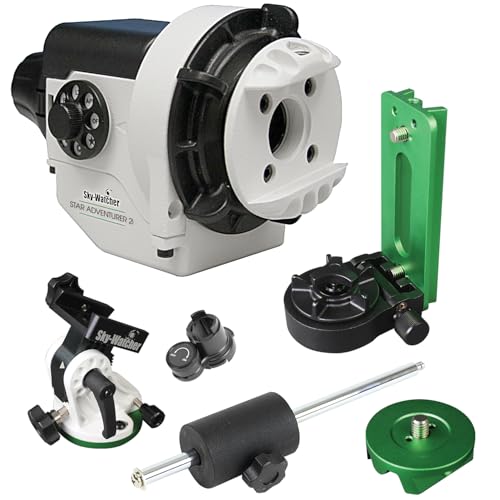
- Compact 7-pound motorized platform
- Wi-Fi smartphone control via SAM Console
- Works with existing photographic tripods
Best For: Mobile users prioritizing low weight and modular wide-field imaging
Best App-Controlled Equatorial Mount
Explore Scientific iEXOS-100-2

- Wi-Fi and Bluetooth ExploreStars control
- Eight-CPU PMC-Eight operating system
- Dual-axis gears and adjustable polar alignment
Best For: Users seeking app-based GoTo control for an equatorial setup
Best Beginner Motor Drive

- 130mm Newtonian optics
- Included RA motor tracking
- No-tool setup with accessories
Best For: Beginners observing from the backyard
Best Portable Tracking Mount

- Compact 2.2-pound body
- 11-pound balanced capacity
- Up to 20 hours of battery life
Best For: Portable astrophotography and lightweight setups
Best Smartphone-Guided Option

- Sky-recognition smartphone guidance
- 130mm Schmidt-Cassegrain optics
- Manual operation needs no external power
Best For: Beginners who want guided target finding
Best Portable GoTo Mount

- Full GoTo tracking in a compact equatorial mount
- Built-in Wi-Fi and illuminated polar scope
- Includes counterweight bar and 5 lb. counterweight
Best For: Portable astrophotography setups needing GoTo control
Best All-in-One Smart Tracker

- Portable 3 lb. integrated imaging system
- 4K auto-tracking with Auto GOTO and AZ/EQ modes
- App-based processing with dual imaging lenses
Best For: Beginners and travelers wanting automated astrophotography
Best DIY Equatorial Tracker

- Custom stellar, lunar, and rotation speeds
- Supports northern and southern hemispheres
- Compact design with USB-C power input
Best For: Experienced users building customizable tracking setups
Best Full GoTo Pick – Sky-Watcher Star Adventurer GTi
For photographers comparing star trackers for lightweight telescopes, the Sky-Watcher Star Adventurer GTi offers a portable GoTo EQ setup with useful alignment and connectivity features. The kit includes the mount head, tripod, pier extension, counterweight bar, and 5-pound counterweight.
Best For: Portable astrophotographers who want automated GoTo control and a complete tripod-based kit.
Pros:
- Full GoTo functionality with built-in Wi-Fi
- Illuminated built-in polar scope supports alignment
- Includes tripod, pier extension, counterweight bar, and 5-pound counterweight
- Offers multiple tracking rates in a portable design
Cons:
- At 26 pounds, it is heavier than the other portable trackers listed here
- Not water resistant
The GTi is the most complete option in this group for users who prefer an integrated, app-connected mount rather than a minimal tracking platform. Its included accessories make it easier to build a working setup without sourcing a separate tripod or counterweight.
Best Beginner Telescope – Celestron StarSense Explorer LT 80AZ
The Celestron StarSense Explorer LT 80AZ is a lightweight manual refractor for beginners exploring star trackers for lightweight telescopes. Its smartphone dock and StarSense app help locate targets, while the 80mm, 400mm-focal-length optical tube is designed for views of the Moon, planets, and brighter deep-sky objects.
Best For: Beginners, families, and casual observers who want guided smartphone navigation instead of motorized tracking.
Pros:
- StarSense app uses sky recognition to guide users to targets
- Lightweight 9.2-pound setup with preassembled mount and tripod
- Includes 25mm and 10mm eyepieces, a 2x Barlow lens, and phone dock
- 80mm refractor provides views of the Moon, planets, and bright deep-sky targets
Cons:
- Manual altazimuth mount is not a motorized star tracker
- Manual focus and operation require user adjustments
This is better understood as a guided visual telescope than as a dedicated astrophotography tracker. Choose it when simple target-finding and family-friendly observing matter more than automated equatorial tracking.
Best Lightweight Tracking Platform – Sky-Watcher Star Adventurer 2i Pro
The Sky-Watcher Star Adventurer 2i Pro Pack is a compact choice for shoppers researching star trackers for lightweight telescopes. Weighing 7 pounds, it provides a motorized portable tracking platform with Wi-Fi control, a deluxe equatorial base, and compatibility with existing photographic tripods.
Best For: Mobile astrophotographers who prioritize low weight, modularity, and wide-field imaging.
Pros:
- Lightweight 7-pound portable tracking platform
- Wi-Fi enables smartphone control through the SAM Console app
- Modular design works with existing photographic tripods
- Supports wide-field astrophotography, time-lapse video, and telescopic use
Cons:
- The supplied notes do not list a tripod or counterweight in the Pro Pack contents
- Its platform-focused design may require additional setup components
The 2i Pro is the practical pick when portability is the deciding factor. Its modular approach is convenient for photographers who already own a suitable tripod and want a tracker that can also support selected telescopic applications.
Best App-Controlled Equatorial Mount – Explore Scientific iEXOS-100-2
The Explore Scientific iEXOS-100-2 is a full equatorial mount and tripod option for users evaluating star trackers for lightweight telescopes. Its PMC-Eight system uses eight independent CPUs, while Wi-Fi and Bluetooth app control support alignment, navigation, and GoTo operation through the ExploreStars app.
Best For: Users who want app-controlled GoTo functionality, smooth balancing, and an equatorial mount with tripod.
Pros:
- PMC-Eight system uses eight independent CPUs for responsive operation
- ExploreStars app supports alignment, GoTo navigation, and access to tens of thousands of objects
- Clutched dual-axis worm gears use quiet precision stepper motor belt drives
- RA-axis sight hole and adjustable altitude control assist polar alignment
Cons:
- The mount does not include a polar scope; alignment uses the RA-axis sight hole
- The supplied notes do not specify the mount’s item weight or payload capacity
This mount is suited to buyers who value software control and equatorial adjustment over the smallest possible footprint. Its app ecosystem and balancing features make it a flexible choice, but shoppers should verify compatibility and capacity for their particular lightweight telescope.
Best Beginner Motor Drive – AstroMaster 130EQ-MD
For shoppers comparing star trackers for lightweight telescopes, the Celestron AstroMaster 130EQ-MD offers a straightforward motorized option. Its 130mm Newtonian reflector, equatorial mount, and included RA motor help beginners keep centered objects in view after initial alignment.
Best For: Beginners who want a full telescope setup with automatic tracking for backyard astronomy.
Pros:
- 130mm optics provide useful light-gathering ability for planets and deep-sky objects.
- Included RA motor automatically follows centered celestial objects.
- Two slow-motion controls support smooth manual pointing.
- Quick, no-tool setup includes eyepieces and a red-dot finderscope.
Cons:
- At 17 pounds, it is less portable than compact tracking mounts.
- The motor drive requires a 9V alkaline battery.
- Manual focusing and equatorial controls may require a short learning period.
The AstroMaster 130EQ-MD is a practical choice when you want the convenience of motorized tracking without giving up a traditional telescope package. It is better suited to stationary backyard use than frequent travel.
Best Portable Tracking Mount – SkyGuider Pro
Among star trackers for lightweight telescopes, the iOptron SkyGuider Pro stands out as a compact, rechargeable tracking mount. Its all-metal construction, illuminated polar scope, and balanced 11-pound capacity make it especially useful for portable camera and lightweight optical setups.
Best For: Mobile astrophotographers and users who prioritize portability, polar-alignment control, and long battery life.
Pros:
- Compact 2.2-pound design is easy to carry in a camera bag or backpack.
- Supports up to 11 pounds when properly balanced.
- Illuminated AccuAlign polar scope simplifies alignment in low light.
- Internal rechargeable battery provides up to 20 hours of operation at 20°C.
Cons:
- It is a camera mount, so telescope compatibility depends on the complete setup and balance.
- Precise polar alignment is still required for accurate tracking.
- The mount is not water resistant.
The SkyGuider Pro is the most travel-friendly option here, but it is not a complete telescope. Check your telescope, tripod, and accessory weight carefully against its balanced capacity before buying.
Best Smartphone-Guided Option – StarSense Explorer DX 5
For anyone researching star trackers for lightweight telescopes, the Celestron StarSense Explorer DX 5 offers guided, rather than motorized, target finding. Its smartphone app identifies the sky and provides on-screen directions, while the manual altazimuth mount uses dual-axis slow-motion controls for positioning.
Best For: Beginners who want smartphone-assisted navigation and compact Schmidt-Cassegrain optics without external power.
Pros:
- StarSense Explorer app uses sky recognition to help locate targets.
- 130mm Schmidt-Cassegrain optics with StarBright XLT coatings deliver sharp views.
- Manual operation avoids dependence on a motor or external power source.
- Includes 25mm and 10mm eyepieces plus a phone dock.
Cons:
- The mount does not automatically track objects across the sky.
- Smartphone guidance requires a compatible phone and app use.
- At 14.6 pounds, it is not the lightest travel option.
This telescope is a strong fit if easier navigation matters more than automatic tracking. The app helps you find targets quickly, but you will still make manual adjustments during observation.
Best Portable GoTo Mount – Star Adventurer GTi
For photographers comparing star trackers for lightweight telescopes, the Sky-Watcher Star Adventurer GTi offers a compact equatorial platform with full GoTo performance. Its built-in Wi-Fi, illuminated polar scope, counterweight system, and camera dovetail make it suited to portable tracking setups, although the camera or telescope is not included.
Best For: Portable astrophotographers who want GoTo control and an equatorial mount for compatible cameras or lightweight optical setups.
Pros:
- Full GoTo functionality in a compact mount head.
- Includes a counterweight bar and 5 lb. counterweight.
- Built-in Wi-Fi and illuminated polar scope.
- Supports DSLR or mirrorless camera mounting through its dovetail.
Cons:
- Camera or mirrorless body is not included.
- At 6.9 kg, it is heavier than ultralight tracker options.
- Requires battery or external power.
The GTi is a feature-rich choice when accurate setup tools and automated GoTo operation matter more than minimum carry weight. Verify that your telescope, camera, and mounting accessories are compatible before buying.
Best All-in-One Smart Tracker – DWARF 3 Smart Telescope
The DWARFLAB Dwarf 3 is a self-contained option for shoppers considering star trackers for lightweight telescopes but preferring an app-controlled imaging system. Weighing about 3 pounds, it combines dual lenses, automatic tracking, Auto GOTO, selectable AZ/EQ modes, and built-in processing in a travel-friendly package.
Best For: Beginners and travelers who want lightweight, automated astronomy imaging without assembling a separate telescope, camera, and tracking mount.
Pros:
- Lightweight 3 lb. design with a carrying bag included.
- Offers 4K auto-tracking, Auto GOTO, and AZ/EQ modes.
- Dual imaging system supports wide-angle and telephoto subjects.
- App-based cloud processing reduces the need for a PC or complex software.
Cons:
- It is an integrated smart telescope rather than a mount for attaching a separate lightweight telescope.
- Requires the dedicated app for control and processing.
- Its 35 mm objective lens may not suit users seeking a larger conventional optical system.
The Dwarf 3 is best viewed as a portable imaging solution rather than a traditional star tracker. Its automation and low weight make it especially appealing for quick trips, casual observing, and app-guided astrophotography.
Best DIY Equatorial Tracker – TeSeek Star Tracker
For hands-on users searching for star trackers for lightweight telescopes, the TeSeek Equatorial Mount Star Tracker provides customizable tracking in a compact, open-source design. It supports stellar and lunar speeds, custom rotation rates, and northern or southern hemisphere operation, but it requires compatible mounting hardware and an external power source.
Best For: Experienced makers and astrophotographers who want adjustable equatorial tracking and are comfortable supplying a ball head, cable, and mounting accessories.
Pros:
- Supports stellar, moon, and custom rotation speeds.
- Works in both northern and southern hemispheres.
- Can also function as a gimbal head for time-lapse photography.
- Compact PETG and carbon-fiber shell with USB-C power input.
Cons:
- No built-in battery; a power bank and USB-A-to-C cable are required.
- A ball head is required to connect a camera, and a screw sleeve may be needed.
- The open-source design and accessory requirements may be less convenient for beginners.
This tracker offers useful flexibility in a small package, but it is not a ready-to-mount telescope system. Confirm the thread sizes, quick-release hardware, and power setup before purchasing.
How We Picked the Best Star Trackers for Lightweight Telescopes
We focused on portability, tracking capability, ease of alignment, payload suitability, and overall flexibility. The selection includes dedicated star trackers, equatorial mounts, motorized telescope mounts, and smart telescopes because lightweight observing setups vary considerably.
We also considered whether each option includes essential accessories such as a tripod, counterweight, pier extension, or ball-head support. A complete package may cost more initially but can be easier to use than assembling compatible components separately.
Quick Comparison
- Best for portable GoTo: Sky-Watcher Star Adventurer GTi options.
- Best for camera-based astrophotography: iOptron SkyGuider Pro or Sky-Watcher Star Adventurer 2i Pro.
- Best for a complete motorized telescope: Celestron AstroMaster 130EQ-MD.
- Best for app-assisted observing: Celestron StarSense Explorer models.
- Best for smart, minimal-setup imaging: DWARFLAB Dwarf 3.
- Best for customizable GoTo mounting: Explore Scientific iEXOS-100-2.
Key Buying Factors for Star Trackers for Lightweight Telescopes
Payload and Balance
Check the mount’s stated payload before choosing a telescope, camera, guide scope, or accessories. Stay comfortably below the maximum capacity when possible, since a lightly loaded mount generally tracks more smoothly. Counterweights and a correctly balanced optical tube are especially important for equatorial mounts.
Tracking and GoTo Functions
Basic sidereal tracking is sufficient for keeping objects centered during visual observation and short exposures. GoTo control adds automated object locating, while app-guided systems can simplify alignment for beginners. These features improve convenience but may require batteries, firmware updates, or a reliable phone connection.
Portability and Setup
Consider the packed weight, tripod stability, pier height, and time needed for polar alignment. A compact tracker is useful only if it is practical to carry and quick to level outdoors. For travel, prioritize a complete kit with fewer loose components.
Imaging Compatibility
Camera trackers work well with mirrorless or DSLR bodies and wide or moderate focal lengths. Lightweight telescopes place greater demands on tracking accuracy, balance, and rigidity. Verify mounting threads, dovetail compatibility, clearance, and whether a ball head or telescope adapter is included.
Who Should Buy Which Star Trackers for Lightweight Telescopes?
Choose a Star Adventurer or SkyGuider-style tracker if you mainly use a camera and want portable long-exposure capability. Select a Star Adventurer GTi or iEXOS-100-2 when GoTo control and future equipment upgrades matter. A motorized telescope is more suitable if you want an integrated visual-observing setup.
Beginners who prefer guided setup should consider a StarSense Explorer model, while users seeking app-controlled imaging with minimal traditional mount work may prefer a smart telescope such as the Dwarf 3. Before buying, match the mount to your actual optical tube and camera weight—not just the advertised maximum payload.