
Choosing among the best soldering stations for electronics repair depends on more than wattage. Temperature stability, tip availability, heat-up speed, ESD protection, and included accessories all affect how confidently you can work on circuit boards, wires, and small components.
This roundup includes straightforward soldering stations, two-in-one hot-air rework systems, and accessory-rich kits for beginners, hobbyists, and experienced repair technicians. Use the guide below to match the station’s capabilities to your projects and workspace.
Best 10 Soldering Stations for Electronics Repair Picks for 2026
High-Power Precision Pick

- 200W station with rapid heating and melting
- F210 and F245 handles with 9 tips
- TFT display, presets, sleep mode, and helping hands
Best For: High-power electronics repair and mixed-size soldering jobs
Dual-Function Rework Choice

- Combines soldering iron and hot air rework
- PID control with dual displays and safety cutoff
- Includes 10 tips, 4 nozzles, and repair accessories
Best For: Component rework and soldering on a 110–127V bench
Organized Workbench Pick
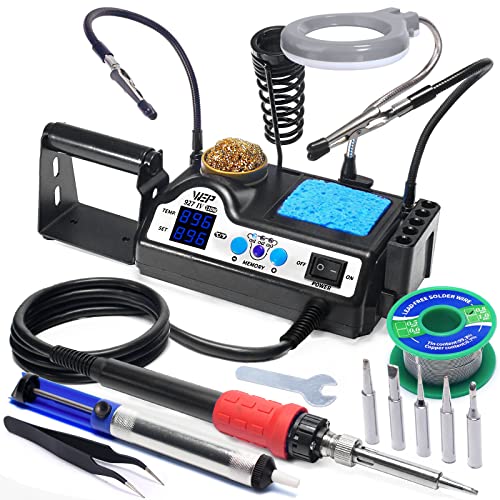
- 110W heating with 194–896°F adjustment
- Integrated magnifier, helping hands, and storage
- Three presets, sleep timer, and broad accessory kit
Best For: Space-conscious repair benches and detailed small-component work
Compact Hot-Air Versatility Pick
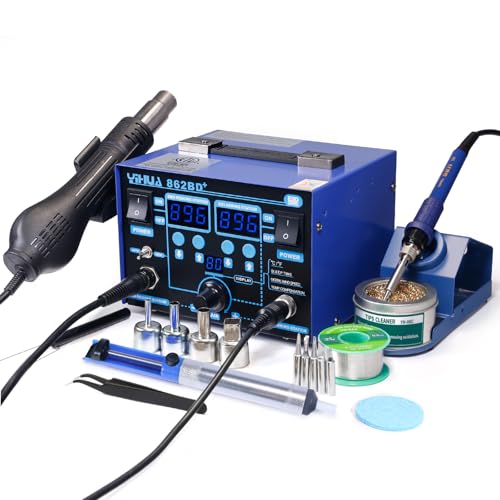
- 75W soldering plus hot air rework
- PID control, sleep timer, and three displays
- Includes tips, nozzles, ESD tweezers, and repair tools
Best For: Mixed soldering and hot air repair on a 110–127V bench
Best Value Starter Kit
100W Digital Soldering Station Kit

- 100W power with 180°C–480°C adjustment
- Auto-hibernate and temperature calibration
- Helping hands and repair accessories included
Best For: Beginners and home electronics repair
Best All-in-One Workstation
YIHUA 853D 3-in-1 Repair Station

- Soldering iron, hot air, and DC supply integrated
- 0–15V/0–2A output with 0–35V test mode
- PID stabilization and 120L/min maximum airflow
Best For: Advanced bench electronics repair
Best for Precision Bench Work

- 90°C–480°C range with PID temperature control
- Three presets, sleep timer, and dual temperature readouts
- Four helping hands and mini magnifying lamp included
Best For: Detailed PCB soldering and bench repairs
Versatile Rework Pick
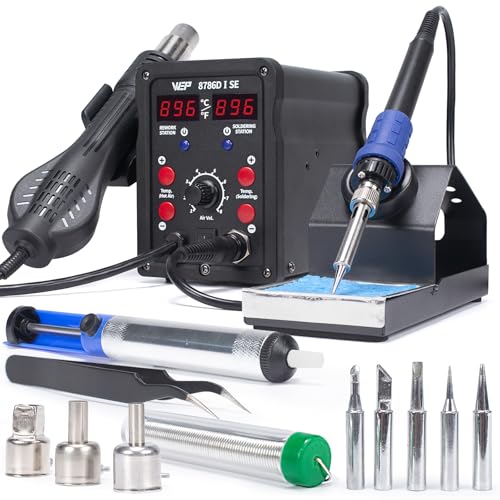
- Combines iron and hot air rework functions
- PID control with sleep and standby modes
- Includes tips, nozzles, wire, tweezers, and pump
Best For: Repairers needing soldering and hot air rework in one station
Beginner-Friendly Value
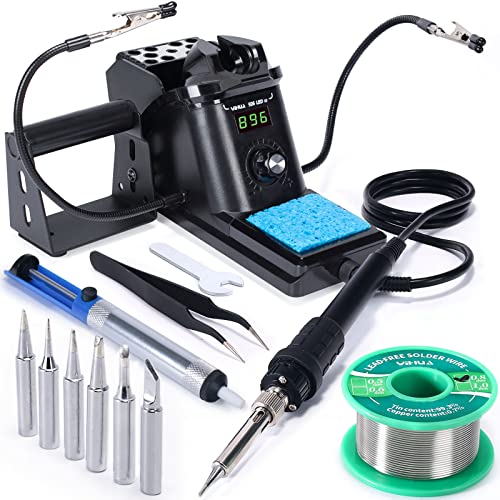
- 60W iron with digital temperature control
- Sleep mode, calibration, and °C/°F conversion
- Includes helping hands and a broad accessory kit
Best For: Beginners and hobbyists working on compact electronics repairs
Compact High-Power Pick
WEP 882D 2-in-1 Rework Station

- Compact iron and hot air rework combination
- 750W design with adjustable airflow
- Includes two solder spools and rework accessories
Best For: SMD repairers wanting broad capability in a compact station
High-Power Precision Pick – FNIRSI DWS-200
For demanding soldering stations for electronics repair, the FNIRSI DWS-200 stands out with 200W of power, rapid heating, and support for both F210 precision and F245 higher-power handles. Its adjustable 212–842°F range and multiple display modes make it suitable for varied repair work.
Best For: Electronics repairers who want high power, fast melting, adjustable temperature control, and two handle options.
Pros:
- 200W output supports fast heating and melting.
- Includes F210 and F245 handles with nine total tips.
- TFT display offers temperature, curve, or combined views.
- Sleep mode, three presets, and two adjustable helping hands improve workflow.
Cons:
- Its high-power feature set may be more than casual users need.
- Only one channel is listed.
- Helping-hand accessories and multiple handles require additional bench space.
The DWS-200 is a strong choice when speed, flexibility, and accessory coverage matter more than keeping the setup minimal. Its wide temperature range and dual-handle compatibility give it room for both precision and heavier soldering tasks.
Dual-Function Rework Choice – YIHUA 8786D I 2-in-1 Station
The YIHUA 8786D I combines a soldering iron and hot air rework station in one unit, making it a versatile option among soldering stations for electronics repair. PID temperature control, ESD-safe design, and included rework accessories support component-level jobs.
Best For: Repairers who need both conventional soldering and hot air rework from one 110–127V station.
Pros:
- Combines soldering and hot air functions with separate displays and power switches.
- PID control provides rapid temperature compensation.
- Includes 10 soldering tips, four hot air nozzles, a pump, extractor, and lead-free solder.
- Fail-safe protection cuts heating power if the hot air gun stops producing air unusually.
Cons:
- Designed for 110–127V operation only.
- Its combined design may take more setup space than a single-function iron.
- Temperature stability is listed at 1.8°F, but actual results depend on the project and technique.
Choose this model when hot air work is as important as iron soldering. It offers a broad accessory package and safety-focused controls, though users outside the stated voltage range will need a compatible setup.
Organized Workbench Pick – WEP 927-IV 110W Soldering Kit
The WEP 927-IV is a practical all-in-one choice among soldering stations for electronics repair, combining a 110W iron with helping hands, an LED magnifier, tip storage, and solder-wire organization. Its 194–896°F range and three preset channels suit recurring repair tasks.
Best For: Bench users who value integrated organization, visual assistance, and quick access to saved temperatures.
Pros:
- 110W heating element is designed for fast heat-up.
- Three preset channels and adjustable sleep timing simplify repeated work.
- Integrated LED magnifier, helping hands, tip storage, and solder dispenser save bench space.
- Includes five extra tips, tweezers, desoldering pump, cleaner, and solder wire.
Cons:
- Rated for 110–127V USA specifications and should not be connected to 220V.
- Uses WEP #1400 tips, so replacement compatibility should be checked.
- It is a single-channel station despite its three temperature presets.
This is a good fit for compact workstations where organization and hands-free positioning are priorities. The magnifier and accessory storage are especially useful for small repairs, while the preset controls reduce repeated setup.
Compact Hot-Air Versatility Pick – YIHUA 862BD+ 2-in-1 Station
The YIHUA 862BD+ adds hot air rework to a 75W soldering station, making it a flexible option for soldering stations for electronics repair. PID temperature control, ESD-safe accessories, three digital displays, and an adjustable sleep timer support both routine soldering and component removal.
Best For: Electronics hobbyists and repair technicians who need soldering and hot air functions with included ESD-safe tools.
Pros:
- Two-in-one design supports soldering and hot air rework.
- PID control checks and corrects the heating element every 20 milliseconds.
- Includes five tips, four nozzles, ESD-safe tweezers, pump, cleaner, and IC extractor.
- Three displays show soldering temperature, hot air temperature, and simulated air volume.
Cons:
- Designed for 110–127V operation.
- The 75W soldering performance is lower than the higher-power stations in this roundup.
- Its multiple functions may require more bench space than a basic iron station.
The 862BD+ makes sense when versatility and included tools are more important than maximum iron wattage. It is a well-equipped starting point for mixed soldering and hot air work, with replaceable station components and a useful sleep timer.
Best Value Starter Kit – 100W Digital Soldering Station Kit
For shoppers comparing soldering stations for electronics repair, this 100W digital kit offers a practical all-in-one setup. It includes adjustable 180°C–480°C temperature control, a digital display, auto-sleep functionality, and accessories for circuit boards, mobile phones, appliances, and general DIY work.
Best For: Beginners and home users who want a compact, accessory-rich station for general electronics repair.
Pros:
- 100W station with 180°C–480°C temperature range and °C/°F switching
- Auto-hibernate timer, on/off switch, and temperature calibration function
- Includes helping hands, five tips, solder wire, solder sucker, tweezers, and tip-cleaning supplies
Cons:
- Single-channel design is focused on soldering rather than hot-air rework or power-supply functions
- Included temperature stability is listed at 180°C, so users needing tighter documented stability may prefer a more specialized station
This is a sensible choice when convenience and included accessories matter more than advanced rework features. Its compact format and broad temperature range make it approachable for routine repairs and projects.
Best All-in-One Workstation – YIHUA 853D 3-in-1 Repair Station
Among soldering stations for electronics repair, the YIHUA 853D stands out by combining a soldering iron, hot-air rework station, and adjustable DC power supply in one unit. It is designed for more involved component work, with independent or simultaneous operation and LED monitoring.
Best For: Advanced electronics repairers who need soldering, hot-air rework, and low-voltage testing or power in one workstation.
Pros:
- Combines a 392°F–896°F soldering station, 212°F–896°F hot-air station, and 0–15V/0–2A DC supply
- Hot-air airflow is adjustable up to 120L/min, with four nozzles included
- PID temperature stabilization, sleep mode, automatic shutdown, and a 5V USB port
Cons:
- At 4.76 kg, it is substantially less portable than a basic soldering station
- Designed for 110–127V operation with a US-standard plug
- Its more extensive controls and functions may be unnecessary for simple soldering tasks
The 853D is the strongest fit for a repair bench handling surface-mount components and powered-device testing. Choose it when the integrated hot air and DC supply justify the larger, more complex workstation.
Best for Precision Bench Work – X-Tronic 3060-PRO 75W Kit
The X-Tronic 3060-PRO is a well-equipped option among soldering stations for electronics repair, pairing a 60W heating element with a 75W system and a broad 90°C–480°C range. Its preset temperatures, dual readouts, sleep timer, and included workholding tools support repeatable bench repairs.
Best For: Hobbyists and experienced users who want a feature-rich soldering station with magnification and multiple hands for detailed PCB work.
Pros:
- Temperature range of 90°C–480°C with PID control, calibration, and three presets
- Adjustable sleep timer, °C/°F programming, and separate set-temperature and real-temperature displays
- Includes four helping hands, mini magnifying lamp, five tips, solder sucker, solder, and cleaning supplies
Cons:
- 110V/60Hz AC operation; the notes specify that 220V is not available
- It is a soldering-focused station without the hot-air or DC power-supply functions of a combination rework unit
- The product carries a California Proposition 65 warning related to lead exposure
With its stable temperature control and unusually complete workholding setup, the 3060-PRO is suited to detailed, repeatable soldering. It makes the most sense for users who value bench ergonomics and control over multi-function rework.
Versatile Rework Pick – WEP 8786D-I SE 2-in-1 Station
For shoppers comparing soldering stations for electronics repair, the WEP 8786D-I SE stands out by combining a conventional soldering iron with a hot air rework station. Separate temperature displays and controls, adjustable airflow, and included rework accessories make it suitable for both standard soldering and desoldering tasks.
Best For: Electronics repairers who need one station for soldering, hot air rework, and desoldering.
Pros:
- Combines soldering and hot air functions in one unit.
- Offers PID temperature stabilization, sleep mode, and hot air standby mode.
- Includes five soldering tips, three hot air nozzles, tweezers, solder wire, and a desoldering pump.
Cons:
- Designed for 110–127V USA power; it should not be connected to a 220V socket.
- Its two-function design may be more equipment than users who only need basic soldering require.
This is a practical all-in-one choice when hot air capability matters as much as a temperature-controlled iron. The standby and sleep features also help reduce unnecessary wear during pauses.
Beginner-Friendly Value – YIHUA 926 III 60W Station Kit
The YIHUA 926 III is a compact option among soldering stations for electronics repair, with a 60W iron, digital temperature control, and a broad 194–896°F adjustment range. Its included helping hands and repair accessories make it especially convenient for getting started with small electronics projects.
Best For: Beginners and hobbyists who want a compact soldering station with useful accessories and hands-free support.
Pros:
- Provides PID temperature stabilization and a wide adjustable temperature range.
- Includes adjustable sleep mode, Celsius/Fahrenheit conversion, and digital calibration.
- Includes two helping hands, six tips, lead-free solder, a solder sucker, tweezers, and a cleaning sponge.
Cons:
- This is a soldering-iron station rather than a hot air rework station.
- Designed for 110–127V operation with a US-standard plug.
Its compact footprint and integrated holder help conserve workspace, while the digital controls provide useful precision features without making the station complicated to operate.
Compact High-Power Pick – WEP 882D 2-in-1 Rework Station
The WEP 882D is a compact 2-in-1 option for soldering stations for electronics repair, pairing an adjustable soldering iron with a variable-airflow hot air rework gun. Individual LED displays, temperature controls, and included consumables make it ready for common soldering and SMD rework tasks.
Best For: Repairers who want a compact, high-power station for both iron soldering and hot air SMD rework.
Pros:
- Combines soldering and hot air rework in a compact body.
- Provides PID control, adjustable airflow, sleep mode, standby mode, calibration, and automatic shutdown.
- Includes two solder-wire spools, five tips, three nozzles, brass wool, tweezers, and a desoldering pump.
Cons:
- Designed for 110–127V USA specifications and should not be connected to 220V power.
- The 2-in-1 feature set may be unnecessary for users who only perform basic iron soldering.
With a 750W rating and adjustable airflow, the WEP 882D is positioned for users who want broader rework capability in a small footprint. Its included supplies also reduce the need for immediate accessory purchases.
How We Picked the Best Soldering Stations for Electronics Repair
We focused on stations suited to electronics repair rather than general-purpose soldering alone. The selection covers several useful configurations, including traditional temperature-controlled irons, high-power models, and two-in-one systems that combine an iron with hot-air rework. We also considered temperature range, power rating, control layout, included tips and nozzles, sleep functions, ESD-safe design, and practical accessories such as helping hands, magnifiers, solder suckers, and tip cleaners.
Because repair needs vary widely, the list includes both compact entry-level options and more versatile equipment for repeated desoldering, SMD work, and component replacement.
Quick Comparison
| Best For | Recommended Type | What to Look For |
|---|---|---|
| Basic electronics repairs | 60W–100W soldering station | Stable temperature control, replaceable tips, and a comfortable iron |
| Small SMD components | Hot-air and iron combination | Adjustable airflow, multiple nozzles, and ESD-safe operation |
| Large connectors or heavy wiring | 110W–200W high-power station | Fast heat recovery and broad tip compatibility |
| Hands-free bench work | Accessory-rich kit | Helping hands, magnifier, solder sucker, and tip-cleaning tools |
Key Buying Factors for Soldering Stations for Electronics Repair
Temperature Control and Heat Recovery
A station should maintain its selected temperature when the tip touches a joint. Higher wattage does not automatically mean better performance, but additional power can improve recovery when working on ground planes, thick wires, or large connectors. Adjustable Celsius and Fahrenheit displays are useful when following repair manuals with different temperature recommendations.
Iron, Hot-Air, and ESD Features
A standard iron is usually the simplest choice for wires, through-hole parts, and routine board repairs. Hot-air capability adds value for SMD rework, desoldering, and shrinking heat-sensitive materials, but it also requires more control and workspace. For sensitive boards, prioritize ESD-safe construction and proper grounding practices.
Tips, Nozzles, and Accessories
Check whether replacement tips and hot-air nozzles are easy to find. Fine conical or hoof tips help with small pads, while wider chisel tips transfer heat more efficiently. Helping hands, magnifiers, solder suckers, brass wool, and included solder can reduce setup costs, although accessory quality varies between kits.
Safety and Convenience
Look for an insulated handle, stable stand, clear controls, auto-sleep or standby functions, and a durable power cord. Keep ventilation and fume extraction in mind, especially when using flux, lead-free solder, or hot-air tools.
Who Should Buy Which Soldering Stations for Electronics Repair?
Choose a basic 60W to 100W station if you mainly repair cables, connectors, through-hole components, and occasional circuit boards. A high-power model is better for frequent work on large joints or projects where fast heat recovery matters. Select a two-in-one hot-air station if you regularly handle SMD components, rework boards, or need both focused and indirect heat. Accessory-heavy kits make sense for beginners building a bench setup, while experienced users may prefer a station with widely available replacement tips and fewer bundled extras.