
The right soldering station can make circuit testing faster, cleaner, and more repeatable. Temperature stability, ESD protection, included accessories, and bench-friendly controls matter as much as raw wattage.
We selected 10 stations covering precision soldering, SMD rework, portable bench testing, and all-in-one repair setups, so you can match the tools to your projects and skill level.
Best 10 Soldering Stations for Circuit Testing Picks for 2026
All-in-One Testing Powerhouse
853D USB 3A Three-Tool Station

- Combines soldering, hot air, and power-supply testing
- 0–15V, 0–3A adjustable output
- Supports simultaneous tool operation
Best For: Multi-tool electronics benches and circuit diagnostics
High-Power Precision Pick
FNIRSI DWS-200 Soldering Station Kit

- 200W power for fast heating and melting
- Three display modes with temperature curves
- Includes F210 and F245 handles plus nine tips
Best For: Mixed SMD and higher-power soldering tasks
Hot-Air Rework Specialist
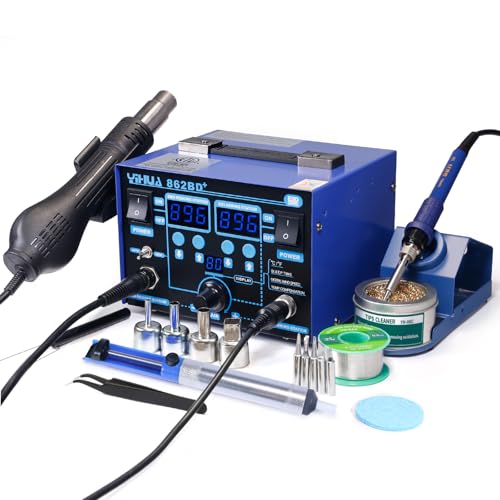
- Combines soldering iron and hot-air rework
- PID control with three digital displays
- Includes tips, nozzles, solder, and repair tools
Best For: Board repair and surface-mount rework
Organized Bench Favorite
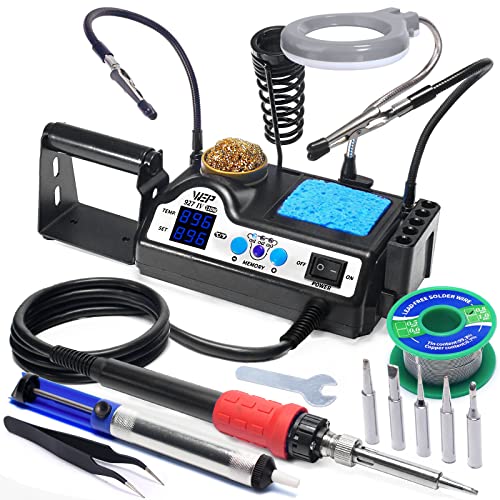
- 110W heating with dual temperature display
- Three presets and adjustable sleep mode
- Built-in magnifier, helping hands, and tip storage
Best For: Compact workbenches and component-level assembly
Best All-in-One Workbench
3-in-1 Soldering and Rework Station

- Combines soldering, hot air, and DC power functions
- Measures up to 35V DC in test mode
- Includes repair accessories and PID temperature control
Best For: Multi-function electronics repair and circuit testing
Best Compact Starter Kit
WEP 926LED V3 Soldering Station

- Compact body-mounted iron holder saves desk space
- Includes five tips and essential soldering accessories
- PID control, digital display, and sleep mode
Best For: Hobbyists and beginners doing routine soldering work
Best Precision Soldering
YIHUA 939D+ Digital Soldering Station

- PID stabilization covers 392–896°F
- Includes calibration and error-detection features
- Metallic build with detachable iron and separate stand
Best For: Precise, frequent hand soldering on electronics
Best 2-in-1 Rework Pick
WEP 882D Hot Air Soldering Station

- Combines soldering and hot air rework
- PID control with independent LED displays
- Includes tips, nozzles, solder, and hand tools
Best For: SMD work and electronics rework
Best Heavy-Duty Pick
YIHUA 926 III Digital Soldering Station
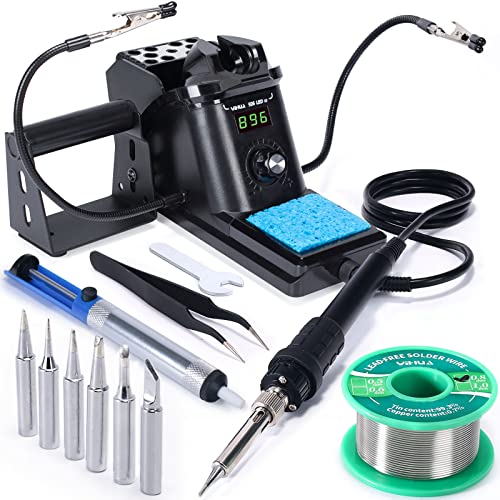
- PID-stabilized 194°F–896°F range
- Compact holder with tip storage
- Includes helping hands and six tips
Best For: Beginners and space-limited electronics benches
Best High-Power Helping-Hands Kit
130W Digital Soldering Station

- Wide 356°F–932°F temperature range
- Integrated dual helping hands
- Includes five tips and repair accessories
Best For: DIY board repair and hands-free soldering
All-in-One Testing Powerhouse – 853D USB 3A Three-Tool Station
For circuit testing and repair work that benefits from multiple tools, the YIHUA 853D combines a soldering station, hot air rework station, and adjustable power supply in one unit. Its 0–15V, 0–3A output and test modes make it a versatile option among soldering stations for circuit testing, while simultaneous operation can reduce bench downtime.
Best For: Electronics users who need soldering, hot-air rework, and low-voltage power-supply functions in one compact station.
Pros:
- Integrates three stations that can be used simultaneously.
- Offers 0–15V and 0–3A power-supply output with testing modes.
- Includes multiple iron tips, hot-air nozzles, tweezers, and a desoldering pump.
- Provides sleep mode and automatic shut-down features.
Cons:
- Designed for 110–127V operation with a US-standard plug.
- Its multi-function design may be more equipment than needed for basic soldering.
The 853D is a strong choice when circuit testing involves both board rework and powered diagnostics. Choose it if consolidating several bench tools matters more than having a single-purpose station.
High-Power Precision Pick – FNIRSI DWS-200 Soldering Station Kit
The FNIRSI DWS-200 focuses on fast, high-power soldering for electronics repair and circuit testing. Its 200W output, adjustable 212–842°F range, temperature curves, presets, and two helping hands make it useful when you need quick heat recovery and stable component positioning.
Best For: Users handling both precision SMD work and higher-power soldering jobs who want fast heating and visual temperature data.
Pros:
- Uses 200W power for rapid heating and solder melting.
- Offers temperature value, curve, and combined display modes.
- Includes F210 and F245 handles with nine assorted tips.
- Two helping hands have 360-degree adjustable alligator clips.
Cons:
- This is a single-channel soldering station rather than a multi-tool rework system.
- Its temperature range starts at 212°F, which may not suit every low-temperature task.
With its broad tip and handle compatibility, the DWS-200 is a practical choice for one-station soldering work that ranges from small components to more demanding joints. The display modes are especially useful for monitoring heating behavior during circuit work.
Hot-Air Rework Specialist – YIHUA 862BD+ 2-in-1 Station
The YIHUA 862BD+ combines a soldering iron and hot-air rework station for circuit testing and board repair involving both through-hole and surface-mount components. PID temperature control, three digital displays, and a 392–896°F soldering range provide useful control when switching between soldering and rework tasks.
Best For: Electronics repairers who need both conventional soldering and hot-air rework with a broad accessory set.
Pros:
- Combines soldering and hot-air rework in one station.
- PID control checks and corrects the heating element every 20 milliseconds.
- Includes five iron tips, four hot-air nozzles, lead-free solder, and hand tools.
- Offers adjustable sleep mode from 0 to 99 minutes.
Cons:
- Designed for 110–127V operation with a US-standard plug.
- It does not include an integrated adjustable power supply for circuit testing.
The 862BD+ is well suited to board-level repair where hot air is as important as the soldering iron. Its included accessories reduce the need for immediate add-on purchases, while the detachable tools support replacement when needed.
Organized Bench Favorite – WEP 927-IV 110W Soldering Kit
The WEP 927-IV is a compact 110W soldering kit built around practical bench organization. For circuit testing and assembly, its fast-heating iron, dual numerical display, preset temperature channels, helping hands, and illuminated magnifier offer useful support without adding separate accessories.
Best For: Hobbyists and repair users who want a space-saving soldering setup with component holding, magnification, and tip storage.
Pros:
- 110W heating element supports fast warm-up.
- Displays set and actual temperatures simultaneously.
- Includes three preset temperature channels and adjustable sleep mode.
- Combines helping hands, LED magnifier, solder dispenser, and tip storage.
Cons:
- Uses WEP #1400 replacement soldering tips.
- Rated for 110–127V USA specifications only.
- It is a single soldering station without hot-air or power-supply functions.
The 927-IV is a sensible choice for straightforward circuit assembly and testing where workspace efficiency matters. Its integrated accessories are particularly helpful for small components, though users needing hot-air rework or powered diagnostics should consider a broader station.
Best All-in-One Workbench – 3-in-1 Soldering and Rework Station
For circuit testing and repair work that spans soldering, hot-air rework, and power checks, the YIHUA 853D 2A combines three stations in one unit. It offers a soldering range of 392–896°F, hot air up to 896°F, and a DC supply that can output up to 15V/2A or measure up to 35V DC.
Best For: Electronics repair benches that need soldering, hot-air rework, adjustable DC power, and voltage testing in one compact package.
Pros:
- Combines soldering, hot air, and DC power supply functions.
- Includes a 0–35V DC test-meter mode for circuit checks.
- PID temperature stabilization supports consistent soldering and rework.
- Includes tips, hot-air nozzles, tweezers, an IC extractor, and a desoldering pump.
Cons:
- Its broader feature set and 4.76 kg weight may be more than needed for basic soldering.
- The unit is designed for 110–127V US-standard power.
- The integrated DC supply is limited to 2A output.
The 853D is the most versatile choice here for soldering stations for circuit testing, especially when a separate bench supply and voltage meter would otherwise take up additional space.
Best Compact Starter Kit – WEP 926LED V3 Soldering Station
The WEP 926LED V3 is a compact, single-channel soldering station for routine circuit assembly and testing work. Its temperature control spans 392–896°F, while the digital display, PID regulation, and included accessories make it easy to start soldering without building a kit separately.
Best For: Hobbyists and electronics learners who want an organized, space-saving station with essential soldering and desoldering tools.
Pros:
- Compact design integrates the iron holder into the station body.
- Includes solder wire, five tips, tweezers, a solder sucker, and tip cleaner.
- PID control displays real-time temperature and supports steady heating.
- Sleep mode reduces idle heat after 10 minutes of inactivity.
Cons:
- It has one channel and does not include a dedicated power supply or voltage-test mode.
- Its 110–127V rating limits use to compatible US power.
- The compact accessory storage may be less flexible than a separate bench setup.
Choose the 926LED V3 when your circuit testing workflow mainly involves soldering and desoldering rather than powering or measuring circuits directly.
Best Precision Soldering – YIHUA 939D+ Digital Soldering Station
The YIHUA 939D+ focuses on controlled, repeatable hand soldering for circuit testing and electronics assembly. It provides adjustable heat from 392–896°F, PID temperature stabilization, calibration support, error detection, and a clear °C/°F display in a durable metal-front design.
Best For: Users who want a dedicated, durable soldering station for precise bench work and frequent electronics assembly.
Pros:
- High-precision PID control helps maintain the selected temperature.
- Supports temperature calibration and automatic handle-status detection.
- Detachable 907E iron and separate metal-alloy stand support flexible workspace organization.
- ESD-safe design and compatibility with 900M-series tips suit electronics work.
Cons:
- It is a dedicated soldering station without hot air, DC output, or voltage-test functions.
- The package includes fewer accessories than the WEP kit.
- It is designed for 110–127V US-standard power.
The 939D+ is a strong fit when temperature consistency and build quality matter more than having integrated circuit-power and measurement features.
Best 2-in-1 Rework Pick – WEP 882D Hot Air Soldering Station
For circuit testing that involves both conventional soldering and component rework, the WEP 882D combines a soldering station and hot air station in one compact unit. Independent LED displays, PID temperature control, and adjustable airflow give you useful control when working on circuit boards.
Best For: Electronics rework, SMD work, and users who want hot air capability alongside a soldering iron.
Pros:
- Combines soldering and hot air rework in one station.
- Offers adjustable soldering temperatures from 392°F to 896°F and hot air temperatures from 212°F to 896°F.
- Includes sleep mode, hot air standby, automatic shutdown, and calibration functions.
- Comes with solder wire, five tips, three hot air nozzles, tweezers, a brass wool cleaner, and a desoldering pump.
Cons:
- Its 110–127V rating makes it unsuitable for direct connection to a 220V outlet.
- The two-function design may be more equipment than needed for basic soldering.
The WEP 882D is the most versatile choice here for circuit testing workflows that include removing or installing surface-mount components. Its broad temperature ranges and included accessories make it a practical all-in-one rework setup.
Best Heavy-Duty Pick – YIHUA 926 III Digital Soldering Station
The YIHUA 926 III is a compact option for soldering stations for circuit testing, especially when you need adjustable heat and basic board-handling accessories without taking up much bench space. Its PID stabilization, digital display, and calibration support help make temperature settings easier to manage.
Best For: Beginners, compact electronics benches, and routine circuit-board soldering and repair.
Pros:
- Provides a 194°F to 896°F adjustable temperature range with PID stabilization.
- Includes sleep mode, Celsius/Fahrenheit conversion, and digital temperature calibration.
- Integrated holder and rear tip-storage slots help conserve workspace.
- Includes two helping hands, six tips, lead-free solder, a solder sucker, tweezers, and cleaning accessories.
Cons:
- At 60W, it is less powerful than the 130W station in this roundup.
- It is designed for 110–127V operation with a US-standard plug.
The 926 III balances useful temperature controls with a space-saving layout and a generous starter kit. It is a sensible pick when circuit testing and repair tasks are straightforward and bench space is limited.
Best High-Power Helping-Hands Kit – 130W Digital Soldering Station
This 130W digital station is built for circuit testing and repair tasks that benefit from quick heating, a wide temperature range, and hands-free board positioning. Its integrated helping hands, iron stand, and solder holder keep common tools together on the bench.
Best For: DIY electronics repair, circuit boards, mobile-phone work, and users who want integrated helping hands.
Pros:
- Offers a 356°F to 932°F adjustable range with temperature calibration.
- Provides adjustable auto-sleep timing from 60 to 999 seconds.
- Integrates two repositionable alligator-clip helping hands with the stand and solder holder.
- Includes five tips, solder wire, flux, a solder sucker, tweezers, and cleaning tools.
Cons:
- The supplied notes do not specify a voltage rating or PID temperature stabilization.
- Its broad accessory package may be unnecessary for users who already own soldering tools.
The 130W station stands out for its higher stated wattage and integrated workholding setup. Choose it when convenient positioning and fast-heating performance matter more than adding hot air rework capability.
How We Picked the Best Soldering Stations for Circuit Testing
We focused on stations that combine practical temperature control with features useful during circuit testing and repair. The lineup includes conventional soldering irons, hot-air rework stations, and combination units with adjustable DC power supplies. We also considered power output, temperature range, display quality, ESD-safe design, included tips and accessories, and the convenience of preset channels or sleep modes.
Because kit contents can vary, check the current listing before buying—especially for replacement tips, solder, nozzles, helping hands, and power-supply leads.
Quick Comparison
| Station type | Best for | What to prioritize |
|---|---|---|
| Digital soldering iron | Through-hole work and routine board repairs | Stable heat, tip availability, ergonomic handle |
| Hot-air combination | SMD components, connectors, and rework | Adjustable airflow, nozzle selection, safe cooling |
| Iron and DC power supply | Powered circuit testing and repair | Voltage/current adjustment, output monitoring, protection |
| High-power station | Large ground planes and heat-demanding joints | Fast recovery, suitable tips, thermal stability |
Key Buying Factors for Soldering Stations for Circuit Testing
Temperature Control and Recovery
Look for a clear digital display and precise adjustment rather than simply choosing the highest temperature. Fast recovery helps the tip maintain heat when working with ground planes, thick wires, or lead-free solder.
Power and Circuit Protection
Higher wattage can improve recovery, but it does not automatically mean better performance. For powered testing, a combination station with adjustable voltage and current limits can reduce the need for separate bench equipment. Confirm the supply’s output range, USB features, and protection functions.
Hot-Air Performance
For SMD work, adjustable airflow is as important as temperature. Multiple nozzle sizes help direct heat, while a controlled cool-down cycle protects the handle and heating element. Avoid relying on hot air near heat-sensitive components without masking and temperature monitoring.
ESD Safety and Accessories
ESD-safe construction is valuable when handling integrated circuits, sensors, and other static-sensitive parts. Also consider whether the kit includes useful essentials such as brass wool, a tip cleaner, spare tips, tweezers, solder wick, a solder sucker, helping hands, and a magnifier.
Who Should Buy Which Soldering Stations for Circuit Testing?
Choose a basic digital iron if you mainly solder wires, headers, and through-hole components. It is usually simpler, cheaper, and easier to maintain.
Choose a hot-air 2-in-1 station if your work includes SMD removal, reflow, connectors, or board-level repairs. Make sure replacement nozzles and heating elements are readily available.
Choose a station with an integrated power supply if you test low-voltage circuits at the same bench where you solder. This setup can save space, but verify current limits and measurement accuracy before treating it as laboratory-grade equipment.
Choose a higher-power kit for frequent repairs, large copper areas, or lead-free work. Beginners should still prioritize stable control, comfortable handling, and replaceable consumables over maximum wattage.