
Learning about planets is more memorable when children can build, paint, and interact with a three-dimensional model. The best solar system kits under $50 turn a school assignment or weekend activity into hands-on science practice.
We selected 10 affordable options ranging from glow-in-the-dark planetariums and gear-driven orbit models to paint-your-own foam kits and decorative gemstone displays. Use the guide below to match the kit’s complexity, materials, movement, and display value to the learner.
Best 10 Solar System Models Under 50 Picks for 2026
Best Glow-in-the-Dark Pick
National Geographic Solar System Model

- Paint and build all eight planets and the sun
- Glows in the dark and includes movable arms
- Includes paints, decals, brush, palette, and fact poster
Best For: Creative astronomy displays for kids ages 8 and up
Best Wall-Mount Project

- Creates a space-saving wall-hanging display
- Includes 63 craft and painting pieces
- Supports STEM learning and hands-on coordination
Best For: School projects and compact classroom or home displays
Best Interactive Build
Smartivity Gear-Driven Solar System

- Builds a rotating gear-driven planet model
- Introduces orbits, day, night, and space science
- Uses eco-friendly, child-safe MDF
Best For: Ages 8–14 who enjoy construction and moving STEM toys
Best Display-Box Kit

- Includes a starry-sky display box
- Provides foam planets, paints, brushes, and accessories
- Works for décor, crafts, and science projects
Best For: Kids making a lightweight project with built-in presentation
Best for Easy Setup
4M DIY Solar System Planetarium

- Snap-together planets need no glue
- Rotating 11.8-inch display
- Includes glow paint and space facts
Best For: Creative astronomy projects for kids ages 8–14
Best Mechanical STEM Pick
Thames & Kosmos Orbiting Solar System

- Wind-up motor needs no batteries
- Explores gears and planetary motion
- Suitable for science fair projects
Best For: Hands-on STEM learners and intermediate builders
Best Wall Display Kit
35-Piece Foam Ball Solar System
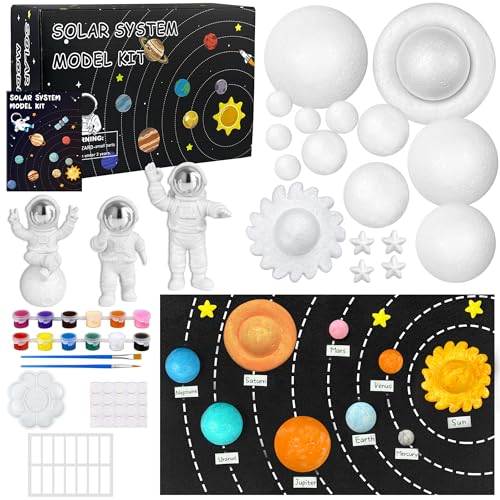
- Includes foam balls, paints, and brushes
- Designed for compact wall display
- Encourages painting and astronomy learning
Best For: DIY classroom, art, and school projects
Gemstone Display Pick

- Nine gemstone planet spheres with wooden stand
- Unique natural color and texture variations
- Compact desktop display for ages 14+
Best For: Adult collectors, astronomy décor, and thoughtful gifts
Creative Project Pick
37-Piece Foam Solar System Kit

- Foam balls in multiple sizes for planet building
- Paints, brushes, stars, glitter, and craft accessories
- Designed for school projects and hands-on learning
Best For: DIY classroom projects and science-fair crafts
Kids’ Learning Pick

- Wood model, puzzle, fact cards, paint, and brushes
- Covers the Sun and nine major planets
- Designed for kids ages 8–12 and science fairs
Best For: Elementary learners and guided astronomy projects
Best Glow-in-the-Dark Pick – National Geographic Solar System Model
For shoppers comparing solar system models under 50, this National Geographic kit stands out as a hands-on build-and-display option for children ages 8 and up. Kids paint all eight planets and the sun, add glow-in-the-dark accents, and arrange the planets using movable arms.
Best For: Kids who want a creative astronomy project that doubles as glowing bedroom décor.
Pros:
- Includes planets, sun, paints, glow paint, brush, palette, decals, and a fact poster.
- Movable arms make it easy to adjust and rearrange the display.
- Combines construction, painting, and astronomy learning.
Cons:
- Recommended for ages 8 and up, so it may not suit younger children.
- The plastic model is a single-size display rather than a large classroom installation.
This is a strong choice when visual appeal and guided creative play matter as much as learning. The glow feature gives the finished project extra display value.
Best Wall-Mount Project – Pllieay Felt Solar System Kit
Among solar system models under 50, this Pllieay kit is a practical pick for school assignments and compact displays. It uses a felt background plate, foam hemispheres, paint supplies, labels, and hooks to create a wall-hanging project while introducing planetary order and names.
Best For: Classroom activities, home science projects, and families needing a space-saving display.
Pros:
- Wall-hanging design helps preserve table and shelf space.
- Includes 63 pieces, including foam parts, stars, paints, brushes, hooks, labels, and instructions.
- Supports hands-on STEM practice, color recognition, and hand-eye coordination.
Cons:
- Recommended for children over 8, limiting use for younger kids.
- Foam and felt construction may be less substantial than a rigid plastic model.
The combination of a guided layout and wall display makes this especially useful when the finished project needs to be both educational and easy to hang.
Best Interactive Build – Smartivity Gear-Driven Solar System
For buyers seeking solar system models under 50 with an interactive element, the Smartivity kit focuses on assembly and motion. Children ages 8 to 14 build a gear-driven model that rotates, helping them explore planets, orbits, day, and night through hands-on play.
Best For: Young builders who prefer a rotating STEM project over a primarily decorative model.
Pros:
- Gear-driven design creates a rotating solar system model.
- Connects construction and creativity with basic astronomy concepts.
- Uses eco-friendly, child-safe MDF and comes in gift-ready packaging.
Cons:
- The supplied components list identifies a box but does not detail separate paint or craft accessories.
- Designed for ages 8 and up rather than preschool users.
This model is a good fit when movement is the main priority. Its rotating mechanism offers a more interactive way to discuss planetary motion and solar-system structure.
Best Display-Box Kit – Pllieay 3D Solar System Model
This Pllieay set is a useful option among solar system models under 50 for children who want to paint and immediately display their work. The included box opens into a starry-sky backdrop, with hanging accessories for the foam planets and stars.
Best For: DIY room décor, parent-child crafting, and school or science projects with a ready-made display.
Pros:
- Display box creates a themed starry-sky backdrop for the finished model.
- Includes 13 foam balls, stars, paints, brushes, palette, string, sticks, labels, and instructions.
- Lightweight foam and straightforward assembly are suitable for craft activities.
Cons:
- Foam construction may be less durable than a rigid model.
- The listing gives mixed age guidance, while the product details also describe it as suitable for children over 8.
The built-in display box is the key advantage here: it turns the completed craft into a compact miniature universe without requiring a separate presentation board.
Best for Easy Setup – 4M DIY Solar System Planetarium
For shoppers comparing solar system models under 50, this 4M planetarium is a creative, hands-on option for children who enjoy building and decorating. Its snap-together planets, rotating stand, glow paint, and included space facts combine craft time with basic astronomy learning.
Best For: Kids ages 8–14, home learning, and school science or craft projects.
Pros:
- Planets snap together without glue for easier assembly.
- Rotating arms create a dynamic 11.8-inch display.
- Includes glow paint, a brush, fun facts, and a bonus wall chart.
Cons:
- Children must paint and finish the planets themselves.
- The manufacturer recommends it for ages 8–14.
This is a strong choice when the making process matters as much as the finished model. Choose it for a display that adds an interactive glow effect and built-in educational content.
Best Mechanical STEM Pick – Thames & Kosmos Orbiting Solar System
Among solar system models under 50, the Thames & Kosmos Orbiting Solar System stands out for its mechanical focus. Children build a rotating model powered by a wind-up motor, then explore gear ratios and planetary motion without relying on batteries.
Best For: STEM learners, science fair projects, and children interested in gears and moving models.
Pros:
- Wind-up motor moves the planets without batteries.
- Introduces planetary gears and basic gear mechanics.
- Includes a manual, planet stickers, and an expansion slot for possible Planet Nine.
Cons:
- The kit is described as an intermediate-level project.
- It is a small model rather than a large room display.
This model is a practical pick for learners who want more than a static planet arrangement. Its rotating mechanism gives the project a clear engineering and science-fair angle.
Best Wall Display Kit – 35-Piece Foam Ball Solar System
This 35-piece foam ball kit is a flexible choice for shoppers seeking solar system models under 50 with a creative wall-display format. It includes foam spheres in multiple sizes, pigments, brushes, a felt background, instructions, and hanging supplies for a personalized astronomy project.
Best For: Kids ages 8–10, classrooms, compact displays, and DIY school or art projects.
Pros:
- Includes 35 pieces, including foam balls, paints, brushes, and accessories.
- Wall-hanging design saves display space.
- Supports hands-on painting, color recognition, and learning planetary positions.
Cons:
- The foam planets require painting and assembly.
- The included components list is not specified in the product details.
Choose this kit when you want a customizable solar system display rather than a rotating tabletop mechanism. Its hanging format works especially well in classrooms or smaller spaces.
Gemstone Display Pick – Natural Gemstone Solar System
For shoppers comparing solar system models under 50, this ZENFUN set stands out as a compact decorative display rather than a hands-on children’s project. It includes nine natural gemstone planet spheres and a wooden stand, with each piece offering naturally varied color, texture, and clarity.
Best For: Adult astronomy enthusiasts, gem collectors, teachers, and desktop décor.
Pros:
- Includes nine planet marbles and a wooden display stand.
- Natural gemstones give every sphere a unique appearance.
- Compact 7.5-by-2.5-by-1.5-inch format suits desks and shelves.
- Giftable choice for space and gemstone enthusiasts.
Cons:
- Natural variations mean the spheres may differ in color, texture, or size.
- Recommended for ages 14 and up, so it is not intended as a children’s toy.
- The notes emphasize display and observation rather than an interactive building activity.
This is a good fit when visual presentation and natural materials matter more than detailed construction or guided science activities. Its small footprint makes it especially practical for a desktop collection.
Creative Project Pick – 37-Piece Foam Solar System Kit
Among solar system models under 50, this 37-piece foam kit is geared toward a creative, hands-on build. It supplies foam balls in multiple sizes along with paints, brushes, stars, bamboo sticks, flags, glitter, and other craft materials for designing a personalized planet display.
Best For: School science projects, classroom activities, and DIY astronomy crafts.
Pros:
- Includes 20 foam balls in multiple sizes and four foam stars.
- Provides 12 color pigments, two brushes, a palette, and five glitter powders.
- Includes bamboo sticks and toothpick flags for assembling and decorating.
- Supports painting, building, and exploratory learning.
Cons:
- The kit is a craft-based model, so assembly and painting are required.
- The listed manufacturer recommendation is ages 16 and up despite the product’s student-focused description.
- Included components are not separately specified in the details.
This kit makes sense for buyers who want an activity rather than a ready-made display. Its broad assortment of craft supplies gives students room to create a customized solar system for home or school.
Kids’ Learning Pick – Nine Planets DIY Model Kit
This DIY option is a strong contender among solar system models under 50 for children who learn best by making. The kit combines a wood model, puzzle, fact cards, paints, and brushes, giving kids a structured way to build and explore the nine major planets.
Best For: Children ages 8–12, elementary science fairs, classrooms, and educational play.
Pros:
- Includes a wood model, puzzle, fact cards, paint, and brushes.
- Covers the Sun, Mercury, Earth, Jupiter, Uranus, Venus, Mars, Saturn, and Neptune.
- Supports both creative construction and basic science awareness.
- Designed to take approximately one to two hours to build.
Cons:
- Assembly and painting are required before the model is ready to display.
- The recommended age range is 8–12, limiting its suitability for younger children.
- The model is made from paper and wood, so it may be less decorative than a finished display piece.
Choose this kit when you want an age-targeted science activity with learning materials included. The fact cards and puzzle add educational value, while the manageable build time works well for a home project or school assignment.
How We Picked the Best Solar System Models Under 50
We focused on kits that provide a practical mix of educational value, build quality, age suitability, and overall completeness at an accessible price. The selection includes models for independent projects, parent-child activities, classroom demonstrations, and finished displays.
We also considered whether each kit encourages meaningful interaction. Painting planets can reinforce identification and scale concepts, while rotating or orbiting mechanisms help demonstrate movement. Included paints, brushes, stands, instructions, fact cards, and display components were treated as useful value-adds rather than assumptions.
Quick Comparison
| Best For | Look For | Typical Kit Type |
|---|---|---|
| First-time builders | Clear instructions and fewer parts | Simple DIY planet model |
| School projects | Paints, brushes, labels, and facts | Foam-ball construction kit |
| STEM learning | Gears, rotation, or a working motor | Orbiting mechanical model |
| Nighttime interest | Glow paint or glow-in-the-dark planets | Planetarium-style kit |
| Room or desk display | Stable stand and polished finish | Mounted decorative model |
Key Buying Factors for Solar System Models Under 50
Age and Build Complexity
Check the recommended age before buying. Younger children generally benefit from larger pieces, straightforward assembly, and adult guidance. Older children may prefer detailed painting, multiple planet sizes, puzzles, or mechanical parts that require more patience.
Materials and Included Supplies
Foam balls are lightweight and easy to paint, but they can dent or need careful handling. Plastic or wooden components may offer better durability. Confirm whether paint, brushes, stands, glue, batteries, or other tools are included; a low sticker price can be less useful if essential supplies must be purchased separately.
Educational Features
For a science assignment, prioritize labeled planets, printed facts, instructions, and a display base. A moving model can make orbital relationships easier to explain, although it should be treated as an educational approximation rather than a perfectly scaled astronomical representation.
Size, Storage, and Display
Measure the intended display area before choosing a kit. Hanging or wide-span models need more room than a compact desktop stand. Consider how easily the finished model can be stored between school presentations or protected from dust.
Who Should Buy Which Solar System Models Under 50?
For Young Learners
Choose a simple, brightly finished, glow-in-the-dark, or guided DIY kit with clear instructions and manageable parts. These options keep the activity engaging without making assembly frustrating.
For STEM-Minded Kids
Select a gear-driven or orbiting model when the main goal is understanding rotation, movement, and mechanisms. These kits are especially suitable for children who enjoy building as much as decorating.
For School Projects
Look for a complete foam-ball or planet model kit that includes paints, brushes, instructions, and a stable base. A complete package helps students begin quickly and present a finished project with less last-minute shopping.
For Decor and Gifts
Prioritize a sturdy stand, attractive finish, and compact footprint. A gemstone or wooden display model may be more appropriate than a craft kit when the recipient wants a lasting desktop piece rather than an assembly activity.