
Finding the right solar system model can turn a school project or curious afternoon into a hands-on lesson about planets, orbits, and space. The best options under $100 balance educational value with age-appropriate building, painting, or interactive features.
This roundup compares 10 solar system models under $100, including glow-in-the-dark planetariums, gear-driven displays, talking models, and creative foam-ball kits. Use the guide below to match the format, complexity, and features to the learner.
Best 10 Solar System Models Under 100 Picks for 2026
Best Glow-in-the-Dark Display
National Geographic Solar System Model

- Paint-and-build kit with all eight planets and the Sun
- Movable arms allow display adjustments
- Includes glow paint and a solar system fact poster
Best For: Ages 8+ and space-themed room decor
Best Classroom Starter Kit
Wookidel 64-Piece Solar System Project Kit

- Includes foam pieces, paints, brushes, sticks, and flags
- Designed for school or at-home solar system projects
- Builds science knowledge alongside creative and coordination skills
Best For: Classroom assignments and family learning activities
Best Planetarium-Style Kit
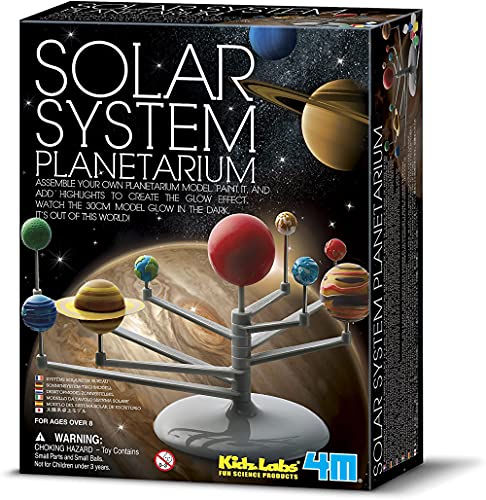
- Assemble, paint, and hang the included planets
- Adds a glow paint pen, wall chart, and quiz questions
- No batteries required; recommended for ages 8+
Best For: STEM learning and hanging planetarium displays
Best Size-Comparison Project
48-Piece Foam Ball Solar System Kit
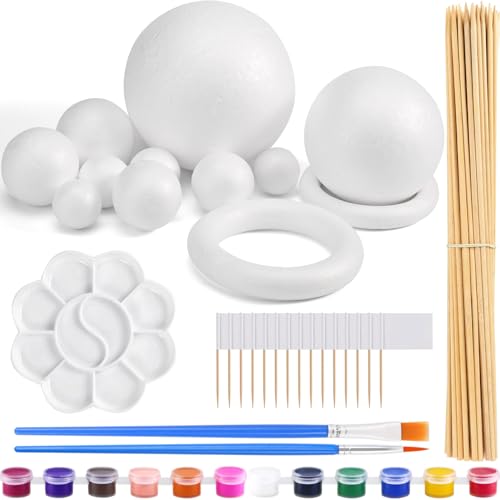
- Uses 10 ball sizes to show relative planetary scale
- Includes paints, brushes, rings, sticks, and labeling flags
- Assembles without glue for school and science projects
Best For: DIY classroom models and visual planet-size lessons
Best Hands-On Build
Smartivity DIY Solar System Kit

- Rotating gear-driven planet model
- STEM building activity for ages 8–14
- Eco-friendly, child-safe MDF construction
Best For: Kids who enjoy building and hands-on astronomy learning
Best Interactive Learning
Science Can Talking Solar System
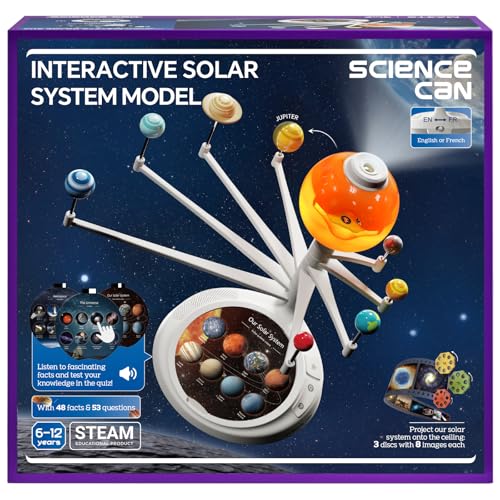
- 48 facts and 53 quiz questions
- Projects 24 colorful space images
- English and French options
Best For: Kids who prefer interactive, guided space activities
Best Craft Project

- 17 foam balls with paints and brushes
- Large display board for projects
- Useful for school or room decoration
Best For: Creative kids making a painted science project
Best DIY Display Kit
35-Piece Foam Solar System Model
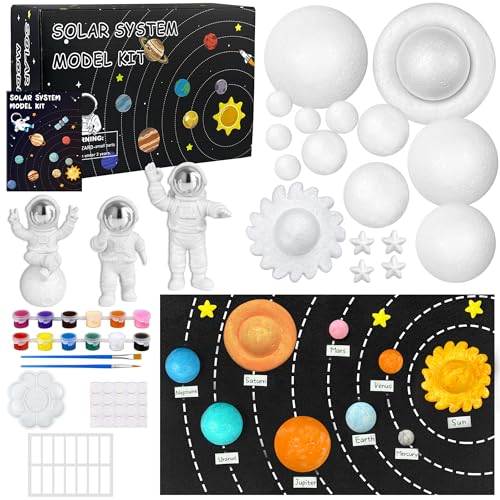
- Includes foam balls, paints, brushes, hanging supplies, and instructions
- Supports astronomy learning through hands-on assembly
- Designed for a compact wall display
Best For: Creative classroom projects and space-themed wall decorations
Best Interactive Option
Talking Solar System Projector

- Projects planets and space scenes using 24 HD images
- Provides English and Spanish astronomy facts
- Doubles as a night light or flashlight
Best For: Young children who prefer interactive STEM learning
Best Rotating Planetarium
4M Glow-in-the-Dark Solar System

- Snap-together planets require no glue
- Rotating stand creates an interactive display
- Includes glow paint and educational space facts
Best For: Older children who enjoy building, painting, and STEM projects
Best Glow-in-the-Dark Display – National Geographic Solar System Model
If you’re comparing solar system models under 100, this National Geographic kit stands out as a build-and-display project for children ages 8 and up. Kids paint all eight planets and the Sun, then arrange them on movable arms for a personalized, glow-in-the-dark room display.
Best For: Kids who want a hands-on astronomy project that doubles as space-themed bedroom decor.
Pros:
- Includes planets, paints, glow-in-the-dark accent paint, brush, palette, decals, and a fact poster.
- Movable arms make it easy to adjust the planetary arrangement.
- Supports construction, creative, hand-eye coordination, and problem-solving skills.
Cons:
- Recommended for ages 8 and up, so it may not suit younger children.
- The compact model measures about 12 inches in its longest dimension.
This is a strong choice when display appeal matters as much as the building activity. The included materials and glow feature make it especially engaging for children interested in decorating a space-themed room.
Best Classroom Starter Kit – Wookidel 64-Piece Solar System Project Kit
Among solar system models under 100, the Wookidel kit is a practical pick for school assignments and family activities. It combines foam pieces, paints, brushes, sticks, flags, and instructions so children can color and assemble a model at home or in the classroom.
Best For: Elementary-age learners completing a solar system project or exploring astronomy through crafts.
Pros:
- Includes foam discs, balls, stars, bamboo sticks, flags, 12 colors, brushes, palette, and instructions.
- Smooth polystyrene foam is designed to be easy to color.
- Encourages hand-eye coordination, focus, artistic skills, and science learning.
Cons:
- The model uses foam components rather than a more durable plastic structure.
- The listing contains mixed age guidance, with details referencing both ages 3–5 and a recommended range of 6–12.
With its broad collection of craft supplies and project-oriented format, this kit is well suited to guided learning. Adults may want to review the instructions and age suitability before starting, particularly with younger children.
Best Planetarium-Style Kit – 4M Solar System Planetarium
For shoppers seeking solar system models under 100 with a glow-in-the-dark element, the 4M Solar System Planetarium offers a straightforward assemble-and-learn activity. Children paint and mount the planets, then use the included string, chart, and quiz questions to extend the astronomy lesson.
Best For: Children ages 8 and up who enjoy STEM kits and want a hanging planetarium-style display.
Pros:
- Includes planets, stencils, glow paint pen, rods, string, and complete instructions.
- Comes with a fact-filled wall chart and 10 sets of Kidz Quiz questions.
- Requires no batteries and combines art with astronomy learning.
Cons:
- Pluto is not included.
- The kit is recommended for ages 8 and up.
- It may require more setup than a simple tabletop model because it uses rods and string.
This kit is a good fit when the goal is more than assembling a static model. Its chart and quiz materials add structured learning, while the glow paint helps turn the finished project into a room display.
Best Size-Comparison Project – 48-Piece Foam Ball Solar System Kit
This foam ball set is one of the more project-focused solar system models under 100, emphasizing painting and visual comparison. Its assortment of differently sized spheres helps learners represent the relative scale of the Sun, planets, and Pluto for a school, science, or craft project.
Best For: DIY school projects where learners need to paint, label, and assemble a customized planetary model.
Pros:
- Includes 12 foam balls, rings, bamboo sticks, toothpick flags, 12 pigments, brushes, and a palette.
- Ten ball sizes support visual learning about planetary size relationships.
- No glue is required; the balls can be assembled with bamboo skewers.
Cons:
- It is a craft-style kit, so painting and assembly are required before display.
- Foam components may be less durable than a rigid plastic model.
- The supplied details list an age range of 0–8, which may require adult supervision for younger children.
This kit makes the most sense for hands-on learning rather than an immediately finished display. The varied sizes, labels, and expanded paint set give children room to create a personalized model while discussing planetary scale and arrangement.
Best Hands-On Build – Smartivity DIY Solar System Kit
Among solar system models under 100, this Smartivity kit suits kids who learn best by building. Designed for ages 8–14, it creates a rotating planet model while introducing basic ideas about planets, orbits, day, and night.
Best For: Curious kids who enjoy construction projects and hands-on STEM learning.
Pros:
- Gear-driven, rotating model encourages interactive learning.
- Combines construction, creativity, and introductory astronomy.
- Uses eco-friendly, child-safe MDF materials.
- Packaged as a gift-ready option for ages 8–14.
Cons:
- Assembly is required, so it may need adult support for some children.
- The kit includes the model components in one set rather than additional activity materials.
This is a practical pick when the building process matters as much as the finished display. Its rotating design gives children a visual way to connect the planets with movement and orbit concepts.
Best Interactive Learning – Science Can Talking Solar System
For shoppers comparing solar system models under 100, this Science Can model stands out for its talking features, quiz mode, and planetarium-style projector. It is designed to make space learning more interactive for children roughly ages 6–12.
Best For: Children who enjoy audio questions, bilingual learning, and projected space images.
Pros:
- Includes 48 space facts across three knowledge cards.
- Offers 53 quiz questions for interactive review.
- Projects 24 full-color images using three included disks.
- Provides English and French language options.
Cons:
- Requires three AA batteries, which are not included.
- Its plastic design may be less suitable for children seeking a craft-building activity.
Choose this model when guided interaction is more appealing than assembling a planet display. The talking content, quiz mode, and projector create several ways to explore planetary positions, orbits, and space phenomena without assembly.
Best Craft Project – Pllieay 3D Solar System Kit
This Pllieay kit is a strong craft-focused choice among solar system models under 100. It gives children a large display board, foam balls, paints, brushes, and stickers for creating a personalized 3D solar system model.
Best For: School projects, parent-child crafting, and children who enjoy painting and decorating.
Pros:
- Includes 17 foam balls, 12 paints, brushes, a palette, and stickers.
- Large 17.32-by-11.02-inch display board supports a prominent finished project.
- Planet sizes are reduced proportionally to help illustrate volume differences.
- Can be used for school, science, decoration, or craft activities.
Cons:
- Painting and assembly take time compared with ready-made models.
- Foam components may be less durable than a solid plastic display.
- The supplied details list differing age guidance, so adult judgment is advisable.
This kit works best when the goal is to create and present a project rather than simply play with a finished model. Its assortment of craft supplies lets children reinforce astronomy concepts while practicing painting and assembly skills.
Best DIY Display Kit – 35-Piece Foam Solar System Model
For shoppers comparing solar system models under 100, this foam-ball kit is a hands-on option for creating a personalized classroom display, science project, or wall decoration. It includes paint, brushes, a palette, background plate, hanging supplies, instructions, and space-themed ornaments.
Best For: Kids ages 8 and up, classroom projects, and families who want a creative model-making activity with a space-saving finished display.
Pros:
- Includes 14 foam balls in multiple sizes, 12 pigments, brushes, palette, and project supplies.
- Instructions support learning planet positions and astronomy basics.
- Finished model can be hung on a wall using the included adhesive hooks.
- Painting and assembly encourage hand-eye coordination and color recognition.
Cons:
- Requires painting and assembly, so it is not a ready-to-display model.
- Foam construction may be less durable than a rigid plastic planetarium.
This is a practical pick when the activity matters as much as the finished model. Its included art materials and compact wall-display format make it especially useful for educational projects or smaller spaces.
Best Interactive Option – Talking Solar System Projector
Among solar system models under 100, this interactive kit combines an eight-planet display with bilingual talking facts, a projector, and a night-light function. It is designed to make astronomy more engaging for younger children through lights, images, and simple controls.
Best For: Children ages 3 and up who enjoy interactive STEM toys, bilingual English-and-Spanish learning, planetarium-style projection, and bedtime-friendly lighting.
Pros:
- Projects eight planets and 24 space images from three included slides.
- Offers educational planet facts in both English and Spanish.
- Works as a night light or flashlight as well as a solar system toy.
- Snap-and-lock assembly is designed for quick setup.
Cons:
- Requires three AA batteries, which are not included.
- Projection and talking features may be more stimulating than a traditional stationary model.
- It is a plastic interactive toy rather than a detailed scale model.
This model is strongest for families seeking an experience-based learning toy rather than a craft project. The bilingual facts, projection slides, and night-light mode give children several ways to explore space.
Best Rotating Planetarium – 4M Glow-in-the-Dark Solar System
For buyers looking at solar system models under 100, this 4M kit offers a more traditional build-and-display experience with snap-together planets, rotating arms, a stand, paint, and educational facts. The completed model is designed to rotate and glow in the dark after painting.
Best For: Kids ages 8 to 14 who want a craft-and-science project that becomes a rotating bedroom or classroom display.
Pros:
- Planets snap together without glue for a straightforward assembly process.
- Rotating arms and stand create a dynamic display.
- Includes glow paint, brush, painting instructions, and a wall chart with space facts.
- Combines creative painting with STEM and observation skills.
Cons:
- Painting and assembly take time before the model is ready to display.
- Glow effect depends on applying the included paint and exposing it to light.
- The kit is intended for older children rather than preschool-age users.
This is a good middle ground between a craft kit and a display model. Choose it when rotating movement, glow-in-the-dark details, and included science information are more important than electronic features.
How We Picked the Best Solar System Models Under 100
We focused on models that offer meaningful hands-on learning without exceeding a $100 budget. The selection includes build-and-paint kits, illuminated planetariums, mechanical displays, and interactive talking models so shoppers can compare different learning styles. We also considered stated age ranges, included materials, project complexity, display value, and whether the model is better suited to independent play, family work, or classroom use.
Because kit contents vary, check the product listing for details such as batteries, paint, brushes, tools, instructions, and display hardware before ordering.
Quick Comparison
| Model type | Best for | What to expect |
|---|---|---|
| Glow-in-the-dark planetarium | Visual learners and bedroom displays | Planets that provide a nighttime space effect |
| Foam-ball craft kit | Creative projects and school assignments | Painting, assembling, and labeling planets |
| Gear-driven model | Hands-on engineering learners | Mechanical movement and construction |
| Talking model | Younger learners and guided study | Audio-based facts and interactive exploration |
| Multi-piece project kit | Older children and group activities | More components, customization, and setup |
Key Buying Factors for Solar System Models Under 100
Age and Project Difficulty
Follow the recommended age range, especially when a kit includes small parts, toothpicks, craft tools, or detailed painting. Younger children may benefit from a talking or guided model, while older kids often prefer assembling a mechanical or paintable display.
Learning Style and Interaction
Choose a talking model for audio facts and guided discovery, a gear-driven design for motion and engineering concepts, or a DIY foam-ball kit for creative visual learning. Glow-in-the-dark models add a display element but may offer less structured instruction than interactive products.
Included Supplies
Compare the number of pieces and confirm whether the kit includes paint, brushes, pigments, sticks, flags, backgrounds, instructions, and a stand. A seemingly inexpensive kit may require extra craft supplies, while a more complete set can be easier to start immediately.
Size, Durability, and Display
Consider where the finished model will go and how often it will be handled. Lightweight foam models are easy to customize but may need careful storage. Mechanical and interactive models can be more engaging, while illuminated designs may work best as decorative learning displays.
Who Should Buy Which Solar System Models Under 100?
For younger children: Choose an interactive talking model with clear audio and simple controls. For ages 8 to 14: A gear-driven or DIY planetarium can provide a stronger mix of building and science learning. For creative school projects: Look for foam-ball kits with paints, labels, brushes, and background pieces. For bedroom displays: A glow-in-the-dark model offers visual appeal after the project is complete. For families or classrooms: Select a larger multi-piece kit with enough materials for shared assembly and discussion.