
The best solar system models for classrooms turn abstract astronomy concepts into lessons students can see, handle, and discuss. The 10 options in this roundup include magnetic displays, illuminated and interactive models, project kits, puzzles, and inflatable planets for different teaching styles and age groups.
Use the buying guide below to compare classroom practicality, learning value, durability, storage needs, and lesson flexibility before choosing a model for your science space.
Best 10 Solar System Models for Classrooms Picks for 2026
Best Magnetic Demonstration Model

- Large magnetic pieces for whiteboards and metal surfaces
- Includes planets, sun, moon, asteroid belt, and Pluto
- Durable format for hands-on STEM lessons
Best For: Whole-class demonstrations and ages 4–10
Best Build-and-Display Kit
Glow-in-the-Dark Solar System Model

- Build and paint all eight planets and the sun
- Includes glow paint, supplies, decals, and fact poster
- Movable arms support adjustable display positions
Best For: Ages 8+ and creative astronomy projects
Best Interactive Projector
Orbiting Solar System & Projector

- Rotating eight-planet model shows orbiting movement
- Projects 32 NASA and space-themed images
- Includes discs and a facts guide
Best For: Interactive lessons for ages 5 and up
Best Collaborative Craft Kit
64-Piece Solar System Project Kit

- Includes foam pieces, paints, brushes, and instructions
- Supports building and decorating a classroom model
- Designed for ages 6–12 school projects
Best For: Hands-on group projects combining science and art
Hands-On Wall Display

- Paint-and-assemble STEM activity
- Includes 63 project components
- Hangs on a wall to save space
Best For: Ages 8–17 and classroom science projects
Build-and-Rebuild Puzzle

- 540-piece glue-free construction
- Includes a facts poster
- Reusable plastic interlocking pieces
Best For: Small-group or independent activities ages 6+
Immersive Room Display
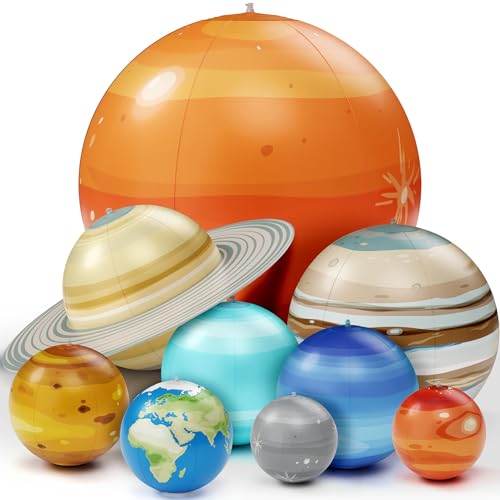
- Includes eight planets and the Sun
- Hangs from the ceiling for tactile learning
- Deflates for compact storage
Best For: Visual STEM lessons for ages 5–8
Interactive STEM Pick
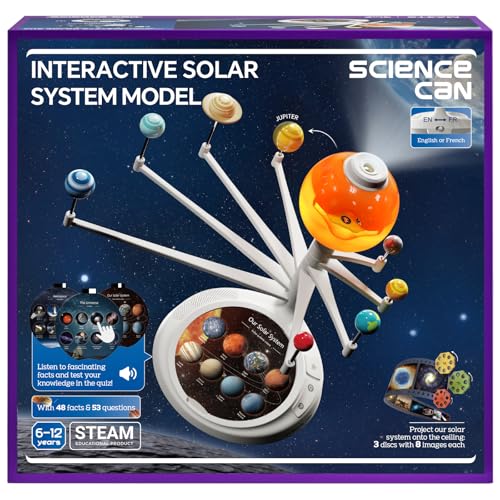
- 48 facts and 53 quiz questions
- English and French options
- Projector with 24 color images
Best For: Elementary STEM lessons with interactive review
Display-Friendly Choice

- 10-piece Sun, planet, and Pluto set
- 8- to 28-inch inflatable pieces
- Uses regular air instead of helium
Best For: Large classroom displays and size comparisons
Orbital Demonstration Pick

- Shows seasons and eclipse positions
- Demonstrates Sun–Earth–Moon orbits
- Includes a seasonal information plate
Best For: Hands-on Earth science and astronomy demonstrations
Best Magnetic Demonstration Model – Giant Magnetic Solar System
For classrooms seeking solar system models for classrooms that support whole-group instruction, this magnetic set offers a practical way to demonstrate planetary order and compare relative sizes. The large pieces attach to whiteboards, metal doors, and other magnetic surfaces.
Best For: Teachers who want a reusable, hands-on display for ages 4–10 and STEM lessons.
Pros:
- Includes the sun, moon, planets, asteroid belt, and Pluto with realistic NASA satellite images.
- Large, proportionally sized magnets make planetary order and size comparisons easier to show.
- Flexible magnetic material is designed for repeated classroom handling.
Cons:
- Requires a magnetic surface for display.
- Its flat magnetic format is better for demonstrations than for a freestanding 3D model.
This is a strong classroom pick when visibility, quick setup, and tactile participation matter more than building or rotation features.
Best Build-and-Display Kit – Glow-in-the-Dark Solar System Model
This National Geographic kit is one of the more creative solar system models for classrooms, combining planet assembly, painting, and display. Students can customize the eight planets and sun, then use the glow-in-the-dark finish for an engaging space-themed presentation.
Best For: Ages 8 and up, especially project-based activities that combine astronomy, construction, and art.
Pros:
- Includes paints, glow-in-the-dark accent paint, brush, palette, decals, and a fact poster.
- Movable arms allow students to adjust the planet positions.
- Build-and-paint activities support creativity, coordination, and problem solving.
Cons:
- Assembly and painting require classroom time and supervision.
- The compact display is less suited to showing large-scale planetary size comparisons.
Choose this model for a memorable student project or display piece rather than a quick instructional prop.
Best Interactive Projector – Orbiting Solar System & Projector
For classrooms that want solar system models for classrooms with an added visual component, this rotating model combines orbiting planets with a Sun-shaped projector. It supports close-up exploration of planets, constellations, asteroids, and other space imagery.
Best For: Ages 5 and up, particularly interactive lessons and indoor astronomy presentations.
Pros:
- Eight planets move on orbiting arms around the Sun.
- Includes 32 images across four projector discs, including NASA images.
- Projects space-related visuals and comes with a guide containing fun facts.
Cons:
- Requires three AA batteries, which are not included.
- Manual operation and moving parts may need teacher oversight.
This is a versatile choice for teachers who want both a physical orbiting model and projected imagery in one classroom activity.
Best Collaborative Craft Kit – 64-Piece Solar System Project Kit
This foam-based kit gives students a hands-on way to create solar system models for classrooms. With foam pieces, paints, brushes, sticks, flags, stars, and instructions included, it is designed for school projects that combine astronomy learning with art and construction.
Best For: Ages 6–12 and classroom or family projects focused on building and decorating a solar system.
Pros:
- Includes 64 pieces, 12 paint colors, two brushes, a palette, and instructions.
- Foam surfaces are smooth and easy to color.
- Building and painting encourage focus, hand-eye coordination, and artistic expression.
Cons:
- Students must assemble and paint the model before it can be displayed.
- Foam construction may be less durable than a magnetic classroom set.
This kit works well when the learning goal includes creating a finished student project, though teachers should plan for craft time and shared supplies.
Hands-On Wall Display – Space Science Model Kit
For classrooms seeking solar system models for classrooms that combine crafting with science instruction, this Pllieay kit offers a hands-on project students can paint, label, and display. The felt backing can be hung on a wall, making it practical when tabletop space is limited.
Best For: Students ages 8–17 completing a guided solar system or STEM classroom project.
Pros:
- Includes foam pieces, felt background, paints, brushes, palette, labels, hooks, and instructions.
- Guidance helps students learn planetary names and orbital positions.
- Wall-mountable design saves classroom display space.
- Encourages hands-on coordination and color-recognition skills.
Cons:
- Students must paint and assemble the model, so it requires project time.
- Designed for ages 8 and up rather than very young learners.
This is a strong choice when the goal is an art-integrated science activity with a finished display. Its 63-piece format provides plenty of components, but teachers should plan for supervised assembly and painting.
Build-and-Rebuild Puzzle – 3D Solar System Puzzle
This Ravensburger set is a good fit for solar system models for classrooms where students can learn through focused construction rather than painting. Its 540 interlocking pieces create a three-dimensional display, while the included poster adds planet facts for follow-up discussion.
Best For: Independent or small-group activities for learners ages 6 and up who enjoy puzzles and structured tasks.
Pros:
- Easy Click Technology assembles without glue.
- Durable plastic pieces can be built and rebuilt.
- Includes planet puzzles, stands, Sun, Moon, hanging cord, and an educational poster.
- Supports concentration, hand-eye coordination, motor skills, and task completion.
Cons:
- A 540-piece build may require substantial classroom time and organization.
- The set is a construction puzzle rather than a paint-based craft project.
Choose this model when reusability and independent problem-solving matter most. The sturdy, glue-free construction works well for repeated center activities, although teachers may want to reserve it for small groups or supervised use.
Immersive Room Display – Inflatable Planet Set
For teachers who want solar system models for classrooms that students can see and physically explore, this inflatable set creates a large hanging display. The eight planets and Sun can be suspended around the room, and the included learning cards add simple fact-based exploration.
Best For: Visual, tactile classroom lessons and space-themed displays for children ages 5–8.
Pros:
- Includes eight inflatable planets, the Sun, hanging strings, and learning cards.
- Large planets make the solar system easy to see and interact with.
- Built-in hanging loops support ceiling or room display.
- Deflates for compact storage and can be reused.
Cons:
- Inflatable pieces need to be hung or arranged before use.
- The set is intended for indoor use.
- Its recommended age range is narrower than some classroom models.
This option stands out for whole-class visual impact and interactive learning. It is especially practical for teachers who need a reusable display that can be stored between lessons, events, or space-themed activities.
Interactive STEM Pick – Talking Solar System Model
This talking model is a feature-rich option for classrooms looking for solar system models for classrooms that combine factual review with hands-on exploration. It teaches 48 space facts, offers 53 quiz questions, and includes a projector for visual demonstrations.
Best For: Elementary classrooms and STEM activities serving children ages 6–12.
Pros:
- Bilingual English and French knowledge modes support flexible instruction.
- Quiz mode reinforces astronomy concepts through 53 questions.
- Projector includes three disks with 24 full-color space images.
- Sun lights up to illustrate how sunlight affects the planets.
Cons:
- Requires three AA batteries, which are not included.
- Its interactive features may be more than needed for a basic display model.
Choose this model when your lessons benefit from audio prompts, quizzes, and projected visuals. It arrives assembled and is designed for classroom STEM lessons, though teachers should plan for battery replacement.
Display-Friendly Choice – Inflatable Solar System Set
This inflatable set is a practical choice for teachers who want solar system models for classrooms that support large-group visual learning. It includes the Sun, eight planets, and Pluto in sizes from 8 to 28 inches for easy comparison.
Best For: Classroom displays, size-comparison activities, and space-themed learning areas for children ages 3 and up.
Pros:
- Includes 10 pieces covering the Sun, all nine listed planets, and Pluto.
- Planet sizes range from 8 to 28 inches to make scale differences visible.
- Inflates with regular air, so helium is not required.
- Lightweight pieces can be hung for classroom displays or used as decor.
Cons:
- Manual inflation and hanging require setup time.
- Inflatable pieces are less suited to detailed orbital demonstrations.
This kit works well when visibility and room-scale presentation matter more than mechanical movement. Its durable plastic construction is intended for repeated inflation and deflation, making it useful for recurring displays or lessons.
Orbital Demonstration Pick – Sun Earth Moon Orbital Model
This rotating Sun–Earth–Moon kit suits classrooms seeking solar system models for classrooms that explain motion and relationships rather than display every planet. Its moving components demonstrate seasons, moon phases, and solar and lunar eclipses.
Best For: Earth science, astronomy, and school project lessons for children over age 6.
Pros:
- Demonstrates Earth’s orbit around the Sun and the Moon’s orbit around Earth.
- Supports explanations of seasons, solar eclipses, lunar eclipses, and moon phases.
- Includes a seasonal plate with four seasons and 24 traditional Chinese solar terms.
- Compact tabletop size measures approximately 15.2 by 7.87 by 11.02 inches.
Cons:
- Assembly is required before classroom use.
- It focuses on the Sun, Earth, and Moon rather than the complete planetary system.
- The supplied instructions include several setup and alignment steps.
This is the strongest choice of the three for demonstrating orbital relationships and eclipse geometry. Allow time for assembly and alignment, then use the moving model for guided Earth science explanations.
How We Picked the Best Solar System Models for Classrooms
We focused on models that support clear astronomy instruction rather than serving only as decorations. The selection covers hands-on building kits, display models, orbital demonstrations, projection and talking features, puzzles, and large inflatable planets. We considered how well each format can support lessons about planet order, relative movement, the Sun-Earth-Moon relationship, scale, vocabulary, and student participation.
We also looked at practical classroom concerns: age range, setup time, durability, storage, visibility from across a room, and whether the product works best for individual work, small groups, or whole-class demonstrations. Because no physical model accurately represents both scale and distance, teachers should use these products as visual teaching aids alongside diagrams and explanations.
Quick Comparison
| Model type | Best use | Classroom advantage |
|---|---|---|
| Magnetic display | Repeated lessons and wall or board demonstrations | Easy to rearrange and reuse |
| Glow or interactive model | Engagement and visual reinforcement | Makes astronomy concepts memorable |
| Project kit | Individual or small-group activities | Encourages construction and ownership |
| Puzzle | Quiet centers and review activities | Combines spatial reasoning with content review |
| Inflatable planets | Large-group demonstrations | Highly visible and easy to handle |
| Orbital model | Motion and relationship lessons | Shows interactions more clearly than a flat chart |
Key Buying Factors for Solar System Models for Classrooms
Age and Lesson Objective
Match the format to the learners and the intended activity. Younger students may benefit from oversized, tactile planets and simple planet-order exercises, while older students may get more value from orbital mechanisms, construction projects, or models that support discussion of rotation and revolution.
Visibility and Scale
A small tabletop kit can work well at a science station but may be difficult for a full class to see. For demonstrations, prioritize large magnetic pieces, inflatable planets, projection features, or a model that can be elevated on a table. Explain that most classroom models use color and size for recognition, not true astronomical scale.
Durability, Safety, and Storage
Check materials, small-part warnings, inflation requirements, and expected supervision. Kits with many pieces can be educational but need labeled storage. Inflatable models save space when deflated, while rigid displays may be faster to use but require a dedicated shelf or wall area.
Interaction and Maintenance
Interactive, light-up, or talking features can increase attention, but they may require batteries and add maintenance. Construction kits and puzzles avoid electronics and provide repeatable hands-on practice, though pieces can be misplaced over time.
Who Should Buy Which Solar System Models for Classrooms?
Choose a magnetic model if you need a reusable visual aid for frequent whole-class instruction. An illuminated, interactive, or projection-based option suits teachers who want a more attention-grabbing introduction to astronomy. Project kits are strongest for STEM centers, homework, and small-group collaboration, while the puzzle format fits review stations and mixed-age learning environments.
For assemblies, libraries, or younger classrooms where visibility matters most, inflatable planets are practical and easy to demonstrate. If your curriculum emphasizes the Sun-Earth-Moon relationship, select an orbital model designed to show those bodies moving together. Finally, consider buying more than one format when possible: a large display supports explanation, while a buildable or puzzle-based model gives students a chance to apply what they learned.