
The right solar charge controller protects your battery, improves charging efficiency, and helps your off-grid system perform reliably. The 10 models in this roundup include compact PWM units and higher-output MPPT controllers for small and large installations.
Use the guide below to compare voltage, amperage, battery compatibility, and system features before choosing a controller for your solar setup.
Best 10 Solar Charge Controllers Picks for 2026
Smart Monitoring Pick
Victron Energy SmartSolar MPPT 100V 50A

- MPPT charging for strong solar harvesting
- App monitoring with history and alarms
- Synchronized multi-controller charging
Best For: Connected off-grid systems needing detailed control
All-Weather Value
Renogy Rover 40A MPPT Controller

- 98% listed MPPT conversion rate
- Supports lead-acid and lithium batteries
- LCD and broad temperature range
Best For: Versatile RV and off-grid installations
High-Voltage System Pick
Victron Energy SmartSolar MPPT 150V 45A

- Supports four battery-system voltages
- 150V solar input rating
- App monitoring and synchronized charging
Best For: Flexible off-grid systems with higher-voltage arrays
Compact Budget Option
Renogy Wanderer 10A PWM Controller
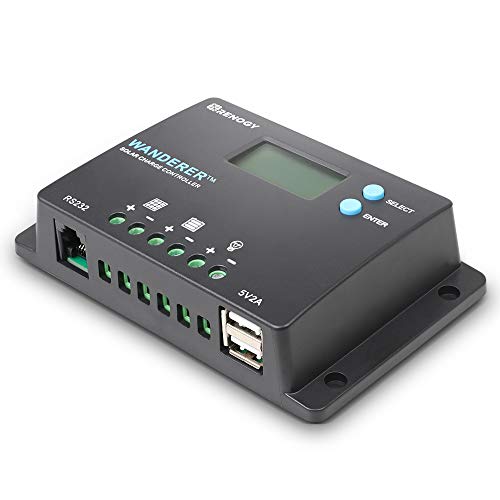
- Compact 12V/24V PWM design
- Four-stage charging for multiple batteries
- LCD, USB, and load-control modes
Best For: Small RV, marine, and DIY solar setups
High-Capacity Smart MPPT
Victron Energy SmartSolar 150V 70A

- Supports 12V–48V battery systems
- 70A charging capacity with 150V rating
- Bluetooth monitoring and synchronized charging
Best For: Larger off-grid solar installations
Versatile RV MPPT

- Works with lead-acid and lithium batteries
- LCD display with adjustable parameters
- Protection features for RV and marine use
Best For: Moderate 12V/24V RV and off-grid systems
Compact Smart MPPT
Victron Energy SmartSolar 100V 20A

- 100V input rating with 20A capacity
- VictronConnect Bluetooth monitoring
- Configurable load disconnect and synchronized charging
Best For: Smaller systems needing smart Victron controls
Best for Large DIY Systems

- 150V maximum solar input
- Supports 12V–48V systems
- LCD and temperature sensor included
Best For: Large off-grid and DIY solar installations
Best Smart Compact Controller

- Built-in Bluetooth connectivity
- MPPT charging for 12V/24V systems
- Configurable load disconnect
Best For: Small systems needing app-based monitoring
Best Value Basic Controller

- Supports four battery chemistries
- MPPT and multi-stage charging
- Optional Bluetooth via dongle
Best For: Simple small 12V/24V solar systems
Smart Monitoring Pick – Victron Energy SmartSolar MPPT 100V 50A
For buyers comparing solar charge controllers, the Victron Energy SmartSolar MPPT 100/50 stands out for efficient power tracking and app-based system management. Its MPPT technology is designed to capture available solar power, including during partial shade, while its configurable load output helps protect batteries from excessive discharge.
Best For: Off-grid systems that prioritize monitoring, configurable settings, and synchronized charging across multiple controllers.
Pros:
- MPPT tracking helps maximize available solar power.
- VictronConnect provides real-time data, history, settings, firmware updates, and alarms.
- Supports synchronized charging with multiple SmartSolar controllers.
- Configurable load disconnect helps protect low batteries.
Cons:
- No built-in display.
- Bluetooth connectivity and app control may be more functionality than simple systems require.
This is a strong choice when system visibility and expandability matter more than a basic, display-based interface. Confirm that the 100V, 50A rating fits your panel and battery configuration before buying.
All-Weather Value – Renogy Rover 40A MPPT Controller
The Renogy Rover 40A is a versatile option among solar charge controllers, combining MPPT charging with automatic 12V/24V detection and an LCD. It supports several battery chemistries and includes protections intended for demanding off-grid installations and variable weather conditions.
Best For: RV, cabin, and off-grid systems using lead-acid or lithium batteries in a wide range of temperatures.
Pros:
- MPPT conversion rate is listed at 98%, with 99% tracking efficiency.
- Supports Gel, AGM, Flooded, and Lithium batteries.
- Operates from -40°F to 149°F and includes low-temperature protection.
- LCD provides an onboard way to view system information.
Cons:
- App connectivity requires the separate BT-2 accessory.
- The 40A capacity may not suit higher-output systems.
- Its larger controller format may require more mounting space.
With broad battery compatibility, multiple charging stages, and extensive electrical safeguards, the Rover 40A is a practical middle-ground controller. Check array sizing, battery voltage, and available mounting space before installation.
High-Voltage System Pick – Victron Energy SmartSolar MPPT 150V 45A
The Victron Energy SmartSolar MPPT 150/45 is designed for buyers who need broader battery-voltage support from their solar charge controllers. It works with 12V, 24V, 36V, and 48V systems, while MPPT tracking and VictronConnect provide efficient charging and detailed system access.
Best For: Off-grid installations using higher-voltage battery banks or systems that may need synchronized controller operation.
Pros:
- Supports 12V, 24V, 36V, and 48V battery systems.
- 150V solar input rating accommodates higher-voltage panel arrangements.
- App supports real-time data, history, configuration, firmware updates, and alarms.
- Multiple units can synchronize charging stages.
Cons:
- No built-in display.
- 45A output is lower than the 50A Victron option in this roundup.
- Its advanced capabilities may be unnecessary for small, simple systems.
This model is especially appealing when system voltage flexibility and a higher solar input ceiling are important. Match the 150V input and 45A output limits to the panel array and battery bank for safe operation.
Compact Budget Option – Renogy Wanderer 10A PWM Controller
The Renogy Wanderer 10A is a compact PWM choice for smaller 12V or 24V setups. These solar charge controllers offer four-stage charging, battery compatibility for AGM, Gel, Flooded, and lithium batteries, plus load-control modes for basic DC applications.
Best For: Small RV, marine, lighting, pump, and DIY off-grid systems where low capacity and compact installation are appropriate.
Pros:
- Supports 12V and 24V battery systems.
- Four-stage charging supports AGM, Gel, Flooded, and lithium batteries.
- Includes protection against overcharge, over-discharge, overload, short circuit, and reverse polarity.
- Compact IP32 housing includes an LCD and USB charging port.
Cons:
- 10A capacity limits it to smaller solar installations.
- PWM charging is less suited to maximizing output from larger or more complex arrays than MPPT.
- Bluetooth app monitoring requires a separate BT-1 module.
This Wanderer makes sense when affordability, simple monitoring, and a small footprint are the priorities. Size the controller conservatively for the panel array, and verify the battery profile before connecting a lithium bank.
High-Capacity Smart MPPT – Victron Energy SmartSolar 150V 70A
For larger solar charge controller installations, the Victron Energy SmartSolar MPPT 150V, 70A model combines high current capacity with Bluetooth monitoring. Its MPPT tracking, synchronized charging support, and configurable load output make it suited to systems where energy harvest and battery management are priorities.
Best For: Larger 12V, 24V, 36V, or 48V solar systems that need high charging capacity and app-based monitoring.
Pros:
- Supports 12V, 24V, 36V, and 48V battery systems.
- 150V input rating and 70A charging capacity support substantial installations.
- Bluetooth connectivity enables VictronConnect monitoring, configuration, firmware updates, and alarms.
- Can synchronize with multiple SmartSolar MPPT controllers.
Cons:
- Its high-capacity design may be more than smaller solar setups require.
- System display and configuration features depend on using the VictronConnect ecosystem.
This is a strong choice when you need a scalable solar charge controller with broad battery-voltage compatibility, advanced monitoring, and intelligent load protection. Its 70A rating makes it particularly appropriate for higher-output systems.
Versatile RV MPPT – Renogy Rover 30A 12V/24V
The Renogy Rover 30A is a flexible solar charge controller for 12V and 24V systems, with an LCD display and adjustable charging parameters. It supports gel, sealed, flooded, and lithium batteries, making it a practical option for RV, marine, and cabin installations.
Best For: RVs, marine setups, and off-grid cabins using 12V or 24V batteries and up to 400W or 800W of solar input, respectively.
Pros:
- Automatically supports 12V and 24V battery systems.
- Compatible with gel, sealed, flooded, and lithium batteries.
- LCD display and adjustable parameters provide local system visibility and control.
- Includes temperature compensation, surge protection, and reverse-polarity and overload safeguards.
Cons:
- Bluetooth monitoring requires the separately sold BT2 module.
- Its 30A capacity is less suitable for larger solar arrays.
With four-stage charging, lithium reactivation, scheduled load control, and broad battery compatibility, the Rover 30A offers useful flexibility for moderate-sized systems. Check array wattage and Voc limits before installation.
Compact Smart MPPT – Victron Energy SmartSolar 100V 20A
The Victron Energy SmartSolar MPPT 100V, 20A is a compact solar charge controller for lower-current systems, while retaining Victron’s app connectivity and MPPT tracking. It can help maximize available solar power and manage loads when system size and charging demands are modest.
Best For: Compact solar installations that need a 20A controller with Bluetooth configuration and monitoring.
Pros:
- 100V input rating and 20A capacity suit smaller solar systems.
- Bluetooth access through VictronConnect provides real-time data and performance history.
- Supports synchronized charging with multiple SmartSolar MPPT controllers.
- Configurable load disconnect helps protect batteries from excessively low voltage.
Cons:
- 20A capacity limits its suitability for higher-output arrays.
- The supplied notes do not specify a broad range of battery voltages beyond the listed 48V compatibility.
This model is a good fit when you want Victron’s smart monitoring and MPPT features in a smaller controller. Confirm that the 20A rating and system-voltage requirements match your solar array and battery setup.
Best for Large DIY Systems – Renogy Rover Lite 60A
For larger solar charge controller installations, the Renogy Rover Lite 60A combines a 150V maximum solar input with support for 12V, 24V, 36V, and 48V battery systems. It is designed for gel, sealed, flooded, and lithium batteries, making it a flexible option for substantial DIY setups.
Best For: Larger off-grid and DIY solar systems that need high input capacity and broad battery-voltage compatibility.
Pros:
- 150V maximum solar input can support up to six Renogy 200W monocrystalline panels in series.
- Works with 12V through 48V battery systems and several battery types.
- LCD screen, labeled ports, and included battery temperature sensor simplify setup and monitoring.
- Designed for full-load operation from -31°F to 113°F, with low-temperature lithium protection.
Cons:
- Compatible only with 12V batteries, which are sold separately.
- Bluetooth monitoring requires a separately purchased module.
- Its 60A capacity may be more than smaller solar systems need.
The Rover Lite 60A is a strong choice when panel voltage, battery-voltage flexibility, and expansion potential matter more than compact sizing. Its separate Bluetooth module adds cost, but the built-in LCD keeps essential controls accessible without it.
Best Smart Compact Controller – Victron SmartSolar MPPT 75/15
The Victron Energy SmartSolar MPPT 75/15 is a compact solar charge controller for 12V or 24V systems. Its built-in Bluetooth connectivity, MPPT tracking, and VictronConnect app make it a practical choice for users who want detailed system access from a phone.
Best For: Smaller 12V or 24V systems where app-based monitoring, configuration, and performance history are priorities.
Pros:
- Built-in Bluetooth supports real-time data, 30-day performance history, configuration, alarms, and firmware updates through VictronConnect.
- MPPT tracking is designed to maximize available power, including when panels are partly shaded.
- Multiple units can synchronize their charging stages for coordinated system operation.
- Configurable load output can disconnect loads when battery voltage becomes too low.
Cons:
- Limited to 15A and a 75V solar input, so it is intended for smaller systems.
- Designed for 12V and 24V battery setups rather than higher-voltage banks.
- Uses an LED or minimal display instead of a full onboard screen.
Choose the SmartSolar 75/15 when connected monitoring is more important than high current capacity. The integrated Bluetooth and synchronized-controller capability provide useful flexibility for compact systems and future expansion.
Best Value Basic Controller – Victron BlueSolar MPPT 75/15
The Victron Energy BlueSolar MPPT 75/15 is a straightforward solar charge controller for 12V and 24V battery systems. It uses multi-stage charging and MPPT technology to maximize energy harvesting, while supporting AGM, gel, LiFePO4, and flooded lead-acid batteries.
Best For: Users who want Victron MPPT charging in a simple installation and do not need built-in wireless monitoring.
Pros:
- Compatible with AGM, gel, LiFePO4, and flooded lead-acid batteries.
- MPPT tracking helps maximize harvested solar energy, including during partial shading.
- Multi-stage charging is designed to move batteries efficiently toward a full charge.
- Remote monitoring and control are available by adding a separate Bluetooth dongle.
Cons:
- Bluetooth is not built in; the required dongle is sold separately.
- There is no onboard display for direct status viewing.
- The 15A, 75V rating is intended for smaller 12V or 24V systems.
The BlueSolar 75/15 suits a simpler installation where reliable MPPT charging is the main requirement. It offers a path to VictronConnect monitoring, but buyers wanting wireless access out of the box should consider the SmartSolar version instead.
How We Picked These Solar Charge Controllers
We selected controllers across common off-grid use cases, from small 12V lighting systems and portable setups to larger 48V battery banks. The lineup includes PWM and MPPT designs, multiple current ratings, and models supporting different panel and battery voltages. We also considered practical features such as automatic voltage detection, adjustable charging parameters, display or monitoring options, lithium compatibility, and maximum PV input voltage.
Because installation requirements vary, no single controller is best for every system. Confirm the manufacturer’s specifications and wiring requirements before purchase.
Quick Comparison
| Controller type | Best suited for | Main advantage | Typical limitation |
|---|---|---|---|
| PWM | Small, budget-conscious 12V or 24V systems | Simple and affordable | Usually less efficient than MPPT |
| MPPT, 15–30A | Small to medium RV, cabin, and backup systems | Better energy harvest and flexible panel sizing | Limited output for large battery banks |
| MPPT, 40–60A | Medium and larger off-grid installations | Higher charging capacity | Requires larger wiring and careful heat management |
| MPPT, 70A | High-output 12V–48V systems | Supports substantial solar arrays | Higher cost and more demanding installation |
Key Buying Factors for Solar Charge Controllers
Controller Type and Efficiency
PWM controllers are suitable when the solar panel voltage closely matches the battery voltage and cost is the priority. MPPT controllers generally extract more usable power, especially in cold weather, partial shade, or systems using higher-voltage panels.
Battery and System Voltage
Match the controller to your battery bank’s nominal voltage. Some models support only 12V and 24V systems, while others accommodate 36V and 48V banks. If you plan to expand, choosing a controller with broader voltage support can provide more flexibility.
Charge-Current and PV Limits
A controller’s amperage rating determines how much charging current it can deliver to the battery. Check both the maximum solar input voltage and the allowable PV power. Exceeding either limit can damage the controller. Size cables, fuses, and disconnects for the expected current.
Battery Chemistry and Configuration
Verify support for flooded, AGM, gel, sealed, or lithium batteries. Lithium batteries often require specific charge voltages and settings, while lead-acid batteries may need temperature compensation and selectable absorption or float parameters.
Monitoring and Installation
LCD displays, Bluetooth connectivity, and adjustable parameters make troubleshooting easier, but they may increase cost. Also check enclosure ventilation, terminal size, environmental rating, and whether the controller can be mounted safely away from excessive heat and moisture.
Who Should Buy Which Solar Charge Controllers?
- For a compact, low-cost setup: Choose a 10A PWM controller for small 12V panels, lights, sensors, or basic battery maintenance.
- For a small RV or cabin system: A 15A or 20A MPPT model is a practical choice when efficiency and compact size matter.
- For medium systems: Look at 30A or 40A MPPT controllers for larger 12V or 24V battery banks and more substantial panel arrays.
- For high-demand installations: A 45A, 60A, or 70A MPPT controller is better suited to larger arrays, provided the battery bank, cabling, and protection devices are sized accordingly.
- For future expansion: Prioritize higher PV voltage and broader 12V–48V compatibility, but select a current rating that matches your actual battery bank and solar array.
Before ordering, calculate the array’s maximum voltage and current under local conditions, then confirm the battery manufacturer’s recommended charging profile. Professional installation is advisable for high-current or permanently wired systems.