
Choosing the right solar charge controller can improve charging efficiency, protect your battery bank, and make an off-grid system easier to monitor. The best option depends on your panel voltage, battery chemistry, system size, and whether you need MPPT performance or a simpler PWM setup.
We selected 10 solar charge controllers under $300 spanning compact 12V systems, 12/24V installations, higher-voltage battery banks, golf-cart applications, and models with Bluetooth or LCD monitoring. Use the guide below to compare the specifications that matter before buying.
Best 10 Solar Charge Controllers Under 300 Picks for 2026
High-Capacity Smart MPPT

- 50A MPPT charging for 12V/24V systems
- Bluetooth monitoring through VictronConnect
- Supports synchronized multi-controller charging
Best For: Higher-capacity off-grid and RV solar systems
RV-Friendly PWM Value

- 30A PWM charging for 12V systems
- Supports lithium, AGM, gel, and flooded batteries
- Compact housing with LED status indicators
Best For: Compact 12V RV and marine installations
Compact Smart MPPT

- 15A MPPT charging for 12V/24V systems
- Bluetooth monitoring and configuration
- Compact design for smaller installations
Best For: Small connected solar systems with limited mounting space
Easy-Read 12V Controller
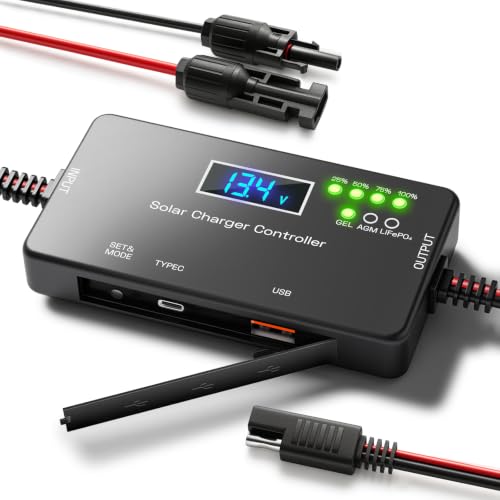
- 12V support for LiFePO4, AGM, and gel batteries
- LCD displays voltage and charge level
- Built-in USB-C PD and USB fast charging
Best For: Simple 12V outdoor systems and device-charging setups
High-Voltage MPPT Pick
DC HOUSE 300W Boost Controller

- Supports 36V/48V/60V batteries
- Up to 99% peak MPPT efficiency
- Durable aluminum case with system protections
Best For: Higher-voltage golf cart and off-grid solar systems
Compact RV Favorite
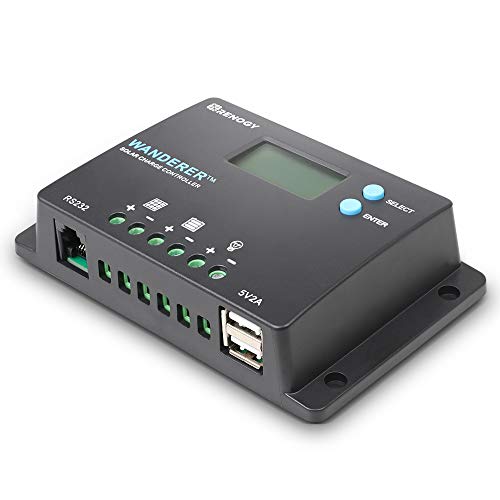
- Works with 12V/24V battery systems
- Four-stage charging for multiple battery types
- LCD, load control, and optional Bluetooth monitoring
Best For: Small RV, marine, and protected DIY installations
Connected MPPT Upgrade
LiTime 30A Bluetooth Controller

- Up to 99% MPPT tracking efficiency
- Built-in Bluetooth and LCD monitoring
- Supports 12V/24V LiFePO4 and lead-acid systems
Best For: Connected RV and off-grid solar installations
Best for App-Based Control
Dyness 40A MPPT Solar Charge Controller

- Bluetooth app with data history and charging controls
- Supports 12V/24V systems and multiple battery types
- 20A load output with extensive protection features
Best For: Medium-sized RV, marine, and off-grid systems needing remote monitoring
Best Compact Choice
Renogy Rover 2 20A MPPT Solar Charge Controller

- Space-saving design for RVs, vans, boats, and cabins
- Bluetooth and LCD monitoring without an external dongle
- Supports 300W/600W PV arrays and multiple battery types
Best For: Small 12V/24V systems installed in tight spaces
High-Capacity Smart MPPT – Victron SmartSolar 100V 50A
For solar charge controllers under 300, the Victron SmartSolar MPPT 100/50 stands out for systems that need higher charging capacity, efficient power-point tracking, and app-based monitoring. Its 100V PV rating and 50A output support 12V or 24V battery systems, while the MPPT design helps maximize available solar power when shading affects the panels.
Best For: Larger 12V/24V off-grid, RV, or backup systems that benefit from Bluetooth monitoring and higher charging capacity.
Pros:
- 50A MPPT charging supports higher-capacity solar setups.
- Bluetooth connectivity provides real-time data, performance history, configuration, and alarms through VictronConnect.
- Can synchronize with other SmartSolar MPPT controllers for coordinated charging.
- Configurable load output can disconnect loads when battery voltage becomes too low.
Cons:
- No built-in display is included.
- Its larger capacity may be unnecessary for small solar systems.
This is a strong choice when harvesting as much solar energy as possible matters more than having the simplest or smallest controller. Confirm that the panel array and battery bank match its voltage and current specifications before installation.
RV-Friendly PWM Value – Renogy Wanderer Li 30A
Among solar charge controllers under 300, the Renogy Wanderer Li 30A is a practical 12V PWM option for RVs, boats, and compact off-grid installations. It supports LiFePO4, AGM, gel, and flooded batteries, with automatic charging stages and built-in protection for common wiring and charging faults.
Best For: 12V RV, marine, and small off-grid systems needing straightforward PWM charging and battery-type flexibility.
Pros:
- 30A charging with bulk, boost, float, and automatic equalization stages.
- Supports LiFePO4, AGM, gel, and flooded battery types.
- LED indicators show charging stages, while optional Bluetooth enables app monitoring.
- Compact IP32 housing and multiple mounting options suit tight installation spaces.
Cons:
- Designed for 12V systems rather than 24V setups.
- PWM technology is less power-optimizing than MPPT technology.
- Bluetooth monitoring requires the compatible optional module.
The Wanderer Li makes sense for a cost-conscious 12V installation where simple operation and broad battery compatibility are priorities. Verify the panel voltage, system grounding, and battery settings before connecting the controller.
Compact Smart MPPT – Victron SmartSolar 75V 15A
For shoppers comparing solar charge controllers under 300, the Victron SmartSolar MPPT 75/15 offers efficient MPPT charging in a compact format. It supports 12V and 24V battery systems, includes Bluetooth connectivity, and is sized for smaller solar arrays where app-based setup and monitoring are useful.
Best For: Small 12V/24V solar systems that need MPPT efficiency, compact installation, and smartphone monitoring.
Pros:
- MPPT tracking helps maximize available solar output, including under partial shade.
- Bluetooth access supports configuration, firmware updates, alarms, and performance history.
- Can synchronize with additional SmartSolar MPPT controllers.
- Compact dimensions make it suitable for space-limited installations.
Cons:
- 15A capacity limits it to smaller solar systems.
- The product has only a minimal or LED-style display rather than a full screen.
This model is a balanced pick for small systems where MPPT performance and connected monitoring are more important than high current capacity. Match the solar array and battery bank to the controller’s 75V and 15A ratings.
Easy-Read 12V Controller – 20A PWM LCD Solar Charger
This 20A PWM unit is a useful option among solar charge controllers under 300 for basic 12V battery systems. It supports LiFePO4, AGM, and gel batteries, handles solar panels up to 300W according to the supplied notes, and adds an LCD status screen plus built-in USB charging ports for small devices.
Best For: 12V RV, boat, shed, and outdoor setups that need simple installation, visible battery information, and direct device charging.
Pros:
- Compatible with LiFePO4, AGM, and gel batteries in 12V systems.
- LCD shows battery voltage and approximate charge levels.
- Six listed protections include overcharge, over-voltage, short-circuit, reverse polarity, over-temperature, and nighttime anti-leakage protection.
- Includes 22W USB-C PD and 18W USB QC3.0 charging ports.
Cons:
- Not compatible with 24V or 36V battery systems.
- PWM charging is less efficient for solar harvesting than MPPT.
- Its 20A rating limits the supported system size.
The LCD and integrated USB ports make this controller convenient for straightforward 12V installations and camping-oriented use. Follow the specified connection order—battery first, then solar panel—and stay within the stated panel and current limits.
High-Voltage MPPT Pick – DC HOUSE 300W Boost Controller
For shoppers comparing solar charge controllers under 300, the DC HOUSE 300W Boost MPPT model stands out for systems using 36V, 48V, or 60V batteries. Its broad 13V–65V input range, selectable battery type, and compact aluminum housing make it a practical choice for golf carts and off-grid setups.
Best For: 36V/48V/60V golf carts, sheds, and off-grid systems using lead-acid or LiFePO4 batteries.
Pros:
- Supports 36V, 48V, and 60V lead-acid or LiFePO4 battery systems.
- MPPT technology offers up to 99% peak charging efficiency.
- Includes protection against overcharging, over-discharging, overloads, short circuits, and reverse polarity.
- Reinforced aluminum case helps with heat dissipation and durability.
Cons:
- Its 13V–65V system range is not intended for standard 12V setups.
- Battery polarity must be confirmed carefully during installation.
This is a strong fit when you need a higher-voltage controller with MPPT performance and straightforward plug-and-play connections. Verify your battery voltage and chemistry before installation.
Compact RV Favorite – Renogy Wanderer 10A PWM
Among solar charge controllers under 300, the Renogy Wanderer 10A is a compact PWM option for smaller 12V or 24V installations. It combines four-stage charging, multiple battery profiles, load-control modes, and an LCD display in a cabinet-friendly design.
Best For: Small RV, marine, and DIY solar systems using 12V or 24V AGM, gel, flooded, or manually configured lithium batteries.
Pros:
- Supports 12V/24V systems with AGM, gel, flooded, and lithium battery options.
- Four-stage charging helps manage bulk, boost, float, and equalization cycles.
- Offers manual, automatic, and timed load-control modes.
- Compact 4.69-by-2.95-by-1.08-inch design includes LCD monitoring and an RS232 port.
Cons:
- Its 10A PWM design is intended for smaller systems rather than high-output arrays.
- Lithium operation requires manual configuration.
- The IP32 rating is suited to protected installations, not direct exposure to water.
The Wanderer is a sensible choice when installation space and flexible load control matter more than maximum MPPT efficiency. Its two-year warranty and monitoring options add useful support for RV and marine applications.
Connected MPPT Upgrade – LiTime 30A Bluetooth Controller
For buyers searching solar charge controllers under 300 with built-in monitoring, the LiTime 30A MPPT controller offers a feature-rich 12V/24V option. It combines high tracking efficiency, Bluetooth connectivity, an LCD screen, and compatibility with LiFePO4 and several lead-acid battery types.
Best For: RV and off-grid users who want 30A charging capacity, app-based monitoring, and support for 12V or 24V battery banks.
Pros:
- MPPT tracking efficiency is rated at no less than 99%, with up to 98% peak conversion efficiency.
- Built-in Bluetooth provides remote control and usage information without an additional module.
- Supports LiFePO4, sealed, gel, and flooded lead-acid batteries through the appropriate settings.
- LCD controls, LED indicators, aluminum construction, and multiple protective functions improve usability.
Cons:
- Its listed PV capacity is limited to 450W at 12V or 900W at 24V.
- The supplied dimensions and 4.4-pound weight may require more installation space than compact controllers.
- Correct battery settings are necessary when switching between lithium and lead-acid batteries.
This LiTime model is a good all-around upgrade for users who want MPPT performance and built-in connectivity rather than a basic controller. Check your panel wattage, battery voltage, and available mounting space before choosing it.
Best for App-Based Control – Dyness 40A MPPT Solar Charge Controller
For shoppers comparing solar charge controllers under 300, the Dyness 40A MPPT model is a capable 12V/24V option with app monitoring, an LCD, and broad battery compatibility. It supports up to 600W at 12V or 1,200W at 24V, provided PV input remains below 100Voc.
Best For: RV, marine, and off-grid users who want Bluetooth monitoring, adjustable load control, and support for multiple battery types.
Pros:
- Bluetooth app provides real-time data, charging adjustments, load management, and up to 300 days of history.
- Supports lithium, AGM/sealed, gel, flooded, and user-defined batteries.
- Includes overcharge, over-discharge, overvoltage, overheating, overload, short-circuit, and reverse-polarity protection.
- Offers LCD monitoring, a 20A DC load output, RS485 communication, and optional parallel charging.
Cons:
- Lithium battery voltage must be selected manually.
- The controller is relatively large and weighs 4.4 pounds.
- PV input must stay below 100Voc.
The Dyness stands out when remote visibility and flexible system control matter as much as charging capacity. Its 40A rating and 12V/24V support suit medium-sized off-grid setups, while the built-in protections add practical reassurance.
Best for High-Current System Flexibility – SA100A 100A MPPT Solar Charge Controller
Among solar charge controllers under 300, this 100A model targets users who need broad system-voltage compatibility and a high current rating. It automatically recognizes 12V, 24V, 36V, or 48V systems and includes an LCD, dual USB ports, and adjustable timing and light-control functions.
Best For: Off-grid homes, backup systems, solar lighting, and remote installations requiring a high-current controller with multiple voltage options.
Pros:
- Supports 12V/24V/36V/48V systems and sealed, GEL, flooded, and LiFePO4 batteries.
- 100A rating and MPPT-based charging algorithm are designed for high-current applications.
- LCD shows battery voltage, PV current, charging/discharging status, temperature, and error codes.
- Includes dual USB outputs, adjustable voltage parameters, memory, and precise load timing.
Cons:
- The supplied details do not specify a maximum PV wattage.
- Its high-current feature set may be more than smaller solar systems require.
- Protection behavior includes a stated surge cutoff above 32V, so system specifications should be checked carefully before installation.
The SA100A is the most versatile choice here for voltage range and current capacity. It makes the most sense for larger or expandable installations, but buyers should confirm PV, wiring, and battery requirements before relying on its 100A rating.
Best Compact Choice – Renogy Rover 2 20A MPPT Solar Charge Controller
For compact setups, the Renogy Rover 2 is a practical contender among solar charge controllers under 300. This 20A 12V/24V controller accepts up to 100V Voc and supports arrays up to 300W at 12V or 600W at 24V, while combining an LCD with built-in Bluetooth.
Best For: RVs, vans, campers, boats, and cabins where installation space is limited and convenient phone-based monitoring is useful.
Pros:
- Compact design is 53% smaller than the previous generation.
- Built-in Bluetooth enables remote monitoring and battery preset selection through the Renogy App.
- Supports lithium, AGM, gel, flooded, and user-defined profiles for 12V/24V battery banks.
- Offers 99% tracking efficiency, thermal performance up to 113°F, and parallel expansion.
Cons:
- The 20A rating limits it to smaller solar arrays than the 40A and 100A options.
- Its stated PV capacity is limited to 300W at 12V or 600W at 24V.
- Parallel expansion may require additional compatible controllers and system planning.
The Rover 2 is a strong fit when cabinet space and straightforward monitoring are priorities. Its 20A capacity is best matched with smaller 12V/24V systems, while Bluetooth, LCD access, and parallel capability leave room for convenient expansion.
How We Picked the Best Solar Charge Controllers Under 300
We focused on controllers that cover the most common small and mid-sized solar applications while staying below the $300 price point. The selection includes both MPPT and PWM models, different amperage ratings, multiple battery-voltage options, and features such as Bluetooth, LCD displays, USB ports, and lithium-battery support.
We also considered practical compatibility: maximum PV input voltage, rated charging current, supported battery chemistries, installation flexibility, and whether the controller suits a portable, RV, cabin, backup, or golf-cart system. Always confirm the manufacturer’s current specifications before connecting equipment.
Quick Comparison
- Best overall performance: Victron Energy SmartSolar MPPT controllers offer efficient charging and dependable monitoring for serious off-grid setups.
- Best value for basic systems: Renogy Wanderer PWM models are straightforward choices for smaller 12V or 24V installations.
- Best compact lithium option: The LiTime 30A MPPT model combines higher efficiency with Bluetooth and LCD monitoring.
- Best for larger current needs: The 100A controller is designed for systems requiring substantial charging capacity, provided its voltage and battery compatibility match.
- Best golf-cart application: The DC HOUSE boost MPPT controller is specifically intended for higher-voltage golf-cart battery systems.
Key Buying Factors for Solar Charge Controllers Under 300
MPPT Vs. PWM
MPPT controllers generally extract more usable energy from solar panels, especially in cold weather, variable sunlight, or systems where panel voltage is substantially higher than battery voltage. PWM controllers cost less and can work well when panel and battery voltages are closely matched.
Voltage and Amperage Ratings
Check both the controller’s maximum PV input voltage and its battery-system voltage. A 12V controller may not support a 24V bank, while a model rated for 12/24V may still have a strict solar-voltage limit. The charging-current rating should also exceed your array’s expected output, with reasonable headroom for expansion.
Battery Chemistry
Verify support for LiFePO4, AGM, gel, or flooded lead-acid batteries. Lithium batteries require appropriate charging profiles and, in some installations, communication or low-temperature protections handled by the battery’s BMS.
Monitoring and Installation
Bluetooth and LCD features make it easier to review charging status, battery voltage, faults, and historical performance. Also check terminal size, enclosure protection, heat management, included temperature sensors, and whether the controller is suitable for indoor or protected outdoor installation.
Who Should Buy Which Solar Charge Controllers Under 300?
Choose a PWM controller for a budget-conscious, uncomplicated 12V setup with a modest panel array. Choose MPPT when efficiency, cold-weather performance, higher panel voltage, or future expansion matters. RV and cabin owners will often benefit from Bluetooth monitoring, while golf-cart owners should prioritize a controller specifically rated for their battery-bank voltage. For larger arrays, select the correct amperage and leave capacity for expected growth rather than operating continuously at the limit.