
Choosing the right solar charge controller helps protect your battery, improve charging performance, and keep an off-grid system operating reliably. This roundup compares 10 options spanning compact PWM units, higher-efficiency MPPT controllers, and feature-rich models with displays or Bluetooth.
Use the buying guide below to match controller type, current capacity, system voltage, and installation features to your solar setup.
Best 10 Solar Charge Controllers Under 1000 Picks for 2026
Smart MPPT Pick
Victron Energy SmartSolar 75V 15A

- MPPT tracking for efficient solar harvesting
- Bluetooth monitoring and configuration
- 12/24V support with intelligent load output
Best For: Small systems needing app connectivity and efficient charging
Budget LCD Controller
Upgraded 30A PWM Solar Controller

- Automatic 12V/24V adaptation
- LCD with load timing and manual controls
- Dual USB output and built-in protections
Best For: Lead-acid systems needing simple monitoring and USB charging
High-Capacity MPPT
Victron Energy SmartSolar 100V 50A

- 50A MPPT charging for larger systems
- 100V PV input and 12/24V support
- Bluetooth monitoring through VictronConnect
Best For: Higher-output solar installations requiring smart MPPT control
Compact RV Controller
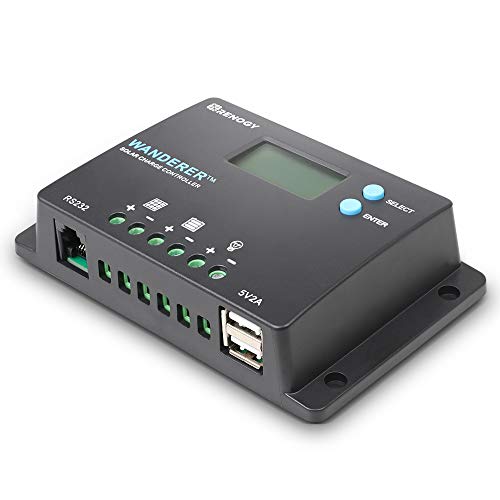
- Compact 10A 12V/24V design
- Four-stage charging for multiple battery types
- LCD, USB charging, and configurable load control
Best For: Small RV, marine, and DIY solar systems
Best Compact MPPT Pick
SunRock 10 10A 12V MPPT Controller

- Compact 10A MPPT design for 12V batteries
- LCD, LED indicator, and multiple protections
- Includes SAE connectors and extension cables
Best For: Portable 12V solar setups
Best Connected PWM Option
ECO-WORTHY 30A Bluetooth Controller

- Supports 12V and 24V systems
- Bluetooth monitoring with LCD display
- Dual USB outputs and three-stage PWM charging
Best For: Connected small-to-medium solar systems
Best High-Capacity Choice
100A Multi-Voltage MPPT Controller

- Supports 12V through 48V systems
- 100A rating with up to 100V PV input
- LCD controls, USB ports, and multiple protections
Best For: Larger or expandable solar installations
Best Value 30A Controller

- 30A capacity for 12V/24V systems
- LCD, adjustable settings, and dual USB ports
- Lead-acid battery compatibility with multiple protections
Best For: Higher-current lead-acid battery systems
Best Weather-Ready Design
LNEX 10A Waterproof PWM Controller
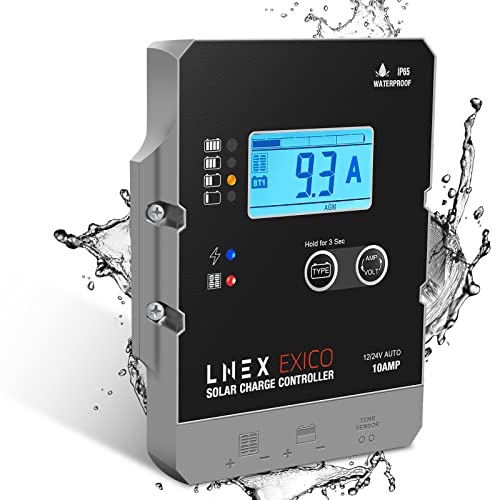
- IP65 waterproof, slim housing for outdoor use
- Five-stage charging with LCD and LED monitoring
- Supports several lithium and lead-acid battery types
Best For: Small outdoor and mixed-battery systems
Best Simple Outdoor Pick
SOLPERK 10A Waterproof Controller

- IP67 waterproof design for outdoor installations
- 12V/24V detection with 150W/300W panel limits
- SAE plug-and-play connection and LED monitoring
Best For: Compact RV, boat, and car systems
Smart MPPT Pick – Victron Energy SmartSolar 75V 15A
For shoppers comparing solar charge controllers under 1000, the Victron Energy SmartSolar MPPT 75/15 stands out for app-based monitoring and efficient charging in a compact 12/24V system. Its MPPT tracking is designed to maximize available solar power, including when panels are partially shaded.
Best For: RV, off-grid, and small solar setups where Bluetooth monitoring and MPPT performance matter.
Pros:
- MPPT tracking helps capture more available panel power.
- Bluetooth connectivity supports real-time data, performance history, settings, and firmware updates through VictronConnect.
- Supports synchronized operation with multiple SmartSolar MPPT controllers.
- Configurable load disconnect helps protect against excessively low battery voltage.
Cons:
- Its 15A rating is better suited to smaller systems than high-current installations.
- It provides a minimal LED-style display rather than a full onboard screen.
This is a feature-rich choice for buyers who want efficient MPPT charging and convenient wireless configuration without moving to a larger controller.
Budget LCD Controller – Upgraded 30A PWM Solar Controller
Among solar charge controllers under 1000, this upgraded 30A PWM model is a practical option for basic 12V or 24V lead-acid battery systems. Automatic voltage adaptation, an LCD, USB outputs, and built-in protection make it convenient for straightforward home, commercial, or industrial installations.
Best For: Lead-acid battery systems that need an affordable controller with an LCD and USB charging.
Pros:
- Automatically adapts to 12V or 24V systems.
- LCD displays operating status and data, with load timing and manual settings.
- Dual USB outputs provide 5V/2.5A maximum charging for compatible devices.
- Includes protection against overcurrent, short circuit, reverse connection, low voltage, and overcharge.
Cons:
- Designed only for lead-acid batteries; it should not be used with lithium or nickel-metal hydride batteries.
- PWM charging is less sophisticated than MPPT-based alternatives.
- Requires installation on a flat, well-ventilated surface.
If your setup uses a compatible lead-acid battery and you value simple controls, device charging, and visible status information, this controller offers a sensible low-cost feature set.
High-Capacity MPPT – Victron Energy SmartSolar 100V 50A
For larger installations in the solar charge controllers under 1000 category, the Victron SmartSolar MPPT 100/50 provides substantially more current capacity than compact controllers. It supports 12/24V systems, uses fast MPPT tracking, and connects to the VictronConnect app for configuration and performance monitoring.
Best For: Higher-output 12V or 24V solar systems that need 50A MPPT charging and smart-device connectivity.
Pros:
- 50A charging capacity suits larger solar arrays than entry-level controllers.
- 100V PV input rating provides greater panel-voltage flexibility.
- MPPT algorithms help maximize output, including during partial shading.
- Bluetooth app access supports data review, settings, alarms, and firmware updates.
Cons:
- The larger housing and 1.5 kg weight require more installation space.
- It has no onboard display, so detailed monitoring depends on connected equipment or the app.
- Its higher capacity may be unnecessary for small solar setups.
This is the strongest fit in this group for buyers scaling beyond small panels and wanting Victron’s monitoring and synchronized-controller capabilities in a higher-current model.
Compact RV Controller – Renogy Wanderer 10A PWM
For compact RV, marine, and DIY systems, the Renogy Wanderer 10A is a space-conscious choice among solar charge controllers under 1000. It supports 12V/24V batteries, offers four-stage PWM charging, and includes load-control options, protections, an LCD, and USB charging.
Best For: Small RV, marine, and off-grid installations where compact size, basic monitoring, and flexible battery support are priorities.
Pros:
- Supports 12V/24V systems with four-stage charging.
- Compatible with AGM, gel, flooded, and lithium batteries when configured appropriately.
- LCD shows voltage, current, and system status; load modes include manual, automatic, and timed control.
- Provides protection features including overcharge, over-discharge, overload, short circuit, reverse polarity, and temperature compensation.
Cons:
- The 10A rating limits it to smaller solar arrays and loads.
- Bluetooth monitoring requires the separately sold BT-1 module.
- Lithium battery operation requires manual configuration.
With its compact 4.69-inch housing, IP32 rating, LCD, and broad battery support, the Wanderer is a practical match for modest mobile or off-grid systems rather than high-power installations.
Best Compact MPPT Pick – SunRock 10 10A 12V MPPT Controller
For shoppers comparing solar charge controllers under 1000, the SunRock 10 is a compact 10A MPPT option for 12V battery systems. It includes an LCD, safety protections, SAE connectors, and support for several lead-acid battery types plus LiFePO4.
Best For: Portable 12V solar setups where compact size, simple monitoring, and MPPT charging are priorities.
Pros:
- Designed for 12V batteries and supports AGM, gel, sealed, flooded, lead-acid, and LiFePO4 batteries.
- Compact housing with LCD display and LED status indicator.
- Includes multiple protections, three-stage charging, SAE connectors, and extension cables.
- Water-resistant design is suitable for outdoor use when kept out of standing water.
Cons:
- It is limited to 12V battery systems.
- PV open-circuit voltage must be above 15V and no higher than 30V.
- The battery must be connected before the solar panel.
This is a practical choice for smaller 12V systems, especially portable installations. Confirm the battery and panel voltage limits before buying.
Best Connected PWM Option – ECO-WORTHY 30A Bluetooth Controller
Among solar charge controllers under 1000, this ECO-WORTHY model stands out for its 30A capacity, 12V/24V compatibility, Bluetooth monitoring, and dual USB outputs. Its LCD supports status viewing and configuration for home, commercial, and industrial installations.
Best For: 12V or 24V systems needing Bluetooth monitoring, USB device charging, and straightforward PWM battery management.
Pros:
- Supports both 12V and 24V systems with a 30A charging rating.
- Built-in Bluetooth offers app integration and monitoring up to 98 feet in open conditions.
- Dual USB outputs provide up to 5V/2.5A for compatible devices.
- Supports lead-acid, gel, and LiFePO4 batteries with three-stage PWM charging.
Cons:
- This is a PWM controller rather than an MPPT model.
- It should be installed on a flat, well-ventilated surface because it heats during operation.
- Wiring must follow the battery, solar panel, then load sequence.
Choose this controller when app-based monitoring and USB charging are more useful than MPPT efficiency. Its 12V/24V flexibility also makes it suitable for a wider range of modest solar systems.
Best High-Capacity Choice – 100A Multi-Voltage MPPT Controller
For buyers seeking solar charge controllers under 1000 with broad system compatibility, this controller supports 12V, 24V, 36V, and 48V batteries and accepts up to 100V PV input. It combines a large 100A rating, LCD monitoring, USB charging, and configurable operating modes.
Best For: Larger or expandable solar systems using lead-acid or LiFePO4 batteries across multiple system voltages.
Pros:
- Automatically recognizes 12V, 24V, 36V, and 48V systems.
- 100A rating and up to 100V solar input support higher-capacity installations.
- LCD displays battery, PV, charging, discharge, temperature, and timing information.
- Offers multiple operating modes, dual USB ports, protection features, a one-year warranty, and lifetime technical support.
Cons:
- The manufacturer notes that it combines MPPT and PWM technologies and may not provide full MPPT functionality.
- Users must connect a powered battery before connecting the solar panel.
- Its higher capacity may be unnecessary for small 12V setups.
This model is best evaluated by matching its 100A capacity and voltage range to the rest of your system. It offers extensive controls and monitoring, but buyers wanting fully specified MPPT performance should review the stated technology limitation.
Best Value 30A Controller – Anern 30A PWM Solar Regulator
For shoppers comparing solar charge controllers under 1000, this Anern model offers a practical 30A PWM design for 12V or 24V systems. Its LCD, adjustable parameters, dual USB ports, and built-in protections make it a flexible choice for basic home, commercial, or outdoor setups.
Best For: Lead-acid battery systems that need higher current capacity, visible operating data, and USB device charging.
Pros:
- 30A capacity with automatic 12V/24V compatibility.
- Three-stage PWM charging helps support battery life and charging efficiency.
- LCD display, adjustable settings, timer functions, and dual 5V/2A USB ports.
- Includes overcurrent, overload, open-circuit, and reverse-polarity protection.
Cons:
- Compatible with lead-acid batteries only; it is not intended for lithium or nickel-metal hydride batteries.
- PWM technology may be less suitable than MPPT for buyers seeking maximum solar harvest.
The Anern is a strong fit when you need more than a basic regulator and your system uses OPEN, AGM, or GEL lead-acid batteries. Confirm battery compatibility and system wiring before installation.
Best Weather-Ready Design – LNEX 10A Waterproof PWM Controller
Among solar charge controllers under 1000, the LNEX stands out for its thin IP65 waterproof housing and broad battery support. It automatically detects 12V or 24V systems and uses a five-stage PWM charging approach with LCD monitoring.
Best For: Outdoor, RV, marine, car, and powersport applications using compatible 12V/24V batteries.
Pros:
- IP65 waterproof construction suits exposure to spray, rain, and condensation.
- Supports LiFePO4, LTO, lithium, GEL, AGM, lead-acid, calcium, and EFB batteries according to the supplied notes.
- Five-stage PWM charging includes soft start, bulk, absorption, float, and equalization.
- Backlit LCD, LED indicators, memory function, and multiple safety protections improve usability.
Cons:
- Limited to 10A, so it is intended for smaller solar systems than a 30A controller.
- The listed manufacturer warranty is 90 days.
Choose the LNEX when weather resistance, battery-type flexibility, and detailed status monitoring matter more than maximum current capacity. Verify the selected charging profile and wiring before connecting a lithium battery.
Best Simple Outdoor Pick – SOLPERK 10A Waterproof Controller
For shoppers seeking solar charge controllers under 1000 for a compact outdoor setup, the SOLPERK 10A controller offers a straightforward 12V/24V PWM solution. Its IP67 rating, LED status indicators, SAE connection, and plug-and-play installation make it convenient for RV, boat, and car applications.
Best For: Small 12V or 24V deep-cycle battery systems with AGM, GEL, or flooded batteries.
Pros:
- IP67 waterproof construction is well suited to outdoor environments.
- Automatically identifies 12V or 24V systems and supports up to 150W at 12V or 300W at 24V.
- Three-stage PWM charging and multiple protections help safeguard the battery and system.
- SAE port, pre-drilled mounting holes, included manual, and LED indicators simplify installation and monitoring.
Cons:
- 10A maximum current limits it to relatively small solar arrays.
- LED indicators provide less detailed information than an LCD display.
- The supplied battery compatibility notes list AGM, GEL, and flooded batteries rather than lithium options.
The SOLPERK is a sensible choice for users who prioritize waterproofing and uncomplicated installation over advanced display controls. Keep the panel wattage within the stated limits and use a compatible deep-cycle battery.
How We Picked These Solar Charge Controllers Under 1000
We focused on the specifications that matter most in real installations: charging technology, rated amperage, supported battery and system voltages, maximum photovoltaic input, monitoring options, protection features, and ease of installation. The selection includes both PWM and MPPT designs so shoppers can compare budget-friendly controllers with more efficient choices.
Because product listings can vary by seller and revision, confirm the current manual and electrical specifications before connecting a controller. Never size a unit solely by its advertised amperage; panel voltage, battery chemistry, wiring, and expected charging conditions also affect compatibility.
Quick Comparison
| Best For | Typical Choice | Why It Matters |
|---|---|---|
| Small 12V systems | 10A PWM or MPPT | Suitable for modest panels, portable setups, and small batteries |
| Budget installations | 20A–30A PWM | Simple, affordable charging for compatible 12V/24V systems |
| Better energy harvest | MPPT controller | More effectively converts excess panel voltage into charging current |
| Larger battery banks | 50A–100A MPPT | Supports higher array output when correctly configured |
| Remote monitoring | Bluetooth-enabled model | Makes system status and charging data easier to check |
Key Buying Factors for Solar Charge Controllers Under 1000
PWM Vs. MPPT
PWM controllers are generally less expensive and work well for straightforward 12V or 24V systems where panel and battery voltages are closely matched. MPPT models usually cost more but can deliver better performance when panel voltage is higher, temperatures vary, or available sunlight is limited.
Amperage and Solar Array Size
Choose a controller with enough current capacity for the array’s expected output, with a sensible margin for production peaks. A 10A unit fits small panels, while 30A, 50A, or 100A models are intended for progressively larger systems. Check both the controller’s maximum charging current and maximum PV wattage.
Battery and System Voltage
Verify support for your battery bank before buying. Many compact controllers support 12V and 24V systems, while larger units may also handle 36V or 48V banks. Lithium batteries may require a dedicated charging profile or user-adjustable voltage settings; lead-acid batteries need appropriate flooded, AGM, or gel profiles.
Safety and Installation Features
Look for reverse-polarity, overcharge, overcurrent, short-circuit, and overheating protection. An LCD can simplify local setup, while Bluetooth is useful when the controller is installed inside a compartment. Confirm terminal sizes, enclosure protection, ventilation requirements, and whether a fuse or breaker is required.
Who Should Buy Which Solar Charge Controllers Under 1000?
- Choose a compact PWM controller for a basic RV, boat, gate, or backup battery system with a modest, matched solar panel.
- Choose a small MPPT controller when efficiency, changing weather, or a higher-voltage panel makes extra harvesting worthwhile.
- Choose a 30A model for a mid-sized 12V/24V setup, provided the panel array stays within its voltage and wattage limits.
- Choose a 50A or 100A MPPT controller for larger arrays and battery banks, but verify system voltage, cable sizing, fusing, and heat management first.
- Choose Bluetooth or LCD monitoring if you want easier troubleshooting and regular visibility into charging status.
For the best result, calculate array current and voltage, identify the battery chemistry, and compare those figures with the controller’s manual before installation.