
Choosing the right solar charge controller with display makes it easier to monitor charging, check battery status, and configure a small off-grid power system with confidence.
This roundup compares 10 options, from compact PWM regulators to higher-capacity MPPT controllers, with attention to battery voltage, display features, input limits, and installation needs.
Best 10 Solar Charge Controller with Display Picks for 2026
Best All-Around MPPT

- 12V/24V MPPT controller with LCD
- Supports lead-acid and lithium batteries
- Bluetooth-ready with optional BT-2 module
Best For: RV, marine, and mid-sized off-grid systems
Best App-Connected Option
Victron SmartSolar MPPT 100/50

- 100V, 50A MPPT controller
- Bluetooth app monitoring and configuration
- No built-in display; uses VictronConnect
Best For: Users wanting app-based solar monitoring
Best Budget PWM

- LCD with automatic 12V/24V adaptation
- Dual USB outputs for device charging
- For lead-acid batteries only
Best For: Simple lead-acid solar systems on a budget
Best High-Capacity Choice

- 60A support for 12V through 48V systems
- LCD with programmable charging settings
- Up to 12 units can operate in parallel
Best For: Large and expandable off-grid solar systems
High-Capacity MPPT Pick

- 12V/24V auto-recognition
- LCD monitoring and adjustable settings
- Up to 99% MPPT efficiency
Best For: Higher-capacity 12V/24V home or commercial systems
RV Flush-Mount Choice

- Backlit LCD with self-diagnostics
- 12V/24V auto-detection
- Compatible with multiple battery types
Best For: RV, marine, and small off-grid installations
Wide-Voltage MPPT Option
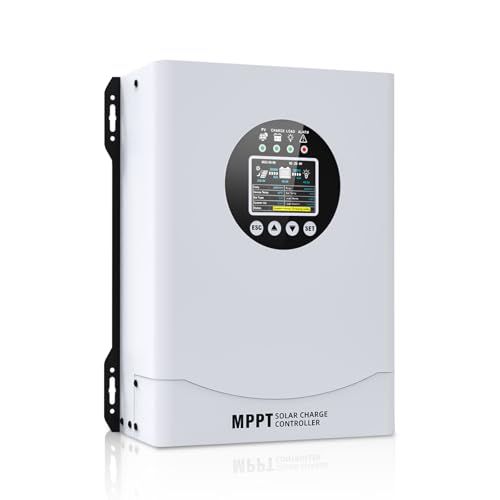
- Supports 12V–96V systems
- LCD display with 230V PV input
- 99%+ tracking efficiency rating
Best For: Large or specialized multi-voltage solar systems
Best Value Display Controller
30A PWM Solar Charge Controller 2-Pack

- Two 30A controllers for 12V/24V systems
- LCD monitoring with adjustable parameters and timers
- Dual USB ports and built-in protection
Best For: Small lead-acid battery systems needing two affordable controllers
Best MPPT Upgrade
60A MPPT Solar Charge Controller with LCD

- Supports automatic 12V/24V/36V/48V systems
- 60A MPPT charging with high stated efficiency
- LCD and four-button interface for status checks
Best For: RV and household systems using multiple battery types
Most Feature-Rich
100A MPPT-Style Solar Controller with LCD

- Automatic 12V–48V recognition and dual USB ports
- Detailed LCD with panel, battery, current, and temperature data
- Multiple modes, scheduling, protections, and reset function
Best For: Larger setups needing detailed monitoring and timed controls
Best All-Around MPPT – Renogy Rover 30A LCD
The Renogy Rover 30A is a versatile solar charge controller with display for 12V and 24V systems. Its LCD, adjustable parameters, MPPT tracking, and support for lead-acid and lithium batteries make it a practical choice for RV, marine, and off-grid installations.
Best For: RVs, cabins, boats, and users who want adjustable charging with a built-in LCD.
Pros:
- Supports 12V/24V systems and up to 400W at 12V or 800W at 24V.
- Works with gel, sealed, flooded, and lithium batteries.
- Includes four-stage charging, lithium recovery, temperature compensation, and multiple safety protections.
- LCD monitoring can be expanded with the optional BT-2 Bluetooth module.
Cons:
- The Bluetooth module is sold separately.
- Its 30A capacity may not suit larger solar arrays.
Choose the Rover when you need a capable MPPT controller with display and broad battery compatibility. Its 30A rating is well suited to mid-sized 12V or 24V systems.
Best App-Connected Option – Victron SmartSolar MPPT 100/50
The Victron SmartSolar MPPT 100/50 is designed for efficient solar charging and detailed monitoring through the VictronConnect app. However, it is not a traditional solar charge controller with display because the supplied specifications list no built-in display.
Best For: Users who prefer smartphone-based monitoring, configuration, alarms, and performance history.
Pros:
- MPPT tracking is designed to maximize available solar power, including in partial shade.
- VictronConnect provides real-time data and 30-day performance history.
- Multiple SmartSolar controllers can synchronize charging stages.
- Configurable load output can disconnect loads when battery voltage is too low.
Cons:
- No built-in display, so monitoring relies on the app or another compatible interface.
- Its 100V, 50A configuration may require careful system matching.
This is a strong choice for connected solar systems, but shoppers specifically seeking an LCD should consider one of the other listed models instead.
Best Budget PWM – 30A PWM LCD Controller
This 30A PWM solar charge controller with display offers automatic 12V/24V adaptation, an LCD interface, timer settings, and dual USB charging. It is aimed at straightforward solar setups using compatible lead-acid batteries.
Best For: Basic home, commercial, or small off-grid systems using lead-acid batteries.
Pros:
- LCD shows operating status and system data.
- Automatically adapts to 12V or 24V systems.
- Includes dual 5V/2.5A USB outputs for charging devices.
- Provides protection against overcurrent, short circuit, reverse connection, low voltage, and overcharge.
Cons:
- Only suitable for lead-acid batteries; it should not be used with lithium or nickel-metal hydride batteries.
- It is a PWM controller rather than an MPPT model.
- The battery should be fully charged initially so the controller can recognize the battery type correctly.
This model makes sense when a built-in display and simple controls matter more than MPPT efficiency or lithium compatibility. Follow the specified installation order and use a well-ventilated mounting location.
Best High-Capacity Choice – PowMr 60A MPPT LCD
The PowMr 60A is a high-capacity solar charge controller with display for 12V, 24V, 36V, and 48V systems. Its LCD, programmable charging settings, cooling system, and support for parallel controllers make it suited to larger and expandable solar installations.
Best For: Larger RV, marine, commercial, and off-grid systems that may need additional charging capacity.
Pros:
- Supports 12V/24V/36V/48V battery systems and up to 60A.
- Compatible with lead-acid and lithium batteries, with customizable parameters.
- Up to 12 controllers can be connected in parallel.
- LCD, energy logging, MPPT tracking, and temperature-controlled bladeless cooling support system management.
Cons:
- Lithium batteries require manual parameter adjustment.
- Solar input recommendations vary substantially by battery voltage and should be matched carefully.
- PV input must be disconnected before changing parameters.
The PowMr is the strongest fit here for systems that need more than a typical 30A controller. Its expandable architecture and broad voltage support add flexibility, provided installation and settings are handled carefully.
High-Capacity MPPT Pick – 100A MPPT LCD Controller
If you want a solar charge controller with display that emphasizes automatic setup and high charging capacity, this 100A MPPT model is worth considering. Its LCD provides at-a-glance system updates, while 12V/24V auto-recognition helps simplify installation.
Best For: Home or commercial solar systems using compatible 12V or 24V batteries, especially lithium setups that benefit from adjustable settings and higher MPPT efficiency.
Pros:
- 12V/24V auto-recognition supports a straightforward plug-and-play installation.
- LCD displays real-time performance information and allows setting adjustments.
- MPPT tracking is rated at up to 99% efficiency.
- Includes protection against overcharging, short circuits, and reverse polarity.
Cons:
- Its listed 100A capacity may be more than needed for smaller solar systems.
- The notes do not specify detailed PV input limits or physical dimensions.
This controller is a strong fit when capacity, visible monitoring, and simplified configuration matter most. Confirm your panel, battery, and system specifications before installation.
RV Flush-Mount Choice – Renogy Adventurer 30A PWM
For shoppers seeking a solar charge controller with display for an RV or other compact installation, the Renogy Adventurer 30A combines a flush-mount design with a backlit LCD. It automatically detects 12V or 24V systems and supports several common battery chemistries.
Best For: RV, marine, and off-grid systems that need a wall-integrated controller for sealed, gel, flooded, or lithium batteries.
Pros:
- Flush-mount design and included surface kit support integrated installation.
- Backlit LCD provides status updates and self-diagnostics.
- Supports sealed, gel, flooded, and lithium batteries with multiple charging phases.
- Includes temperature compensation, protective features, and a two-year warranty.
Cons:
- Its 30A PWM design is less suited to larger systems than a high-capacity MPPT controller.
- The listed operating-temperature detail is limited in the supplied specifications.
This is the most installation-friendly option of the three when a neat wall-mounted appearance and broad battery compatibility are priorities. Its 30A PWM capacity is best matched to appropriately sized RV or small off-grid arrays.
Wide-Voltage MPPT Option – 120A Multi-System Controller
This 120A MPPT model stands out for its unusually broad system-voltage range and high maximum PV input. As a solar charge controller with display, it adds LCD monitoring to automatic support for systems from 12V through 96V.
Best For: Large or specialized solar installations using compatible 12V–96V battery systems and lead-acid or lithium battery chemistries.
Pros:
- Automatically recognizes 12V, 24V, 36V, 48V, 60V, 72V, 84V, and 96V systems.
- Supports up to 230V PV input and system-specific panel wattages listed up to 11,520W.
- MPPT tracking efficiency is rated at no less than 99%, with peak conversion efficiency up to 98%.
- Offers broad protection features, including over-current, over-voltage, overload, temperature, and low-temperature charging protection.
Cons:
- The broad voltage range and 120A rating may be unnecessary for basic residential or RV systems.
- The supplied notes do not provide physical dimensions or warranty information.
Choose this controller when system flexibility and substantial solar capacity are more important than a compact, simple setup. Because its supported voltages and input levels are extensive, carefully match it to the complete battery and panel configuration.
Best Value Display Controller – 30A PWM Solar Charge Controller 2-Pack
If you want a solar charge controller with display for a basic 12V or 24V setup, this two-pack from ACEIRMC offers practical monitoring and adjustable controls. Its LCD shows system status and data, while dual USB ports and timer settings add everyday convenience.
Best For: Budget-conscious buyers managing small home, commercial, or industrial lead-acid battery systems.
Pros:
- Includes two 30A PWM controllers for 12V and 24V systems.
- LCD display supports parameter adjustments and status monitoring.
- Offers dual 5V/2.5A USB ports, timer settings, and three-stage charging.
- Includes reverse-connection, short-circuit, overcurrent, and open-circuit protection.
Cons:
- Uses PWM charging rather than MPPT technology.
- Battery compatibility is primarily listed for open, AGM, and GEL lead-acid batteries.
This is a useful choice when you need two straightforward controllers with visible readouts and basic automation. It is less suited to buyers prioritizing MPPT efficiency or advanced high-voltage system support.
Best MPPT Upgrade – 60A MPPT Solar Charge Controller with LCD
For buyers seeking a solar charge controller with display and broader system compatibility, the POWLAND 60A model supports 12V, 24V, 36V, and 48V systems. Its MPPT design is intended to track available panel power efficiently, while the LCD and four buttons make operating data easier to review.
Best For: RV, household, and other multi-voltage solar systems using lead-acid or lithium-ion batteries.
Pros:
- Supports automatic 12V, 24V, 36V, and 48V system recognition.
- 60A MPPT charging supports efficient panel power tracking.
- LCD screen and four buttons display system data and operating status.
- Works with flooded, AGM, GEL, and lithium-ion batteries.
Cons:
- It is a single controller rather than a multi-pack.
- The supplied details do not mention USB outputs or timer controls.
With its 60A capacity, wide voltage range, and MPPT architecture, this controller is the more capable option for larger or more varied installations. Confirm your panel and battery specifications before installation.
Most Feature-Rich – 100A MPPT-Style Solar Controller with LCD
This solar charge controller with display is designed for users who want extensive monitoring and timed control features. The upgraded 100A model automatically recognizes 12V through 48V systems, provides dual USB charging, and displays battery, panel, current, temperature, and operating-mode information.
Best For: Larger multi-voltage setups requiring high stated current capacity, detailed readouts, and programmable operating modes.
Pros:
- Supports 12V, 24V, 36V, and 48V systems with up to 100A stated capacity.
- LCD shows battery voltage, PV charging current, discharge current, temperature, and mode.
- Offers multiple control modes, time scheduling, dual USB ports, and a reset function.
- Includes protections for over-voltage, overcurrent, overcharge, deep discharge, reverse connection, and overheating.
Cons:
- The supplied notes clarify that it may not provide full MPPT functionality.
- The product notes advise connecting the battery before the solar panel.
This controller stands out for configurable timing and unusually detailed LCD information. Its stated 100A capacity is appealing, but buyers who specifically require fully implemented MPPT performance should evaluate that limitation carefully.
How We Picked the Best Solar Charge Controller with Display
We focused on controllers that provide onboard visual monitoring rather than requiring a separate meter or phone app. The selection includes both MPPT and PWM designs, multiple current ratings, common 12V and 24V systems, and models intended for larger battery banks. We also considered adjustable charging parameters, battery-type compatibility, input-voltage limits, USB outputs, mounting style, and the clarity of available status information.
Specifications vary considerably across this category. Before buying, verify the manufacturer’s current manual and confirm that the controller’s ratings apply to your exact panel configuration and battery chemistry.
Quick Comparison
| Type | Best For | Main Advantage | Watch For |
|---|---|---|---|
| MPPT | Higher-output or variable-weather systems | Better energy harvesting and broader configuration flexibility | Higher price and more detailed installation requirements |
| PWM | Small, budget-conscious 12V or 24V systems | Simple setup and lower upfront cost | Less efficient when panel and battery voltages differ |
| 30A class | Compact RV, cabin, and backup systems | Manageable wiring and straightforward sizing | Limited expansion capacity |
| 60A to 120A class | Larger battery banks and higher solar input | More room for system growth | Requires careful fuse, cable, cooling, and voltage planning |
Key Buying Factors for a Solar Charge Controller with Display
MPPT or PWM
MPPT controllers generally extract more usable power, especially in cold conditions, with longer cable runs, or when panel voltage is substantially above battery voltage. PWM can be a sensible economical choice when the solar array is closely matched to the battery voltage and the system is modest.
Battery and Panel Compatibility
Confirm the controller supports your battery chemistry, including flooded, sealed, gel, or lithium where applicable. Check nominal battery voltage separately from maximum solar open-circuit voltage. A controller rated for 12V and 24V is not automatically suitable for a 36V, 48V, or higher-voltage bank.
Current and Safety Margins
Size the controller for the array’s expected charging current, then leave practical headroom for expansion and operating conditions. High-current models need appropriately sized conductors, overcurrent protection, ventilation, and a solid mounting surface. Connect the battery before the solar input when the instructions require it.
Display and Controls
Look for readable voltage, current, charging stage, battery condition, fault codes, and accumulated energy data. Parameter adjustment is useful, but only change values when they match the battery manufacturer’s recommendations. A flush-mount display can be preferable for permanent installations, while an integrated screen suits portable setups.
Who Should Buy Which Solar Charge Controller with Display?
Choose a 30A PWM model for a basic, cost-sensitive 12V or 24V setup with a closely matched panel array. A 30A MPPT controller is a better fit when efficiency, colder-weather performance, or future flexibility matters. Move to a 60A MPPT option for larger RV, cabin, or backup systems, provided the battery bank and wiring support it.
High-capacity 100A or 120A controllers are intended for substantial systems rather than casual upgrades. Confirm every voltage and current specification before purchase, because unusually broad voltage claims deserve especially careful manual verification. If you need remote monitoring, note that an LCD display alone may not provide Bluetooth, data logging, or an external communication interface.