
A solar charge controller with Bluetooth makes it easier to monitor charging performance, review battery data, and adjust settings from a phone instead of relying on guesswork.
We compare 10 options across MPPT and PWM designs, current ratings, voltage ranges, battery support, displays, and app connectivity to help you choose the right controller for your system.
Best 10 Solar Charge Controller with Bluetooth Picks for 2026
Compact Smart Pick

- Built-in Bluetooth and LCD monitoring
- 12V/24V support with 100V PV input
- Compact design for tight installations
Best For: Compact RV, van, boat, and cabin solar systems
Proven App-Controlled Option

- 50A MPPT charging for 12V/24V systems
- VictronConnect app with history and alarms
- Multiple units can synchronize charging
Best For: Managed 12V/24V systems needing detailed app control
Heavy-Duty Bluetooth Controller

- 100A charging for 12V–48V systems
- 150V PV input with built-in Bluetooth
- LCD and heat-management features
Best For: Large off-grid battery banks and high-power solar arrays
Smart MPPT Pick
Victron Energy SmartSolar 75V 15A

- MPPT charging for optimized solar harvest
- VictronConnect app with monitoring and configuration
- Supports synchronized multi-controller charging
Best For: Compact 12V/24V systems needing advanced Bluetooth monitoring
Budget Bluetooth Choice

- 30A capacity for 12V/24V systems
- Built-in Bluetooth and LCD monitoring
- Dual USB outputs plus multiple protections
Best For: Feature-focused PWM setups with USB charging needs
Efficient MPPT Upgrade

- Up to 99% stated MPPT tracking efficiency
- Includes Bluetooth module, LCD, and indicators
- Supports lead-acid and lithium charging profiles
Best For: Moderate 12V/24V systems seeking efficient, protected charging
Flexible PWM Pick
30A Bluetooth PWM Solar Charge Controller
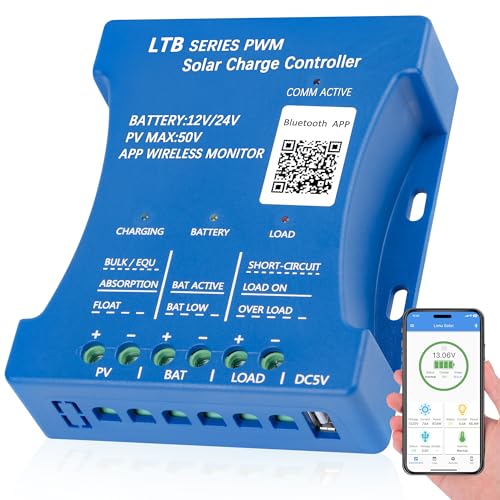
- App-based monitoring and load control
- Supports five battery categories
- Seven load modes plus USB output
Best For: Small off-grid systems needing flexible app control
Efficient MPPT Choice
LiTime 30A Bluetooth MPPT Controller

- High-efficiency MPPT tracking
- Built-in Bluetooth and LCD display
- Supports LiFePO4 and lead-acid batteries
Best For: RV and off-grid systems seeking efficient charging
High-Capacity Smart Pick
Dyness 40A Bluetooth MPPT Controller

- 40A MPPT capacity for larger systems
- App includes live data and 300-day history
- Adds LCD, RS485, and parallel-charging support
Best For: Larger RV, marine, and off-grid installations
Compact Smart Pick – Renogy Rover 2 20A MPPT
If you need a solar charge controller with bluetooth for a compact RV, van, boat, or cabin setup, the Renogy Rover 2 combines phone monitoring with a built-in LCD. Its 20A MPPT design supports 12V and 24V battery systems while accepting solar arrays up to 100V Voc.
Best For: Space-constrained 12V/24V off-grid systems that need Bluetooth monitoring without an external dongle.
Pros:
- Compact design is 53% smaller than the previous generation.
- Built-in Bluetooth and LCD provide remote and on-device monitoring.
- Supports lithium, AGM, gel, flooded, and user-defined battery profiles.
- Can be connected in parallel with additional Rover 2 controllers.
Cons:
- Limited to 20A of charging current.
- Designed for 12V/24V systems rather than higher-voltage battery banks.
This is a practical choice when installation space is limited and straightforward app-based monitoring matters. Its 300W 12V or 600W 24V solar capacity fits modest off-grid systems, while the 100V PV input leaves room for a capable panel arrangement.
High-Capacity Connected Choice – ECO-WORTHY 60A MPPT
For larger battery banks, this solar charge controller with bluetooth adds WiFi connectivity and automatic 12V-to-48V system detection. The 60A MPPT controller also supports app-based customization, performance history, and several DC load-control modes.
Best For: Larger off-grid, RV, or solar systems using lead-acid or LiFePO4 batteries and needing both nearby Bluetooth and longer-distance WiFi monitoring.
Pros:
- 60A charging capacity with automatic 12V/24V/36V/48V detection.
- Bluetooth and WiFi support app monitoring and parameter customization.
- Offers three load-control modes, including optical and timed control.
- Supports lead-acid and LiFePO4 charging profiles.
Cons:
- Its larger capacity may be unnecessary for small solar installations.
- The Bluetooth/WiFi module should be verified as included before installation.
The ECO-WORTHY stands out for system flexibility: it combines high current capacity, a 150V maximum PV input, broad voltage compatibility, and app connectivity. It is a stronger fit for expandable systems than for a minimal, low-power setup.
Proven App-Controlled Option – Victron SmartSolar 100/50
The Victron SmartSolar is a solar charge controller with bluetooth designed for users who want detailed system control through the VictronConnect app. Its 50A MPPT design supports 12V and 24V systems, with synchronized operation available when multiple controllers are installed.
Best For: 12V/24V solar installations where app configuration, charging synchronization, load control, and performance history are priorities.
Pros:
- VictronConnect provides real-time data, 30-day history, settings, firmware updates, and alarms.
- 50A MPPT charging is suited to higher-power 12V/24V systems.
- Multiple controllers can synchronize their charging stages.
- Configurable load output can disconnect equipment when battery voltage is too low.
Cons:
- No built-in display for viewing readings directly on the unit.
- Supports 12V/24V systems rather than higher-voltage battery banks.
This controller is a good match for a more managed solar setup, especially if you plan to expand with synchronized controllers. The app supplies the visibility and configuration tools that the absent physical display does not.
Heavy-Duty Bluetooth Controller – LiTime 100A MPPT
This LiTime is a high-output solar charge controller with bluetooth for 12V, 24V, 36V, and 48V battery systems. With a 100A charging rating, 150V maximum PV input, LCD, and app monitoring, it is built for substantially larger off-grid installations.
Best For: High-power off-grid systems that need 100A charging, broad battery-voltage compatibility, and local Bluetooth status monitoring.
Pros:
- Supports 12V through 48V systems and up to 100A charging.
- Built-in Bluetooth offers password-protected monitoring from a phone.
- LCD provides real-time system status at the controller.
- Aluminum heat dissipation and optional fan silent mode support quieter operation.
Cons:
- Not waterproof and not suitable for marine environments.
- Its size and 5.5-pound weight require more installation space.
- PV wattage limits vary by system voltage and must be observed.
The LiTime offers the highest charging capacity in this group, making it appropriate for large battery banks rather than small recreational systems. Careful installation is important: keep within the stated PV limits and protect the non-waterproof controller from moisture.
Smart MPPT Pick – Victron Energy SmartSolar 75V 15A
For shoppers seeking a solar charge controller with bluetooth, the Victron Energy SmartSolar MPPT 75V 15A combines app-based monitoring with efficient MPPT charging. It supports 12V and 24V systems, provides real-time data and 30-day performance history through VictronConnect, and can synchronize with additional SmartSolar controllers.
Best For: Users who want Bluetooth monitoring, configurable settings, and MPPT performance in a compact 12V/24V system.
Pros:
- MPPT tracking helps optimize available solar power, including during partial shade.
- VictronConnect provides real-time data, performance history, configuration, firmware updates, and alarms.
- Supports synchronized charging with multiple compatible SmartSolar controllers.
- Includes an intelligent load output with configurable low-voltage disconnect.
Cons:
- Its 15A rating is better suited to smaller solar installations.
- The controller has only a minimal LED-style display rather than a full LCD screen.
This is a strong choice when app connectivity and MPPT efficiency matter more than a built-in large display or higher current capacity.
Budget Bluetooth Choice – ECO-WORTHY 30A PWM
The ECO-WORTHY 30A PWM is a practical solar charge controller with bluetooth for 12V and 24V systems. It combines app connectivity with an LCD display, dual USB charging ports, three-stage PWM charging, and compatibility with lead-acid, gel, and lithium phosphate batteries.
Best For: Home, commercial, or industrial users who want a higher-current PWM controller with Bluetooth, local display, and USB outputs.
Pros:
- 30A charging capacity supports compatible 12V and 24V systems.
- Built-in Bluetooth offers app integration and monitoring within a stated open-field range of up to 98 feet.
- LCD display shows system status and data while allowing mode and parameter configuration.
- Includes dual 5V/2.5A USB outputs and multiple protection functions.
Cons:
- PWM charging is less power-optimized than the MPPT designs in the other listed options.
- The unit can heat during operation and should be installed in a flat, well-ventilated location.
- Installation requires connecting the battery first, followed by the solar panel and load.
Choose this model for practical features and straightforward monitoring, especially if USB charging and an integrated LCD are priorities.
Efficient MPPT Upgrade – Renogy Rover 20A
The Renogy Rover 20A is a solar charge controller with bluetooth designed for 12V and 24V systems. Its MPPT design offers stated tracking efficiency of up to 99% and peak conversion efficiency of 98%, while the included Bluetooth module, LCD, and LED indicators make system status easier to monitor.
Best For: Users wanting efficient MPPT charging, broad battery support, and detailed protection features in a 20A controller.
Pros:
- MPPT technology is designed to maintain efficient charging as panel conditions change.
- Automatically detects 12V or 24V system voltage for non-lithium battery types.
- Supports four-stage lead-acid charging and two-stage lithium charging with lithium reactivation.
- Includes protection against reverse polarity, overcharging, over-discharging, overload, short circuits, and reverse current.
Cons:
- Lithium battery settings require manual configuration.
- The 20A rating may not suit larger solar arrays or higher-current systems.
- Bluetooth monitoring uses the included module rather than being described as built directly into the controller.
With efficient MPPT charging, an LCD, load controls, and extensive system protection, the Rover is a balanced option for moderately sized battery-based solar setups.
Flexible PWM Pick – 30A Bluetooth PWM Solar Charge Controller
If you want a solar charge controller with bluetooth for straightforward monitoring and load scheduling, this 30A PWM model offers app-based control through the LiMu Solar app. It automatically matches 12V or 24V systems for compatible non-lithium batteries and supports several common battery chemistries.
Best For: RV, cabin, and small off-grid setups that prioritize Bluetooth monitoring, broad battery compatibility, and flexible load modes.
Pros:
- Bluetooth app provides remote system monitoring, parameter configuration, and load-mode control.
- Supports sealed, gel, flooded, LiFePO4, lithium, and customizable battery settings.
- Offers seven load modes, built-in protection features, and a 5V/1.5A USB output.
Cons:
- Uses PWM charging rather than the more efficient MPPT approach.
- Automatic 12V/24V matching applies to non-lithium batteries; lithium settings require attention.
- The app must be installed and paired for remote monitoring and adjustments.
This controller is a practical choice when app access and scheduling matter more than maximizing harvest from every panel. Confirm the battery settings, wiring sequence, and system voltage before installation.
Efficient MPPT Choice – LiTime 30A Bluetooth MPPT Controller
This LiTime solar charge controller with bluetooth combines 30A MPPT charging with a built-in Bluetooth module, LCD screen, and menu controls. Its tracking technology is designed to capture more available panel power, while the 12V/24V design supports LiFePO4 and several lead-acid battery types.
Best For: RV and off-grid users who want higher-efficiency MPPT charging, local LCD monitoring, and wireless access without buying a separate Bluetooth module.
Pros:
- MPPT tracking efficiency is rated at not less than 99%, with peak conversion efficiency up to 98%.
- Built-in Bluetooth, LCD display, four-button controls, and LED status indicators provide multiple monitoring options.
- Supports LiFePO4, sealed, gel, and flooded lead-acid batteries with multiple protection features.
- Handles up to 900W at 24V or 450W at 12V according to the supplied details.
Cons:
- Its 30A capacity is lower than the 40A Dyness option in this roundup.
- Battery parameters may need adjustment when switching among supported chemistries.
- The supplied details do not identify a specific mobile app name.
Choose this model when MPPT efficiency and built-in display controls are central to your setup. Check the panel wattage, battery voltage, and installation clearances against the controller’s specifications.
High-Capacity Smart Pick – Dyness 40A Bluetooth MPPT Controller
For larger systems needing a solar charge controller with bluetooth, the Dyness 40A MPPT model adds app control, LCD monitoring, and a higher current rating. Its app can display live solar, battery, and load data, change settings, manage DC loads, and review up to 300 days of operating history.
Best For: Higher-capacity RV, marine, and off-grid installations that need detailed remote monitoring and support for up to 600W at 12V or 1,200W at 24V.
Pros:
- 40A MPPT design supports up to 600W at 12V or 1,200W at 24V, with PV input below 100Voc.
- Bluetooth app offers real-time data, charging adjustments, DC load management, and 300 days of history.
- Supports lithium, AGM/sealed, gel, flooded, and user-defined batteries.
- Includes LCD and LED monitoring, 20A DC load output, RS485 Modbus, and optional parallel charging.
Cons:
- Lithium battery voltage must be selected manually rather than automatically detected.
- Its listed 10.6-by-7.1-by-3.3-inch body may require more installation space.
- PV input must remain below 100Voc, so panel configuration requires careful checking.
The Dyness stands out for users who want more current capacity and deeper system data than a basic Bluetooth controller provides. Verify PV voltage, load requirements, and battery settings before connecting the system.
How We Picked the Best Solar Charge Controller with Bluetooth
We evaluated these controllers based on charging technology, rated output, maximum PV input voltage, supported battery chemistries, monitoring features, installation flexibility, and suitability for common 12V and 24V systems. MPPT models generally offer better energy harvest, especially when panel voltage exceeds battery voltage, while PWM models can be practical for smaller, budget-focused setups.
Bluetooth connectivity was also considered for practical usefulness—not just its presence. A good controller should make it reasonably easy to view solar input, charging current, battery voltage, historical performance, and configurable charging parameters through an app or onboard display.
Quick Comparison
- Best for premium monitoring: Victron Energy SmartSolar models offer established app-based configuration and detailed system data.
- Best for compact systems: The Renogy 20A and Victron 15A controllers suit smaller 12V or 24V installations.
- Best for higher output: The LiTime 100A and ECO-WORTHY 60A models are designed for substantially larger charging setups.
- Best budget-oriented option: A PWM controller can reduce upfront cost when panel and battery voltages are closely matched.
- Best for built-in visibility: Models with LCD screens provide local status checks when a phone is unavailable.
Key Buying Factors for a Solar Charge Controller with Bluetooth
MPPT Versus PWM
MPPT controllers typically extract more usable power from panels and are the better choice for variable conditions, higher-voltage arrays, or systems where efficiency matters. PWM controllers are simpler and may work well with small arrays using matched nominal voltages.
Current and Solar Input Limits
Match the controller’s rated charging current to the battery bank and expected solar production. Also check maximum PV voltage carefully, including the panel array’s cold-weather open-circuit voltage. Exceeding that limit can damage the controller.
Battery Compatibility
Confirm support for your battery chemistry, such as sealed lead-acid, gel, flooded, AGM, or LiFePO4. Lithium batteries often require different charging settings, and some controllers allow more detailed voltage and timing adjustments than others.
Bluetooth, Wi-Fi, and Local Controls
Bluetooth is convenient for nearby setup and monitoring, but range is limited. Wi-Fi-enabled models may support remote access if configured correctly. An LCD or physical interface is valuable as a backup and can simplify installation.
Who Should Buy Which Solar Charge Controller with Bluetooth?
Choose a smaller 15A or 20A MPPT controller for compact RV, cabin, shed, or backup systems. A 30A or 40A model is a better fit for mid-sized 12V/24V battery banks and growing solar arrays. For high-demand installations, select a 50A, 60A, or 100A controller only after confirming panel wattage, battery-bank voltage, cable sizing, fusing, and the manufacturer’s input limits.
If you want the most efficient charging and detailed app data, prioritize a reputable MPPT model. If your system is small and cost-sensitive, a Bluetooth PWM controller may be sufficient—provided its battery settings and voltage limits match your equipment.