
Choosing the best solar charge controller for an off-grid system means matching solar input, battery voltage, charging chemistry, and expected power demand. The right controller improves charging efficiency while protecting batteries from overcharging and poor operating conditions.
This roundup compares 10 options across compact 12-volt systems, RV and cabin installations, larger battery banks, and hybrid inverter setups. Use the buying guide below to narrow the list by system size, controller type, connectivity, and installation requirements.
Best 10 Solar Charge Controller for Off Grid Picks for 2026
Best Smart MPPT Pick
Victron Energy SmartSolar 75V 15A

- MPPT tracking helps maximize solar harvest
- Bluetooth app includes monitoring and configuration
- Supports synchronized multi-controller charging
Best For: Compact 12V/24V systems needing smart monitoring
Best Budget 12V PWM Option

- 30A PWM charging for 12V systems
- Supports lithium and lead-acid batteries
- Compact housing with multiple protections
Best For: Small RV, boat, and 12V off-grid setups
Best RV Mounting Choice

- Supports 12V/24V systems and common battery types
- Includes LCD, temperature compensation, and protections
- Offers flush- or surface-mount installation
Best For: RV and marine installations needing flexible mounting
Premium MPPT Pick

- 12V–48V support with 150V PV input
- 99% MPPT tracking and four-stage charging
- LCD display with one-year data logging
Best For: Large RV, cabin, marine, and off-grid battery systems
Complete Kit Pick

- Includes panels, 30A PWM controller, cables, and brackets
- Two 100W monocrystalline panels
- Configurable for 12V or 24V systems
Best For: Small RV, camper, cabin, marine, and backup installations
High-Capacity Pick

- Auto-senses systems from 12V to 96V
- 120A charging capacity with MPPT operation
- LCD monitoring and multiple protection features
Best For: Large off-grid arrays, battery banks, RVs, and power stations
Low-Voltage Boost Pick
30A MPPT Solar Boost Controller
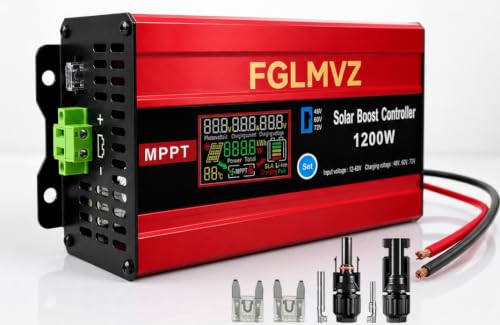
- Boosts 12–60V solar input for 48V–72V batteries
- Supports up to 1200W and multiple battery chemistries
- LCD display, six protections, and dual cooling
Best For: Off-grid systems with lower-voltage panels and higher-voltage battery banks
All-in-One Power Choice
VEVOR 3000W Hybrid Solar Inverter

- Combines inverter and 100A MPPT charger
- Provides 3000W pure sine wave AC output
- Includes WiFi monitoring and selectable charge modes
Best For: 24V off-grid systems needing integrated solar charging and AC power
Flexible Battery-System Pick
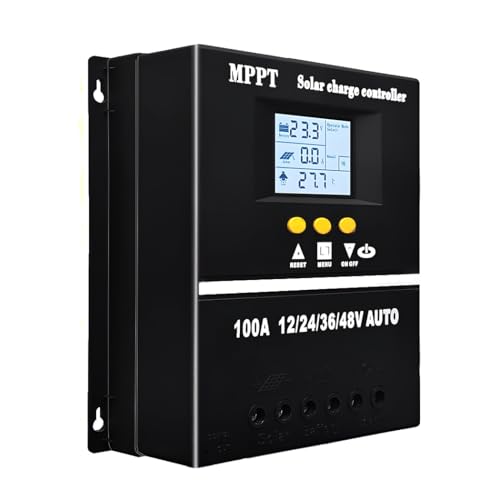
- Supports automatic 12V–48V recognition
- Works with lead-acid and LiFePO4 batteries
- Adds LCD data, seven modes, and dual USB ports
Best For: Multi-voltage off-grid systems needing flexible controls and monitoring
Best Smart MPPT Pick – Victron Energy SmartSolar 75V 15A
For shoppers seeking a solar charge controller for off grid use, the Victron Energy SmartSolar MPPT 75V/15A is a compact 12V/24V option focused on extracting more energy from changing sunlight. Its Bluetooth connectivity, synchronized charging support, and configurable load output make it especially useful when monitoring and system control matter.
Best For: Compact off-grid systems that benefit from app monitoring and MPPT performance.
Pros:
- MPPT tracking is designed to maximize available solar power, including during partial shading.
- VictronConnect provides real-time data, 30-day history, configuration, firmware updates, and alarms.
- Supports synchronized operation with multiple SmartSolar MPPT controllers.
- Configurable low-voltage load disconnect helps protect the battery.
Cons:
- Its 15A rating is better suited to smaller systems than high-demand installations.
- Supports 12V and 24V systems, rather than a broader range of system voltages.
The Victron is a strong choice when efficient charging and detailed control outweigh the need for higher current capacity. Confirm your panel array and battery voltage before choosing it.
Best Budget 12V PWM Option – Renogy Wanderer Li 30A
The Renogy Wanderer Li 30A is a practical solar charge controller for off grid 12V setups in RVs, boats, and compact battery systems. Its PWM design, selectable battery chemistry support, and built-in protections keep the feature set focused while maintaining a small footprint.
Best For: 12V RV, marine, and small off-grid systems using lithium or lead-acid batteries.
Pros:
- 30A PWM charging supports LiFePO4, AGM, gel, and flooded battery types.
- Uses bulk, boost, float, and automatic equalization charging stages.
- Includes protection against reverse polarity, overcharging, overload, and short circuits.
- Compact housing offers IP32 protection and rail or wall mounting options.
Cons:
- It is a 12V PWM controller rather than an MPPT model.
- Bluetooth monitoring requires the optional BT-1 module.
- The listed PV input is limited to 25V.
The Wanderer Li makes sense for a straightforward 12V installation where affordability, battery-type flexibility, and simple LED status feedback are priorities. It is less suitable for larger or higher-voltage arrays.
Best High-Capacity Smart Controller – ECO-WORTHY 60A MPPT
For larger installations, the ECO-WORTHY 60A MPPT stands out as a solar charge controller for off grid systems that need higher charging capacity and broad voltage compatibility. It automatically detects 12V, 24V, 36V, or 48V systems and combines app connectivity with an LCD and several load-control modes.
Best For: Larger off-grid systems needing 60A charging, higher PV input, and remote monitoring.
Pros:
- 60A rated charging supports 12V, 24V, 36V, and 48V systems.
- MPPT technology is specified with tracking efficiency up to 99.5% and peak conversion efficiency up to 98%.
- Bluetooth and Wi-Fi enable nearby or long-distance monitoring, customization, and 30-day history.
- Supports lead-acid and LiFePO4 batteries with multiple charging profiles and LiFePO4 activation.
Cons:
- Its larger 60A capacity may be unnecessary for small solar arrays.
- Remote monitoring depends on the included Bluetooth/Wi-Fi module being present and functional.
- System setup is more involved than a basic controller because it offers multiple voltage and load modes.
The ECO-WORTHY is the most flexible choice here for expanding systems, particularly when higher PV input and remote access are important. Verify array voltage, battery chemistry, and load requirements before installation.
Best RV Mounting Choice – Renogy Adventurer 30A PWM
The Renogy Adventurer 30A is a practical solar charge controller for off grid RV and marine installations that need a readable display and flexible mounting. It automatically detects 12V/24V systems, supports common battery chemistries, and includes both flush- and surface-mount hardware.
Best For: RV and marine owners wanting an LCD-equipped controller with flexible installation options.
Pros:
- Automatically detects 12V or 24V systems and supports lithium, AGM, gel, and flooded batteries.
- Four-stage charging includes bulk, boost, float, and equalization phases.
- Backlit LCD, self-diagnostics, and optional DC Home App compatibility simplify monitoring.
- Includes flush- and surface-mount options, plus temperature compensation and protective functions.
Cons:
- Flush mounting requires a precise cutout, with no cutout template provided.
- Its 50V PV input and 30A rating may limit larger solar arrays.
- App monitoring requires a compatible Renogy BT-1 accessory.
The Adventurer is a good fit when installation flexibility and an onboard LCD are more important than MPPT efficiency. Use the surface-mount kit for a simpler installation, or carefully plan the flush opening.
Premium MPPT Pick – Renogy Rover 60A
For demanding off-grid systems, the Renogy Rover 60A is a versatile solar charge controller for off grid use. Its MPPT design supports 12V, 24V, 36V, and 48V systems, with a 150V PV input, LCD monitoring, and compatibility with lithium and lead-acid battery types.
Best For: RVs, cabins, marine systems, and larger off-grid battery banks requiring flexible voltage support and detailed monitoring.
Pros:
- Supports 12V through 48V battery systems and up to 150V PV input.
- MPPT tracking is rated at 99%, with claimed 98% conversion efficiency.
- Includes LCD data display, one-year performance logging, and four-stage charging.
- Offers surge, reverse-polarity, overload, and short-circuit protection.
Cons:
- Bluetooth monitoring requires a separately sold BT-1 or BT-2 module.
- Lithium battery selection is manual rather than automatic.
- Its 60A capacity may be more than needed for small solar arrays.
The Rover is a strong choice when you need a feature-rich controller with broad system-voltage support. Its logging, load scheduling, and lithium reactivation features add practical value for regularly monitored off-grid installations.
Complete Kit Pick – ECO-WORTHY 200W Solar Kit
The ECO-WORTHY kit is a practical entry point for a solar charge controller for off grid applications because it combines two 100W monocrystalline panels with a 30A PWM controller and installation accessories. It can be wired for 12V or 24V setups.
Best For: RVs, campers, caravans, small cabins, boats, and backup projects that need a bundled 200W solar setup.
Pros:
- Includes two 100W panels, a 30A controller, mounting brackets, cables, and connectors.
- Panels use monocrystalline cells with claimed efficiency up to 21.5%.
- Supports series or parallel wiring for 24V or 12V configurations.
- Aluminum frames and an IP65-rated junction box support outdoor use.
Cons:
- The included controller is PWM rather than the more efficient MPPT type.
- Listed output depends on available sunlight and the stated four-hour full-sun condition.
- The kit’s listed maximum voltage and 12V output may limit larger system designs.
This kit prioritizes convenience over advanced charge-control features. It is a sensible option for a modest installation where having panels, controller, cables, and brackets in one package matters more than maximizing energy harvest.
High-Capacity Pick – POWLAND 120A MPPT
The POWLAND 120A is designed for high-capacity off-grid builds. As a solar charge controller for off grid systems, it automatically detects battery voltages from 12V through 96V and pairs a 120A charging capacity with a claimed 230V maximum solar input.
Best For: Large solar arrays, high-capacity battery banks, RV systems, off-grid homes, and mobile power stations needing broad voltage compatibility.
Pros:
- Automatic voltage detection covers 12V, 24V, 36V, 48V, 60V, 72V, 84V, and 96V systems.
- 120A charging capacity is suited to substantially larger installations.
- MPPT operation claims up to 98% efficiency and real-time power-point tracking.
- LCD dashboard displays PV input, charging stage, warnings, and diagnostics.
Cons:
- The product details do not specify a warranty period.
- Its high capacity may be excessive for small panels or compact battery systems.
- The controller is listed with a plastic housing, which may be less substantial than metal-bodied alternatives.
POWLAND stands out for its unusually wide voltage range and very high current rating. Confirm that your battery bank, array sizing, wiring, and installation environment match the controller’s requirements before choosing it for a large system.
Low-Voltage Boost Pick – 30A MPPT Solar Boost Controller
For an off-grid setup where panel voltage may be below the battery-bank voltage, this solar charge controller for off grid use is designed to boost 12–60V solar input for charging 48V, 60V, or 72V battery systems. Its MPPT design, LCD monitoring, and broad battery compatibility make it a specialized choice for higher-voltage battery banks.
Best For: Off-grid systems needing step-up charging from lower-voltage solar panels to 48V, 60V, or 72V battery banks.
Pros:
- Supports adjustable 48V, 60V, or 72V output and up to 1200W of rated power.
- Compatible with lithium, LiFePO4, lead-acid, and AGM batteries.
- Includes MPPT tracking, LCD monitoring, six protection functions, and dual cooling hardware.
Cons:
- Its 48V–72V battery focus is unsuitable for standard 12V or 24V systems.
- The maximum output current is 15A, despite the 30A maximum input rating.
This controller stands out when voltage conversion is the main requirement. Confirm your panel voltage, battery-bank voltage, wattage, and current limits before installation.
All-in-One Power Choice – VEVOR 3000W Hybrid Solar Inverter
This hybrid unit combines a pure sine wave inverter with a built-in MPPT solar charge controller, making it a practical solar charge controller for off grid installations that also need 120V AC power. It is built around a 24V battery system and supports solar, mains, or combined charging modes.
Best For: 24V off-grid, RV, home, or office systems needing integrated 3000W AC conversion and solar charging.
Pros:
- Combines a 3000W pure sine wave inverter and MPPT controller in one unit.
- Supports up to 100A battery charging, 4000W of solar power, and 60–500V DC input.
- Offers WiFi monitoring, selectable charging modes, and multiple protection features.
Cons:
- Designed for 24V battery systems rather than 12V, 36V, or 48V banks.
- The WiFi app collects system data every five minutes, so monitoring is not real time.
Choose this model when simplifying an off-grid power system matters more than using a standalone controller. Check the high-voltage PV requirements, 24V battery compatibility, and installation conditions before connecting equipment.
Flexible Battery-System Pick – 100A MPPT Solar Controller
For buyers comparing a solar charge controller for off grid use across several battery-bank voltages, this 100A controller supports automatic recognition of 12V, 24V, 36V, and 48V systems. It adds an LCD interface, dual USB ports, configurable operating modes, and support for common lead-acid and LiFePO4 batteries.
Best For: Off-grid users who want one controller for multiple battery voltages, LCD status information, and USB charging.
Pros:
- Automatically recognizes 12V, 24V, 36V, and 48V battery systems.
- Supports sealed, GEL, flooded, and LiFePO4 battery charging.
- Provides LCD operating data, seven control modes, dual 5V USB ports, and multiple protections.
Cons:
- The supplier notes that the design combines MPPT and PWM technologies and may not provide fully true MPPT performance.
- The housing is plastic, which may be less rugged than a metal-enclosed controller.
This is a versatile, feature-focused option for modest off-grid installations and users who value broad voltage compatibility. Treat the 100A rating and solar-array limits as key specifications to verify against your system design.
How We Picked the Best Solar Charge Controller for Off Grid
We selected controllers representing the main configurations used in off-grid solar: PWM units for simple, budget-conscious systems; MPPT models for improved energy harvest; high-current controllers for larger battery banks; and integrated inverter-charger products for more complete power systems. We also considered supported battery voltages, maximum charging current, solar input limits, monitoring options, wiring flexibility, and compatibility with lead-acid and lithium batteries.
Specifications should always be checked against the manufacturer’s latest documentation. Solar array voltage, charging current, battery chemistry, grounding method, and fuse requirements must all match the planned installation.
Quick Comparison
- Best for efficiency: MPPT controllers generally perform better than PWM models, especially in cold weather, with higher-voltage panels, or when array voltage differs substantially from battery voltage.
- Best for simple 12V systems: A 30A PWM controller can suit modest RV, shed, cabin, or backup installations when panel and battery voltages are closely matched.
- Best for larger battery banks: Higher-current 60A, 100A, or 120A controllers are intended for larger arrays, but require appropriately sized conductors, overcurrent protection, and heat management.
- Best for monitoring: Bluetooth, Wi-Fi, or display-equipped models make it easier to review charging performance and battery status.
- Best for all-in-one power: A hybrid inverter with built-in MPPT can reduce separate components, but it demands careful attention to inverter capacity, battery voltage, and installation safety.
Key Buying Factors for a Solar Charge Controller for Off Grid Use
MPPT Versus PWM
MPPT technology continually adjusts the operating point of the solar array to transfer more available energy to the battery. PWM is usually less expensive and can be adequate for smaller systems with closely matched panel and battery voltages. For a performance-focused Solar Charge Controller for Off Grid living, MPPT is often the stronger choice.
Voltage, Current, and Array Headroom
Confirm the controller supports the battery bank’s nominal voltage, such as 12V, 24V, or 48V. Size charging current above the array’s expected output, but do not exceed the controller’s maximum solar voltage or power rating. Cold-weather panel voltage can rise, so leave adequate voltage headroom.
Battery Chemistry and Protection
Look for selectable profiles for flooded, AGM, gel, or lithium batteries. Lithium installations may require configurable charge stages and communication with a battery management system. Check for temperature compensation, low-voltage disconnect behavior, reverse-polarity protection, and required external fusing.
Installation and Monitoring
Compare terminal capacity, grounding requirements, enclosure ventilation, display quality, and app connectivity. High-current units may need short cable runs, substantial copper conductors, and a cool, dry mounting location.
Who Should Buy Which Solar Charge Controller for Off Grid?
Choose a PWM model for a straightforward, lower-cost 12V system with a modest panel array and conventional batteries. Choose a compact MPPT controller when efficiency, variable weather, or higher panel voltage matters more than the lowest purchase price. Choose a 60A-or-larger MPPT model for expanded cabins, workshops, or battery banks that may grow over time. Choose a boost controller only when its step-up design matches the panel and battery voltage relationship. Choose a hybrid inverter with built-in MPPT when you need AC power and want fewer separate components, provided the unit’s inverter and charging limits fit the entire system.