
Keeping a freezer running from solar power requires more than choosing a panel and battery. The charge controller must match the system voltage, battery chemistry, panel output, and the freezer’s startup demands.
These 10 options include efficient MPPT controllers, budget-friendly PWM models, and higher-capacity units for larger off-grid systems. Use the guide below to narrow the list based on compatibility, protection, and real-world operating needs.
Best 10 Solar Charge Controller for Freezer Picks for 2026
Top Performance Pick
Victron SmartSolar MPPT 100/50

- 100V PV input and 50A charging capacity
- Bluetooth monitoring via VictronConnect
- Configurable low-voltage load disconnect
Best For: Higher-capacity 12V or 24V freezer systems
Compact 12V Pick

- 12V, 30A PWM charging
- Supports lithium and lead-acid batteries
- Compact housing with protective features
Best For: Small 12V RV, marine, or off-grid freezer systems
Space-Saving MPPT Pick

- 75V PV input and 15A charging
- Works with 12V or 24V systems
- Bluetooth monitoring and configurable load output
Best For: Smaller freezer systems with limited installation space
Budget Display Pick
Upgraded 30A PWM LCD Controller

- Automatic 12V/24V system recognition
- LCD with adjustable load timer
- Designed for lead-acid batteries only
Best For: Basic lead-acid freezer systems needing a visible display
High-Capacity Pick
120A MPPT Solar Charge Controller

- Supports 12V–96V battery systems
- Up to 11,520W PV input at 96V
- LCD, RS485, and adjustable charging
Best For: Large off-grid freezer systems
Compact RV Choice
Renogy Wanderer 10A PWM Controller
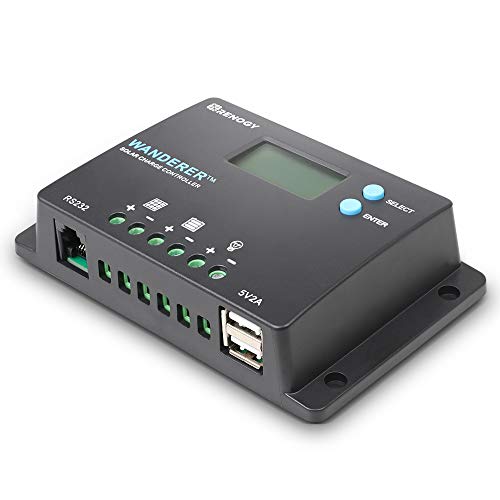
- Designed for 12V/24V systems
- Compact housing for RV or marine panels
- Multiple battery profiles and protections
Best For: Small RV and marine freezer setups
Easy-Setup Option
100A MPPT Solar Charge Controller

- Auto-recognizes 12V or 24V systems
- LCD controls with up to 99% claimed efficiency
- 100A rating with built-in protections
Best For: 12V/24V freezer systems needing simple setup
Best 12V MPPT Pick
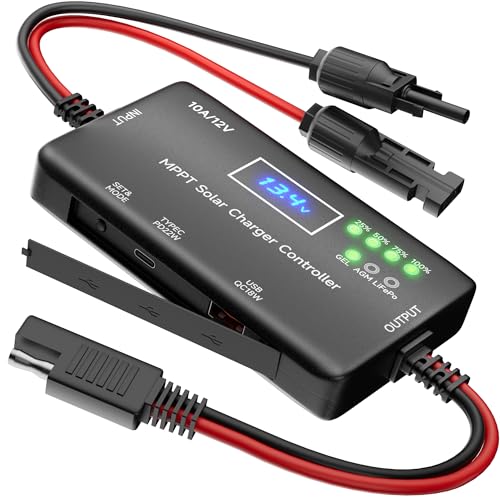
- MPPT charging with four-stage battery care
- LCD monitoring and USB/Type-C outputs
- Designed exclusively for 12V battery systems
Best For: Portable 12V freezer systems using compatible solar panels and batteries
Best Outdoor Protection
SOLPERK 10A Waterproof PWM Controller

- IP67 waterproof housing for outdoor installations
- Automatic 12V/24V voltage identification
- 10A capacity with three-stage PWM charging
Best For: Outdoor freezer systems in RV, boat, and vehicle applications
Best Higher-Output 12V Option
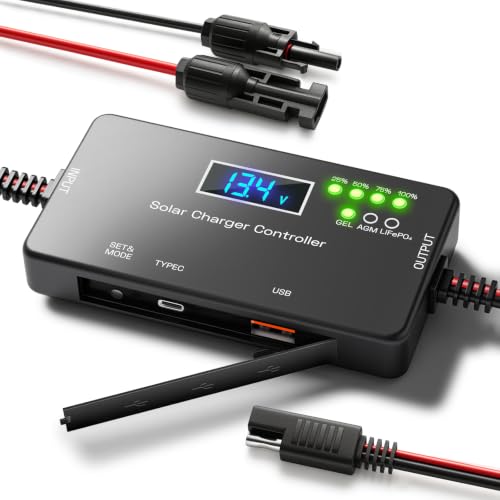
- Handles up to 300W of solar input at 12V
- 20A capacity with LCD battery monitoring
- 22W Type-C and 18W USB fast-charging ports
Best For: Larger 12V freezer systems needing more charging capacity
Top Performance Pick – Victron SmartSolar MPPT 100/50
For a high-capacity solar charge controller for freezer setups, the Victron Energy SmartSolar MPPT 100/50 combines 100V solar input with a 50A charging rating for compatible 12V or 24V battery systems. Its MPPT tracking, app connectivity, and configurable load output make it well suited to systems where dependable battery management matters.
Best For: Higher-capacity off-grid freezer systems using 12V or 24V batteries.
Pros:
- MPPT tracking is designed to maximize available solar power, including during partial shading.
- Bluetooth connectivity provides real-time data, performance history, configuration, firmware updates, and alarms through VictronConnect.
- Configurable load disconnect helps protect batteries when voltage drops too low.
- Multiple units can synchronize charging stages in larger systems.
Cons:
- No built-in display is listed.
- Its 50A capacity may be more than needed for smaller freezer systems.
- Battery and solar-panel compatibility still need to be matched to the system design.
This is the strongest option here for a larger, expandable freezer power system. The MPPT design and load-management features are particularly useful when solar conditions vary, though its higher capacity may be unnecessary for a compact installation.
Compact 12V Pick – Renogy Wanderer Li 30A PWM
The Renogy Wanderer Li is a practical 12V solar charge controller for freezer installations using compatible lithium or lead-acid batteries. Its 30A PWM charging, compact housing, protective features, and optional Bluetooth monitoring make it a convenient choice for RV, marine, and small off-grid systems.
Best For: Compact 12V freezer setups in RVs, boats, and other space-limited installations.
Pros:
- Supports LiFePO4, AGM, gel, and flooded battery types with chemistry-specific charging options.
- 30A multi-stage charging includes bulk, boost, float, and automatic equalization functions.
- Built-in safeguards address reverse polarity, overcharging, overload, and short circuits.
- Optional Bluetooth monitoring can show solar input, battery state of charge, and fault alerts through the DC Home App.
Cons:
- It is a 12V controller, so it is not intended for 24V battery systems.
- PWM charging may be less efficient than MPPT in some solar installations.
- Bluetooth monitoring requires the compatible BT-1 module.
Choose this controller when your freezer system is 12V and installation space is limited. It offers broad battery support and useful monitoring, but a higher-capacity or MPPT controller may be preferable for demanding solar arrays.
Space-Saving MPPT Pick – Victron SmartSolar MPPT 75/15
The Victron SmartSolar MPPT 75/15 is a compact solar charge controller for freezer systems using 12V or 24V batteries and a smaller solar array. MPPT tracking, Bluetooth connectivity, and automatic low-voltage load control provide useful performance and oversight without the bulk of a higher-amperage controller.
Best For: Smaller 12V or 24V freezer systems where efficiency and compact installation are priorities.
Pros:
- MPPT technology is designed to extract more available power from solar panels, including in partial shade.
- Bluetooth access provides real-time readings, 30-day history, settings, firmware updates, and alarms.
- Supports both 12V and 24V battery systems.
- Load output can disconnect connected equipment when battery voltage falls too low.
Cons:
- The 15A rating limits it to smaller charging requirements.
- The listed 75V PV limit must be matched carefully to the solar-panel configuration.
- It does not list a full built-in display.
This is a strong fit for a modest freezer system that benefits from MPPT efficiency and app-based monitoring. Confirm that the panel array and expected charging current stay within its 75V and 15A limits before choosing it.
Budget Display Pick – Upgraded 30A PWM LCD Controller
This upgraded 30A PWM unit is a straightforward solar charge controller for freezer systems that use 12V or 24V lead-acid batteries. Automatic voltage recognition, an LCD, adjustable load timing, USB outputs, and multiple protection functions make it useful for basic home, commercial, or off-grid installations.
Best For: Budget-conscious 12V or 24V freezer systems using lead-acid batteries.
Pros:
- Automatically adapts to 12V or 24V systems.
- LCD shows operating status and system data, with adjustable load-time settings.
- 30A charging capacity and dual 5V/2.5A USB outputs add practical flexibility.
- Includes protections for overcurrent, short circuit, reverse connection, low voltage, and overcharge.
Cons:
- It is suitable only for lead-acid batteries, not lithium or nickel-metal hydride batteries.
- As a PWM controller, it may not provide the same solar-harvesting efficiency as an MPPT model.
- The system must be installed in the specified order, with the battery connected before the solar panel.
This controller is a sensible basic choice when you need an LCD and broad 12V/24V lead-acid compatibility at a lower-complexity level. Avoid it for lithium battery systems, and follow the installation instructions carefully.
High-Capacity Pick – 120A MPPT Solar Charge Controller
For a large off-grid freezer setup, this high-capacity solar charge controller for freezer systems offers broad battery-voltage support and substantial charging headroom. Its MPPT design supports up to 11,520W of PV input at 96V, making it better suited to sizable solar arrays than compact controllers.
Best For: Large off-grid freezer systems using 12V–96V battery banks and compatible lithium, lead-acid, or GEL batteries.
Pros:
- Supports 12V, 24V, 36V, 48V, 60V, 72V, 84V, and 96V battery systems.
- Handles up to 120A of charging current and 230V maximum PV open-circuit voltage.
- Offers adjustable charging parameters, LCD monitoring, RS485 communication, and multiple protection features.
Cons:
- Its 8.7-pound, 12.4-inch-wide housing may be excessive for a small freezer installation.
- Higher-capacity wiring and system components are required to use its full output.
This is the most capable option here for a freezer that must operate as part of a substantial off-grid solar system. For smaller battery banks, its capacity may be more than necessary.
Compact RV Choice – Renogy Wanderer 10A PWM Controller
The Renogy Wanderer is a compact solar charge controller for freezer applications built around 12V or 24V battery systems. Its 10A PWM output is best matched with a modest solar array, while its protections and selectable load-control modes can simplify smaller RV or marine installations.
Best For: Small 12V/24V freezer setups in RVs, boats, and other space-limited off-grid applications.
Pros:
- Compact 4.69-by-2.95-inch design fits RV electrical cabinets and marine panels.
- Supports AGM, Gel, Flooded, and manually configured lithium batteries.
- Includes overcharge, over-discharge, overload, short-circuit, reverse-polarity, and temperature-compensation features.
Cons:
- The 10A PWM rating limits the size of the solar array and freezer system it can support.
- It is designed for 12V/24V systems rather than higher-voltage battery banks.
This controller makes sense when compact size and straightforward battery charging matter more than maximum solar harvest. Confirm that the freezer’s battery and panel requirements stay within the 10A rating.
Easy-Setup Option – 100A MPPT Solar Charge Controller
This 100A MPPT solar charge controller for freezer systems focuses on simple installation and visible system feedback. It automatically recognizes 12V or 24V battery systems, uses an LCD display for adjustments, and is intended for users who want a high-current controller without complicated initial configuration.
Best For: 12V/24V lithium-based freezer systems where automatic setup, LCD monitoring, and high charging capacity are priorities.
Pros:
- Automatically recognizes 12V or 24V battery voltage after the battery is connected first.
- Uses MPPT tracking with claimed efficiency up to 99%.
- Provides LCD monitoring, adjustable settings, USB ports, and protection against overcharging, short circuits, and reverse polarity.
Cons:
- Its supplied specifications do not identify support for battery voltages above 24V.
- The notes emphasize lithium battery tuning, so users of other chemistries should verify compatibility and settings.
For a 12V or 24V freezer bank, this controller offers a convenient mix of automatic recognition and high current capacity. Its 100A rating should still be matched carefully to the battery, panel array, wiring, and protection equipment.
Best 12V MPPT Pick – SUNAPEX 10A MPPT Controller
For a 12V freezer setup, the SUNAPEX MPPT controller is a compact option for managing solar input and protecting a compatible battery. It supports Lead-Acid, Gel, AGM, and LiFePO4 batteries, but it is limited to 12V systems and should be connected with correct polarity.
Best For: Portable 12V solar systems powering a freezer from a compatible battery bank.
Pros:
- MPPT charging with four-stage battery maintenance.
- LCD and LED monitoring for voltage, current, charge level, and status.
- USB and Type-C outputs for charging small devices.
- Protection against overcharge, over-voltage, reverse current, reverse polarity, short circuits, and overheating.
Cons:
- Only suitable for 12V batteries; it cannot be used with 24V or 36V packs.
- Not compatible with solar panels that have built-in controllers.
- Requires careful polarity matching and does not include a polarity converter.
Choose this model when efficient MPPT charging, status visibility, and zero battery drain are priorities in a compact 12V freezer system. Verify the panel and battery specifications before installation.
Best Outdoor Protection – SOLPERK 10A Waterproof PWM Controller
The SOLPERK is a practical solar charge controller for freezer installations exposed to outdoor conditions. Its IP67 waterproof housing and automatic 12V/24V identification make it suitable for RV, boat, and vehicle setups, provided the battery type and panel wattage stay within its limits.
Best For: Outdoor freezer systems in RVs, boats, cars, and other locations where water resistance matters.
Pros:
- IP67 waterproof construction for outdoor use.
- Automatically identifies 12V or 24V systems.
- Supports up to 150W at 12V or 300W at 24V with a 10A maximum current.
- Three-stage PWM charging and multiple protective functions.
Cons:
- Uses PWM charging rather than MPPT.
- LED indicators provide status information but not detailed LCD readings.
- Designed for AGM, GEL, and flooded deep-cycle batteries; battery compatibility should be confirmed before use.
For a freezer powered in a damp or mobile environment, the waterproof enclosure and straightforward SAE installation are useful advantages. Check the controller’s 10A limit and the solar array’s wattage before pairing it with your system.
Best Higher-Output 12V Option – 20A PWM LCD Controller
This 20A PWM controller suits a 12V freezer system that needs more controller capacity than a basic 10A model. It supports up to 300W of solar input and works with LiFePO4, AGM, and Gel batteries, while its LCD makes battery voltage and charge level easier to monitor.
Best For: 12V freezer setups using larger solar arrays and batteries that benefit from detailed status readings.
Pros:
- 20A capacity supports solar panels up to 300W in a 12V system.
- Compatible with LiFePO4, AGM, and Gel batteries.
- LCD displays battery voltage and 25%, 50%, 75%, and 100% charge levels.
- Includes six protection features plus nighttime anti-leakage protection.
Cons:
- Only designed for 12V systems, not 24V or 36V batteries.
- Uses PWM charging rather than MPPT.
- Connection order matters: connect the battery before the solar panel.
The higher 20A rating gives this controller more headroom for a 12V freezer system, while the LCD and built-in device charging ports add convenience. Confirm that the battery bank, panel output, and wiring are all compatible with its 12V and 300W limits.
How We Picked the Best Solar Charge Controller for Freezer
We focused on controllers that can support common 12V and 24V battery banks, with several higher-voltage options for larger systems. The selection includes MPPT models for better energy harvesting, PWM controllers for simpler and less expensive setups, and units that support LiFePO4, AGM, or gel batteries.
We also considered rated charging current, solar input compatibility, display or monitoring features, weather resistance, battery protections, and the practical needs of a freezer system. A controller is only suitable when its ratings align with the complete solar array and battery bank, not just the freezer’s nominal voltage.
Quick Comparison
| Controller type | Best suited to | Main advantage | Watch for |
|---|---|---|---|
| MPPT | Higher-output or variable solar systems | Better panel efficiency and flexible array voltage | Higher purchase price and more setup requirements |
| PWM | Small, budget-conscious 12V or 24V systems | Simple installation and low cost | Less efficient when panel and battery voltages differ |
| High-current MPPT | Large battery banks and multiple panels | Supports substantial charging capacity | Requires correctly sized wiring, fusing, and batteries |
Key Buying Factors for a Solar Charge Controller for Freezer
Match the Battery Voltage and Chemistry
Confirm whether the system uses a 12V, 24V, or another battery-bank voltage. Select the correct charging profile for LiFePO4, AGM, gel, or flooded lead-acid batteries. An incorrect profile can reduce battery life or prevent a full charge.
Check Solar and Charging Ratings
The controller’s maximum PV voltage must exceed the array’s open-circuit voltage, including cold-weather increases. Its current rating should also accommodate the array’s expected output with an appropriate safety margin. Do not assume a higher amp rating alone makes a controller better for a freezer.
Prefer MPPT When Efficiency Matters
MPPT is generally the better choice for cold climates, larger panels, long cable runs, or systems where every watt matters. PWM can work well with a small matched panel and battery bank, particularly when installation simplicity and cost are priorities.
Allow for Freezer Startup Demand
The controller charges the battery; it does not replace an inverter or provide the freezer’s starting surge. Size the battery, inverter, wiring, and fuses for the compressor’s running and startup loads. Look for low-voltage protection elsewhere in the system as needed.
Consider Monitoring and Installation Conditions
LCD screens, Bluetooth monitoring, RS485 communication, and programmable settings can make troubleshooting easier. For RV, boat, or outdoor installations, verify enclosure protection, ventilation, temperature limits, and cable-terminal capacity before mounting the unit.
Who Should Buy Which Solar Charge Controller for Freezer?
Choose a compact PWM model for a small 12V freezer system with a modest, voltage-matched panel and a tight budget. These controllers are straightforward but offer less flexibility.
Choose a midrange MPPT controller when dependable charging efficiency is more important than the lowest upfront cost, especially with variable sunlight or higher-voltage panels.
Choose a high-current MPPT model for multiple panels, a large battery bank, or an expandable off-grid installation. Confirm every voltage and current limit before connecting the array.
For any Solar Charge Controller for Freezer installation, size the complete system around the freezer’s measured energy use, compressor surge, local sunlight, and the number of hours of backup required.