
The best resin printers for small businesses balance fine detail, dependable operation, manageable running costs, and enough build volume for your typical jobs. Whether you produce miniatures, jewelry prototypes, dental models, product samples, or custom parts, the right printer can improve consistency without requiring industrial-scale equipment.
This roundup compares 10 current resin 3D printers across resolution, speed, capacity, automation, and bundle value. Use the guide below to narrow the choices based on your workload, available space, and production priorities.
Best 10 Resin Printers for Small Businesses Picks for 2026
High-Resolution Workhorse

- 16K detail with a 150mm/h claimed print speed
- Heated resin tank supports cooler-workspace printing
- AI camera and automated checks aid production monitoring
Best For: Detailed prototypes and repeatable small-business production
Precision Production System

- High-contrast amber screen supports detail and faster curing
- One-click slicing repairs models and generates supports
- Force monitoring and precision Z-axis target repeatable production
Best For: Professional studios and process-controlled small-business printing
Large-Format Production Choice
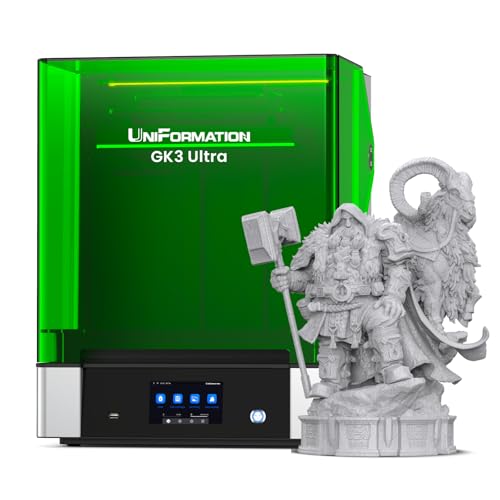
- 300 × 160 × 300mm build volume for large or batch prints
- Automatic heating and resin feeding support longer jobs
- Quick-release vat and drip hanger improve maintenance
Best For: Large prototypes and high-volume batch production
Compact Detail Specialist

- 10K LCD with 17 × 17μm pixel size for detailed models
- Compact 153.4 × 87 × 165mm build volume
- Simple leveling and power-resume support daily use
Best For: Small-workspace prototyping and detailed low-volume parts
Fast Detail Specialist
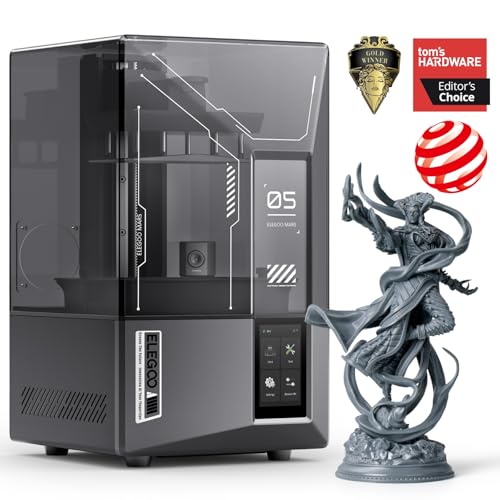
- 9K mono LCD with 18 μm XY resolution
- Up to 150 mm/h with tilt-release printing
- AI monitoring and Wi-Fi cluster control
Best For: Detailed small-batch work and multi-printer workflows
High-Volume Automation Pick

- 16K LCD and up to 170 mm/h speed
- Larger 211.68 × 118.37 × 200 mm build volume
- Automated heating, RFID, feeding, and recycling
Best For: Larger batches and streamlined production
Connected Workflow Choice

- 9K LCD with 18 μm XY resolution
- Up to 150 mm/h and one-click calibration
- Wi-Fi control, AI camera, and issue alerts
Best For: Remote operation and coordinated small-team printing
Complete Detail Starter

- 7-inch 10K resolution for detailed models
- 153.4 × 87 × 165mm build volume
- Includes Wash & Cure 3.0 with 4L bucket
Best For: Small businesses wanting a complete print, wash, and cure setup
High-Throughput Precision

- Print speeds up to 150mm/h
- 16K display with 14×19μm XY resolution
- AI camera, sensors, and heated resin tray
Best For: Production-focused teams needing speed and automated monitoring
Best Simple Pick

- 10K resolution with 17×17μm pixels
- Up to 120mm/h with high-speed resin 2.0
- Self-check functions and 4.3-inch touchscreen
Best For: Small teams wanting fast, detailed printing in a focused setup
High-Resolution Workhorse – Saturn 4 Ultra 16K
For small businesses evaluating resin printers for small businesses, the ELEGOO Saturn 4 Ultra 16K combines fine detail, a sizable build area, and workflow automation. Its heated resin tank, automatic leveling, monitoring camera, and 150mm/h claimed print speed are geared toward repeatable production.
Best For: Small-business prototyping, detailed models, and teams that want monitoring and automated checks.
Pros:
- 16K LCD with 15120 x 6230 resolution and 14 x 19 μm XY resolution.
- Automatic resin heating helps maintain suitable printing temperatures.
- AI camera, resin-level monitoring, foreign-object detection, and automatic leveling support unattended jobs.
- Wi-Fi transfer, power-on resume, and cluster printing can streamline repeated work.
Cons:
- Its 35.4-pound weight and larger footprint require dedicated workspace.
- The advanced monitoring and automation may be more than occasional users need.
Choose this model when detail, production speed, and built-in monitoring matter more than compact size. The heated tank is particularly useful for businesses printing in cooler conditions.
Precision Production System – Reflex RS Turbo
The Reflex RS Turbo is aimed at businesses that need controlled, repeatable resin printing rather than a basic entry-level workflow. Its high-contrast amber screen, one-click slicing tools, force-based failure detection, and precision motion system are designed to support demanding production work.
Best For: Professional studios and small businesses prioritizing process control, dimensional consistency, and resin flexibility.
Pros:
- High-contrast amber screen is engineered for crisp details and faster curing with standard or high-speed resins.
- One-click slicing can repair common model defects and generate supports.
- Force sensors can detect fine residue, pause prints, and produce diagnostic reports.
- C5 ball-screw Z-axis and calibrated LCD are specified for precise, consistent results.
Cons:
- The 50.6-pound printer is relatively heavy for a small workspace.
- Its professional feature set may involve a steeper learning curve than simpler printers.
- The supplied notes do not specify the build volume or screen resolution.
This is the strongest fit for a production-minded operation that values diagnostics and repeatability. Its adaptive process packages and motion algorithms may help reduce unnecessary movement while maintaining print quality.
Large-Format Production Choice – UniFormation GK3 Ultra
For resin printers for small businesses that need to produce larger parts or several components at once, the UniFormation GK3 Ultra stands out with its 300 × 160 × 300mm build volume. Automatic resin feeding, built-in heating, and maintenance-focused design support longer production runs.
Best For: Small and medium-sized businesses, industrial prototyping, large models, and higher-volume batch printing.
Pros:
- Large 300 × 160 × 300mm build volume supports large models or multiple parts.
- 16K LCD and 20 × 26μm pixel size are designed for detailed prints.
- Heating can bring resin to 25°C or 30°C even when the outside temperature reaches 0°C.
- Automatic resin feeding helps reduce interruptions from insufficient vat material.
Cons:
- At 85.8 pounds and 19 × 21 × 26 inches, it needs substantial, stable floor or bench space.
- The large-format system may be excessive for small parts or low-volume work.
- Large resin prints still require careful handling and post-processing.
The GK3 Ultra is a practical capacity upgrade for businesses whose bottleneck is build volume. Its quick-release vat, drip hanger, and carbon filter also make routine handling more manageable.
Compact Detail Specialist – ANYCUBIC Photon Mono 4
The ANYCUBIC Photon Mono 4 is a compact option for resin printers for small businesses that need detailed parts without committing to a large-format machine. Its 7-inch 10K LCD, uniform light source, simple four-point leveling, and power-resume feature suit everyday prototyping and small models.
Best For: Small workspaces, detailed prototypes, and businesses starting with resin printing.
Pros:
- 10K resolution with 17 × 17μm pixel size supports fine model detail.
- 153.4 × 87 × 165mm build volume handles many routine parts and models.
- LighTurbo matrix lighting is designed to reduce layer lines and rasterization.
- Four-point leveling and power-loss resume simplify operation and reduce wasted material.
Cons:
- Its build volume is substantially smaller than the large-format options in this roundup.
- The supplied notes state that Anycubic app service is not supported.
- It lacks the automatic heating and resin-feeding features described for larger production models.
This printer makes the most sense when footprint, straightforward setup, and fine detail are the priorities. It is less suited to oversized parts or continuous high-volume production.
Fast Detail Specialist – ELEGOO Mars 5 Ultra
The ELEGOO Mars 5 Ultra is a practical choice for small businesses seeking resin printers for small businesses that combine fine detail with faster production. Its 9K mono LCD, 18 μm XY resolution, tilt-release system, and AI monitoring support detailed prototypes, miniatures, and small-batch parts.
Best For: Small businesses prioritizing detailed prints, faster turnaround, and multi-printer workflow control.
Pros:
- 9K resolution and 18 μm XY resolution support intricate detail.
- Print speeds reach up to 150 mm/h with fast and slow modes.
- AI camera, residue detection, and resin-shortage alerts can help reduce failed prints.
- Wi-Fi cluster printing supports control of multiple compatible printers.
Cons:
- The AI detection results can vary with the environment, model, and resin type.
- Its compact build volume may be less suitable for larger parts or high-volume production.
For a small operation balancing precision and throughput, the Mars 5 Ultra offers useful automation and networking features without sacrificing resolution. It is particularly appealing when several printers need to be managed together.
High-Volume Automation Pick – Creality HALOT-X1 Combo
The Creality HALOT-X1 Combo stands out among resin printers for small businesses that need a larger build area and streamlined material handling. Its 16K LCD, 170 mm/h speed, fixed build plate, and intelligent resin management are designed for repeatable production with less manual setup.
Best For: Small businesses producing larger batches or parts that benefit from a bigger build volume and automated resin handling.
Pros:
- 10.1-inch 16K LCD delivers 14 × 19 μm pixel size and detailed prints.
- 211.68 × 118.37 × 200 mm build volume supports larger or multiple models.
- Resin heating, RFID parameter recognition, feeding, recycling, and weight monitoring simplify material management.
- Fixed build plate design eliminates leveling, while dual rails and lead screws support 0.01 mm positioning precision.
Cons:
- At 38 pounds, it is heavier than the other listed options.
- Its larger footprint may require more dedicated workspace.
- Some intelligent resin features may depend on compatible tagged materials.
The HALOT-X1 Combo is the strongest fit here for businesses that value capacity and automation over a compact desktop footprint. Its resin-management system and no-leveling design can help make recurring production more consistent.
Connected Workflow Choice – ELEGOO Mars 5 Ultra MSLA
The ELEGOO Mars 5 Ultra MSLA is a strong option for small businesses looking for resin printers for small businesses with connected operation and failure monitoring. It pairs a 9K screen with tilt-release printing, one-click calibration, interruption recovery, AI camera monitoring, and Wi-Fi file transfer.
Best For: Small teams that want remote operation, multiple-printer control, and practical safeguards against common print issues.
Pros:
- 9K monochrome LCD, 18 μm XY resolution, and 92% light uniformity support precise prints.
- Up to 150 mm/h printing with fast and slow modes improves workflow flexibility.
- Smart mechanical sensors can detect low resin, foreign objects, and high light-board temperature.
- Wi-Fi supports file transfer, simultaneous LAN printing, remote control, and OTA updates.
Cons:
- The supplied notes do not specify the build volume, making capacity comparisons harder.
- AI camera detection may not identify every issue in all printing conditions.
This model makes the most sense when workflow coordination matters as much as print quality. Its network features and interruption recovery can be especially useful for small teams running several jobs or printers.
Complete Detail Starter – ANYCUBIC Photon Mono 4 Bundle
For small businesses seeking resin printers for small businesses, this bundle combines a detailed 10K printer with washing and curing equipment. Its generous build volume and included post-processing setup make it practical for producing detailed models with a more streamlined workflow.
Best For: Small businesses that want a printer-and-post-processing bundle for detailed models and regular project work.
Pros:
- 7-inch 10K resolution with 17×17μm pixels supports highly detailed prints.
- Build volume reaches 153.4 × 87 × 165mm for a range of projects.
- Wash & Cure 3.0 includes a 4L cleaning bucket and 42% greater basket capacity than Wash & Cure 2.
- Gooseneck curing light is designed to strengthen curing in subtle model areas.
Cons:
- The bundle may take more workspace than a printer alone.
- Its post-processing features add equipment that may be unnecessary for occasional users.
Choose this option when an all-in-one workflow matters as much as print resolution. The included wash-and-cure station can reduce the need to source compatible post-processing equipment separately.
High-Throughput Precision – ELEGOO Saturn 4 Ultra 16K
Among resin printers for small businesses, the ELEGOO Saturn 4 Ultra 16K stands out for combining a fast claimed print speed with very high resolution and automated monitoring features. Its heated resin tray and recovery functions are useful for businesses focused on repeatable production.
Best For: Small businesses prioritizing fast, high-detail production with automated checks and temperature management.
Pros:
- Tilt-release technology supports printing speeds up to 150mm/h.
- 16K screen provides 14×19μm XY resolution and 92% COB light uniformity.
- Smart sensors can detect low resin, debris, and high lamp temperature, with power-loss resume support.
- Built-in AI camera monitors for issues such as empty build plates and model warping.
Cons:
- At 40.7 pounds, it is relatively heavy to move.
- The printer’s listed dimensions require a dedicated workspace.
- Its advanced features may be more than occasional users need.
This is the strongest fit for production-oriented teams that can use its speed, monitoring, and heated resin tray. Businesses should plan for a substantial, stable work area before choosing it.
Best Simple Pick – ANYCUBIC Photon Mono 4 Ultra
The ANYCUBIC Photon Mono 4 Ultra is a compact choice for small businesses evaluating resin printers for small businesses. It pairs 10K detail with a claimed 120mm/h maximum speed, self-check functions, and a straightforward touchscreen interface.
Best For: Small businesses that need detailed prints, faster production, and a user-friendly control experience.
Pros:
- 7-inch 10K LCD offers 17×17μm pixels for fine model detail.
- COB light source and Fresnel lens provide at least 90% light uniformity.
- ACF film and intelligent release algorithms support speeds up to 120mm/h with high-speed resin 2.0.
- 360° self-check functions and a 4.3-inch touchscreen simplify operation.
Cons:
- The supplied notes do not specify the build volume.
- The printer alone does not include wash-and-cure equipment.
- Its maximum speed is tied to high-speed resin 2.0.
This model makes sense when a business wants a focused printer rather than a larger bundle. Its self-check features and simple interface can help reduce routine setup friction while retaining high-resolution output.
How We Picked the Best Resin Printers for Small Businesses
We focused on the factors that matter most in a professional small-shop environment: print resolution, build volume, operating speed, ease of setup, reliability features, workflow support, and overall value. The selection includes compact machines for limited workspaces, larger-format printers for batch production, and bundles that include washing and curing equipment.
Screen resolution is only one part of performance. A useful business printer also needs consistent exposure, dependable leveling or mechanical sensing, practical software support, and a workflow that does not create unnecessary post-processing delays. We also considered whether each model suits prototypes, detailed display pieces, functional patterns, or repeat production.
Quick Comparison
| Best For | Recommended Type | What to Prioritize |
|---|---|---|
| Detailed miniatures and small parts | Compact 9K–16K MSLA printer | XY resolution, exposure consistency, and detail preservation |
| Batch production | Large-format resin printer | Build volume, print speed, and resin capacity |
| New business owners | Printer with smart sensors or guided setup | Leveling assistance, failure detection, and simple maintenance |
| Complete workflow | Printer-and-wash/cure bundle | Included accessories, workspace efficiency, and total cost |
Key Buying Factors for Resin Printers for Small Businesses
Resolution and Real-World Detail
Higher-resolution mono screens can produce sharper edges and finer surface detail, but resin quality, exposure settings, orientation, and support placement also affect results. Choose a 9K or 10K model for most detailed commercial work; consider 13.5K or 16K machines when small features and premium surface quality justify the added cost.
Build Volume and Throughput
Build volume determines whether you can print one large item or several smaller items in a single run. A compact printer may be more efficient for custom orders and limited space, while a larger Saturn-, GK3-, or Halot-class machine can reduce the number of production cycles. Compare usable platform dimensions rather than screen size alone.
Speed, Reliability, and Automation
Fast printing is valuable only when it remains consistent. Look for rigid construction, dependable resin exposure, mechanical sensors, automatic or assisted leveling, and features that reduce failed prints. For a business, predictable uptime is often more important than a headline speed figure.
Total Operating Cost
Budget for resin, replacement screens, release films, gloves, cleaning solvent, ventilation, support materials, and curing equipment. A printer bundle can be economical if it includes a suitable wash-and-cure station, while a standalone printer may be preferable if you already have post-processing equipment.
Safety and Workflow Space
Resin requires careful handling, ventilation, protective equipment, and proper disposal. Allow room for washing, curing, storage, and spill control. A smaller printer may be the better business choice if your workspace cannot safely accommodate a large machine and its supporting equipment.
Who Should Buy Which Resin Printers for Small Businesses?
Choose a compact Mars 5 Ultra or Photon Mono 4 when you need detailed parts, have limited space, or are building a lower-cost production setup. These formats are well suited to prototypes, miniatures, jewelry patterns, and custom orders.
Choose the Saturn 4 Ultra, Halot-X1 Combo, or GK3 Ultra when batch output and larger models matter more than footprint. Their larger platforms can help reduce per-piece production time, especially when your orders contain multiple small items.
Choose the Reflex RS Turbo if dependable high-contrast exposure and production speed are your main priorities. Select a Photon Mono 4 bundle when you want a simpler all-in-one entry point with washing and curing included.
Finally, compare similarly named models carefully. Several options use the same product family with different screen resolutions, bundles, or included accessories. Confirm the exact build volume, screen specification, software compatibility, warranty, and package contents before purchasing.