
Resin printing can produce exceptionally detailed miniatures, prototypes, and small functional parts, but the right printer makes the learning curve much easier.
We compared 10 resin printers for beginners across print quality, automation, build space, ease of setup, and day-to-day ownership so you can choose with confidence.
Best 10 Resin Printers for Beginners Picks for 2026
Best Smart Features
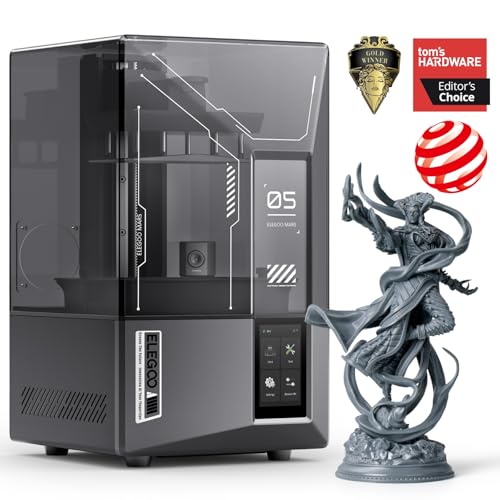
- 9K monochrome LCD with 18 μm XY resolution
- Up to 150 mm/h printing with tilt release
- AI camera and smart error alerts
Best For: Beginners prioritizing speed, detail, and monitoring features
Best Simple Starter

- 7-inch 10K LCD with 17 μm pixel size
- Beginner-friendly four-point leveling
- Build volume up to 153.4 × 87 × 165 mm
Best For: First-time users wanting detailed prints and simple setup
Best Large Build Volume

- 10-inch 12K monochrome LCD
- Generous 218.88 × 122.88 × 250 mm build volume
- Uniform COB and Fresnel light source
Best For: Beginners planning larger models or batch printing
Best Plug-and-Play Design

- 16K resolution with 14 × 19 μm pixels
- Factory pre-leveling and smart resin handling
- Heating and remote monitoring features
Best For: Beginners wanting guided setup and convenient monitoring
Best Beginner-Friendly Pick
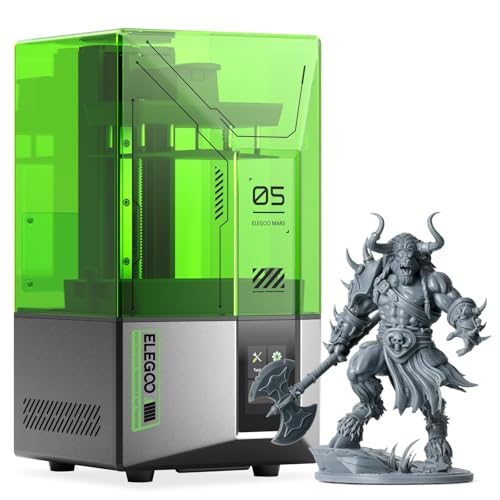
- One-click automatic leveling
- 4K detailed printing
- Built-in safety and self-check features
Best For: New users prioritizing simple setup and reliable desktop printing
Best Plug-and-Play Option

- Factory pre-leveled platform
- 9K resolution with 18μm XY detail
- USB, WiFi, and cloud file transfer
Best For: Beginners making detailed miniatures and desktop-sized models
Best High-Resolution Upgrade

- 16K detail at 14 × 19μm XY resolution
- Automatic heated resin tank
- AI camera and automated monitoring
Best For: Users wanting large, detailed prints with room to advance
Best Compact Starter

- Automatic calibration and leveling
- Magnetic, easy-release build plate
- Compact design with 2K LCD detail
Best For: Beginners printing smaller detailed models
Best Feature-Rich Beginner Pick

- Automatic leveling with intelligent sensors
- 6.6-inch 4K monochrome LCD
- COB light source and active cooling
Best For: Beginners wanting automation and higher-resolution output
Best Easy-Cleanup Resin
Anycubic Water-Washable ABS-Like Resin 3.0
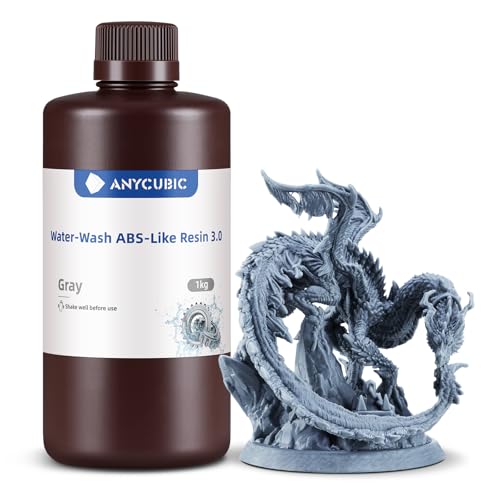
- Cleans with water instead of alcohol
- ABS-like toughness with low shrinkage
- Low odor and broad LCD/DLP compatibility
Best For: Beginners wanting simpler resin cleanup
Best Smart Features – ELEGOO Mars 5 Ultra
The ELEGOO Mars 5 Ultra is a strong option for beginners seeking resin printers for beginners with fast printing, high detail, and helpful monitoring features. Its 9K monochrome LCD, tilt-release system, and guided alerts make it easier to manage detailed projects with less guesswork.
Best For: Beginners who want high-resolution prints, fast output, and automated error monitoring.
Pros:
- 9K LCD provides 18 μm XY resolution for detailed models.
- Prints at speeds up to 150 mm/h with tilt-release technology.
- AI camera and sensors can detect select errors, residue, resin shortages, and leveling failures.
- Wi-Fi cluster printing supports control of multiple compatible printers.
Cons:
- AI detection results can vary with the environment, model, and resin type.
- Its feature-rich design may be more than needed for very basic projects.
The Mars 5 Ultra stands out when convenience and productivity matter as much as print quality. Beginners should still expect to learn resin handling and normal post-processing, but the built-in monitoring features can help reduce avoidable failures.
Best Simple Starter – ANYCUBIC Photon Mono 4
The ANYCUBIC Photon Mono 4 is a practical pick for beginners shopping for resin printers for beginners. It combines a sharp 10K screen with a straightforward four-point leveling process, while its moderate build volume suits everyday models and small projects.
Best For: First-time users who want detailed prints and a simple leveling routine.
Pros:
- 7-inch 10K LCD delivers 17 μm pixel size and fine detail.
- LighTurbo lighting is designed for stable, uniform exposure and smoother surfaces.
- Build volume supports models up to 153.4 × 87 × 165 mm.
- Four-point leveling does not need repeating after the initial setup and tightening.
Cons:
- Anycubic APP service is not supported.
- The build volume is smaller than that of larger-format resin printers.
For a beginner, the Mono 4’s repeatable leveling approach is especially appealing. It offers strong resolution without moving into a larger, heavier machine, making it a sensible entry point for miniatures, figures, and routine resin projects.
Best Large Build Volume – ELEGOO Saturn 3
The ELEGOO Saturn 3 is aimed at beginners who need more room than compact resin printers for beginners typically provide. Its 10-inch 12K screen and generous build volume support highly detailed models, larger pieces, or multiple smaller parts in one job.
Best For: New users planning larger projects or batch printing with high detail.
Pros:
- 10-inch 12K monochrome LCD produces detailed prints.
- Build volume measures 218.88 × 122.88 × 250 mm.
- COB and Fresnel optics provide uniform 405 nm lighting.
- Laser-carved build plate is designed for strong adhesion.
Cons:
- At 33 pounds, it is substantially heavier than compact options.
- Its larger footprint requires more dedicated workspace.
- Printing speed is listed at up to 70 mm/h, slower than some smaller models.
The Saturn 3 makes sense when capacity is the priority. It is less portable and demands more workspace, but its large build area gives beginners room to grow into ambitious models and batch production.
Best Plug-and-Play Design – UniFormation GK3T
The UniFormation GK3T focuses on convenience for people comparing resin printers for beginners. Factory pre-leveling, resin-feeding features, temperature management, remote monitoring, and workflow-oriented hardware are designed to simplify setup and make longer printing sessions easier to manage.
Best For: Beginners who value guided operation, year-round temperature control, and remote monitoring.
Pros:
- 16K resolution and 14 × 19 μm pixels target highly detailed prints.
- Factory pre-leveling supports a plug-and-play setup.
- Built-in heating maintains resin fluidity in temperatures as low as 0°C/32°F.
- App and slicing software support remote control, progress updates, and timelapse capture.
Cons:
- At 52.8 pounds, it is the heaviest option in this roundup.
- Its 12.99 × 15.75 × 20.47-inch dimensions require substantial space.
- Some workflow features depend on compatible wash and cure stations.
The GK3T is a convenience-first choice rather than a compact starter printer. Its pre-leveling, heating, and remote-control features can reduce setup friction, while the 16K screen gives beginners room to pursue intricate models.
Best Beginner-Friendly Pick – ELEGOO Mars 5
For shoppers comparing resin printers for beginners, the ELEGOO Mars 5 focuses on reducing setup and troubleshooting. One-click automatic leveling, self-checks, residue detection, and a 4K mono LCD make it a practical entry point for detailed desktop printing.
Best For: Beginners who want simple setup, built-in checks, and detailed prints in a compact desktop printer.
Pros:
- One-click automatic leveling helps eliminate tedious manual calibration.
- Self-checks, residue detection, and resin-shortage alerts can reduce avoidable print problems.
- 4K mono LCD and COB light source support detailed models and textures.
- Overheat protection automatically stops printing if LED temperature exceeds 80°C.
Cons:
- The listed print features do not include the higher resolution of the 9K or 16K alternatives.
- Its compact size may be less suitable for larger models.
The Mars 5 is a sensible choice when ease of operation matters more than maximum resolution or build volume. Its automated checks and leveling are especially useful for newcomers learning the resin-printing workflow.
Best Plug-and-Play Option – Creality HALOT-X1 Neo
The Creality HALOT-X1 Neo is designed for shoppers seeking resin printers for beginners with minimal initial setup. Its factory pre-leveled platform, beginner tutorials, flexible file transfer, and 9K resolution make it approachable while preserving fine model detail.
Best For: Beginners, miniature creators, tabletop gamers, and DIY users who want pre-leveled operation and high-resolution results.
Pros:
- Factory pre-leveled build platform supports a plug-and-play start.
- 9K LCD with 18μm XY resolution is suited to miniatures, figurines, and intricate models.
- Files can be transferred through USB, 2.4GHz WiFi, or Creality Cloud.
- Supports HALOT BOX, CHITUBOX, and Lychee Slicer workflows.
Cons:
- The 153.36 × 77.76 × 160 mm build volume is more suited to desktop-sized models than large prints.
- AI 2D-to-3D generation is listed as taking up to 3.5 hours for model creation.
The HALOT-X1 Neo stands out for its straightforward out-of-box setup and connectivity choices. It is a strong fit for users who want to start quickly and focus on detailed miniatures rather than oversized projects.
Best High-Resolution Upgrade – ELEGOO Saturn 4 Ultra 16K
For beginners who want room to grow, the ELEGOO Saturn 4 Ultra 16K combines automated setup with a larger print area and advanced monitoring. Its heated resin tank, automatic leveling, AI camera, and 16K resolution address several common concerns in resin printing.
Best For: New or experienced makers who need large, highly detailed prints and automated monitoring features.
Pros:
- 16K LCD delivers 14 × 19μm XY resolution for highly detailed models.
- Large 8.33 × 4.66 × 8.66-inch printing size accommodates bigger projects.
- Automatic resin-tank heating maintains temperature when it falls below 25°C.
- AI camera, automatic leveling, self-checks, and smart sensors support monitoring and reliable operation.
Cons:
- Its extensive feature set may be more than a first-time user needs.
- Advanced hardware and larger capacity may require more workspace and resin-handling preparation.
The Saturn 4 Ultra 16K is the most capable option here for detail, print size, and automation. Choose it if you want beginner-friendly safeguards without quickly outgrowing the printer as your projects become more ambitious.
Best Compact Starter – MALYAN S100 Mini
The MALYAN S100 Mini is a compact option for shoppers comparing resin printers for beginners. Its automatic calibration and leveling, magnetic build plate, and ready-to-print setup reduce some of the initial hands-on work, while the 5.5-inch 2K LCD is designed for detailed models.
Best For: Beginners who want a small, straightforward resin printer for detailed models and compact projects.
Pros:
- Automatic calibration and leveling can simplify setup.
- Magnetic build plate is easy to remove for cleaning and repeat printing.
- 2K LCD and upgraded parallel LED array support detailed, smoother-looking models.
- Laser-engraved build plate is designed to improve adhesion.
Cons:
- The 115 x 65 x 110 mm build volume is relatively compact.
- Different resins require appropriately matched printing parameters.
The S100 Mini emphasizes convenience and a small footprint, making it approachable for first-time users. Its limited build area is the main trade-off, so it is best suited to smaller models rather than large prints.
Best Feature-Rich Beginner Pick – ELEGOO Mars 5
The ELEGOO Mars 5 is a feature-rich choice among resin printers for beginners, combining automatic leveling with sensors that monitor several potential printing issues. Its 6.6-inch 4K monochrome LCD and guided design features make it a strong option for users who want a more capable starting platform.
Best For: Beginners who want automatic setup, monitoring features, and high-resolution printing in a more advanced entry-level machine.
Pros:
- Intelligent automatic leveling simplifies initial setup.
- Mechanical sensors can detect low resin, foreign objects, release film replacement needs, and overheating.
- 6.6-inch 4K monochrome LCD provides 35 × 35 μm XY resolution.
- COB lighting, cooling fans, and copper tubes support uniform exposure and heat management.
Cons:
- Successful printing still depends on correct settings and properly supported models in slicing software.
- The printer requires prompt resin-tank cleaning after printing.
- Its larger 19.11-pound form factor may require more dedicated workspace.
The Mars 5 adds useful automation and safety-oriented detection beyond basic printing hardware. It remains important for beginners to learn support placement, machine settings, and resin-tank maintenance to get consistent results.
Best Easy-Cleanup Resin – Anycubic Water-Washable ABS-Like Resin 3.0
While it is not a printer, Anycubic Water Washable ABS-Like Resin 3.0 can make the workflow around resin printers for beginners simpler. The water-washable formula reduces reliance on alcohol during cleanup, while its low odor, low viscosity, and ABS-like toughness suit users who want practical post-processing and durable-looking prints.
Best For: Beginners seeking easier cleanup and tougher, precise prints from compatible LCD or DLP resin printers.
Pros:
- Residual liquid resin can be washed off with water rather than alcohol.
- Low shrinkage supports accurate models with reduced cracking risk.
- ABS-like formulation offers a Shore hardness of 86D and elongation at break of up to 40%.
- Low viscosity, low odor, and broad LCD/DLP compatibility support a more convenient workflow.
Cons:
- It is consumable resin, not a printer, so a compatible LCD or DLP printer is required.
- The formula works best with Anycubic LCD printers, according to the supplied notes.
- Water-washable prints still require appropriate printing and curing practices.
This resin is a useful companion purchase for beginners who prioritize simpler cleanup and low odor. Its toughness and precision broaden its use beyond display models, but printer compatibility and correct settings remain important.
How We Picked the Best Resin Printers for Beginners
We focused on features that matter most when learning resin 3D printing: dependable exposure performance, useful screen resolution, straightforward leveling, practical build volume, and accessible controls. We also considered safety and maintenance requirements, since resin printing involves ventilation, protective equipment, washing, and curing.
The lineup includes compact entry-level models, larger MSLA printers for batch printing, and advanced options with automated leveling, sensors, Wi-Fi, or assisted workflows. Specifications can vary by firmware, resin, and region, so confirm the current listing before buying.
Quick Comparison
| What to compare | Best for | Why it matters |
|---|---|---|
| Compact build volume | Small workspaces and occasional projects | Lower footprint and often a lower entry price |
| Large build volume | Multiple miniatures or larger models | Fewer print runs, but more resin and workspace required |
| High-resolution LCD | Fine miniatures and intricate details | Can improve detail when exposure, settings, and model preparation are correct |
| Automation and sensors | First-time users | May reduce setup mistakes and simplify troubleshooting |
| Water-washable or specialty resin | Easier cleanup or tougher parts | Resin choice affects odor, durability, washing, and curing requirements |
Key Buying Factors for Resin Printers for Beginners
Resolution and Print Quality
Higher advertised resolution is useful for detailed models, but it is not the only quality factor. Pixel size, light uniformity, exposure consistency, slicing settings, resin type, and mechanical stability all affect the finished result. Choose a reputable printer with a resolution appropriate to your subjects rather than paying for specifications you may not use.
Build Volume and Printer Size
Small printers are easier to place and can be economical for miniatures, jewelry-scale designs, and test prints. A larger machine is better if you plan to print several pieces at once or make taller models. Measure your work surface, allowing room to remove the cover and access the vat.
Leveling and Beginner-Friendly Controls
Pre-leveled platforms, assisted leveling, mechanical sensors, and clear touchscreen menus can make the first setup less intimidating. These features do not eliminate calibration, cleaning, or support placement, but they can reduce preventable errors.
Resin Handling and Cleanup
All standard photopolymer resin requires careful handling. Plan for nitrile gloves, eye protection, ventilation, a washing method, and a UV curing station or suitable curing setup. Water-washable resin can simplify cleanup, but it still must be handled responsibly and cured fully; contaminated wash water should never be poured down a drain.
Software, Connectivity, and Support
Check compatible slicers, file transfer options, replacement parts, user documentation, and community support. Wi-Fi and AI-assisted features can be convenient, but reliable basic controls and readily available consumables are often more important for a first printer.
Who Should Buy Which Resin Printers for Beginners?
- Choose a compact Mars, Photon, or mini printer if you have limited space, mainly print small models, or want to keep initial resin use modest.
- Choose a Saturn-class printer if you print batches, need more height or width, or expect your projects to grow. Budget for additional resin and a sturdier workspace.
- Choose an automated or sensor-equipped model if setup confidence is your priority and you value guided features over the lowest purchase price.
- Choose a high-resolution model if you regularly print intricate miniatures, but pair it with careful exposure testing and well-supported models.
- Choose specialty or water-washable resin based on the finished part and your cleanup preferences—not simply the label. Confirm compatibility and follow the resin maker’s safety instructions.