
Choosing the right fume extractor is about more than suction power. If you work at a soldering bench, in a small workshop, or around indoor tools, you need cleaner air without adding distracting noise.
This roundup focuses on quiet fume extractors that balance airflow, filtration quality, and desktop-friendly design so you can work more comfortably for longer sessions.
Best 10 Quiet Fume Extractors Picks for 2026
Compact Desktop Smoke Trap
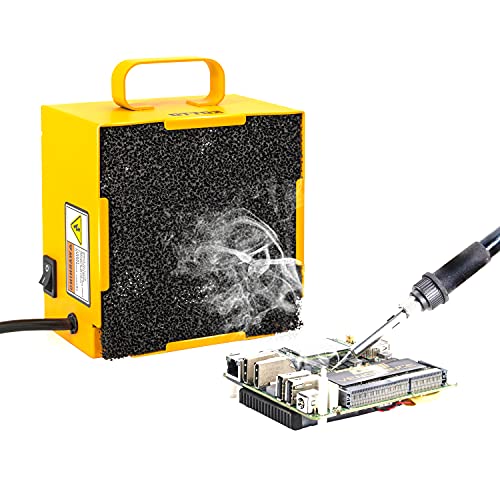
- Activated carbon filter for solder and flux fumes
- 3000 RPM fan is described as low noise
- Small, portable desktop body with carrying handle
Best For: Hobby soldering benches and compact DIY workspaces
Multi-Use Filtration Station

- 3-stage HEPA + activated carbon filtration
- 180 m³/h airflow with low-noise operation
- Flexible hose, LED light, and USB port
Best For: Mixed-use workstations needing stronger suction and flexibility
Long-Life Bench Filter

- Double ball bearing fan rated up to 50,000 hours
- Low-noise desktop design for close-range soldering
- Includes 5 activated carbon filters
Best For: Electronics repair benches and routine soldering
High-Capacity Brushless Extractor

- 120-180 m³/h capacity with 3-speed control
- True H13 HEPA and activated carbon filtration
- Filter is designed to last 3x longer
Best For: Desktop soldering users wanting stronger suction and long filter life
Compact Desktop Quiet-Control Pick
Compact H13 HEPA Solder Fume Extractor
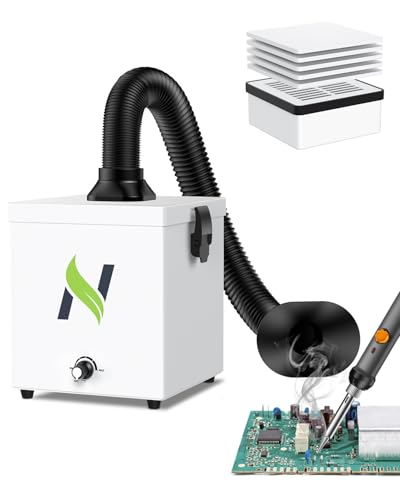
- Compact 5.1" x 5.1" x 6.3" desktop size
- 168 m³/h airflow with adjustable fan speed
- H13 HEPA plus pre-filter for fine smoke
Best For: Small desks and light-duty soldering with limited space
High-Suction Workshop Choice
FC-100A Low-Noise Fume Extractor
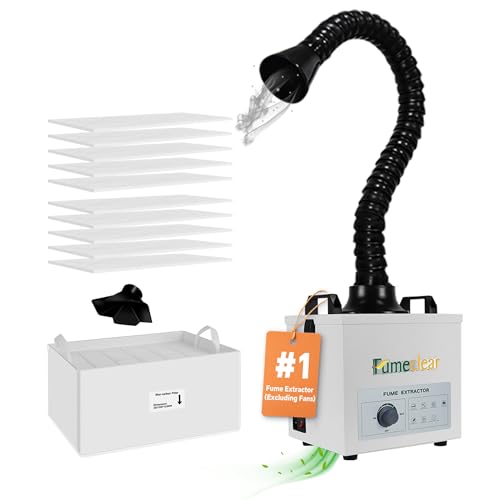
- Up to 200 m³/h suction with 100W max power
- 3-stage filtration with upgraded HEPA-carbon filter
- Designed for small bench soldering and indoor use
Best For: Garages, workshops, and small bench soldering
Balanced Desktop Performer
DX50 HEPA+Carbon Fume Extractor

- 180 m³/h airflow with 3 speed settings
- HEPA plus activated carbon and 5 pre-filters
- 20-inch gooseneck hose for precise placement
Best For: Desktop soldering and small light-duty repair work
High-Output Shop Pick

- 250m³/h airflow with 100W brushless motor
- 3-stage filtration with HEPA and activated carbon
- Reported noise stays below 55dB
Best For: Soldering, 3D printing, and small laser work
Balanced Bench Choice

- 220m³/h airflow with 2300Pa negative pressure
- 4-layer filtration with HEPA and carbon
- Reported noise is below 55dB
Best For: Soldering, PCB repair, and resin 3D printing
Compact Quiet Performer

- 168m³/h airflow in a mini footprint
- Dual-layer HEPA and carbon filtration
- 360° adjustable swan neck hose
Best For: Compact bench setups and light-duty soldering
Compact Desktop Smoke Trap – KOTTO Solder Smoke Absorber
If you want quiet fume extractors for a small soldering setup, this KOTTO unit is built for simple desktop use. It uses activated carbon filtration and a 3000 RPM fan to help capture solder, flux, and chemical fumes while staying low noise enough for close-range work.
Best For: Hobby soldering benches, DIY electronics work, and users who want a small, easy-to-move smoke absorber.
Pros:
- 0.4-inch activated carbon filter helps absorb solder and flux fumes.
- 3000 RPM fan is described as low noise and effective at 5-6 inches.
- Compact 5″ x 3″ x 5″ size with non-slip rubber feet and a carrying handle.
- Includes one replacement filter for easier maintenance.
Cons:
- Single-fan desktop design is best for close-up use, not larger work areas.
- Only one replacement filter is included.
Overall, this is a straightforward pick if you need a compact solder smoke absorber for bench-top tasks and want a simple balance of suction, portability, and low-noise operation.
Multi-Use Filtration Station – USB LED Fume Extractor
Among quiet fume extractors, this model stands out for users who need stronger airflow and broader coverage than a basic desktop trap. It combines 3-stage filtration, adjustable speed, and a flexible hose so it can handle soldering, laser work, 3D printing, and other fume-heavy tasks.
Best For: Makers who want one extractor for soldering, laser engraving, 3D printing, and mixed-use workstations.
Pros:
- 3-stage filtration with HEPA and activated carbon targets fine particles and fumes.
- 180 m³/h airflow and 6,800 RPM motor are paired with low-noise operation at or below 60 dB.
- 360° bendable hose and adjustable hood improve positioning over the source.
- Built-in LED light and USB port add convenience on crowded benches.
Cons:
- More complex than a basic desktop smoke absorber.
- Best suited to bench setups that can accommodate the hose and extractor unit.
This is the most versatile option in the group if you need practical extraction across multiple hobby or light-production scenarios and want a feature-rich, low-noise setup.
Long-Life Bench Filter – 5-Filter Solder Smoke Remover
Solder Fume Extractor Soldering Smoke Absorber with 5 Carbon Filters | Welding Smoke Remover
Check Price On AmazonIf you are comparing quiet fume extractors for routine soldering, this compact smoke remover focuses on simple, dependable capture. Its double ball bearing fan is rated for long service life, and the activated carbon filters are designed to help stop fumes from spreading across the room.
Best For: Electronics repair benches and users who want a lightweight, low-noise solder smoke absorber with extra filters.
Pros:
- Double ball bearing fan is rated for up to 50,000 hours of service life.
- Low-noise design aims to keep bench work more comfortable.
- Five activated carbon filters are included for easy replacement.
- 3000 RPM fan is designed to draw smoke from 5-6 inches away.
Cons:
- Best for close-range soldering rather than larger fumes or multi-tool use.
- Very compact footprint may limit coverage area.
For users who want a light, simple extractor with extra filter запас, this model offers practical bench-side performance without adding much bulk.
High-Capacity Brushless Extractor – FumeClear FC2001A
For buyers focused on quiet fume extractors with more power, the FumeClear FC2001A is built for stronger solder fume removal than small exhaust fans. It uses a metal housing, H13 HEPA filtration, and activated carbon to contain and purify fumes at a wider working distance.
Best For: Desktop soldering users who want stronger suction, wide-voltage compatibility, and longer filter life.
Pros:
- 120-180 m³/h purification capacity with 3-speed adjustment.
- True H13 HEPA plus activated carbon filtration targets smoke and odors.
- Brushless motor is designed to extend effective range to 15 cm.
- Filter is described as lasting 3 times longer than other compact units.
Cons:
- Heavier and larger than basic compact desktop extractors.
- Most useful when paired with a dedicated soldering workspace.
This is a strong fit if you want a more capable extraction unit and value low maintenance, wide voltage support, and a longer-lasting filter system.
Compact Desktop Quiet-Control Pick – Compact H13 HEPA Solder Fume Extractor
If you want quiet fume extractors for a small bench setup, this compact soldering unit is built for hobby spaces where footprint and control matter. It combines a modest desktop size with adjustable suction, so you can pull smoke away without overwhelming a tight work area.
Best For: Small desks, apartment workspaces, and DIY soldering where adjustable airflow and compact size are priorities.
Pros:
- Space-saving design at just 5.1″ x 5.1″ x 6.3″ and 3 lbs.
- 168 m³/h airflow with stepless speed control for dialing noise down.
- H13 HEPA filtration with a pre-filter for fine rosin smoke and larger debris.
- Flexible 360° hose makes it easy to position the suction head precisely.
Cons:
- Best suited to hobby and light-duty soldering rather than larger industrial jobs.
- Claims quiet operation through speed control, but no specific dB rating is provided.
This is a practical choice if you need a compact, adjustable extractor for everyday electronics work and want to keep the workspace clear without taking over the desk.
High-Suction Workshop Choice – FC-100A Low-Noise Fume Extractor
Among quiet fume extractors for bench work, this FC-100A stands out for pairing low-noise positioning with stronger suction and multi-stage filtration. It is aimed at users who want more capacity than a basic smoke absorber while still keeping the unit practical for indoor workshop use.
Best For: Small bench soldering, garages, workshops, and indoor spaces that need stronger filtration and suction.
Pros:
- Up to 200 m³/h suction and 100W max power for stronger pickup.
- 3-layer filtration system with upgraded HEPA-carbon filter and pre-filters.
- High-iodine activated carbon is designed for better adsorption and longer service life.
- Engineered for small bench soldering and similar smoke-removal tasks.
Cons:
- At 19.51 pounds, it is heavier than compact desktop alternatives.
- Not suitable for large laser engravers, according to the notes.
If you need a more substantial extractor for a workspace that sees regular soldering or light fumes, this model offers a solid mix of suction, filtration, and support.
Balanced Desktop Performer – DX50 HEPA+Carbon Fume Extractor
If you’re comparing quiet fume extractors for desktop soldering, the DX50 is a balanced option with strong airflow, multi-stage filtration, and a flexible hose that holds position well. It is built for light-duty work where you want effective smoke capture without making the setup complicated.
Best For: Desktop soldering, jewelry soldering, and PCB repair in a small work area.
Pros:
- 180 m³/h airflow with three adjustable speed settings.
- HEPA plus activated carbon filter system with 5 pre-filters.
- 20-inch flexible gooseneck hose stays positioned for precise hood placement.
- Side exhaust design is intended to maintain a stable suction path.
Cons:
- Designed for light-duty desktop tasks, not high-volume laser engraving.
- At 9.15 pounds, it is less portable than the smallest compact units.
Overall, the DX50 makes sense if you want a desktop extractor with straightforward airflow control and a filtration setup that goes beyond simple smoke blowing.
High-Output Shop Pick – 3-Stage HEPA Fume Extractor
If you need quiet fume extractors for soldering, laser work, or light workshop use, this model focuses on strong capture with a 3-stage filtration stack. It combines an H13 HEPA layer, activated carbon, and pre-filters to help manage fine particles and smoke at the source, while keeping reported noise below 55dB.
Best For: Users who want a high-suction extractor for soldering, 3D printing, and small laser tasks with broad filtration.
Pros:
- 250m³/h airflow from a 100W brushless motor for strong smoke capture
- 3-stage system includes activated carbon, H13 HEPA, and 12 pre-filter cottons
- Reported noise level stays below 55dB for a quieter work setup
- Includes round and square hoods for different placement needs
Cons:
- Larger unit at 18.01 pounds, so it is less portable than compact models
- Best suited to small laser devices rather than heavy-duty extraction needs
This is a strong all-around option if you want substantial suction and layered filtration in a single unit. The included accessory kit and replacement-friendly filter setup make it practical for regular bench work.
Balanced Bench Choice – LF105 2-in-1 Filter Extractor
This is a practical pick among quiet fume extractors if you want solid airflow without going oversized. The LF105 pairs a brushless motor with a 4-layer filtration setup, and its reported operating noise is below 55dB, making it a sensible fit for soldering benches and other light-duty filtration tasks.
Best For: Hobbyists and small workspaces needing a compact extractor for soldering, PCB repair, and resin 3D printing.
Pros:
- 220m³/h airflow and up to 2300Pa negative pressure for strong capture
- 4-layer filtration with pre-filter, F8, HEPA, and activated carbon
- Reported noise below 55dB for a quieter workspace
- Replaceable filter components and included hood, pipe, and filters
Cons:
- Not suitable for exhausting fumes from large laser engravers over 10W
- Filter replacement packages may be needed for longer-term use
Overall, the LF105 is a balanced choice if you want a quiet-ish extractor with meaningful suction and flexible filter stages. Its limits with larger laser machines are important, but within its intended range it looks well suited to everyday bench work.
Compact Quiet Performer – KQZ B1 Mini Extractor
If you are comparing quiet fume extractors in a compact size, the KQZ B1 stands out for its small footprint and one-button strong suction. It uses a dual-layer filtration design with an H13 HEPA coal-based activated carbon cartridge, and the product notes emphasize fast purification in a mini, space-saving body.
Best For: Users who want a compact extractor for soldering, 3D printing, welding, or small lab-style workspaces.
Pros:
- 168m³/h airflow from a high-efficiency centrifugal motor
- Dual-layer filtration claims 99.99% capture of dust, smoke, and gases
- Mini, space-saving design with a 360° adjustable swan neck hose
- Wide-voltage 110–220V support and solid metal construction
Cons:
- Lower airflow than the larger 220m³/h and 250m³/h options here
- No explicit noise rating is provided in the supplied notes
The KQZ B1 is the most compact option in this group, so it makes sense when bench space matters more than raw output. Its filtration claims are strong, but buyers should weigh the smaller airflow rating against their smoke load.
How We Picked These Quiet Fume Extractors
We prioritized models that combine practical suction performance, multi-stage filtration, and low-noise operation. For desktop and bench use, that usually matters more than raw airflow alone. We also looked for useful extras such as adjustable speed controls, replaceable filters, compact footprints, and filter stacks that handle solder smoke and fine particulates more effectively.
Quick Comparison
The strongest options in this group tend to fall into three buckets: compact desktop units for light soldering, higher-airflow extractors for larger benches or heavier use, and multi-stage systems with HEPA and carbon filtration for users who want better overall air cleaning. If you need the quietest experience, look for lower-speed settings and good enclosure design, not just the highest m³/h rating.
Key Buying Factors for Quiet Fume Extractors
Noise Level
Quiet operation is essential if you work close to the unit for long periods. Adjustable fan speeds can help you run the extractor at a lower, less distracting setting when full power is not necessary.
Filtration Type
For soldering and fine smoke, HEPA filtration plus activated carbon is a strong combination. HEPA captures fine particles, while carbon helps reduce odors and fumes. Pre-filters are also useful because they can extend the life of the main filter.
Airflow and Suction
More airflow is not always better if the unit is loud or overkill for your bench. Match suction to your workspace size, the distance from the source, and the type of fumes you generate. Higher airflow helps when the source is less controlled or spread across a wider area.
Filter Maintenance
Replacement cost matters over time. Models with easy-access filter compartments and included spares can be more convenient and economical, especially for frequent use.
Size and Placement
Desktop-friendly units are best for close-range soldering and hobby work, while larger extractors suit shared benches, garages, and multipurpose indoor areas. Make sure the intake position matches where your smoke actually rises.
Who Should Buy Which Quiet Fume Extractors?
Hobby solderers and electronics builders should focus on compact Quiet Fume Extractors with solid filtration and adjustable speed. Users working longer hours or handling heavier smoke loads should lean toward higher-airflow units with better filter stacks. If you want a more versatile setup for soldering, laser work, or workshop use, choose a model with stronger suction, a larger filter area, and easy maintenance so it stays effective over time.