
The best PTZ camera for broadcast production can simplify multi-camera coverage without requiring a large crew. Today’s leading models combine 4K video, remote pan-tilt-zoom control, NDI or SDI connectivity, PoE networking, and AI tracking for consistent framing.
We selected 10 cameras spanning church services, live events, studios, classrooms, and streaming setups. Use the guide below to match resolution, connection types, zoom range, tracking features, and control options to your production workflow.
Best 10 Ptz Camera for Broadcast Production Picks for 2026
Best Full HD Value

- 30x optical zoom for large venues
- 1080p60 with broadcast-ready formats
- Simultaneous HDMI, SDI, USB, and LAN output
Best For: Churches, auditoriums, and Full HD installations
AI Tracking Bundle
Tenveo 20X PTZ Camera with NDI Controller
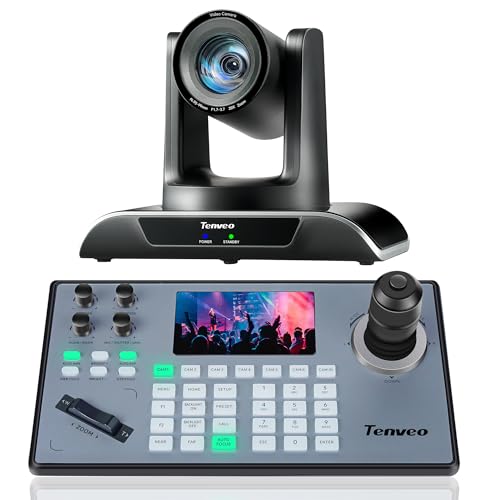
- 1080p 60fps video with 20X optical zoom
- AI body and face tracking with gesture control
- NDI joystick controller with 5-inch preview
Best For: Churches, events, and small broadcast teams needing automated tracking and manual control
Flexible 4K Streamer
Tenveo 4K NDI PTZ Camera with AI Control
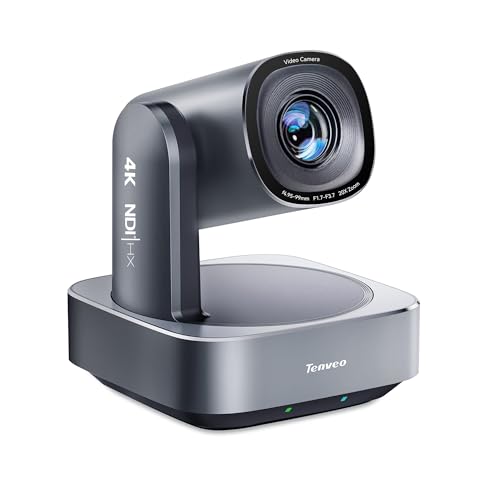
- 4K30 video with 20X optical zoom
- NDI HX2, HDMI, USB 3.0, and PoE connectivity
- AI tracking, auto-framing, and gesture control
Best For: Studios, conferences, churches, and OBS-based network productions
Best 4K60 NDI Pick

- 4K 60fps NDI HX3, HDMI, USB, and LAN output
- 20x optical zoom with configurable Gen 3 AI tracking
- PoE, 3G-SDI, RTSP, RTMP, and SRT support
Best For: Churches, studios, and live events needing flexible 4K60 production
Top Pick – Tenveo 4K NDI AI Tracking PTZ
For demanding PTZ camera for broadcast production setups, the Tenveo VX30M-Ultra combines 4K 60fps capture, NDI connectivity, and extensive output options. Its 30x optical zoom and configurable AI tracking make it well suited to covering presenters, stages, and large venues with limited operator intervention.
Best For: Large live events, church services, concerts, and multi-camera IP production workflows.
Pros:
- 4K 60fps output through HDMI and LAN/NDI, with 3G-SDI 1080p60 support.
- 30x optical zoom, 1/1.8-inch 8.42MP CMOS sensor, and low-light-oriented high-SNR imaging.
- Presenter, auto-framing, and zone-tracking modes with customizable settings.
- Built-in tally light, FreeD support, PoE, and simultaneous HDMI, SDI, USB, and LAN outputs.
Cons:
- Dante AV-H functionality requires an additional upgrade cost.
- The extensive configuration options may be more than smaller productions need.
This is a feature-rich choice when broadcast production depends on 4K, IP-based workflows, long-reach zoom, and automated subject coverage. Its broad connectivity also makes it easier to adapt as a production system grows.
Reliable Pro Option – Canon CR-N300 PTZ Camera
The Canon CR-N300 is a practical PTZ camera for broadcast production when dependable autofocus, smooth movement, and established professional connections matter. It records 4K 30p or Full HD 60p and supports SDI, HDMI, USB, IP streaming, and NDI|HX2 integration.
Best For: Education, houses of worship, stage events, conferences, and operators building Canon-based production systems.
Pros:
- 4K 30p and Full HD 60p output from a 1/2.3-inch CMOS sensor with DIGIC DV 6 processing.
- 20x optical zoom, optical image stabilization, and Hybrid AF for steady, precise coverage.
- Supports SDI, HDMI, USB, IP, RTMP, and NDI|HX2 workflows.
- Remote and software options can support control of multiple cameras, including up to 100 with the RC-IP100 controller.
Cons:
- Its maximum 4K frame rate is 30p rather than 60p.
- The 20x zoom may provide less reach than 30x alternatives for very large venues.
The CR-N300 favors polished, predictable operation over headline-grabbing specifications. Its autofocus, stabilization, flexible connections, and multi-camera control options make it a strong fit for institutional and event productions.
Most Versatile – OBSBOT Tail 2 PTZR NDI Camera
The OBSBOT Tail 2 brings unusual framing flexibility to a PTZ camera for broadcast production, combining 4K 60fps video with a three-axis PTZR design that switches between landscape and portrait orientation. Its AI tracking, hybrid zoom, and broad protocol support suit productions that need both conventional broadcasts and modern creator-focused formats.
Best For: Esports, live creators, social-first productions, and teams needing portrait and landscape capture.
Pros:
- 4K 60fps video, 1080p 120fps slow motion, and a 1/1.5-inch CMOS sensor.
- Three-axis PTZR gimbal enables one-button vertical shooting, with auto levelling and anti-shake performance.
- AI Tracking 2.0 supports group, single-target, human, animal, and object tracking.
- HDMI, SDI, USB-C, Ethernet, NDI, SRT, RTMP, VISCA, and Free-D support simplify integration.
Cons:
- The 5x lossless optical zoom is shorter than the 20x or 30x optical zoom offered by some conventional PTZ models.
- Its broad software and protocol ecosystem may require additional setup time.
Tail 2 stands out for productions that move beyond standard fixed-aspect broadcast coverage. The rotating PTZR design and advanced tracking give it particular value for esports, streaming, and mixed-format content.
Best Full HD Value – Prisual 30X AI Tracking PTZ
The Prisual 30X is a broadcast-ready PTZ camera for broadcast production focused on reliable Full HD coverage, long-range zoom, and hands-free tracking. It offers simultaneous HDMI, 3G-SDI, USB 3.0, and LAN output, plus PoE and common control and streaming protocols for straightforward venue installations.
Best For: Churches, auditoriums, conference halls, stages, and Full HD live-streaming systems.
Pros:
- 30x optical zoom with autofocus for distant speakers, performers, and stage details.
- Full HD up to 1080p60 with selectable 1080p, 1080i, and 720p formats.
- HDMI, 3G-SDI, USB 3.0, and LAN can output simultaneously.
- Presenter, zone, and auto-frame tracking, plus PoE and VISCA, Pelco, RTMP, SRT, and ONVIF support.
Cons:
- Maximum listed resolution is Full HD rather than 4K.
- Digital rather than optical image stabilization is specified.
For productions that remain centered on 1080p, the Prisual offers a useful combination of reach, output flexibility, and automated framing. Its PoE support can also simplify cabling in permanent installations.
AI Tracking Bundle – Tenveo 20X PTZ Camera with NDI Controller
For buyers seeking a ptz camera for broadcast production with hands-free subject handling, this Tenveo bundle combines a 1080p 60fps PTZ camera with a dedicated NDI joystick controller. Its HDMI, USB 3.0, LAN, and PoE connectivity supports flexible live-production and streaming setups.
Best For: Churches, schools, events, and small broadcast teams that want AI tracking plus physical joystick control.
Pros:
- 20X optical zoom with 1080p video at up to 60fps.
- Human-body and face tracking with presenter and auto-framing modes.
- Includes an NDI controller with a 5-inch preview screen and 4D joystick.
- Supports HDMI, USB 3.0, LAN/PoE, RTSP, RTMP, ONVIF, and VISCA over IP.
Cons:
- No built-in microphone, so audio requires separate equipment.
- Gesture control works best with appropriate distance and a clear view of the camera.
This is a practical all-in-one choice when tracking automation and operator control are equally important. The included controller adds production convenience, while the 1080p output keeps the system focused on reliable live streaming rather than 4K acquisition.
Broadcast 4K Pick – FoMaKo 12G-SDI FreeD PTZ Camera
The FoMaKo K820 is a strong candidate for a ptz camera for broadcast production when uncompressed 4K60 SDI, IP workflows, and virtual production matter. It pairs a 1/1.8-inch 8.42MP sensor and 20X optical zoom with 12G-SDI, NDI HX3, SRT, HDMI, USB, and FreeD support.
Best For: Broadcast studios, OB vans, virtual sets, and larger live-production systems using SDI or IP infrastructure.
Pros:
- 12G-SDI delivers uncompressed 4K at 60fps over a single coaxial cable.
- FreeD transmits PTZ position, rotation, and lens data for AR/VR workflows.
- Ambarella processing, 3D noise reduction, and 0.5-lux sensitivity support challenging lighting.
- Supports simultaneous HDMI, SDI, USB, and LAN outputs plus PoE+.
Cons:
- The broadcast-focused feature set may be more than a basic streaming setup requires.
- USB output is limited to 4K30, while 4K60 is available through specified outputs.
Among these options, this model is the most directly aligned with conventional broadcast and virtual-production infrastructure. Its 12G-SDI and FreeD capabilities make it especially useful where established switchers, routers, or Unreal Engine-based workflows are part of the plan.
Flexible 4K Streamer – Tenveo 4K NDI PTZ Camera with AI Control
This Tenveo offers a flexible route to a ptz camera for broadcast production when 4K capture, NDI networking, and automated framing are priorities. The camera combines 20X optical zoom, 4K30 video, HDMI, USB 3.0, LAN/PoE, and AI tracking in a standalone unit.
Best For: Studio broadcasts, church services, conferences, and OBS-based productions that need network video and automated subject framing.
Pros:
- 4K30 capture from an 8.29MP 1/2.8-inch CMOS sensor.
- 20X optical zoom plus 8X digital zoom and a 63-degree wide-angle lens.
- NDI HX2 supports low-latency IP video and PTZ control in lower-bandwidth environments.
- AI body and face tracking includes presenter, auto-framing, and gesture-control modes.
Cons:
- No built-in microphone.
- IP/NDI streaming output is specified up to 1080p30, despite 4K HDMI and USB outputs.
- The notes recommend at least 2.5 meters between camera and subject for best focus.
This model makes sense for teams that want 4K local outputs while keeping an efficient NDI-based network workflow. It is less suited to buyers specifically requiring 4K60 or 12G-SDI, but its AI controls and PoE connectivity simplify many studio and event installations.
Best 4K60 NDI Pick – FoMaKo K600N
For buyers seeking a PTZ camera for broadcast production with high-frame-rate 4K, the FoMaKo K600N stands out for its 4K 60fps NDI HX3, HDMI, and USB 3.0 output options. Its 20x optical zoom, configurable Gen 3 AI tracking, PoE support, and broad software compatibility suit multi-camera live production.
Best For: Churches, live studios, events, and producers needing simultaneous 4K60 outputs.
Pros:
- Supports 4K 60fps through NDI HX3, HDMI, USB 3.0, and LAN.
- Offers 20x optical zoom with fast autofocus and adjustable pan, tilt, and zoom speeds.
- Gen 3 AI tracking provides presenter, regional, sensitivity, and lost-target adjustments.
- Includes 3G-SDI output, PoE, RTSP, RTMP, and SRT support.
Cons:
- 3G-SDI output is limited to 1080p60 rather than 4K.
- The feature set may require more setup than a basic plug-and-play webcam.
The K600N is a strong choice when 4K60 flexibility and customizable tracking matter more than keeping the system simple. Its NDI, SDI, HDMI, and USB connectivity also makes it easier to integrate into varied production environments.
Best Networked Production Workflow – Tenveo 4K NDI PTZ Camera
The Tenveo 4K NDI PTZ camera is a practical PTZ camera for broadcast production when network control, presenter tracking, and mixed-format outputs are priorities. It combines 4K30 HDMI and USB video with 3G-SDI, NDI networking, PoE, tally signaling, and multiple control methods.
Best For: Broadcast teams, churches, educators, and event producers using NDI, OBS, vMix, or IP-based workflows.
Pros:
- Provides 20x optical zoom and 4K30 video through HDMI and USB 3.0.
- AI tracking includes presenter, humanoid/face, and auto-framing modes.
- Supports simultaneous HDMI, 3G-SDI, USB, and NDI video output.
- PoE, tally lights, audio line input/output, H.264/H.265, and an IP search tool simplify production integration.
Cons:
- NDI output does not transmit audio.
- NDI streaming is listed at 1080p30, while HDMI and USB support 4K30.
- Optimal focusing distance is at least 2.5 meters from the subject.
Tenveo’s model is especially useful for teams building a networked studio or venue system. The combination of NDI control, tally communication, PoE, and multiple video interfaces gives it a production-oriented feature set, though buyers should plan separate audio routing for NDI workflows.
Best Full HD Broadcast Value – Prisual TEM-20S Pro
For productions that prioritize dependable Full HD delivery, the Prisual TEM-20S Pro is a capable PTZ camera for broadcast production. It offers 1080p60 output, broadcast-friendly 1080p, 1080i, and 720p formats, 20x optical zoom, AI framing modes, and four simultaneous connection types.
Best For: Churches, classrooms, conferences, and live-streaming setups built around professional Full HD systems.
Pros:
- Captures Full HD video at up to 1080p60 with selectable broadcast formats.
- Presenter, Zone, and Auto Frame tracking modes help maintain subject framing.
- Offers HDMI, 3G-SDI, USB 3.0, and LAN output simultaneously.
- Supports PoE, VISCA control, RTSP, RTMP, SRT, ONVIF, and H.264/H.265 workflows.
Cons:
- Maximum listed video resolution is Full HD rather than 4K.
- The supplied details contain differing warranty references, so buyers should confirm the current coverage.
The TEM-20S Pro makes sense for buyers who do not need 4K but want smooth 60fps video and broad broadcast compatibility. Its 20x optical zoom, fast autofocus, PoE, and multiple control protocols provide a solid foundation for established Full HD production systems.
How We Picked the Best Ptz Camera for Broadcast Production
We focused on features that directly affect reliability and production flexibility: video resolution and frame rates, sensor size, optical zoom, output connections, network support, tracking performance, remote control, and installation requirements. Models with NDI, SDI, HDMI, USB, PoE, or combinations of these standards can fit different studio and venue infrastructures.
We also considered practical use cases. A camera for a permanent studio may prioritize 12G-SDI, low-light performance, and precise presets, while a small streaming team may benefit more from USB connectivity, NDI, AI auto-tracking, and a simple PoE installation.
Quick Comparison
- Best for maximum connectivity: Choose a model offering SDI, HDMI, USB, NDI, and PoE when you need compatibility with both traditional broadcast gear and IP workflows.
- Best for long-distance framing: A 20x or 30x optical zoom is useful for auditoriums, stages, houses of worship, and large classrooms.
- Best for solo operators: AI auto-tracking and auto-framing can keep presenters or speakers centered without a dedicated camera operator.
- Best for 4K streaming: Look for 4K at 60 frames per second when motion detail and smooth camera movement matter.
Key Buying Factors for a Ptz Camera for Broadcast Production
Resolution, Frame Rate, and Sensor
4K provides extra detail and cropping flexibility, while 60fps produces smoother movement and is valuable for live performances or fast camera moves. A larger sensor can improve image quality in dim venues, but lighting and lens performance remain equally important.
Optical Zoom and Placement
Optical zoom preserves image quality; digital zoom generally sacrifices detail. Choose 20x for many medium-sized rooms and 30x when the camera must cover a long distance. Confirm that the lens’s wide end is suitable for close positions.
Outputs and Networking
SDI is a dependable choice for longer cable runs and broadcast systems. HDMI works well with nearby switchers and displays, while USB simplifies computer-based production. NDI and PoE can reduce cabling by carrying video, control, and power over a network, but verify switch compatibility and bandwidth.
Tracking and Control
AI tracking is helpful for presenters, instructors, and speakers who move around a defined area. Check whether the camera supports face, body, gesture, or zone tracking, and whether tracking can be disabled for conventional preset-based operation. Also confirm compatibility with your controller, software, tally system, and automation workflow.
Who Should Buy Which Ptz Camera for Broadcast Production?
Studios and established broadcast facilities should prioritize SDI, reliable presets, low-latency control, and broad integration support. Churches, schools, and event venues may prefer 20x or 30x optical zoom, PoE, NDI, and AI tracking to cover large spaces with minimal staffing. Independent creators and small production teams should look for 4K60, USB connectivity, straightforward software control, and tracking that works without extensive configuration.
Before buying, confirm the camera’s actual output formats, regional power requirements, mounting method, controller compatibility, and network capacity. The right Ptz Camera for Broadcast Production is the one that fits your existing workflow while leaving enough connectivity and zoom headroom for future upgrades.