
Choosing the right bench PSU can make prototyping, repair, and testing faster, safer, and more repeatable. The best programmable bench power supplies give you precise voltage and current control, plus convenience features that reduce setup time.
In this roundup, we focus on models that balance accuracy, usability, output range, and value for lab, workshop, and hobby use.
Best 10 Programmable Bench Power Supplies Picks for 2026
Lab-Grade Control
KORAD KA3005P 30V 5A Programmable Linear Supply

- 30V/5A linear output with 0.001V/0.001A resolution
- USB and RS232 remote control with software included
- 4 memory presets plus constant voltage/current modes
Best For: Small labs and hobbyists who need precise, programmable bench control
Color Screen Workhorse
Siglent SPD1305X 30V 5A DC Supply
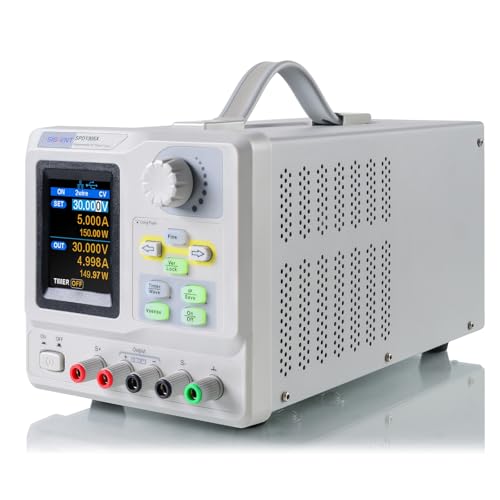
- 30V/5A output with 150W capacity
- 2.8-inch true-color TFT-LCD with 1 mV/1 mA steps
- USB and LAN connectivity for remote operation
Best For: Engineers who want a networked bench supply with a color display
Compact High-Current Option
NANKADF 30V 10A Adjustable Bench Supply

- 30V/10A output in a compact form factor
- Encoder knob and 4-digit display for precise setting
- USB fast-charging port plus output enable/disable button
Best For: Anyone needing a compact high-current adjustable bench supply
Modern Programmable Pick
FNIRSI DPS-150 30V 5A Smart Supply

- PC programmable with 6 preset output groups
- 2.8-inch IPS color screen with curve display
- <20mV ripple and multiple safety protections
Best For: Makers and technicians who want smart programmable control in a compact supply
Compact Programmable Bench Supply

- 2.8-inch TFT LCD shows set and actual readings
- Includes current, thermal, overload, short-circuit, and over-power protection
- 4 memory presets plus timing output and PC software control
Best For: Small workbenches needing a compact programmable DC supply with clear status display
Portable PC-Programmable PSU

- 30V/5A output with <20mV ripple
- PC programmable with 6 preset output groups
- Supports multiple connection methods and input modes
Best For: Portable electronics work needing a compact programmable DC supply with low ripple
High-Control Bench PSU
SKY TOPPOWER 32V 10A Dual Display

- 32V/10A output with dual display feedback
- USB-C PC control with real-time recording support
- 1mV/1mA encoder adjustment plus lock and OCP
Best For: Precision bench work that benefits from higher current, fine control, and PC connectivity
High-Range Pick
MATRIX 150V 5A Programmable Lab Supply

- 0-150V, 0-5A output with 300W capacity
- 1mV / 0.1mA resolution and low ripple
- RS232, RS485, USB, and 9 memory presets
Best For: Higher-voltage lab and repair benches
PC Control Pick
NICE-POWER 200V Programmable Supply

- 200V, 1A, 200W output for high-voltage tasks
- Windows PC software with RS232/USB control
- 4 memory slots, lock button, and output switch
Best For: PC-controlled testing and saved voltage setups
Value Current Pick

- 0-32V, 0-10A output with up to 320W
- Live digital voltage and current display
- Multiple protections with temperature-controlled fan
Best For: General bench use needing higher current
Lab-Grade Control – KORAD KA3005P 30V 5A Programmable Linear Supply
If you want programmable bench power supplies for precise everyday lab work, the KORAD KA3005P is built around easy, repeatable control. It combines a fine/coarse adjustment knob, constant voltage and constant current modes, plus USB and RS232 remote control for setups where dialing in exact output matters.
Best For: Small labs, hobbyists, and technicians who want a precise 30V/5A linear supply with memory and remote control.
Pros:
- 0.001V and 0.001A resolution with a clear 4-digit back-lit LED display
- 4 memory recall buttons help save common settings
- USB and RS232 ports support programmable remote control
- Built-in protections include overload, short-circuit, thermal protection, and a load on/off switch
Cons:
- Single-channel output only
- Linear benchtop design is larger and heavier than compact units
- No color screen or app-style interface
For users who value straightforward controls and dependable measurement accuracy, the KA3005P is a practical bench option. Its combination of memory presets, safety features, and remote-programming support makes it easy to use in a lab or home test bench.
Color Screen Workhorse – Siglent SPD1305X 30V 5A DC Supply
Siglent Technologies SPD1305X Programmable DC Power Supply 1 Channel,30 V / 5 A,150W
Check Price On AmazonAmong programmable bench power supplies, the Siglent SPD1305X stands out for users who want a more polished bench experience. It offers a 2.8-inch true-color TFT-LCD, fine 1 mV/1 mA display steps, and USB/LAN connectivity for remote operation in a lab or test station.
Best For: Engineers and lab users who want a benchtop 30V/5A supply with a color display and network control.
Pros:
- 0 to 30V and 0 to 5A output range with 150W capacity
- 2.8-inch true-color TFT-LCD is easy to read
- USB and LAN connectors support remote use
- Quoted accuracy specs are tight for voltage and current settings
Cons:
- Only one output channel
- Heavier benchtop unit at 5.5 kg
- Higher-end presentation may be more than casual users need
The SPD1305X is a strong fit when display quality and connectivity matter as much as output control. It keeps the familiar 30V/5A bench format while adding a color interface and LAN support for more modern lab workflows.
Compact High-Current Option – NANKADF 30V 10A Adjustable Bench Supply
If your shopping list for programmable bench power supplies leans toward higher current in a compact package, this NANKADF unit is worth a look. It pairs a precise encoder knob with a 4-digit LED display, output enable/disable control, and a built-in USB fast-charging port for extra convenience at the bench.
Best For: Users who want a compact 30V/10A adjustable supply with precise digit-by-digit control.
Pros:
- Encoder knob lets you adjust each digit more precisely
- Output enable/disable button helps prevent accidental load issues
- 4-digit display shows 0.01V and 0.001A resolution
- Includes OCP short-circuit protection and an 18W USB fast-charging port
Cons:
- Uses only a basic LED display, not a color screen
- Designed for 115V input only
- Less feature-rich than larger lab-style programmable supplies
This model makes sense when you need more current than a typical 5A bench supply and prefer simple, accurate control. Its compact size, protection features, and output switch make it especially practical for general bench use.
Modern Programmable Pick – FNIRSI DPS-150 30V 5A Smart Supply
The FNIRSI DPS-150 brings a more modern take to programmable bench power supplies with PC programming, preset output groups, and a color IPS display. It supports PC, QC, and DC input modes, while still delivering the familiar 30V/5A bench range and low ripple output for sensitive electronics.
Best For: Makers and technicians who want a compact programmable supply with presets, multiple input modes, and a color display.
Pros:
- PC programmable output with 6 preset parameter groups
- 2.8-inch IPS color screen with 90° flip and curve display
- <20mV power ripple helps protect precision electronics
- Multiple safety protections include overvoltage, overcurrent, short circuit, and overheating
Cons:
- Only 5A output, so it is not for higher-current loads
- Compact 150W unit may be limiting for larger bench tasks
- Connection options are diverse, but the overall unit is still a single-channel supply
For users who want a compact bench supply with smarter controls and a vivid display, the DPS-150 is a compelling option. The preset memory, PC programmability, and broad input support make it especially flexible for modern test setups.
Compact Programmable Bench Supply – OWON SPE3051 0-30V 0-5A LCD
If you want a programmable bench power supply for a small electronics workspace, the OWON SPE3051 focuses on practical control and clear status feedback. It offers 0-30V and 0-5A output, CC protection behavior, memory presets, and PC software support, making it useful for routine lab testing and adjustable DC tasks.
Best For: Hobbyists and technicians who want a compact programmable bench PSU with preset recall and USB/PC control.
Pros:
- 2.8-inch TFT LCD shows set and actual voltage/current, output power, time, and output status
- Includes multiple protections such as current limit, thermal, overload, short-circuit, and over-power protection
- 4 memory shortcut parameter groups and 10 groups of timing output for quicker repeatable setup
- Built-in 5V/1A USB charging port plus USB communication for firmware updates and PC software control
Cons:
- Single-channel output only
- 150W class output may be limiting for higher-power bench jobs
- Small size is convenient, but it may be less suitable if you need a larger front panel or more channels
Overall, the SPE3051 stands out as a compact programmable bench power supply with useful display detail and everyday protection features. It fits well when you need a small, controllable DC source rather than a heavy-duty multi-output station.
Portable PC-Programmable PSU – FNIRSI DPS-150 30V 5A
The FNIRSI DPS-150 is a programmable bench power supply aimed at users who want a compact variable DC source with modern input options. It supports 30V, 5A output, PC programmable control, preset output groups, and a low ripple rating under 20mV, which makes it practical for sensitive electronics work.
Best For: Electronics users who need a small programmable bench PSU with low ripple, multiple input modes, and quick preset access.
Pros:
- 30V/5A, 150W output with 0.01V and 0.001A display resolution
- Low power ripple under 20mV for better stability with precision equipment
- PC programmable output with 6 preset groups for faster setup changes
- Flexible connections including banana heads, U-shaped terminals, and fine copper wires
Cons:
- No power adapter included
- Battery charging use calls for a reverse-current protection module
- Compact format may not suit users needing larger bench controls or higher output power
For bench work where portability and control matter, the DPS-150 combines a tidy footprint with useful programmable features. Its low ripple and preset memory make it a sensible option for electronics testing and general variable DC use.
High-Control Bench PSU – SKY TOPPOWER 32V 10A Dual Display
This programmable bench power supply is built for users who want more control and more output headroom in a single-channel lab PSU. With 32V and 10A capability, USB-C PC control, dual display feedback, and an encoder knob for fine adjustments, it is aimed at test benches, repair work, and repeatable power settings.
Best For: Engineers, makers, and lab users who need a higher-current programmable bench supply with precise adjustment and PC control.
Pros:
- 32V/10A, 320W output for broader bench and repair use
- Dual display shows set value and actual output value at the same time
- USB-C communication enables PC control, parameter adjustment, and real-time recording
- Encoder knob supports 1mV/1mA fine adjustment plus lock and one-key OCP functions
Cons:
- Single-channel design only
- Fan cooling may be a consideration in quiet workspaces
- Focuses on control and versatility rather than multi-output bench use
For users comparing programmable bench power supplies, this SKY TOPPOWER model leans toward precision, automation, and easier parameter management. It is a strong fit when you want fine control, PC integration, and enough current for a wide range of electronics tasks.
High-Range Pick – MATRIX 150V 5A Programmable Lab Supply
If you need programmable bench power supplies for higher-voltage work, this MATRIX unit stands out with a 0-150V, 0-5A output range and 300W capacity. It is aimed at electronics repair, DIY projects, lab use, and school settings, and it adds fine 1mV / 0.1mA resolution plus low ripple for more controlled testing.
Best For: Labs, repair benches, and projects that need a wide voltage range with programmable control.
Pros:
- Wide 0-150V, 0-5A output range with 300W capacity.
- High 1mV and 0.1mA resolution with low ripple noise.
- RS232, RS485, and USB support SCPI and MODBUS control.
- Stores and recalls up to 9 data sets, plus LIST output mode.
Cons:
- Higher-voltage bench supply may be more than casual hobbyists need.
- Front-panel feature set can feel complex if you only want basic output.
This is a strong fit if programmability, remote control, and a broad output range matter more than simplicity. The compact 4.4 lb design, five-digit display, and built-in protections make it practical for repeated bench use.
PC Control Pick – NICE-POWER 200V Programmable Supply
Among programmable bench power supplies, this NICE-POWER model is built for users who want direct computer control and simple front-panel operation. It offers a 200V, 1A, 200W output, RS232/USB connectivity, Windows software for setting values and plotting data, plus memory storage for repeat tasks.
Best For: Users who want PC-based control, saved settings, and a high-voltage bench supply.
Pros:
- PC software lets you control voltage/current from a Windows computer.
- RS232/USB connection supports programming, data export, and graphs.
- Encoder knob and output switch make adjustment and load protection straightforward.
- Four memory presets and a lock button help prevent accidental changes.
Cons:
- Software is Windows-only.
- 1A output makes it better for voltage-focused work than high-current loads.
This is a practical choice if you value software-driven control and a compact bench footprint. The color screen, protection features, and included cables make it easy to set up for repeated lab or test work.
Value Current Pick – Tuodapu 32V 10A Bench Supply
If you want programmable bench power supplies for everyday lab and workshop use, this Tuodapu unit covers a broad 0-32V, 0-10A range with up to 320W output. It is positioned for electronics, ham radio, electroplating, model trains, LED strips, and other AC-to-DC uses, while the digital display and adjustable controls make monitoring simple.
Best For: General-purpose bench work that needs higher current and flexible everyday output.
Pros:
- 0-32V and 0-10A output suits a wide range of bench tasks.
- Digital voltmeter and ammeter show live voltage and current.
- Built-in over-voltage, over-current, over-power, and short-circuit protection.
- Temperature-controlled fan helps with cooling and quieter operation.
Cons:
- Programmable features are less detailed in the supplied notes than on some rivals.
- Broader-purpose design may not be as specialized for precision high-voltage work.
This is a flexible option when you need more current headroom for common bench projects. The sturdy metal case and active cooling make it a sensible everyday supply for hobby and shop environments.
How We Picked the Best Programmable Bench Power Supplies
We prioritized Programmable Bench Power Supplies that offer dependable regulation, practical control features, and enough output headroom for common electronics tasks. We also looked at display quality, adjustment resolution, output enable controls, PC/software support, and the overall fit for bench, lab, and repair workflows.
Because different users need different voltage and current ranges, we included compact single-channel units, higher-power options, and models with broader programmability for more specialized use cases.
Quick Comparison
For basic electronics and hobby work, a 0-30V, 0-5A supply is usually the sweet spot. If you need higher current for motors, LED arrays, or automotive accessories, step up to a 10A model. For advanced testing, multi-step automation, or wider voltage coverage, a higher-range programmable supply may be the better long-term choice.
Also consider whether you want a linear or switching design. Linear units are often favored for lower noise, while switching supplies can deliver more power efficiently and at a lower cost per watt.
Key Buying Factors for Programmable Bench Power Supplies
Voltage and Current Range
Match the output range to your projects first. A supply that is too small will feel limiting quickly, while an oversized unit may cost more than you need. Think about your most common loads, not only your maximum possible load.
Resolution, Accuracy, and Ripple
Fine adjustment matters when you are powering sensitive circuits. Look for clear voltage/current resolution, stable regulation, and low ripple if you work with analog, RF, or precision digital electronics.
Programmability and Controls
Some Programmable Bench Power Supplies offer simple memory presets, while others add PC control, list output, or remote adjustment. Choose the level of automation that matches your workflow, not just the most feature-rich spec sheet.
Display and Safety Features
A readable display, output on/off button, overcurrent protection, and clear status indicators improve both usability and safety. These features are especially useful when testing new circuits or training new users.
Who Should Buy Which Programmable Bench Power Supplies?
Hobbyists and general electronics users usually do best with a compact 0-30V, 0-5A unit that is easy to read and simple to operate. Repair techs and lab users may prefer stronger regulation, better display feedback, and programmable presets.
If you routinely work on high-current loads, choose a higher-amp model. If your work involves automation, repeatable test sequences, or remote operation, prioritize PC control and deeper programming features. In short, the best choice depends on whether you value simplicity, power, precision, or software-driven control most.