
The right inverter can make RV travel more comfortable by turning 12-volt battery power into usable AC electricity for appliances, electronics, tools, and other essentials. But choosing among different wattage ratings, waveforms, outlets, and installation features can be confusing.
We evaluated these 10 power inverters for RVs with an emphasis on usable output, surge capacity, device compatibility, battery demands, and practical features such as transfer switches, displays, remotes, and solar readiness.
Best 10 Power Inverters for Rvs Picks for 2026
Top RV Integration Pick
2500W Pure Sine Wave Inverter with ATS

- 2,500W continuous and 5,000W peak output
- Automatic shore-power and battery switching
- Hardwire-ready design for RV electrical systems
Best For: RV owners wanting automatic transfer switching and permanent installation
High-Capacity Value Pick
TOPBULL 3000W Vehicle and RV Inverter
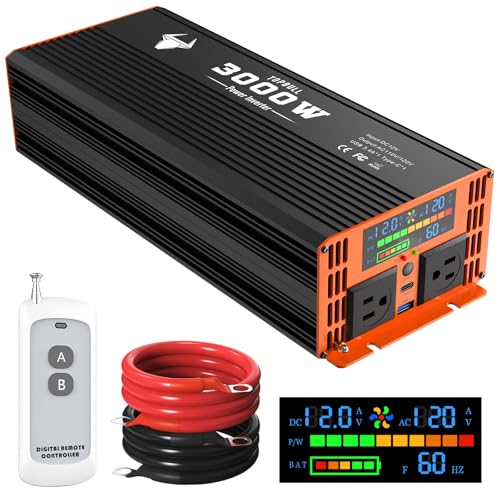
- 3,000W continuous and 6,000W peak output
- Two 20A outlets with USB and Type-C charging
- Color display and 200-foot wireless remote
Best For: RV users needing high output and convenient remote monitoring
Pure Sine Wave Performance Pick

- 3,000W pure sine wave and 6,000W peak output
- Three AC outlets plus hardwired terminal
- 15-foot wired remote with status monitoring
Best For: RV users powering sensitive electronics and demanding appliances
Remote-Control Convenience Pick

- 3,000W continuous and 6,000W peak output
- 200-foot wireless remote with color LED display
- Two 20A outlets plus USB and Type-C ports
Best For: RV owners wanting long-range control and quiet operation
Best High-Capacity Pick
2000W Pure Sine Wave RV Inverter

- 2,000W continuous and 4,000W peak output
- Pure sine wave power for sensitive electronics
- LCD display and 23-foot wired remote
Best For: RV and off-grid users needing clean, higher-capacity power
Best Maximum-Output Value
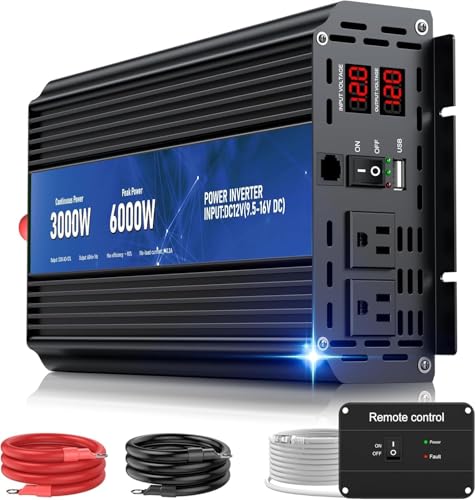
- 3,000W continuous and 6,000W peak output
- LCD monitoring with 14.8-foot remote
- Automatic fans and aluminum housing
Best For: High-demand RV, truck, and emergency-power setups
Best Compact Pure Sine Option

- 1,500W continuous and 3,000W peak output
- Pure sine wave power with four AC outlets
- 14.76-foot LCD remote plus USB and Type-C ports
Best For: Moderate RV and off-grid loads needing clean power
Best with Extra Features

- 4000W continuous and 8000W peak output
- Four AC outlets plus USB and Type-C charging
- LCD display, 200-foot remote, and multiple protections
Best For: High-demand RV and off-grid appliance use
Pure Sine Wave Pick

- 1000W continuous and 2000W surge output
- Pure sine wave power for compatible electronics
- Two AC outlets, USB port, terminal block, and remote
Best For: Sensitive electronics and moderate RV loads
Maximum Output Option

- 5000W continuous and 10000W peak output
- LCD status display and 150-foot wireless remote
- Four AC outlets with built-in protection features
Best For: Large RVs and high-demand off-grid applications
Top RV Integration Pick – 2500W Pure Sine Wave Inverter with ATS
For RV owners seeking dependable power inverters for RVs, this ZETAWALE model combines clean pure sine wave output with an automatic transfer switch. Its 2,500W continuous capacity is suited to common RV appliances, while the hardwire-ready design supports a more permanent installation.
Best For: RV owners who want automatic shore-power and battery switching in a hardwired electrical setup.
Pros:
- Pure sine wave output with 2,500W continuous and 5,000W peak power
- Built-in ATS switches between shore power and battery power automatically
- Supports lithium, AGM, deep-cycle, and lead-acid 12V batteries
- Includes protection features, dual cooling fans, LCD remote, USB, and Type-C charging
Cons:
- Requires an external 12V battery, which is not included
- Hardwired installation may require additional electrical setup
This is a practical choice for campers, fifth wheels, and motorhomes that need uninterrupted AC power and a cleaner installation than a basic plug-in inverter provides.
High-Capacity Value Pick – TOPBULL 3000W Vehicle and RV Inverter
This TOPBULL model is one of the higher-output power inverters for RVs, delivering 3,000W continuously and up to 6,000W at peak. It offers two 20A AC outlets, fast-charging USB ports, a color display, and remote operation for flexible use in an RV, vehicle, or off-grid setup.
Best For: RV and vehicle users who need substantial AC capacity with multiple charging ports and remote control.
Pros:
- 3,000W continuous output with 6,000W peak capacity
- Two 20A AC outlets plus 3.4A USB and 30W Type-C ports
- Color display shows voltage, power, and operating status
- Wireless remote supports operation from up to 200 feet away
Cons:
- The supplied notes do not identify the output waveform
- Requires connection to a compatible 12V or 12.8V battery
With its strong output rating, broad protection package, and long-range remote, this inverter is appealing for larger RV power demands, though buyers who specifically need pure sine wave output should verify the specification before purchasing.
Pure Sine Wave Performance Pick – LANDERPOW 3000W RV Inverter
The LANDERPOW is a strong contender among power inverters for RVs when clean electricity and heavy startup loads are priorities. Its pure sine wave output, 3,000W continuous rating, and 6,000W surge capacity are designed for appliances and electronics ranging from microwaves and laptops to coffee makers and window air conditioners.
Best For: RV travelers who want pure sine wave power, high capacity, and detailed monitoring from a wired remote.
Pros:
- 3,000W pure sine wave output with 6,000W peak power
- Three AC outlets plus a hardwired terminal for higher-current equipment
- Includes USB and 30W PD charging ports
- 15-foot remote displays battery level, output, and errors
Cons:
- Higher-capacity operation can place significant demands on a 12V battery system
- Its wired remote may be less convenient than a wireless controller for some layouts
Thick 1 AWG copper cables, multiple protection functions, a metal housing, and a three-year coverage package make this a well-equipped option for demanding RV, job-site, and emergency use.
Remote-Control Convenience Pick – TOPBULL 3000W RV Converter
This TOPBULL converter brings high output and convenient status monitoring to the power inverters for RVs category. It converts 12V DC to 110V/120V AC at up to 3,000W continuously, with two high-power outlets, USB and Type-C charging, and a wireless remote rated for operation from up to 200 feet.
Best For: RV owners who value long-range wireless control, quiet operation, and multiple output ports.
Pros:
- 3,000W continuous output with 6,000W peak power
- Two 20A AC outlets, 3.4A USB, and 30W Type-C charging
- 200-foot wireless remote and color LED display show operating data
- Reported conversion efficiency above 93% and dual smart fans
Cons:
- The supplied notes do not specify the output waveform
- Its high output requires a suitable 12V or 12.8V battery and proper cabling
The extensive protection system and low-noise cooling design make this a versatile choice for RV travel, emergency power, and off-grid use. Confirm the waveform requirement for sensitive equipment before buying.
Best High-Capacity Pick – 2000W Pure Sine Wave RV Inverter
For RV owners looking for power inverters for rvs that can handle sensitive electronics and startup surges, this BELTTT model combines 2,000W of continuous output with a 4,000W peak rating. Its pure sine wave output, LCD monitoring, and included remote make it practical for off-grid use.
Best For: RVs, trucks, and off-grid setups needing clean power for electronics, appliances, and other loads.
Pros:
- Pure sine wave output is suitable for sensitive and inductive loads.
- Provides 2,000W continuous power and up to 4,000W peak power.
- Includes an LCD display, dual AC outlets, USB port, hardwire port, and 23-foot remote.
- Built-in protection covers undervoltage, overvoltage, overload, overheating, short circuits, and reverse connection.
Cons:
- Requires a 12V battery or solar-battery setup and appropriate installation.
- Its 2,000W capacity may not be enough for multiple high-draw appliances running simultaneously.
With reported efficiency above 93% during normal operation and UL/ETL specifications, this is a well-equipped choice when clean, monitored power matters more than minimizing size.
Best Maximum-Output Value – 3000W RV Power Inverter
This HONOURLIGHT model stands out among power inverters for rvs with 3,000W of continuous output and a 6,000W peak rating. It is designed for 12V battery systems and includes real-time monitoring, automatic cooling fans, and a long wired remote.
Best For: RV travel, trucks, trailers, emergency backup, and off-grid setups that need substantial modified-sine-wave output.
Pros:
- Offers 3,000W continuous power and 6,000W peak power for demanding loads.
- LCD display shows input/output voltage, battery level, and protection status.
- 14.8-foot wired remote supports operation from a convenient location.
- UL and CSA certification claims, dual cooling fans, and aluminum housing support practical installation and heat management.
Cons:
- Uses a modified sine wave rather than pure sine wave output.
- Only two AC outlets and one USB port are listed.
- High output demands suitable 12V battery capacity and properly sized wiring.
If your priority is maximum rated output for an RV or truck system, this inverter offers more continuous and peak capacity than the other options here, though its modified sine wave design makes device compatibility worth checking.
Best Compact Pure Sine Option – 1500W RV Inverter
For shoppers who want power inverters for rvs with clean output in a smaller package, this ZETAWALE unit delivers 1,500W continuously and 3,000W at peak. It adds four AC outlets, USB and Type-C ports, terminal blocks, and a 14.76-foot LCD remote.
Best For: RV owners, truck drivers, contractors, and off-grid users running moderate loads that benefit from pure sine wave power.
Pros:
- Pure sine wave output is specified for appliances and sensitive electronics.
- Four AC outlets plus USB, Type-C, and terminal-block connections provide flexible connectivity.
- Remote displays battery voltage, AC output voltage, and load wattage.
- Protection features include overload, overvoltage, low voltage, overheating, and short-circuit safeguards.
Cons:
- Its 1,500W continuous rating is lower than the other two models.
- High-demand appliances may exceed its capacity when used together.
- It requires a 12V battery system and suitable installation wiring.
This is a practical middle-ground choice for RV use: it offers clean power and unusually broad outlet options while remaining smaller and lighter than many higher-output alternatives.
Best with Extra Features – DEECHI 4000W RV Inverter
For RV owners who need substantial off-grid output, this 4000W DEECHI is one of the more powerful power inverters for RVs. It converts 12V DC battery power to 110/120V AC, with four outlets, USB charging, an LCD display, and a long-range remote.
Best For: RVs, trucks, and off-grid setups running several higher-demand appliances, provided the battery system and wiring are sized appropriately.
Pros:
- 4000W continuous output with 8000W peak capacity.
- Four AC outlets, two USB ports, and one Type-C port.
- LCD monitoring and a 200-foot remote controller.
- Includes multiple protection features and temperature-controlled fans.
Cons:
- Uses a modified sine wave output rather than pure sine wave.
- Its high power rating can require substantial battery capacity and cabling.
This is a feature-rich option when maximum output matters more than compactness or pure sine wave compatibility. Check your appliances’ power requirements and follow the installation instructions before use.
Pure Sine Wave Pick – Renogy 1000W RV Inverter
The Renogy P2 is a practical choice for RV owners prioritizing clean power for sensitive electronics. As one of the more electronics-friendly power inverters for RVs, it provides 1000W of pure sine wave AC power, plus USB charging, two outlets, and a wired remote.
Best For: RVs, trucks, and campers powering laptops, televisions, freezers, lights, and other electronics within a 1000W continuous limit.
Pros:
- Pure sine wave output is designed to help electronics run smoothly and quietly.
- 1000W continuous output with 2000W startup surge capacity.
- Includes two AC outlets, a USB port, and an AC terminal block.
- UL 458 and CSA C22.2 No. 107.1 certified, according to the supplied details.
Cons:
- Lower output capacity than the 4000W and 5000W alternatives.
- The included remote is wired and has a shorter 16.4-foot cable.
This is the strongest fit of the three for users who value pure sine wave output over maximum wattage. Use a suitable deep-cycle battery and keep the total connected load within the inverter’s limits.
Maximum Output Option – EFFORTWAY 5000W RV Inverter
With 5000W of continuous output, the EFFORTWAY is built for RV users who need to run multiple substantial loads from a 12V battery system. It converts DC power to 110/120V AC and includes four outlets, an LCD display, and a wireless remote.
Best For: Large motorhomes, mobile offices, and off-grid systems with sufficient battery capacity, ventilation, and appropriately sized cables.
Pros:
- 5000W continuous output and 10000W peak capacity.
- LCD shows input/output voltage, battery capacity, load capacity, and error codes.
- Four AC outlets and a wireless remote with up to 150 feet of range.
- Includes cooling fans, built-in fuses, and several fault protections.
Cons:
- Uses a modified sine wave waveform.
- Large loads can quickly demand significant 12V battery current.
- The remote has a specific startup procedure noted in the product instructions.
This model makes sense when maximum rated output is the priority, but its 12V architecture requires careful installation and battery planning. Monitor the LCD and respond to error codes using the supplied guidance.
How We Picked These Power Inverters for Rvs
We focused on the specifications that matter most in an RV: continuous wattage, peak or surge capacity, output waveform, input voltage, connection options, monitoring, and installation features. The lineup includes pure sine wave models for sensitive electronics, higher-output options for demanding loads, and more compact units for basic off-grid use.
Because advertised wattage does not tell the whole story, we also considered whether an inverter is practical for a 12-volt battery system. A powerful model can require very thick cables, substantial battery capacity, careful ventilation, and appropriate fusing.
Quick Comparison
- Best for sensitive electronics: Pure sine wave models, including the Renogy 1000W, BELTTT 2000W, and 2500W and 3000W pure sine wave options.
- Best for moderate loads: 1000W to 2000W inverters for laptops, televisions, chargers, small kitchen appliances, and similar equipment.
- Best for demanding RV appliances: 3000W to 5000W models, provided your battery bank, cables, and charging system can support them.
- Best for easier monitoring: Models with LCD displays or wired and wireless remotes.
- Best for shore-power integration: An inverter with a built-in automatic transfer switch can simplify switching between external AC power and battery power.
Key Buying Factors for Power Inverters for Rvs
Continuous and Surge Wattage
Choose continuous wattage based on the devices you expect to run at the same time. Add their running watts, then leave headroom for startup loads. Refrigerators, microwaves, pumps, compressors, and power tools can briefly require considerably more power than their operating ratings.
Pure Sine Wave Output
Pure sine wave power is the safer choice for medical equipment, motor-driven appliances, modern chargers, audio equipment, and sensitive electronics. Modified-sine models may cost less, but they can create noise, excess heat, reduced efficiency, or compatibility problems with some devices.
Battery, Cabling, and Safety
At 12 volts, a 3000W load can draw roughly 250 amps before accounting for conversion losses. Use appropriately sized cables, short connections, proper overcurrent protection, and a battery bank designed for high discharge rates. Follow the manufacturer’s installation instructions, and do not use a vehicle accessory socket for high-power models unless it is specifically rated for that load.
Controls and Installation Features
LCD screens and remotes make it easier to monitor voltage, output, alarms, and battery condition. Multiple AC outlets and USB ports improve convenience, while an automatic transfer switch may be useful for integrated RV electrical systems. Confirm that the inverter’s ventilation, grounding, and mounting requirements fit your available space.
Who Should Buy Which Power Inverters for Rvs?
Occasional campers and light users should consider a 1000W to 1500W pure sine wave inverter for electronics, chargers, lighting, and modest appliances. Most RV owners with moderate off-grid needs will likely find 2000W to 3000W models the most versatile, especially when running several devices or handling short startup surges.
Full-time travelers and high-demand users may prefer 4000W or 5000W units, but only if their battery bank, alternator or solar system, wiring, and protection equipment are properly matched. Before buying, make a list of your appliances, check their running and startup wattage, and verify that the inverter’s waveform, input voltage, outlets, and installation requirements suit your RV.