
Choosing an inverter for an off-grid cabin means balancing usable power, battery voltage, solar input, and installation complexity. The right model can run essential appliances reliably without wasting valuable stored energy.
This roundup compares 10 options across compact 12V inverters, 24V hybrid systems, and high-output 48V split-phase units, helping you match the inverter to your cabin’s loads and renewable-energy setup.
Best 10 Power Inverters for Off Grid Cabins Picks for 2026
Whole-Cabin Power Hub
8000W 48V Hybrid Split-Phase Inverter

- 8000W pure sine output with 120/240V split phase
- 10000W dual-MPPT solar charger and 160A charger
- Expandable to six units with app monitoring
Best For: Large cabins, workshops, and whole-home backup
Portable Cabin Backup
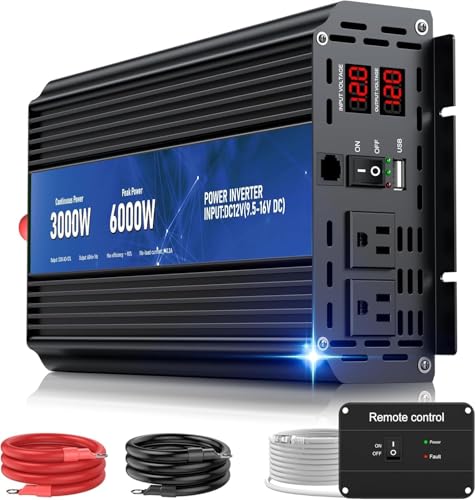
- 3000W continuous and 6000W peak output
- LCD display and 14.8-foot wired remote
- Compatible with common 12V battery types
Best For: Small cabins, RVs, and everyday backup loads
High-Capacity Cabin System

- 12000W pure sine output with selectable split phase
- Dual MPPT and up to 13200W PV input
- Parallel support for up to six units
Best For: Large cabins, farms, workshops, and high-demand loads
Flexible Mid-Size Option
4000W 24V Hybrid Solar Inverter

- 4000W pure sine output with 8000W peak
- 140A MPPT controller with up to 5600W PV input
- Supports batteryless daytime solar operation
Best For: Small-to-medium 120V cabins with flexible solar needs
Best High-Capacity System
10kW 48V Off-Grid Inverter Charger

- 10,000W pure sine wave output
- Dual MPPT and 200A charging capacity
- Supports 120V/240V and six-unit parallel expansion
Best For: Large permanent off-grid cabins and expandable solar systems
Best Compact 12V Option

- 2,000W continuous and 4,000W surge output
- Pure sine wave power for sensitive electronics
- 10-foot remote and LCD power monitoring
Best For: Small cabins using a 12V battery bank
Best Hybrid Flexibility
4000W 24V Solar Inverter Charger

- 4,000W output with 8,000W surge capacity
- Built-in 140A MPPT solar charger
- Supports solar, battery, utility, and generator input
Best For: Medium-size cabins needing flexible backup and charging options
All-in-One Solar System
4200W 24V Pure Sine Wave Hybrid Inverter

- 4200W pure sine wave AC output
- 120A MPPT charger with 6200W PV input
- Supports solar, utility, and battery priority modes
Best For: 24V cabins needing integrated solar and battery charging
Connected Solar Control
4200W 24V Hybrid Inverter with WiFi

- 4200W pure sine wave output
- 6200W PV input and 120A charging
- WiFi module plus LCD and communication ports
Best For: 24V cabins needing flexible solar input and monitoring
Whole-Cabin Power Hub – 8000W 48V Hybrid Split-Phase Inverter
For cabins that need more than basic electronics, this hybrid unit is a powerful choice among power inverters for off grid cabins. Its 120/240V split-phase output, integrated solar charging, and battery compatibility can support substantial household and workshop loads.
Best For: Larger off-grid cabins, workshops, and whole-home backup systems with 48V batteries and high-demand 240V appliances.
Pros:
- Provides 8000W continuous and 12000W surge pure sine wave output with native 120/240V split phase.
- Combines an inverter, 10000W dual-MPPT solar charger, and 160A battery charger.
- Offers under-10ms UPS switching, multiple charging modes, and support for up to six parallel units.
- Includes Wi-Fi/Bluetooth monitoring and compatibility with several battery chemistries.
Cons:
- Its 48V architecture and high output are likely more system than a small cabin needs.
- Installation and battery-bank planning require careful attention to the unit’s substantial power capacity.
This is the most expandable option here for demanding cabin loads, especially where split-phase service, solar flexibility, and remote monitoring matter. It is less compelling for compact, low-consumption setups.
Portable Cabin Backup – 3000W 12V RV Inverter
This 12V model is a practical entry point for power inverters for off grid cabins when the priority is running everyday electronics from a battery bank. It delivers 3000W continuously, includes a wired remote, and is compact enough for RV, truck, or small-cabin installations.
Best For: Small cabins, recreational setups, and battery-based backup for TVs, laptops, fans, small appliances, and power tools.
Pros:
- Delivers 3000W continuous and 6000W peak output from a 12V battery system.
- Includes two AC outlets, a USB port, LCD monitoring, and a 14.8-foot wired remote.
- Works with LiFePO4, AGM, GEL, and lead-acid batteries.
- Comes with battery cables, low-battery protection, and dual temperature-controlled cooling fans.
Cons:
- The supplied details identify the output waveform as modified sine wave, which may be less suitable for some sensitive or inductive equipment.
- A 12V system can require high battery-side current at heavier loads.
Choose this inverter when convenience and 12V compatibility matter more than premium waveform quality or split-phase capability. The remote and display are especially useful when the inverter is mounted out of reach.
High-Capacity Cabin System – 12000W 48V Solar Inverter
Designed for high-demand properties, this 48V unit stands out among power inverters for off grid cabins with its 12000W pure sine output and 120/240V split-phase operation. Dual MPPT inputs and expansion support make it suitable for larger solar arrays and growing electrical needs.
Best For: Large cabins, farms, workshops, and backup systems running air conditioners, well pumps, refrigerators, and power tools.
Pros:
- Supplies 12000W continuous pure sine wave power with selectable 120V/240V split phase.
- Supports two independent PV arrays with dual MPPT inputs and up to 13200W PV input.
- Includes a 200A battery charger, rapid-shutdown support, integrated breakers, and Smart Load output.
- Can be expanded by paralleling up to six units and supports multiple battery types.
Cons:
- At 61.8 pounds, it is a substantial installation rather than a portable cabin inverter.
- Its 48V battery system and high solar capacity may be excessive for modest electrical loads.
This is a strong fit for a cabin designed around serious electrical infrastructure. Its touchscreen, protection features, and expandable architecture favor a planned installation over a simple plug-in backup setup.
Flexible Mid-Size Option – 4000W 24V Hybrid Solar Inverter
This 24V hybrid inverter offers a balanced approach to power inverters for off grid cabins, combining 4000W pure sine output with a 140A MPPT controller. It can use solar, utility power, and batteries, while its batteryless daytime operation adds flexibility for cabins with variable energy needs.
Best For: Small-to-medium cabins seeking pure sine power, flexible charging priorities, and compatibility with 24V battery systems.
Pros:
- Provides 4000W rated and 8000W peak pure sine wave output.
- Includes a 140A MPPT controller supporting up to 5600W PV input and 350VDC.
- Can operate without a battery during daytime solar production under the stated conditions.
- Supports AGM, gel, lead-acid, lithium-ion, and LiFePO4 batteries with adjustable priority settings.
Cons:
- It provides 120V output rather than 120/240V split-phase power.
- The supplied notes recommend careful manual review and installation according to the instructions.
- Batteryless operation has specific PV-voltage and grid-connection conditions.
For a cabin using standard 120V loads, this model offers useful solar and battery flexibility without moving to a 48V system. Confirm the operating conditions and expected loads before relying on its battery-free mode.
Best High-Capacity System – 10kW 48V Off-Grid Inverter Charger
For cabins with substantial electrical demands, this ECO-WORTHY unit is one of the most capable power inverters for off grid cabins. It combines a 10,000W pure sine wave inverter, inverter charger, and dual MPPT solar controllers for 48V battery systems. It provides 120V/240V split-phase or 120V single-phase output, but it is designed for off-grid use only and cannot feed power back to the utility grid.
Best For: Permanent off-grid cabins, larger solar arrays, and systems that may eventually need parallel expansion.
Pros:
- 10,000W continuous output with 20,000W peak output and pure sine wave power.
- Dual MPPT controllers support up to 11,000W of total PV input and up to 200A battery charging.
- Supports 120V/240V split-phase output and parallel connection of up to six units.
- UL1741 certified and compatible with several 48V battery types.
Cons:
- It is not grid-tie capable.
- The 48V architecture and permanent wiring make professional installation advisable.
- Its high capacity may be excessive for a small cabin with modest loads.
This is a strong choice when a cabin needs whole-system capacity, split-phase flexibility, and room to grow. Confirm your battery bank, solar-array design, and local installation requirements before choosing it.
Best Compact 12V Option – 2000W Pure Sine Wave Inverter
If your cabin uses a 12V battery bank and you want a straightforward way to run everyday electronics, this 2,000W model is a practical option among power inverters for off grid cabins. It delivers pure sine wave 120V AC power, includes a wired remote, and provides LCD monitoring for battery, voltage, load, and output information.
Best For: Small cabins, modest off-grid loads, and users who want remote control and clear power monitoring.
Pros:
- Provides 2,000W continuous output and 4,000W surge capacity.
- Pure sine wave output suits sensitive electronics, refrigerators, laptops, and similar loads.
- Low approximately 7.5W idle draw helps limit battery consumption.
- Includes a 10-foot remote, two AC outlets, and a 20A hardwire output.
Cons:
- It requires a 12V battery system, which can mean higher DC current at heavier loads.
- Its 2,000W continuous rating is less suitable for multiple high-demand appliances.
- It does not include an integrated solar charge controller.
This inverter makes sense for a compact cabin power setup built around 12V batteries. Check appliance running and startup wattages carefully, especially before connecting refrigerators, pumps, or other inductive loads.
Best Hybrid Flexibility – 4000W 24V Solar Inverter Charger
For cabin owners building a more complete energy system, this 4,000W hybrid model combines inverter output, solar charging, and utility or generator input. It is a versatile middle-ground choice among power inverters for off grid cabins, with 24V battery support, pure sine wave 120V output, and configurable source priorities.
Best For: Cabins needing solar, battery, and generator or utility backup in one 24V system.
Pros:
- Delivers 4,000W continuous output and 8,000W surge capacity.
- Built-in 140A MPPT controller supports up to 5,600W of PV input.
- Accepts solar, 24V battery, and utility or generator AC input.
- Supports several 24V battery types and configurable charging and output priorities.
Cons:
- It is limited to 24V systems and 120V AC output.
- A 24V battery bank is strongly recommended for stable nighttime and surge-heavy operation.
- Battery settings and BMS compatibility must be confirmed before installation.
This is a flexible choice for cabins that need more than a basic inverter but do not require a 10kW platform. Its integrated MPPT charging and multiple input sources can simplify system design, provided the PV voltage and battery specifications match.
High-Output Cabin Backup – 5500W 12V Modified Sine Wave Inverter
For cabins using a 12V battery bank, this 5500W inverter offers substantial output for everyday electronics, lighting, chargers, and other suitable loads. Its wired LCD remote, multiple outlets, and temperature-controlled cooling make it a practical option among power inverters for off grid cabins, though its modified sine wave output requires careful load selection.
Best For: 12V off-grid cabins, RVs, boats, and emergency backup setups running compatible household and electronic loads.
Pros:
- Provides 5500W continuous output and up to 11000W peak power.
- Includes four AC outlets, USB charging, and a 30W Type-C port.
- LCD wired remote displays voltage, load, and protection warnings.
- Temperature-controlled fans are designed for quieter operation.
Cons:
- Modified sine wave output may not suit every appliance or sensitive device.
- Designed for 12V systems, which can require high battery-side current at full load.
This is a strong fit when a cabin already has a 12V battery system and needs high-capacity AC power plus convenient device charging. Confirm appliance compatibility and use appropriately sized battery cables and protection equipment.
All-in-One Solar System – 4200W 24V Pure Sine Wave Hybrid Inverter
This 24V hybrid unit combines a pure sine wave inverter, MPPT solar controller, and AC battery charger in one enclosure. For shoppers comparing power inverters for off grid cabins, its 4200W output, broad PV input range, and selectable charging priorities provide a flexible foundation for a solar-plus-battery system.
Best For: 24V off-grid cabins, workshops, RVs, and backup systems that need integrated solar charging and utility or battery support.
Pros:
- Pure sine wave output supports common household appliances and electronics.
- Built-in 120A MPPT charger accepts up to 6200W of PV input.
- Supports solar, utility, and battery power with several priority modes.
- LCD settings accommodate multiple battery types, including user-defined configurations.
Cons:
- Requires a 24V battery system rather than a common 12V setup.
- Installation involves high-voltage PV inputs and should be planned carefully.
With integrated charging hardware and pure sine wave output, this model can simplify a cabin power system while leaving room for flexible solar configuration. Review the PV voltage limits, battery settings, and installation requirements before selecting it.
Connected Solar Control – 4200W 24V Hybrid Inverter with WiFi
This 24V hybrid inverter pairs 4200W pure sine wave output with a 120A MPPT controller and a supplied WiFi module. It is a compelling choice among power inverters for off grid cabins when you want flexible solar-panel configuration, adjustable charging settings, and system communication ports in addition to standard AC conversion.
Best For: 24V off-grid cabins, garages, workshops, RVs, and small solar systems running appliances, electronics, and backup loads.
Pros:
- Delivers 4200W continuous pure sine wave power for common AC loads.
- Accepts up to 6200W PV input with a 60V–500V MPPT operating range.
- Provides up to 120A solar charging for 24V battery banks.
- Includes WiFi, LCD controls, RS485, RS232, and dry-contact connectivity.
Cons:
- Designed specifically for 24V battery systems.
- High-voltage PV installation requires appropriate breakers, fuses, cabling, and qualified work.
The high PV-input capability and communication options make this a flexible choice for a more configurable cabin energy system. Its value is greatest when you can use a 24V bank and need pure sine wave power alongside detailed system controls.
How We Picked the Best Power Inverters for Off Grid Cabins
We evaluated these inverters by looking at continuous wattage, surge capacity, battery-voltage compatibility, output waveform, solar-charging features, and installation flexibility. We also considered whether each model is designed for basic backup power, a small cabin electrical system, or a larger solar installation with 120/240V loads.
Pure sine wave output is a priority for cabins because it is generally safer and more compatible with refrigerators, pumps, electronics, tools, and other motor-driven equipment. Models with integrated MPPT charge controllers can simplify a solar installation, while UL, ETL, or UL1741 listings may provide additional confidence when local requirements and system safety matter.
Quick Comparison
Lower-wattage 12V models are practical for lights, charging devices, televisions, and occasional small appliances. They are easier to install but can require very high battery currents at larger loads. A 24V inverter offers a useful middle ground for modest cabins, reducing cable size and current compared with 12V systems.
High-output 48V models are better suited to full-cabin systems, larger battery banks, substantial solar arrays, and split-phase 120/240V service. They typically provide more charging capacity and expansion potential, but they also demand more careful system design, heavier equipment, and professional installation in many cases.
Key Buying Factors for Power Inverters for Off-Grid Cabins
Continuous and Surge Wattage
Add the running wattage of the devices you expect to use at the same time, then allow headroom. Refrigerators, well pumps, compressors, and power tools can draw several times their running wattage when starting, so check the inverter’s surge rating rather than relying on continuous output alone.
Battery Voltage and Capacity
Match the inverter to a compatible 12V, 24V, or 48V battery bank. Higher-voltage systems usually deliver the same power with less current, improving cable efficiency. Battery capacity also matters: a powerful inverter can drain a small battery quickly, even when its output rating is suitable.
Solar Input and Charging
For an integrated hybrid inverter, compare maximum photovoltaic input, MPPT voltage range, charge-current capacity, and the number of solar inputs. Confirm that your planned panel string voltage stays within the inverter’s limits in both normal and cold-weather conditions.
Output, Safety, and Installation
Choose pure sine wave output for sensitive or motor-driven loads. Split-phase output is useful when the cabin has 240V equipment, while a 120V-only model may be simpler and less expensive for basic needs. Verify grounding, disconnects, battery protection, ventilation, and local electrical-code requirements before installation.
Who Should Buy Which Power Inverters for Off Grid Cabins?
Choose a 12V inverter for a small cabin, weekend shelter, RV-style setup, or essential loads with a compact battery bank. A 24V hybrid unit suits a moderately equipped cabin running lights, refrigeration, communications gear, and selected appliances from a larger solar-battery system.
Choose a 48V hybrid or split-phase inverter for a full-time or high-demand off-grid cabin, especially when you need substantial solar charging, 240V capability, parallel expansion, or backup-style transfer performance. Before buying, list your largest starting loads, estimate daily energy use, and size the battery bank and solar array as a complete system rather than selecting the inverter by wattage alone.