
The best portable power inverters make it easier to run small electronics, charge devices, and stay powered during travel, outdoor work, or short outages. This roundup includes compact car inverters, battery-powered models, and a full portable power station.
Because output, battery compatibility, and outlet options vary widely, the right choice depends on what you need to power and how long you need it to run. Use the guide below to narrow the options quickly.
Best 10 Portable Power Inverters Picks for 2026
Best Lightweight Power Station

- 292Wh LiFePO4 battery in a portable design
- Two AC outlets plus USB-C, USB-A, and car outputs
- 300W rated output with optional solar charging
Best For: Camping, travel, CPAP backup, and small electronics
Best Compact Car Inverter
PiSFAU 200W Car Power Inverter

- Two AC outlets and four USB charging ports
- Compact 8.8-ounce design for vehicle use
- Multiple protections for everyday car charging
Best For: Road trips, commuting, camping, and charging small electronics
Best Pure Sine Wave Option

- 400W continuous and 800W peak output
- Pure sine wave power for sensitive electronics
- Works with EGO 56V batteries, sold separately
Best For: EGO battery owners and outage-ready electronics backup
Best Multi-Port Vehicle Inverter

- Dual AC outlets and four USB-A/C ports
- Compact 9-ounce vehicle-friendly design
- Cooling fan supports quieter extended use
Best For: Road trips, camping, and charging several small devices
Best Feature-Rich Pick
Ecarke 350W Milwaukee-Compatible Inverter

- 350W output with AC, USB-C, USB-A, and 12V DC ports
- 800-lumen adjustable LED with SOS mode
- Display and independent AC/DC controls
Best For: Camping, job sites, and roadside emergencies
Best Compact Value
Azocek 220W Milwaukee-Compatible Inverter
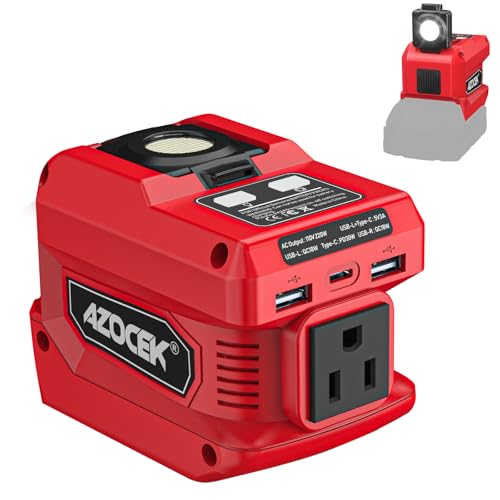
- 220W output with one AC outlet
- 30W USB-C PD and two USB QC ports
- 400-lumen adjustable work light
Best For: Small electronics, outdoor use, and emergencies
Best High-Output Option
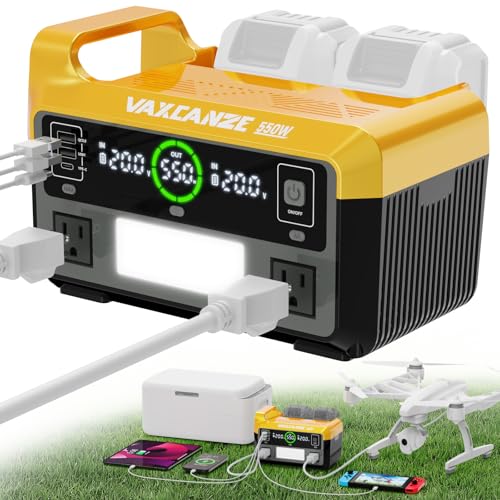
- 550W pure sine wave AC output
- Compatible with listed DeWalt 20V batteries
- Two AC, two USB, and one USB-C charging outputs
Best For: Camping, RVs, road trips, and higher-power loads
Ryobi Battery Pick

- Two AC outlets with 300W total output
- 65W USB-C PD plus USB-A charging
- Protective aluminum housing with cooling fan
Best For: Ryobi battery owners needing flexible backup power
DeWALT Worksite Pick

- 220W output and 250W peak capacity
- AC, dual USB, and 36W USB-C ports
- Adjustable three-level LED work light
Best For: DeWALT users needing charging and task lighting
DeWALT Lighting Pick
220W Inverter with LED Work Light

- 220W output with one AC outlet
- 30W USB-C PD and dual USB QC ports
- 400-lumen adjustable light with strobe mode
Best For: DeWALT users wanting charging plus emergency illumination
Best Lightweight Power Station – Jackery Explorer 300
The Jackery Explorer 300 is a compact option for shoppers who need portable power inverters with more battery capacity than a basic car adapter. Its 292Wh LiFePO4 battery, multiple outputs, and solar-charging compatibility make it suitable for camping, travel, and backup power for smaller electronics.
Best For: Camping, hiking, travel, CPAP backup, and charging laptops, cameras, and other modest-wattage devices away from an outlet.
Pros:
- Lightweight 7.5-pound design with an integrated handle.
- Offers two AC outlets, USB-C, two USB-A ports, and a 120W car port.
- 300W rated output with 600W peak surge capacity.
- LiFePO4 battery is rated for more than 4,000 charge cycles, with optional solar charging.
Cons:
- Solar panel is optional rather than included.
- Its 300W output is not intended for high-power appliances.
- Requires a physical delivery address instead of only a PO Box.
Choose the Explorer 300 if you want a rechargeable power station that balances portability, battery capacity, and output variety. It is more capable than a simple vehicle inverter but remains practical to carry outdoors.
Best Compact Car Inverter – PiSFAU 200W Car Power Inverter
The PiSFAU 200W is a practical choice for shoppers comparing portable power inverters for a vehicle. It plugs into a 12V cigarette lighter socket and provides two AC outlets plus four USB charging ports for everyday electronics during road trips, commutes, and camping.
Best For: Charging phones, tablets, laptops, lights, and other modest-power devices from a car or truck.
Pros:
- Very compact, lightweight design measuring 5 by 2.7 by 1.4 inches and weighing about 8.8 ounces.
- Combines two AC outlets with four USB charging ports.
- Includes protection against overheating, undervoltage, overvoltage, overload, and short circuits.
- Designed with heat dissipation features intended to reduce noise and energy loss.
Cons:
- Requires a vehicle’s 12V power socket.
- Uses a modified sine wave output.
- Its 200W capacity is limited for high-demand appliances.
This PiSFAU model makes sense when low weight and easy storage matter more than battery capacity. It is a straightforward in-car charging solution, not a standalone power station.
Best Pure Sine Wave Option – EGO POWER+ 400W Inverter
The EGO POWER+ PAD5000 stands out among portable power inverters for its pure sine wave output and compatibility with EGO 56V ARC Lithium batteries. The battery and charger are sold separately, but the inverter can provide clean power for sensitive electronics and includes useful USB-C and lighting features.
Best For: EGO battery owners who need quiet backup power for sensitive electronics, USB devices, and selected 120V equipment.
Pros:
- Pure sine wave output is suitable for sensitive electronics.
- Provides 400W continuous power and 800W peak power.
- Includes a 120V outlet, USB-C, USB-C PD, and USB-A ports.
- Supports pass-through charging and has built-in LED lights for outages.
Cons:
- Battery and charger are not included.
- Requires an EGO 56V ARC Lithium battery for operation.
- Only one 120V AC outlet is provided.
The PAD5000 is a strong fit for users already invested in the EGO battery platform. Its clean waveform and 100W USB-C PD port add versatility, while the battery requirement increases the total setup cost for new buyers.
Best Multi-Port Vehicle Inverter – YSOLX 300W Car Power Inverter
The YSOLX 300W is designed for drivers who want portable power inverters with several charging connections in a small package. Its 12V vehicle connection, dual AC outlets, and four USB-A/C ports can support everyday travel and camping electronics, provided total power demand stays within the vehicle socket’s limits.
Best For: Road trips, camping, mobile work, and charging phones, cameras, laptops, lights, and other low-power devices from a vehicle.
Pros:
- Provides six output ports, including two AC outlets and four 24W USB-A/C ports.
- Compact 5.43-by-2.75-by-1.4-inch design weighing about 9 ounces.
- Upgraded cooling fan is designed for quieter, more stable extended use.
- Convenient for powering multiple small devices from a cigarette lighter socket.
Cons:
- Designed only for a DC 12V vehicle connection.
- Uses modified sine wave output.
- Not suitable for high-power appliances such as hair dryers or electric heaters.
This YSOLX inverter is a space-saving choice when multiple ports are more important than a built-in battery. Its cooling system and broad port selection make it useful for travel, but users should avoid exceeding the vehicle outlet’s practical power limit.
Best Feature-Rich Pick – Ecarke 350W Milwaukee-Compatible Inverter
For shoppers comparing portable power inverters, the Ecarke 350W model stands out for its broad port selection and built-in lighting. It converts power from a compatible Milwaukee 18V battery into modified-sine-wave 110–120V AC and also includes USB-C, USB-A, and 12V DC outputs.
Best For: Job sites, camping, roadside emergencies, and users who already own compatible Milwaukee 18V batteries.
Pros:
- 350W output with two 70W USB-C PD ports, an AC outlet, USB-A, and 12V DC.
- 800-lumen LED light offers three brightness levels, two color temperatures, and SOS mode.
- Display shows battery voltage, wattage, battery level, and error codes.
- Independent AC and DC switches plus multiple protection features help manage battery use.
Cons:
- Battery and charger are not included.
- Uses modified sine wave output rather than pure sine wave.
- Requires removing the battery after use to help preserve battery life.
The Ecarke is a versatile choice when you want more than a basic AC outlet from a tool battery. Its display, dedicated 12V output, and adjustable emergency light add practical value, though compatibility and the lack of an included battery should be considered first.
Best Compact Value – Azocek 220W Milwaukee-Compatible Inverter
The Azocek 220W is a straightforward option for portable power inverters if your main needs are charging personal electronics and adding light during travel or outages. It runs from compatible Milwaukee 18V batteries and provides one AC outlet alongside USB and USB-C charging ports.
Best For: Phones, tablets, laptops, outdoor activities, emergency use, and light job-site charging.
Pros:
- Converts 18V DC battery power to 110–120V AC with 220W output and 250W peak output.
- Includes one AC outlet, two 18W USB QC ports, and one 30W PD USB-C port.
- 400-lumen LED work light has three brightness levels, strobe mode, and a 90-degree adjustable angle.
- Built-in fan and protections cover short circuit, overcurrent, low voltage, overheating, overload, and over-discharge conditions.
Cons:
- Battery is not included.
- Modified sine wave output may be less suitable for sensitive equipment than pure sine wave output.
- Lower output capacity than the 350W and 550W options in this roundup.
The Azocek keeps the design focused and practical for smaller electronics. Its charging mix and adjustable work light make it useful in the field, while the 220W rating is best matched to modest loads rather than larger appliances.
Best High-Output Option – VAXCANZE 550W DeWalt Inverter
Among these portable power inverters, the VAXCANZE model offers the highest stated output and pure sine wave AC. Designed for compatible DeWalt 20V batteries, it can support devices such as laptops, mini refrigerators, coffee machines, and small power tools when paired with an appropriate battery.
Best For: Camping, road trips, RV use, and users needing higher-output power from DeWalt 20V batteries.
Pros:
- 550W output with 110V pure sine wave AC for wall-outlet-like power.
- Compatible with a wide range of listed DeWalt 20V battery series models.
- Can charge up to five devices through two AC ports, two USB ports, and one USB-C output.
- 600-lumen hanging LED light offers three brightness levels.
Cons:
- Battery is not included.
- Only a one-year warranty is specified in the supplied details.
- Its larger listed dimensions may be less convenient than smaller inverter designs.
The VAXCANZE is the strongest fit when output quality and capacity matter most. Pure sine wave power broadens its usefulness for electronics and small appliances, but buyers should confirm their DeWalt battery compatibility and account for the separate battery purchase.
Ryobi Battery Pick – 300W Portable Power Inverter
For shoppers seeking portable power inverters that work with Ryobi batteries, this 300W model offers two AC outlets plus USB charging in a compact, aluminum-bodied design. It can power small electronics and low-power appliances, while the 65W USB-C port is useful for compatible laptops and other devices. The battery is not included.
Best For: Ryobi users who need versatile backup charging for travel, camping, or outages.
Pros:
- Two AC outlets provide up to 300W total output.
- Includes USB-C PD up to 65W and USB-A up to 18W.
- Built-in protections address undervoltage, overload, overheating, and short circuits.
- Aluminum housing and internal cooling fan support portable outdoor use.
Cons:
- Ryobi 18V battery is sold separately.
- AC output shuts down when battery voltage drops below 15.5V.
- USB output is limited when USB-A and USB-C are used simultaneously.
This is a well-equipped choice if you already own compatible Ryobi batteries and want more outlet capacity than a basic USB adapter. Its 300W ceiling makes it suitable for small electronics, not high-power appliances.
DeWALT Worksite Pick – 220W Battery Power Inverter
This compact option is among the portable power inverters designed for DeWALT 20V batteries. It provides one AC outlet, two USB ports, USB-C charging, and an adjustable LED work light, making it practical for job sites, workshops, camping, and short-term emergency use. The battery is not included.
Best For: DeWALT battery owners who want portable device charging with integrated work lighting.
Pros:
- Provides 220W real output with a 250W peak rating.
- Offers one AC outlet, two 5V/2.1A USB ports, and 36W USB-C output.
- Three brightness levels and adjustable LED angle add utility in dark work areas.
- Includes fan-assisted cooling and multiple safety protections.
Cons:
- Only one AC outlet is available.
- Battery is not included.
- Uses a modified sine wave output.
The integrated light separates this model from simpler battery inverters, especially for close-range tasks. Its modest output is best matched with phones, tablets, laptops, lights, and other small electronics rather than demanding equipment.
DeWALT Lighting Pick – 220W Inverter with LED Work Light
For portable power inverters that combine charging with emergency illumination, this DeWALT-compatible model pairs a 220W AC outlet with two USB QC ports, 30W USB-C PD, and a 400-lumen LED work light. It is intended for small electronics, outdoor use, travel, and power outages; the battery is not included.
Best For: DeWALT battery users who prioritize multi-device charging and adjustable emergency lighting.
Pros:
- Provides one AC outlet with 220W output and a listed 440W peak rating.
- Supports two 18W USB QC ports and 30W USB-C PD charging.
- 400-lumen light includes three brightness levels, strobe mode, and 90-degree adjustment.
- Includes cooling and protection against overload, overheating, overcurrent, and short circuits.
Cons:
- Only one AC outlet is provided.
- Battery is sold separately.
- Its 220W output is intended for small electronics rather than high-draw appliances.
This model is a practical match for outdoor kits and outage preparedness when a work light is as important as device charging. The combination of USB-C PD, USB QC, and adjustable illumination makes it especially versatile for compact electronics and nighttime tasks.
How We Picked These Portable Power Inverters
We selected products across the main portable-power categories represented in this roundup: 12V car plug inverters, cordless-tool battery adapters, and self-contained power stations. We compared stated wattage, outlet and USB availability, battery requirements, portability, and intended use. We also considered whether a model uses a pure sine wave output, which can be preferable for sensitive electronics.
Product specifications can vary by battery, vehicle, and connected load. Always confirm the manufacturer’s limits before operating appliances or high-draw equipment.
Quick Comparison
| Type | Best For | Key Advantage | Main Limitation |
|---|---|---|---|
| Portable power station | Camping and emergency backup | Built-in battery and multiple outputs | Heavier and typically more expensive |
| Car power inverter | Road trips and vehicle charging | Uses a 12V vehicle outlet | Limited by vehicle outlet and battery runtime |
| Tool-battery inverter | Job sites and cordless-tool users | Uses batteries you may already own | Requires a compatible battery and charger |
| Pure sine wave inverter | Sensitive electronics | Cleaner AC power output | May cost more than basic alternatives |
Key Buying Factors for Portable Power Inverters
Continuous and Peak Wattage
Check continuous wattage first, then compare the startup or peak rating. Chargers, phones, lights, laptops, and small fans usually need modest output, while heating appliances, refrigerators, compressors, and power tools can demand substantially more. Do not exceed the inverter’s continuous rating.
Power Source and Runtime
A car inverter draws from the vehicle’s 12V system, while tool-battery models depend on the capacity and condition of a compatible battery. Runtime is determined by watt-hours, load, and conversion losses. A self-contained station is usually the simplest option when you need predictable capacity without carrying separate tool batteries.
Output Quality and Ports
Look for the ports you actually need, such as AC outlets, USB-A, USB-C Power Delivery, or a regulated DC output. Pure sine wave models are a safer choice for sensitive or motor-driven electronics, although many basic charging tasks work with less expensive designs.
Safety and Practical Design
Useful protections include overload, short-circuit, over-temperature, and low-voltage shutoff. Also check cooling, cable length, display information, mounting or carry options, and whether the battery or charger is included. A tool-only inverter can be economical if you already own the matching battery platform.
Who Should Buy Which Portable Power Inverters?
- For camping or emergency backup: Choose a self-contained portable power station with a clearly stated watt-hour capacity and several output types.
- For road trips: A compact 12V car inverter is convenient for charging phones, laptops, cameras, and other modest loads while driving.
- For job sites: A tool-battery inverter makes sense if you already use Milwaukee, DeWalt, Ryobi, or another supported battery system.
- For sensitive electronics: Prioritize pure sine wave output, adequate continuous wattage, and reliable overload protection.
- For occasional low-power charging: A smaller, less expensive inverter may be all you need; avoid paying for capacity or outlets you will not use.
Before buying, total the running wattage of your intended devices and leave extra headroom for startup surges. That simple check will help you choose among these Portable Power Inverters with greater confidence.