
The best portable light meters make it easier to measure illumination, exposure, or color temperature without relying on guesswork. This roundup includes dedicated photography meters, general lux meters, and compact tools for lighting checks at home, work, or on location.
Compare measurement ranges, display designs, sensor flexibility, operating modes, and connectivity to find the right meter for your workflow.
Best 10 Portable Light Meters Picks for 2026
Best for Photo and Cine Exposure

- Ambient and flash readings to one-tenth-stop accuracy
- Photo, Cine, and HD Cine modes
- Pocket-sized 3.52-ounce design
Best For: Still photography and video exposure control
Best for Plants and General Illuminance

- Measures up to 200,000 lux and 20,000 foot candles
- Rotating probe with backlit LCD
- Adds temperature, humidity, and data logging
Best For: Plant lighting and everyday light inspections
Best for Color-Critical Workflows

- Measures light, color temperature, chromaticity, and DUV
- Bluetooth app integration for real-time data
- Supports multiple meters up to 80 feet away
Best For: Wireless photo, video, and lighting production
Best for Straightforward Lux Testing
Dr.meter Digital Illuminance Meter

- Measures 0 to 200,000 lux
- Switches between lux and foot-candles
- Includes PEAK recording for brief light pulses
Best For: Basic indoor, outdoor, and plant-light checks
Best High-Range Value

- Measures up to 200,000 lux
- Lux and foot-candle modes
- Hold and auto/manual range functions
Best For: General lighting checks on a budget
Best Compact Professional Pick

- 0.5-second sampling time
- Measures up to 199,900 lux
- Backlit display with max/min and hold
Best For: Portable work, photography, and lab measurements
Best Display and Warranty
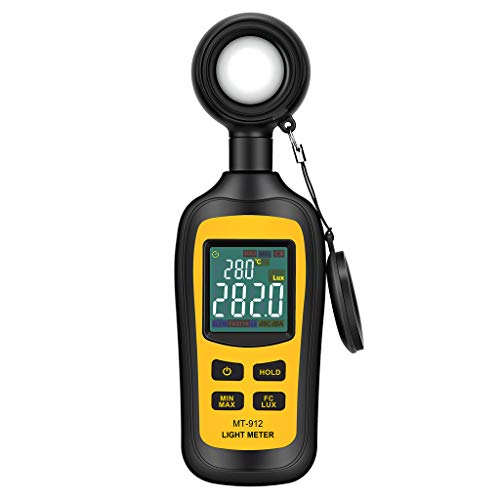
- Measures up to 200,000 lux
- Adds ambient temperature measurement
- Two-year warranty and color LCD
Best For: Set design, office, factory, and home use
Best Overall Range
POROMETISTO 200,000-Lux Handheld Meter

- 0–200,000 lux and 0–20,000 FC range
- Backlit digital and analog display
- Includes batteries and two-year warranty
Best For: Grow lights, photography, offices, warehouses, and outdoor lamp checks
Best Rotating Sensor

- 360-degree rotating separate sensor
- Four auto-ranging lux settings
- MAX/MIN, hold, and power-off controls
Best For: General indoor light checks and hard-to-angle measurement positions
Best for Environmental Checks
Ohcans AS803 Illuminance Meter
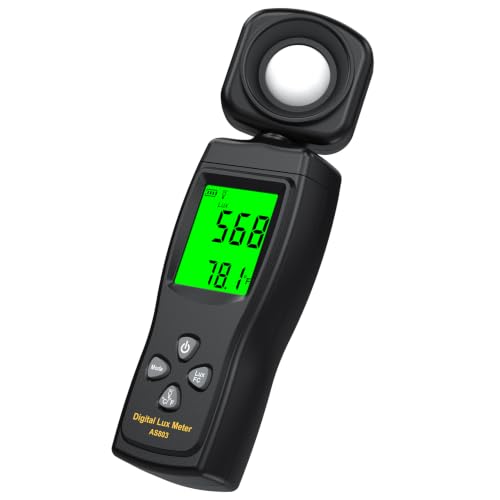
- Measures light and real-time temperature
- 180-degree rotating sensor and backlit LCD
- 0.5-second sampling with MAX/MIN and hold
Best For: Plant environments, photography setups, and indoor space evaluations
Best for Photo and Cine Exposure – Sekonic L-308X-U Flashmate
The Sekonic L-308X-U is a pocket-sized choice among portable light meters for photographers and videographers who need exposure readings for both ambient and flash light. Its dedicated Photo, Cine, and HD Cine modes make it more versatile than a basic illuminance meter.
Best For: Still photographers, DSLR and mirrorless videographers, and cinema-camera users who need incident or reflected exposure readings.
Pros:
- Measures ambient and electronic flash exposure to one-tenth-stop accuracy in full-stop mode.
- Offers Photo, Cine, and HD Cine modes with shutter, aperture, frame-rate, and shutter-angle controls.
- Compact 4.3-by-2.5-by-0.9-inch design weighs just 3.52 ounces.
Cons:
- Uses two AAA batteries.
- Its feature set is focused on photographic and cinema exposure rather than general lux testing.
Choose this Sekonic when exposure control is the priority. Its broad ambient and flash ranges, along with cine-specific modes, make it the most photography-focused option in this roundup.
Best for Plants and General Illuminance – TopTes TS-710 Light Meter
The TopTes TS-710 is one of the more versatile portable light meters for checking visible light in homes, offices, workshops, farms, and grow rooms. It measures up to 200,000 lux, displays readings on a large backlit screen, and includes temperature and humidity monitoring.
Best For: Plant lighting checks, workplace and home inspections, LED troubleshooting, and general lux or foot-candle measurements.
Pros:
- Measures 0.1 to 200,000 lux and 0.1 to 20,000 foot candles with stated 3%rdg+5dgt accuracy.
- Its 180-degree rotating probe and fast 0.5-second sampling support measurements from multiple angles.
- Includes temperature, humidity, MAX/MIN recording, data hold, and a backlit 2.25-inch LCD.
- Comes with a soft case and three AAA batteries.
Cons:
- Designed for visible-light illuminance rather than photographic flash or color-temperature readings.
- Temperature sensing can take time to adapt to a new environment.
The TS-710 is a practical all-purpose illuminance meter when you want more than a basic light reading. Its rotating sensor and environmental features are particularly useful for plant and facility checks.
Best for Color-Critical Workflows – Datacolor LightColor Meter
The Datacolor LightColor Meter expands the role of portable light meters by combining illuminance, color temperature, chromaticity, and green-magenta balance measurements. Bluetooth connectivity sends readings to its mobile app, making it suited to hands-free and multi-meter production workflows.
Best For: Film, photo, and lighting teams that need wireless color and exposure information across multiple light sources.
Pros:
- Measures lux, chromaticity, color temperature from 1,600K to 20,000K, DUV, ambient light, and flash.
- Bluetooth 4.0 LE syncs data in real time with the Datacolor LightColor Meter app.
- Supports multiple connected meters at distances up to 80 feet.
- Compact, drop-resistant, hands-free design provides up to 40 hours of use with two AAA batteries.
Cons:
- Its Bluetooth features require the Datacolor mobile app and a compatible connected device.
- It is more specialized than a simple lux-only meter.
This is the strongest choice when color consistency matters as much as light intensity. Wireless synchronization and support for multiple meters can help streamline larger lighting setups.
Best for Straightforward Lux Testing – Dr.meter Digital Illuminance Meter
The Dr.meter Digital Illuminance Light Meter is a straightforward option among portable light meters for measuring light intensity indoors or outdoors. Its 0-to-200,000-lux range, FC/LUX conversion, and peak recording make it useful for plant, office, factory, and brief high-intensity light checks.
Best For: Basic illuminance testing, plant-light evaluation, sunlight checks, and recording peak readings from short light pulses.
Pros:
- Provides a broad 0-to-200,000-lux measurement range.
- Switches between foot-candles and lux for flexible measurements.
- Samples readings twice per second and includes a PEAK function for brief high-intensity sources.
- Includes a 9V battery and low-battery alert.
Cons:
- Uses a 9V zinc-carbon battery rather than AAA cells.
- Does not list color-temperature, Bluetooth, temperature, or humidity functions.
- At 12 ounces, it is heavier than the compact photographic meter in this roundup.
For uncomplicated lux and foot-candle measurements, the Dr.meter keeps the controls focused. The peak-reading function is a useful addition if you occasionally need to capture short bursts of intense light.
Best High-Range Value – Leaton Digital Luxmeter
The Leaton Digital Luxmeter is a practical choice for shoppers comparing portable light meters for general lighting checks. It measures up to 200,000 lux with ±4% accuracy, offers lux and foot-candle units, and includes both hold and auto/manual range functions.
Best For: Home, office, photography, and other general-purpose illumination measurements.
Pros:
- Measures a broad range up to 200,000 lux.
- Supports both lux and foot-candle readings.
- Includes data hold, low-battery detection, and auto/manual ranging.
- Lightweight at 3.53 ounces.
Cons:
- Requires a 9V battery, which is not included.
- Automatically powers off after approximately 15 minutes.
With its wide measurement range and straightforward controls, this meter offers useful flexibility. The main consideration is remembering to purchase the required battery separately.
Best Compact Professional Pick – UNI-T UT383 Light Meter
The UNI-T UT383 is a compact option for anyone comparing portable light meters for work, home, agriculture, laboratories, or photography. It measures up to 199,900 lux, samples every 0.5 seconds, and displays readings on a large four-digit LCD with backlight.
Best For: Users who want a compact meter with quick sampling and practical professional features.
Pros:
- Measures up to 199,900 lux or 18,500 foot-candles.
- Fast 0.5-second sampling time.
- Includes max/min readings, data hold, overload indication, and low-battery warning.
- Compact design with a backlit four-digit display.
Cons:
- Listed accuracy is ±(4%+8), so it is not the most precise option for every application.
- The supplied notes do not specify a battery or charger in the package contents.
The UT383 stands out for its compact form and fast response, while its backlit display improves readability. It is a versatile choice when portability and measurement convenience matter.
Best Display and Warranty – Color LCD Light Meter
This handheld light meter is a useful choice for comparing portable light meters when display visibility and warranty coverage are priorities. It measures up to 200,000 lux, also measures ambient temperature, and provides min/max readings, data hold, and automatic shutdown.
Best For: Set design, offices, factories, and home users who want a colorful display and extended warranty.
Pros:
- Measures luminosity from 0 to 200,000 lux.
- Also measures ambient temperature.
- Features a four-digit color LCD, min/max readings, and data hold.
- Includes a two-year warranty.
Cons:
- Requires three AAA batteries.
- Accuracy varies by range, from ±3% rdg ±8 digits below 10,000 lux to ±4% rdg ±10 digits above it.
The color display and temperature measurement give this meter useful versatility beyond basic illumination checks. Its two-year warranty is an added benefit for buyers seeking longer-term coverage.
Best Overall Range – POROMETISTO 200,000-Lux Handheld Meter
For shoppers comparing portable light meters, the POROMETISTO LT01 stands out with a broad 0–200,000-lux range, a backlit display, and a compact handheld design. Its digital and analog readings, fast sampling, and included batteries make it ready for everyday light checks.
Best For: Grow-light placement, photography lighting, office or warehouse checks, and outdoor lamp inspections.
Pros:
- Measures up to 200,000 lux and 20,000 foot-candles with stated ±(3% + 5 lux) accuracy under standard incandescent lamps.
- Backlit digital display and analog bar graph show changing light levels at two readings per second.
- Data hold, MAX/MIN recording, low-battery indicator, and automatic shutoff support convenient use.
- Includes two batteries, a sensor cap, lanyard, and a two-year warranty.
Cons:
- The stated accuracy specification is specifically based on standard incandescent lamps.
- Its automatic power-off interval is fixed at 10 minutes.
Choose this model if you want a versatile portable light meter with especially broad measurement coverage and helpful display features. It is a practical fit for users moving between dim indoor areas and bright outdoor settings.
Best Rotating Sensor – DANOPLUS DP-331 Light Meter
The DANOPLUS DP-331 is one of the more flexible portable light meters for awkward measurement angles. Its separate 360-degree rotating sensor can be positioned independently from the main unit, while auto-ranging and a four-digit LCD simplify routine readings.
Best For: Measuring visible light in homes, offices, schools, hospitals, factories, and other general-purpose spaces.
Pros:
- Separate sensor rotates 360 degrees to help position it toward the light source.
- Offers four automatic lux ranges from 200 to 200,000 and switchable foot-candle readings.
- Includes MAX/MIN, data hold, low-battery indication, and selectable automatic power-off functions.
- Measures visible light across a stated 400–700 nm spectral range.
Cons:
- Its stated accuracy is ±4% ±10 digits, which is less precise on paper than some competing specifications.
- The sensor’s separate design may require more handling than an integrated sensor.
The DP-331 makes the most sense when sensor positioning is a priority. The rotating head adds flexibility for checking light in spaces where holding the entire meter at the ideal angle is inconvenient.
Best for Environmental Checks – Ohcans AS803 Illuminance Meter
The Ohcans AS803 adds temperature monitoring to the core functions expected from portable light meters. Along with a 0–200,000-lux range, it provides a 180-degree rotating sensor, backlit LCD, and rapid 0.5-second sampling for plant care, photography, and indoor evaluations.
Best For: Plant-growing environments, photography and film setups, offices, classrooms, warehouses, and other spaces where temperature context is useful.
Pros:
- Measures 0–200,000 lux with stated ±4% +10 accuracy and switchable temperature readings in Celsius or Fahrenheit.
- 180-degree rotating sensor supports flexible positioning, while the backlit LCD improves low-light readability.
- 0.5-second sampling, data hold, MAX/MIN recording, and three measurement modes support active monitoring.
- Works with common LED, fluorescent, halogen, and HID light sources.
Cons:
- Requires three AAA batteries, one more than the two-battery designs in the other listed models.
- The stated accuracy is ±4% +10, rather than a tighter professional calibration specification.
If you want more than a brightness reading, the AS803 is the strongest match in this group because its temperature function can add useful environmental context. Its rotating sensor and quick sampling also suit hands-on lighting adjustments.
How We Picked the Best Portable Light Meters
We focused on the features that matter most when comparing Portable Light Meters: measurement range, accuracy-oriented design, sensor positioning, display readability, portability, controls, and intended use. The selection covers both photography-focused exposure meters and general-purpose illuminance meters, so you can compare specialized tools with affordable options for everyday light checks.
We also considered practical details such as backlighting, rotating sensors, temperature measurement, automatic or manual functions, and whether a meter supports color-temperature or Bluetooth features. Because specifications and availability can change, confirm the latest manufacturer details before purchasing.
Quick Comparison
| Best For | What to Look For | Recommended Type |
|---|---|---|
| Photography and flash exposure | Incident and reflected readings, flash support, cine modes | Dedicated photographic exposure meter |
| General room or workplace checks | Wide lux range, clear display, simple controls | Handheld digital lux meter |
| Hard-to-reach fixtures | Rotating or remote-positioning sensor | Meter with an adjustable sensor head |
| Color-critical lighting | Color-temperature measurement and app connectivity | Light and color meter |
| Occasional home measurements | Low cost, compact body, auto-ranging | Basic illuminance meter |
Key Buying Factors for Portable Light Meters
Measurement Range and Units
Check the stated lux range before buying. A broad range is useful when you need to measure everything from dim indoor areas to bright daylight. Foot-candle support can also be important for professional lighting, workplace, or horticultural applications.
Sensor Design and Positioning
A rotating sensor makes it easier to aim at ceiling fixtures, shelves, plants, and awkward angles while keeping the display visible. For photography, consider whether the meter uses an incident dome and supports reflected-light readings, since those functions serve different exposure workflows.
Display and Controls
Large digits, backlighting, auto-ranging, data hold, and maximum or minimum readings improve usability in the field. A straightforward interface is often more valuable than extra functions if several people will use the meter.
Specialized Features
Photographers should prioritize flash, cine, and HD cine modes where relevant. For color-sensitive work, a dedicated color-temperature meter with Bluetooth may provide more useful information than a standard lux-only device. Temperature readings can be helpful, but they should not be treated as a substitute for a dedicated environmental instrument.
Who Should Buy Which Portable Light Meters?
Choose the Sekonic L-308X-U if your priority is photographic exposure, flash work, or video production. Its specialized modes make it a stronger fit than a basic lux meter for camera-based workflows.
Choose the Datacolor LightColor Meter if matching or evaluating light color is as important as measuring brightness, especially when app connectivity supports your process.
Choose a TopTes, Dr.meter, Leaton, UNI-T, POROMETISTO, or similar 0–200,000-lux model for general illumination checks, room assessments, plant lighting, maintenance, or occasional troubleshooting. Compare the display, sensor rotation, included accessories, and warranty rather than choosing by range alone.
For professional decisions, use the meter type designed for the measurement you actually need. A broad-range lux meter can confirm brightness, but it may not replace a photographic incident meter or a color measurement instrument.