
Portable 3D scanners make it easier to capture real-world objects for 3D printing, reverse engineering, prototyping, and digital archiving without a full studio setup.
In this roundup, we focus on compact models that balance accuracy, workflow speed, and usability so you can choose the right scanner for your budget and project type.
Best 10 Portable 3d Scanners Picks for 2026
Premium AI-Driven Precision
Revopoint POP 4 for Detailed Scans
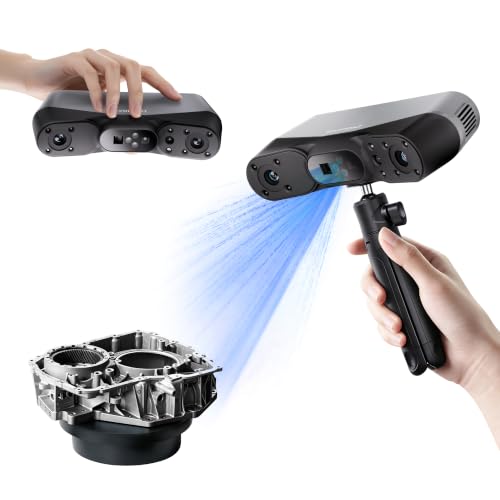
- Up to 0.03 mm single-frame accuracy
- Five scan modes for indoor and outdoor use
- Wi-Fi 6 plus battery grip for cable-free scanning
Best For: High-precision 3D printing, reverse engineering, and field scanning
Starter Medium-Format Pick

- 0.07 mm accuracy and 0.10 mm resolution
- Markerless AI tracking helps resume scans
- JMStudio handles scanning, editing, and optimization
Best For: Beginners and hobbyists starting with medium-format scanning
Pocket Wireless Performer
Creality Pika Portable Scanner

- Up to 0.03 mm accuracy with 0.1 mm resolution
- Blue laser and NIR modes cover small to large subjects
- Wi-Fi 6, touchscreen, and swappable batteries
Best For: Users wanting a compact scanner for detail work and body scans
Lightweight Wireless Value

- Only 105g and easy to travel with
- WiFi6 scanning across major platforms
- 24-bit color and anti-shake tracking
Best For: Entry-level users scanning medium-sized objects on the go
Industrial Laser Pick
Revopoint MetroY Ultra 3D Scanner

- Up to 0.01 mm single-frame precision
- 5 scan modes for small to medium objects
- Wi‑Fi 6 and 5500 mAh battery grip
Best For: High-precision industrial scanning and reverse engineering
Budget Portable Pick

- Portable design with 5V power-bank support
- Dual modes for wide-range and detailed scans
- Full-color texture capture with RGB camera
Best For: Portable scanning with color capture and Android support
All-Weather Performer

- Up to 0.03 mm single-frame accuracy
- Five scan modes for small to large objects
- Wi‑Fi 6 wireless scanning and mobile preview
Best For: Versatile indoor/outdoor scanning across many object sizes
Wireless Handheld Pick

- 0.1 mm accuracy with 30FPS scanning
- WiFi 6 bridge for portable wireless use
- Anti-shake tracking helps beginners
Best For: portable handheld scanning for 3D printing and mobile workflows
Premium Portable Scanner

- 0.05 mm accuracy and 0.03 mm precision
- WiFi 6 mobile scanning with dual modes
- 190 g body is easy to carry
Best For: detailed portable scanning for demanding 3D print and reverse-engineering work
Travel-Friendly Value Pick

- WiFi 6 wireless scanning in a 190 g body
- Up to 0.05 mm accuracy for detailed models
- RGB texture capture adds color detail
Best For: travel-friendly scanning with strong detail and full-color capture
Premium AI-Driven Precision – Revopoint POP 4 for Detailed Scans
If you want portable 3d scanners for precision work, the Revopoint POP 4 is built for demanding scanning jobs. It combines high stated accuracy, multiple scan modes, and wireless use so you can move from small parts to larger objects without being tied to a desk.
Best For: Users who need high-accuracy scanning for 3D printing, reverse engineering, and fieldwork on complex objects.
Pros:
- Single-frame accuracy up to 0.03 mm with detailed volumetric accuracy claims
- Five scan modes, including blue laser options for reflective metal and dark objects
- Wi-Fi 6 and a 5500mAh battery grip support wireless outdoor scanning
- AI segmentation and photorealistic model features help streamline cleanup and output
Cons:
- Windows-only AI segmentation limits one key feature to a single platform
- Advanced capabilities may be more than casual users need
The POP 4 looks aimed at users who want a compact scanner with serious capability rather than a simple entry model. Its mix of accuracy, speed, and outdoor-friendly scanning makes it a strong fit for technical workflows.
Starter Medium-Format Pick – 3DMakerpro Fox for Beginners
The 3DMakerpro Fox is a practical choice if you want portable 3d scanners without jumping straight into a complex pro system. It targets beginners and hobbyists with medium-format scanning, straightforward software, and enough precision for useful prints and models.
Best For: Beginners and hobbyists who want an approachable scanner for 3D printing, modeling, and basic inspection.
Pros:
- 0.07 mm accuracy and 0.10 mm resolution are solid for an entry-level scanner
- Markerless AI visual tracking helps recover from missed passes
- JMStudio combines scanning, editing, and optimization in one workflow
- Designed as an accessible medium-format option for new users
Cons:
- Geared toward entry-level use rather than advanced metrology
- Best suited to medium-format projects, not ultra-small precision parts
Fox makes the most sense if you value a gentle learning curve and dependable everyday results. It is positioned as a simple, confidence-building way to get started with 3D scanning.
Pocket Wireless Performer – Creality Pika Portable Scanner
The Creality Pika is built for buyers who want portable 3d scanners with real flexibility. Its pocket-sized body, dual scan modes, and wireless features make it a strong all-around option for scanning everything from small collectibles to full-body subjects.
Best For: Creators who want a compact, wireless scanner for detailed objects, body scans, and mixed-use workflows.
Pros:
- Up to 0.03 mm accuracy with 0.1 mm resolution for fine detail capture
- Dual-mode design switches between blue laser and NIR structured light
- Wireless PC mode, dual batteries, and Wi-Fi 6 support portable operation
- AI body completion, retexturing, and hole filling add useful automation
Cons:
- Best results still depend on choosing the right mode for the subject
- Advanced feature set may be more than casual users need
Pika stands out as a versatile scanner for people who want one device to handle both precision small-part work and larger full-body captures. The combination of mobility and AI tools makes it especially appealing for on-the-go scanning.
Lightweight Wireless Value – Creality CR-Scan Ferret Pro
The Creality CR-Scan Ferret Pro is a sensible pick for portable 3d scanners if you want something lightweight and easy to carry. It focuses on beginner-friendly operation, wireless scanning, and full-color captures for everyday 3D printing projects.
Best For: Entry-level users who want a lightweight, wireless scanner for medium-sized objects and casual 3D printing work.
Pros:
- Just 105g, making it one of the easiest options to carry around
- WiFi6 wireless scanning supports Windows, macOS, Android, and iOS
- 24-bit full-color scanning with anti-shake tracking
- Includes a useful kit with tripod, power bank, phone holder, and carrying case
Cons:
- Not suitable for very small or highly detailed items like jewelry or precision parts
- Best avoided on reflective, transparent, or very dark surfaces
Ferret Pro is aimed at users who prioritize convenience and portability over top-tier fine-detail scanning. For general-purpose scanning at home or on the go, it offers a practical balance of features and simplicity.
Industrial Laser Pick – Revopoint MetroY Ultra 3D Scanner
If you need one of the more capable portable 3d scanners for tight-tolerance work, the Revopoint MetroY Ultra is built around speed, precision, and flexibility. Its blue laser system, multi-mode scanning, and wireless battery grip make it a strong fit for field inspections, reverse engineering, and detailed industrial capture.
Best For: Users who want high-precision portable scanning for industrial parts, inspection, and reverse engineering.
Pros:
- Up to 0.01 mm single-frame precision and 0.015 + 0.04 mm x L volumetric accuracy
- 5 scanning modes, including laser cross-lines, parallel lines, single-line, structured light, and turntable scanning
- Scans dark, shiny, and metallic parts without spray
- Wi-Fi 6 support plus a 5500 mAh battery grip for mobile use
Cons:
- Battery grip runtime is about 2.5 hours
- Best suited to industrial and precision workflows rather than casual use
The MetroY Ultra stands out when scan quality matters more than simplicity. If you want a portable scanner that can handle demanding surfaces, outdoor light, and multiple object sizes, this model offers a very complete feature set.
Budget Portable Pick – Creality CR-Scan Ferret
The Creality CR-Scan Ferret is a practical choice if you want portable 3d scanners that are easy to power on the go. It combines a handheld design with Android support, full-color capture, and dual scanning modes, making it useful for everyday 3D printing and mobile scanning tasks.
Best For: Buyers who want a portable, lower-power scanner with color capture and phone-friendly operation.
Pros:
- Portable scanning with low power draw and support for a 5V power bank
- Dual-mode scanning for both wide-range and fine-detail capture
- Up to 0.1 mm accuracy and 0.16 mm resolution in high-accuracy mode
- Built-in RGB camera captures full-color textures
Cons:
- Mobile scanning support is Android-focused
- Performance depends on meeting the listed device requirements
This is a solid option if you value flexibility over maximum precision. The Ferret keeps the setup light and mobile, while still offering enough detail for 3D printing and textured model capture.
All-Weather Performer – Revopoint POP 4 3D Scanner
The Revopoint POP 4 is one of the more versatile portable 3d scanners for users who need accuracy, outdoor stability, and multiple scan styles in one device. With five scanning modes, Wi-Fi 6 connectivity, and strong performance on both small and large objects, it is built for demanding 3D printing, reverse engineering, and field work.
Best For: Users who want a versatile portable scanner for indoor and outdoor scanning across a wide range of object sizes.
Pros:
- Up to 0.03 mm single-frame accuracy with 0.03 mm + 0.05 mm x L volumetric accuracy
- Five scanning modes cover laser, structured light, hybrid HD, VCSEL, and deep-hole capture
- Handles very small parts up to large 2 x 2 x 2 m objects
- Wireless scanning with Wi-Fi 6 and phone/tablet preview support
Cons:
- Outdoor filter is sold separately
- Battery grip is available separately
If you need broad scanning coverage rather than a single-purpose tool, the POP 4 is a strong fit. It balances precision, outdoor readiness, and wireless convenience in a way that suits both creative and technical workflows.
Wireless Handheld Pick – Creality CR-Scan Ferret Pro
If you want portable 3D scanners that are easy to move around and still deliver detailed results, the Creality CR-Scan Ferret Pro is built around speed, stability, and wireless convenience. It combines up to 0.1 mm accuracy, 30FPS scanning, and WiFi 6 bridging for a smoother handheld workflow, while also supporting outdoor scanning in ambient light up to 30,000 lux.
Best For: Users who want a wireless handheld scanner for 3D printing, hobby work, and flexible mobile scanning on iOS, Android, or PC.
Pros:
- Up to 0.1 mm accuracy and 0.16 mm resolution for detailed models
- WiFi 6 bridge enables faster, more stable wireless scanning
- Anti-shake tracking helps maintain smooth capture during handheld use
- Supports OBJ, STL, and PLY export for common workflows
Cons:
- Best results require avoiding reflective, transparent, and very dark surfaces
- Requires device and OS compatibility checks before purchase
- Wireless mode depends on the supported bridge and device setup
The Ferret Pro stands out if portability matters most, especially when you want a scanner that can move between desktop, mobile, and outdoor use without giving up much on speed or detail.
Premium Portable Scanner – Revopoint INSPIRE 2 Premium
The Revopoint INSPIRE 2 is a strong option in portable 3D scanners if you want high-end flexibility in a lightweight body. It pairs WiFi 6 mobile scanning with dual scanning modules, supports outdoor use up to 20,000 lux, and is designed to handle reflective or dark surfaces without scanning spray.
Best For: Users who want a lightweight premium scanner for detailed 3D printing, reverse engineering, and portable capture in varied lighting.
Pros:
- Up to 0.05 mm accuracy and 0.03 mm precision
- WiFi 6 supports on-the-go scanning and interactive streaming
- 11 infrared laser lines help scan challenging surfaces without spray
- At 190 g, it is built for easy portability
Cons:
- Revo Design is sold separately
- Minimum system requirements are fairly demanding
- Outdoor performance is rated for shaded or semi-bright conditions, not full sun
This model is a good fit when you want a more advanced portable scanner with strong accuracy, flexible capture modes, and a software workflow aimed at serious modeling tasks.
Travel-Friendly Value Pick – Revopoint INSPIRE 2 Standard
If you’re comparing portable 3D scanners and want the core INSPIRE 2 hardware without the premium package extras, the Standard version keeps the same lightweight, wireless scanning focus. You still get WiFi 6, dual scanning modules, outdoor scanning up to 20,000 lux, and support for high-detail models up to 0.05 mm accuracy.
Best For: Buyers who want a lightweight, travel-friendly 3D scanner with strong accuracy and broad device support for printing, archiving, and mixed-use scanning.
Pros:
- Up to 0.05 mm accuracy and 0.03 mm precision
- Built-in WiFi 6 supports mobile and interactive scanning
- Weighs only 190 g for easier transport
- RGB camera captures full-color texture data
Cons:
- Revo Design is separate paid software
- Included accessories are simpler than the premium bundle
- Performance still depends on supported devices and system specs
The Standard edition makes sense if you want the scanning performance and portability of the INSPIRE 2 line without paying extra for the more accessorized package.
How We Picked the Best Portable 3d Scanners
We prioritized scanners that are genuinely practical to move, set up, and use in everyday workflows. The best Portable 3d Scanners should combine reliable tracking, repeatable capture quality, and software that does not create unnecessary friction. We also considered whether a model is better suited to small objects, larger items, outdoor use, or body scanning.
Quick Comparison: What Matters Most
Before choosing, compare scan accuracy, capture speed, working distance, supported surfaces, and connection type. Faster scanners help with larger objects and mobile workflows, while higher-precision units are usually better for detailed parts, fit checks, and 3D printing. Wireless options can improve convenience, but a stable wired setup may still be preferable for consistency.
Key Buying Factors for Portable 3d Scanners
Accuracy and Detail
Higher accuracy matters if you need clean dimensions, mechanical parts, or model repair work. For casual scanning or visual replicas, slightly lower precision may still be fine.
Tracking and Stability
Good tracking reduces drift and missed geometry. Anti-shake features, markerless tracking, and AI-assisted alignment can make a big difference for beginners.
Object Size and Surface Type
Some Portable 3d Scanners are optimized for small-to-medium objects, while others handle larger items or even outdoor subjects more comfortably. Shiny, black, transparent, and featureless surfaces may require extra prep or a different scanning method.
Software and Output Workflow
Look for easy mesh cleanup, export compatibility, and dependable app support. If you plan to print parts, a scanner with a smooth handoff into modeling or slicing software will save time.
Power, Portability, and Connectivity
Battery life, wireless scanning, and phone or PC compatibility can shape how portable a scanner really feels in use. If you scan on the go, cable management and device support matter as much as raw specs.
Who Should Buy Which Portable 3d Scanners?
If you want a beginner-friendly all-rounder, choose a balanced scanner that emphasizes easy setup and flexible use. If your priority is high detail for 3D printing, look for stronger accuracy and stable tracking. Users scanning larger objects, outdoor scenes, or bodies should favor models with broader capture range and modes built for those tasks. For mobile creators and hobbyists, the most convenient Portable 3d Scanners are the ones that keep the workflow simple from first scan to final export.