
The best physics experiment sets turn abstract formulas into hands-on lessons. Whether you are teaching circuits, force, motion, optics, or magnetism, the right kit can make experiments easier to understand and more engaging.
We compared 10 options for students, classrooms, homeschoolers, and curious young makers, focusing on experiment range, included components, age fit, and learning value.
Best 10 Physics Experiment Sets Picks for 2026
Hands-On Electromagnetism Lab
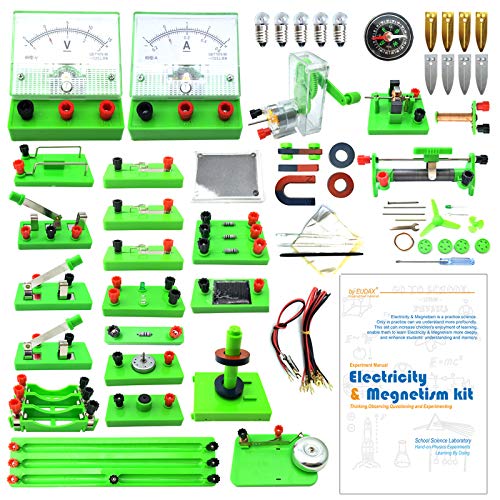
- 79 items for electricity and magnetism projects
- Includes circuits, electromagnets, and generator activities
- Color manual and storage bag included
Best For: Grades 9–11 and broad STEM exploration
Build-and-Measure Mechanics

- 26 model-building exercises
- Covers all six classic simple machines
- Includes a force-measuring spring scale
Best For: Ages 8+ learning mechanics through models
Guided Circuit Discovery
Electricity & Magnetism STEM Kit

- More than 50 guided experiments
- Includes LED, magnetic switch, and Joule’s law modules
- 55 items in a portable storage case
Best For: Ages 13–18 studying circuits and electromagnetism
Light & Lens Demonstrator
Optical Physics Experiment Set

- Explores reflection and refraction
- Includes lenses, mirrors, prism, and light source
- Compact 8-piece set with color manual
Best For: Ages 14+ studying hands-on optics
Best Building Physics Kit
Inertia, Friction & Circular Motion

- Build six working physics models
- Includes theory, experiments, and quizzes
- Designed for ages 9 and up
Best For: Young learners who prefer building-based STEM activities
Best Complete Mechanics Lab Set

- Includes equipment for 26 experiments
- Covers core classical mechanics topics
- Designed for ages 14 and up
Best For: Classrooms and independent students studying mechanics
Best Motion Experiment Set

- Explores velocity, acceleration, and momentum
- Includes steel and rubber bumpers
- Useful for classroom or home labs
Best For: Hands-on lessons about motion and collisions
Best All-Around Mechanics Kit

- Supports 30+ mechanics experiments
- Includes pulleys, balances, gauges, and measurement tools
- Manual included; compact for classroom storage
Best For: Broad introductory mechanics lessons and lab practice
Best Optics-Focused Set
Physics Light and Refraction Kit

- Demonstrates reflection, refraction, lenses, and prisms
- Includes a no-assembly 60cm optical bench
- Comes with extensive optics accessories and a manual
Best For: Hands-on light, imaging, and color experiments
Best Magnetism Set
38-Piece Electromagnet Experiment Kit

- Includes 38 magnetism and electromagnetism components
- Supports levitation, field, attraction, and repulsion experiments
- Includes compass, battery box, wires, and magnet shavings
Best For: Classroom magnetism and electromagnetism demonstrations
Hands-On Electromagnetism Lab – Electricity & Magnetism Kit
For students who want broad coverage, this physics experiment set combines introductory electricity and magnetism activities in one organized kit. It includes 79 items, a color-page manual, and projects ranging from circuits and fruit batteries to electromagnets and a hand-crank generator.
Best For: Students ages 8–18, especially grades 9–11, exploring foundational electricity and magnetism through guided projects.
Pros:
- Supports series circuits, parallel circuits, Ohm’s law, electromagnets, electric bells, and more.
- Includes 56 electricity items, 21 magnetism items, repair tools, and a storage bag.
- Color manual encourages students to learn, think, and explore.
Cons:
- Requires three AA batteries, which are not included.
- The wide range of components may require adult guidance for younger users.
This is a versatile choice when you want one physics experiment set to cover both electrical and magnetic principles rather than focusing on a single topic.
Build-and-Measure Mechanics – Simple Machines Physics Set
This physics experiment set takes a model-building approach to mechanics, using 26 exercises to demonstrate the six classic simple machines. Its included spring scale also lets learners measure how machines affect the direction and magnitude of forces.
Best For: Children ages 8 and up who learn best by building models and connecting physics to everyday tools.
Pros:
- Covers wheels and axles, levers, pulleys, inclined planes, screws, and wedges.
- Includes a force-measuring spring scale for practical investigation.
- Comes with a 32-page illustrated manual and modular, durable construction pieces.
Cons:
- Focuses on simple machines rather than electricity, magnetism, or optics.
- No batteries are required, but building exercises may take hands-on setup time.
Choose this set if your priority is clear, tangible demonstrations of mechanical advantage and force instead of a broad collection of physics topics.
Guided Circuit Discovery – Electricity & Magnetism STEM Kit
This portable physics experiment set offers more than 50 guided activities for learning how circuits, electronics, and magnetism work. The 55-piece kit includes distinctive projects such as a light-control LED, magnetic switch, and Joule’s first law experiment module.
Best For: Students ages 13–18 who want a structured introduction to circuit boards, electromagnets, and related STEM concepts.
Pros:
- Provides more than 50 experiments with explanations of both what happens and why.
- Includes unusual electricity and magnetism modules beyond basic circuit activities.
- Solid storage case keeps the 55 items organized and portable.
Cons:
- The manufacturer recommends it for ages 13–18, limiting its fit for younger children.
- Its focus is electricity and magnetism, not general-purpose physics.
This is a strong option for learners who want many guided electronics activities and the flexibility to design additional experiments after completing the manual.
Light & Lens Demonstrator – Optical Physics Experiment Set
For a focused look at light, this physics experiment set includes lenses, a prism, mirrors, a reflector, and a three-way linear light source. The included manual supports demonstrations of refraction, reflection, diffuse reflection, and image behavior with convex and concave optical components.
Best For: Students ages 14 and up, or teachers demonstrating foundational optics indoors.
Pros:
- Supports experiments with plane mirrors, convex and concave mirrors, lenses, and prisms.
- Includes three biconvex lenses, concave and convex lenses, a prism, reflector, and light source.
- Compact 8-piece package with an English color-page manual.
Cons:
- Requires two AAA batteries, which are not included.
- Its scope is limited to optics rather than circuits, mechanics, or magnetism.
- The light-source direction may require screwdriver adjustment.
This set makes sense when optics is the main learning goal and you want physical components for demonstrating how lenses, mirrors, and prisms change light.
Best Building Physics Kit – Inertia, Friction & Circular Motion
For younger learners seeking physics experiment sets, the Engino Physics Laws kit combines construction with guided exploration. Kids ages 9 and up can build six working models, including a rocket launcher, crash test rig, and sharpening wheel, while learning about inertia, friction, and circular motion.
Best For: Children who enjoy building projects and want an approachable introduction to motion-related physics.
Pros:
- Includes six working model options for hands-on learning.
- Offers theory, experiments, quizzes, and easy-to-follow instructions.
- Includes an interactive 3D app for virtual building.
- Supports construction, critical thinking, creativity, and other STEM skills.
Cons:
- Its focus is limited to inertia, friction, and circular motion rather than broad mechanics.
- The manufacturer recommends it for ages 9 and up.
This is a strong choice when the priority is engaging construction-based learning rather than traditional lab equipment. The six model options and supporting theory give children multiple ways to revisit core concepts.
Best Complete Mechanics Lab Set – 26-Experiment Physics Kit
Among physics experiment sets, this mechanics kit stands out for its broad collection of lab equipment and 26 suggested experiments. It includes pulleys, a tray balance, force gauge, trolley, ramp, lever ruler, pressure gauge, and other tools for exploring classical mechanics.
Best For: Middle- and high-school students, classrooms, and independent learners studying forces, motion, gravity, pressure, and buoyancy.
Pros:
- Covers Newton’s laws, kinematics, gravity, friction, pressure, buoyancy, pulleys, and levers.
- Includes a wide range of dedicated mechanics equipment.
- Comes with a professional manual containing operating steps and principle analysis.
- Storage is organized in a portable box to help manage small components.
Cons:
- The manufacturer recommends the kit for ages 14 and up.
- Its larger equipment selection may be more than beginners need for a single topic.
This is the most comprehensive option of the three for structured mechanics work. Its range of instruments makes it suitable for planned lessons or repeated home experiments, provided the learner is ready for a more advanced setup.
Best Motion Experiment Set – Dynamics Carts
For focused physics experiment sets, the United Scientific Dynamics Carts kit provides a straightforward way to investigate motion and collisions. The two low-friction carts support lessons on velocity, acceleration, Newton’s laws, friction, and conservation of momentum.
Best For: Classroom or home-lab activities centered on Newton’s laws, collisions, and motion dynamics.
Pros:
- Includes two carts for comparative motion and collision experiments.
- Spring steel and rubber bumpers allow different collision setups.
- Each cart has a weight well and low-friction snap-in wheels.
- Includes experiment suggestions and is suitable for classroom or home use.
Cons:
- It focuses mainly on dynamics rather than covering a broad range of physics topics.
- The set includes carts and bumpers but does not provide the wider equipment found in a full mechanics lab kit.
This compact set is a practical pick when the goal is to demonstrate motion principles clearly and repeatedly. Its interchangeable bumpers add useful flexibility for collision-based lessons without requiring a large collection of equipment.
Best All-Around Mechanics Kit – Junior Physics Mechanics Lab
For shoppers comparing physics experiment sets, this mechanics-focused kit offers a broad collection of tools for measurements, motion, pressure, buoyancy, levers, pulleys, and energy experiments. Its included manual and organized design make it practical for junior-school classrooms, labs, and guided home learning.
Best For: Students, teachers, and classrooms needing a versatile hands-on mechanics set with more than 30 supported experiments.
Pros:
- Supports more than 30 classic mechanics experiments.
- Includes measurement tools, pulleys, a lever ruler, pressure gauge, trolley, ramp, and other accessories.
- Comes with step-by-step operating instructions and physics explanations.
- Durable, compact, and designed for storage and portability.
Cons:
- Its focus is mechanics rather than optics, magnetism, or other physics areas.
- The listed age range is adult, despite the notes describing junior-school use.
This is the strongest choice for broad introductory mechanics coverage. It is especially useful when one kit needs to support repeated classroom demonstrations and student experiments across several related topics.
Best Optics-Focused Set – Physics Light and Refraction Kit
Among physics experiment sets, this optics kit is designed for hands-on demonstrations of reflection, refraction, lenses, mirrors, imaging, and color. The integrated 60cm optical bench requires no assembly, while the included components support use at home, in laboratories, or in educational institutions.
Best For: STEM learners and teachers exploring light behavior, lens imaging, mirrors, prisms, and the primary colors of light.
Pros:
- Covers plane, diffuse, convex-mirror, concave-mirror, lens, and prism experiments.
- Includes an integrated optical bench with adjustable light sources.
- Provides a broad selection of lenses, mirrors, screens, prisms, color tools, and imaging accessories.
- Acrylic optical components are described as durable, shatterproof, and suitable for home or lab use.
Cons:
- Batteries are not included.
- The specialized optics focus makes it less suitable for general mechanics experiments.
This kit is a practical pick when the learning goal is specifically light and optics. Its extensive component list makes it useful for demonstrating multiple related concepts without assembling a separate optical bench.
Best Magnetism Set – 38-Piece Electromagnet Experiment Kit
For physics experiment sets centered on magnetism, this 38-piece kit combines permanent magnets, an electromagnet, magnetic levitation equipment, a compass, magnet shavings, cars, wires, and other accessories. Diagram-based activities help students investigate attraction, repulsion, magnetic fields, electromagnetism, and Earth’s magnetic field.
Best For: Teachers and learners conducting approachable classroom demonstrations and hands-on experiments in magnetism and electromagnetism.
Pros:
- Includes 38 listed items covering permanent magnets and electromagnetism.
- Supports magnetic-field, levitation, attraction, repulsion, compass, and electromagnet experiments.
- Provides battery, wires, pins, thread, cars, butterflies, and magnet shavings for varied activities.
- Compact ABS-based set designed as a classroom teaching aid.
Cons:
- Its subject coverage is concentrated on magnetism and electromagnetism.
- The manufacturer recommends it for ages 15 and up.
This is a focused and accessible option for lessons about magnetic forces and fields. Choose it over a broad mechanics kit when electromagnets, levitation, and magnetic demonstrations are the main priorities.
How We Picked These Physics Experiment Sets
We looked for kits that support genuine, repeatable experiments rather than one-off demonstrations. The selection covers several major physics topics, including electricity, electromagnetism, mechanics, Newton’s laws, simple machines, optics, friction, inertia, and circular motion.
We also considered how clearly each set appears to match its intended learner. A basic circuit kit may suit an introductory student, while a dynamics-cart or optics set can provide more focused laboratory practice. Component variety, hands-on usability, classroom potential, and the likelihood of supporting multiple projects were also important factors.
Quick Comparison
| Best For | Recommended Kit Type | Topics Covered |
|---|---|---|
| Electricity beginners | Basic circuit discovery kit | Circuits, current, magnetism |
| Mechanics lessons | Pulley, balance, or force-gauge kit | Force, work, mass, and motion |
| Newton’s laws | Dynamics-cart set | Acceleration, collisions, and inertia |
| Optics practice | Prism, lens, and reflector kit | Refraction, reflection, and light |
| Creative STEM play | Engineering-focused construction set | Friction, circular motion, and design |
Key Buying Factors for Physics Experiment Sets
Subject Coverage
Choose a kit that matches the lesson or skill you want to develop. Electricity sets are useful for learning circuits and electromagnetism, while mechanics kits are better for measuring force, balance, pulleys, and motion. Optics sets are the natural choice for studying lenses, mirrors, prisms, and light paths.
Age and Difficulty
Check the recommended age, supervision requirements, and whether the activities require prior knowledge. Younger learners generally benefit from guided construction and visible demonstrations. Older students may need measurement-focused equipment and experiments that connect directly to equations or lab reports.
Included Equipment
Review the parts list before buying. Look for essentials such as wires, circuit boards, magnets, lenses, carts, pulleys, force gauges, balances, or light sources, depending on the topic. A kit with more components is not automatically better if the instructions are unclear or the pieces are difficult to use.
Instruction Quality and Repeatability
Clear diagrams and experiment instructions can make a major difference, especially for home learning. Favor sets that support several activities and allow students to change one variable at a time, record observations, and repeat tests.
Who Should Buy Which Physics Experiment Sets?
For introductory electricity lessons, choose a circuit or electromagnetism kit with accessible components and visible results. For classroom demonstrations of force and motion, a dynamics-cart set or a mechanics kit with pulleys and a force gauge is more appropriate. Optics-focused learners should select a set containing multiple lenses, mirrors, prisms, and a controllable light source.
Families seeking open-ended STEM activities may prefer an engineering or simple-machines set, especially when building and experimentation matter as much as formal measurement. Teachers should prioritize durable parts, enough equipment for the planned group size, and activities that align with the curriculum. Before purchasing, confirm what batteries, rulers, stands, or other household supplies may be required.