
The best physics experiment sets for high school students turn abstract formulas into observable results. With the right kit, students can build circuits, measure forces, explore magnetism, test motion, or investigate how lenses and mirrors manipulate light.
This roundup compares 10 hands-on options across major high school physics topics, with attention to experiment variety, included equipment, age suitability, and classroom or home-learning value.
Best 10 Physics Experiment Sets for High School Students Picks for 2026
Best All-in-One Electromagnetism Kit
Basic Electricity & Magnetism Lab
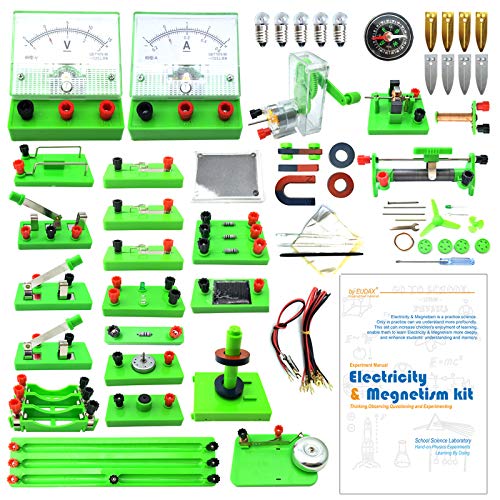
- 79 items for electricity and magnetism activities
- Build circuits, electromagnets, bells, and generators
- Color manual and storage bag included
Best For: Grades 9–11 students learning introductory electricity and magnetism
Best Mechanics-Focused Set
26-Experiment Physics Mechanics Kit

- Covers 26 classical mechanics experiments
- Includes pulleys, ramp, trolley, balance, and force gauge
- Manual and storage box included
Best For: Students 14+ studying forces, motion, gravity, and simple machines
Best Magnetism Classroom Set
38-Piece Electromagnet Experiment Kit

- 38 pieces for magnetism and electromagnetism
- Includes levitation gear, compass, and magnetic shavings
- Designed for step-by-step classroom demonstrations
Best For: Students 15+ and teachers focusing on magnetic fields and electromagnets
Best Build-and-Learn Option
Inertia, Friction & Circular Motion Kit

- Build six working physics models
- Covers inertia, friction, and circular motion
- Includes theory, quizzes, instructions, and 3D app
Best For: Ages 9+ learners who prefer construction-based physics projects
Best Starter Circuit Kit
EUDAX Electricity & Magnetism Lab

- 27-count kit for grades 7–11
- Includes guided circuit and magnetism projects
- Transparent storage box and color manual
Best For: Foundational electricity and magnetism practice
Best Comprehensive Lab

- 79 total pieces with measurement tools
- Covers electricity, magnetism, and energy conversion
- Includes color manual and storage case
Best For: Broad home or school physics exploration
Best High School Coursework Kit
Physics Electricity & Magnetism Lab

- 77 components for electricity and magnetism
- Includes Ohm’s law and Joule’s Law modules
- Double-layer case keeps parts organized
Best For: High school physics coursework and independent lab practice
Optics Explorer

- 15+ experiments in reflection, refraction, and image formation
- 25+ optics components, including lenses, mirrors, and prisms
- 32-page illustrated guide for structured learning
Best For: Students exploring light and optics through guided experiments
Circuit Starter
Basic Electricity Learning Kit

- Builds series and parallel circuits
- Includes English assembly instructions
- Stores components in a plastic box
Best For: Beginners learning core electricity concepts and circuit building
Electromagnetism Workshop

- More than 50 electricity and magnetism experiments
- 55 components with specialized experiment modules
- Illustrated manual and organized storage case
Best For: Teen learners seeking an extensive electromagnetism project set
Best All-in-One Electromagnetism Kit – Basic Electricity & Magnetism Lab
For shoppers comparing physics experiment sets for high school students, the EUDAX kit combines introductory electricity and magnetism activities in one portable package. Students can build series and parallel circuits, investigate Ohm’s law, make an electromagnet, and explore a hand-crank generator using the included components and color manual.
Best For: Grades 9–11 students studying foundational electricity, circuits, and magnetism.
Pros:
- Includes 79 items spanning electricity and magnetism experiments.
- Supports hands-on projects such as fruit batteries, electric bells, and electromagnets.
- Includes a color-page manual and storage bag.
Cons:
- Requires three AA batteries, which are not included.
- The manufacturer’s recommended age range starts at 8, so some activities may be introductory for older students.
This is a versatile choice when a student needs broad introductory coverage rather than a kit focused on one physics unit. The combination of circuit and magnetism activities makes it suitable for guided study or exploratory projects.
Best Mechanics-Focused Set – 26-Experiment Physics Mechanics Kit
This mechanics kit is a practical option among physics experiment sets for high school students who need equipment for force, motion, and simple-machine investigations. Its included trolley, ramp, pulleys, lever ruler, balance, force gauge, and pressure gauge support experiments tied to Newton’s laws, kinematics, gravity, friction, pressure, and buoyancy.
Best For: Students ages 14 and up working on classical mechanics in a classroom, lab, or home setting.
Pros:
- Supports 26 hands-on mechanics experiments.
- Includes tools for investigating pulleys, levers, force balance, friction, and buoyancy.
- Comes with a professional manual and storage box.
Cons:
- Its focus is classical mechanics rather than electricity or magnetism.
- The listing does not specify included batteries or other power accessories.
Choose this set when the priority is a structured mechanics lab with multiple measuring and motion tools. The age recommendation and equipment selection make it better suited to more advanced schoolwork than play-oriented physics kits.
Best Magnetism Classroom Set – 38-Piece Electromagnet Experiment Kit
For a focused addition to physics experiment sets for high school students, this 38-piece magnet kit concentrates on magnetic fields, attraction and repulsion, electromagnets, and levitation. The assortment includes horseshoe, bar, and ring magnets, an electromagnet, compass, magnetic shavings, battery box, wires, and activity components.
Best For: Students 15 and up, teachers, and classrooms demonstrating magnetism and electromagnetism.
Pros:
- Provides 38 pieces for classic magnetism and electromagnetism demonstrations.
- Includes magnetic levitation equipment, compass, and magnetic shavings.
- Supports step-by-step experiments using diagrams.
Cons:
- Its subject coverage is narrower than a combined electricity-and-magnetism kit.
- The listing does not specify the quantity or type of every wire and small accessory.
This set is a strong fit for lessons centered on visual demonstrations of magnetic fields and forces. It works particularly well as a classroom teaching aid or as a dedicated supplement to a broader physics curriculum.
Best Build-and-Learn Option – Inertia, Friction & Circular Motion Kit
Among physics experiment sets for high school students, the Engino kit stands out for its model-building approach to motion. Students can construct six working models, including a rocket launcher, crash test rig, and sharpening wheel, while using the theory, experiments, quiz section, and 3D app to explore inertia, friction, and circular motion.
Best For: Younger learners ages 9 and up who benefit from construction-based introductions to motion concepts.
Pros:
- Offers six working model options related to physics laws.
- Includes theory, experiments, facts, quizzes, and an interactive 3D app.
- Develops construction, creative, logical, and critical-thinking skills.
Cons:
- The recommended age of 9+ makes it less specialized for advanced high school coursework.
- It focuses on inertia, friction, and circular motion rather than a broad range of physics topics.
This is best viewed as an engaging project kit rather than a conventional measurement-based laboratory set. It can help younger students build intuition about motion before moving to more formal high school experiments.
Best Starter Circuit Kit – EUDAX Electricity & Magnetism Lab
For shoppers comparing physics experiment sets for high school students, the EUDAX kit offers a straightforward introduction to electricity and magnetism. Its 27-piece setup supports guided, hands-on projects for grades 7–11, though you will need to provide two AA batteries.
Best For: Junior and senior high students learning basic circuits, electromagnets, and simple energy projects.
Pros:
- Supports simple, series, and parallel circuit projects.
- Includes components for electromagnets, a hand-crank generator, wind-power car, LED, and traffic-light activities.
- Includes a full-color manual and transparent storage box.
- Ready to use out of the box apart from two AA batteries.
Cons:
- Its 27-count component set is less comprehensive than larger lab kits.
- Two AA batteries are not included.
This is a practical choice when you want an accessible, organized kit for foundational electricity and magnetism rather than an advanced measurement laboratory.
Best Comprehensive Lab – 79-Piece Magnet Science Kit
Among physics experiment sets for high school students, this 79-piece kit stands out for its broad selection of electrical and magnetic components. It is designed for learners ages 8–16 and includes measuring tools, generators, magnets, and a detailed manual for progressively varied experiments.
Best For: Students who want a versatile home or school lab for circuits, electromagnetism, measurements, and energy conversion.
Pros:
- Includes an ammeter, voltmeter, sensitive galvanometer, resistors, rheostats, diodes, switches, and magnetic components.
- Supports projects involving circuit analysis, electromagnetism, induction, and energy conversion.
- Comes with a full-color manual and durable storage case.
- Includes distinctive activities and parts such as a solar panel, hand-crank generator, electric bell, compass, and iron filings.
Cons:
- The wide range of parts may be more than beginners need.
- The supplied notes do not specify whether batteries are included.
Choose this set when component variety and measurement capability matter more than a minimal starter setup. It offers room to progress from introductory activities toward more involved investigations.
Best High School Coursework Kit – Physics Electricity & Magnetism Lab
This physics electricity and magnetism kit is tailored to junior and senior high school coursework, making it a focused option among physics experiment sets for high school students. It combines 55 electrical components with 22 magnetism components and includes a manual for guided and independent investigations.
Best For: Students connecting classroom theory with practical work on circuits, electromagnetism, Ohm’s law, and related experiments.
Pros:
- Provides 77 components covering electricity, magnetism, and elementary electronics.
- Supports series and parallel circuits, fruit batteries, Ohm’s law, Oersted experiments, electromagnets, and electric bells.
- Includes specialized parts such as a sensitive ammeter, magnetically controlled switch, and Joule’s First Law module.
- Uses a double-layer storage box with fixed positions for transport and organization.
Cons:
- Requires three AA batteries, which are not included.
- Its 14-years-and-up recommendation makes it less suitable for younger learners.
For coursework-aligned practice, this kit offers a strong balance of structured instruction and creative experimentation. Its specialized modules are particularly useful for students ready to move beyond basic circuit building.
Optics Explorer – Hands-On Light Lab
For shoppers comparing physics experiment sets for high school students, the Teenii Optics Science Kit offers a focused way to investigate light through hands-on activities. Its collection of lenses, mirrors, prisms, transparent blocks, and light emitters supports more than 15 experiments covering reflection, refraction, image formation, rainbows, and color effects.
Best For: Students interested in optics, classroom demonstrations, homeschooling, and guided science projects.
Pros:
- Includes more than 25 components for building a small optics laboratory.
- Supports 15+ experiments involving lenses, mirrors, prisms, and light.
- Provides a 32-page, full-color manual with step-by-step instructions.
- Includes useful setup accessories such as stands, holders, screens, and a protractor card.
Cons:
- Its subject matter is concentrated on optics rather than electricity or mechanics.
- The recommended age range begins at 8, so some activities may be introductory for advanced high school students.
This is a strong choice when the goal is visual, guided exploration of light. The broad component selection makes it more versatile than a single-demonstration kit, though students seeking a wider physics curriculum may want a set covering additional topics.
Circuit Starter – Basic Electricity Learning Kit
This EUDAX kit is a straightforward option among physics experiment sets for high school students who need practice with introductory electricity. It focuses on assembling series and parallel circuits, helping learners connect textbook concepts with simple, hands-on construction.
Best For: Introductory electricity lessons, grades 7–9 projects, science clubs, camps, and homeschool activities.
Pros:
- Designed to demonstrate basic current and electrical rules.
- Supports both series and parallel circuit builds.
- Includes English instructions for guided assembly.
- Components come in a plastic storage box for organization.
Cons:
- Two AA batteries are not included.
- The basic kit has a narrower electricity focus than broader electromagnetism sets.
- Its stated target of grades 7–9 may make it less challenging for advanced students.
Choose this set when you want a compact, beginner-oriented introduction to circuit fundamentals. Its limited scope is also its advantage: students can concentrate on series and parallel connections without being overwhelmed by a large project catalog.
Electromagnetism Workshop – 55-Piece Physics Lab
For students who want a broader project selection, the Mysterystone kit combines electricity and magnetism in a portable physics lab. It includes 55 items and instructions for more than 50 experiments, with projects involving circuits, electromagnets, a magnetic switch, light control, and Joule’s first law.
Best For: Students ages 13–18 who want exploratory electricity and magnetism projects for STEM learning, class reinforcement, or group activities.
Pros:
- Offers more than 50 experiments across electricity and magnetism.
- Includes 55 items, including specialized modules such as a magnetic switch and light-control LED.
- The illustrated manual explains both procedures and the underlying concepts.
- Comes in a solid storage case with designated spaces for components.
Cons:
- Its large project range may require more setup and organization than a basic circuit kit.
- The supplied notes do not specify whether batteries are included.
- Its physics focus is centered on electricity and magnetism rather than optics or mechanics.
This is the most expansive choice of the three for learners who want repeated experimentation and room to create additional projects. The combination of a substantial component count, illustrated guidance, and storage case makes it well suited to ongoing STEM exploration.
How We Picked the Best Physics Experiment Sets for High School Students
We selected kits that support practical investigation rather than simple demonstration alone. The lineup covers core topics commonly taught in high school physics, including electricity, magnetism, mechanics, forces, motion, optics, inertia, friction, and circular motion. We also considered the range of experiments, the usefulness of the included components, apparent durability, clarity of the learning purpose, and suitability for independent or supervised use.
Because these products vary considerably, the best choice depends on the student’s course level and the type of work they need to complete. Some are focused circuit-building sets, while others are broader lab collections or topic-specific kits.
Quick Comparison
| Kit type | Best suited to | Typical learning focus |
|---|---|---|
| Electricity and circuit kits | Beginners and electronics learners | Series and parallel circuits, current, voltage, and components |
| Magnetism and electromagnetism kits | Students studying fields and induction | Magnets, coils, electromagnets, and magnetic effects |
| Mechanics lab kits | Physics-course lab work | Force, pulleys, balance, motion, and mechanical advantage |
| Optics kits | Students learning light | Reflection, refraction, lenses, mirrors, and prisms |
| Multi-topic STEM kits | Exploration and demonstrations | Several introductory physics principles in one package |
Key Buying Factors for Physics Experiment Sets for High School Students
Match the Kit to the Syllabus
Start with the concepts the student is currently studying. A circuit kit is more useful for an electricity unit, while a mechanics set with a pulley and force gauge may better support forces and Newtonian mechanics. Choose an optics kit when the course includes lenses, mirrors, or light behavior.
Check Measurement Capability
Hands-on experiments are more valuable when students can record and compare results. Look for force gauges, balances, rulers, graduated components, or compatible multimeters where appropriate. A kit with many parts but no practical way to measure outcomes may be better for demonstrations than formal lab reports.
Review Component Quality and Safety
Inspect the listed contents before buying. Check whether wires, connectors, magnets, lenses, pulleys, and mounting pieces are included or must be purchased separately. For electrical kits, confirm the intended power source and use low-voltage equipment when possible. Younger students should work with adult or teacher supervision, especially around small parts, strong magnets, batteries, and glass optics.
Consider Experiment Variety and Documentation
A focused kit can teach one subject more effectively than a crowded box of unrelated pieces. However, students completing multiple assignments may benefit from a broader set. Clear instructions, diagrams, experiment prompts, and explanations of expected results can make a major difference for independent study.
Who Should Buy Which Physics Experiment Sets for High School Students?
Choose an electricity-focused EUDAX, Mysterystone, or comparable circuit kit for students who need repeated practice building and troubleshooting basic circuits. Magnet and electromagnet sets are a good fit for lessons on magnetic fields, coils, and induction. A mechanics kit is the practical choice for students working on force, pulleys, balance, and motion measurements.
For light and vision topics, the Teenii optics kit offers a more targeted direction through prisms, lenses, and mirrors. Students who want a broader introduction may prefer a multi-topic STEM or magnet science kit, while teachers should prioritize experiment count, reusable components, and enough parts for pairs or small groups. Before purchasing, compare the included equipment with the required class activities and confirm the recommended age, power requirements, and supervision guidance.