
The best physics experiment sets for elementary students turn abstract ideas into hands-on discoveries. With the right kit, children can explore motion, magnetism, electricity, light, and simple engineering through guided activities they can see and repeat.
This roundup compares 10 options across skill level, experiment focus, included components, and classroom or home-learning usefulness, so you can choose a set that matches your child’s age and interests.
Best 10 Physics Experiment Sets for Elementary Students Picks for 2026
Build-and-Test Motion Kit
Physics Laws: Inertia, Friction & Circular Motion

- Build six working physics models
- Covers inertia, friction, and circular motion
- Includes theory, experiments, quiz, and 3D app
Best For: Ages 9+ and hands-on young engineers
Magnetism Discovery Set

- Includes 14 magnets and accessories
- Features compass, magnetic cars, and iron filings
- Designed for creative magnetism experiments
Best For: Ages 8+ learning magnetism at home or school
Multi-Experiment STEM Set
7-in-1 Science Circuits Experiments

- Includes seven hands-on STEM projects
- Explores circuits, energy, motion, and aerodynamics
- Provides step-by-step assembly instructions
Best For: Ages 8+ in classrooms, homeschool, or family activities
Light-and-Lens Demonstration Kit
Physics Optical Experiment Set

- Explores reflection and refraction
- Includes lenses, mirrors, prism, and light source
- Comes with an English color-page manual
Best For: Older students and supervised optics demonstrations
Hands-On Circuit Explorer

- 50-piece kit with 18 listed experiments
- Explores circuits, generators, motors, and magnets
- Includes meters and a 40-page color manual
Best For: Ages 8+ seeking a broad, guided physics activity set
Magnetism Discovery Starter

- 16-piece magnetism-focused set
- Includes bar, ring, horseshoe, and compass magnets
- Supports attraction and magnetic-field activities
Best For: Ages 8+ beginning hands-on magnetism exploration
Advanced Circuit Project Lab
Electricity and Magnetism Experiment Kit

- 55-item kit with more than 50 experiments
- Includes circuit, electromagnet, light, and magnetic-switch modules
- Illustrated manual and organized storage case
Best For: Older students ages 13–18 seeking extensive physics projects
Best Electricity & Magnetism Builder
EUDAX School Physics Labs Circuit Kit
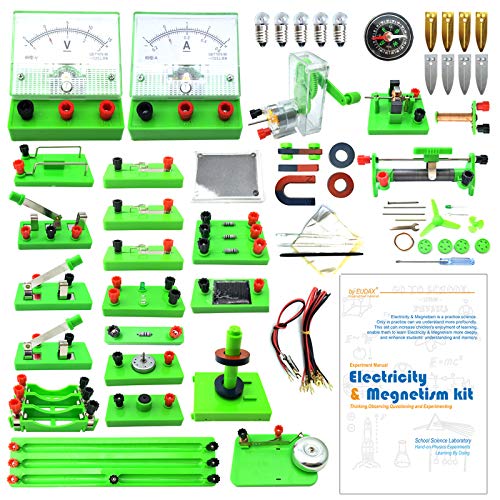
- Explores electricity and magnetism
- Includes 79 listed items and a color manual
- Builds circuits, electromagnets, and generators
Best For: Older elementary beginners exploring multiple physics topics
Best Optics Exploration Set
Teenii Physics & Optics Science Kit

- Offers 15+ light experiments
- Includes lenses, mirrors, prisms, and screens
- Comes with a 32-page full-color guide
Best For: Students ages 8–16 learning introductory optics
Best Circuit-Building Practice Kit

- Emphasizes hands-on circuit building
- Includes switches, wires, bulbs, and LEDs
- Parts store in a transparent box
Best For: Older students practicing guided electricity projects
Build-and-Test Motion Kit – Physics Laws: Inertia, Friction & Circular Motion
For families seeking physics experiment sets for elementary students, this Engino kit offers a hands-on way for children ages 9 and up to explore inertia, friction, and circular motion. Kids build six working models, including a rocket launcher, crash test rig, and sharpening wheel, while using the included theory, experiments, quiz, and app materials.
Best For: Budding engineers who enjoy construction projects and want a structured introduction to motion laws.
Pros:
- Includes six working model options.
- Combines building with theory, experiments, and a quiz.
- Includes an interactive 3D app for virtual building.
- Supports construction, critical thinking, and other STEM skills.
Cons:
- Recommended for ages 9 and up, so it may be advanced for younger elementary students.
- The projects focus specifically on inertia, friction, and circular motion.
This is a strong choice when you want physics learning paired with model construction rather than isolated demonstrations. The six builds provide variety, while the written material helps connect each project to the underlying concepts.
Magnetism Discovery Set – Junior Science Magnetism Set
This junior magnetism set is a focused option among physics experiment sets for elementary students ages 8 and up. It supplies magnets, a compass, magnetic cars, and an iron-filings box so children can investigate magnetic forces and Earth-related magnetism with simple household tools such as paper, rulers, and pens.
Best For: Classroom or home learners beginning hands-on experiments with magnets and observation skills.
Pros:
- Includes 14 magnets and experiment accessories.
- Provides bar, U-shaped, and ring ceramic magnets.
- Includes a compass, magnetic cars, and an iron-filings box.
- Encourages children to create experiments using everyday materials.
Cons:
- The set centers on magnetism rather than a broad range of physics topics.
- Some experiments require additional household tools.
Choose this kit when you want a compact, topic-specific introduction to magnetism. Its variety of magnetic components gives students multiple ways to observe attraction, movement, and magnetic effects in practical activities.
Multi-Experiment STEM Set – 7-in-1 Science Circuits Experiments
For children ages 8 and up, this multi-project kit broadens the usual physics experiment sets for elementary students with seven activities involving circuits, energy conversion, motion, color, and aerodynamics. Projects include a telegraph, fruit battery, Newton’s cradle, color wheel, spin art machine, electric buoyancy ball, and flying saucer launcher.
Best For: Families, teachers, and homeschoolers looking for varied STEM activities with repeated building and experimenting.
Pros:
- Offers seven different science and engineering projects.
- Introduces circuitry, energy conversion, and aerodynamics.
- Includes step-by-step instructions for assembly.
- Works for classroom, homeschool, or family activities.
Cons:
- Several experiments share one electric motor kit.
- Projects may require assembly and adult guidance depending on the child’s experience.
- The listing describes a broad STEM mix rather than a single physics topic.
This kit stands out for variety: children can move between electrical, mechanical, and motion-based activities instead of repeating one type of experiment. It is particularly useful when keeping a group engaged across multiple learning sessions.
Light-and-Lens Demonstration Kit – Physics Optical Experiment Set
This optical experiment set gives students a practical way to study light behavior through lenses, mirrors, a prism, and an adjustable linear light source. It covers reflection, refraction, diffuse reflection, and convex and concave lens or mirror demonstrations, making it a more advanced option among physics experiment sets for elementary students.
Best For: Older students, teachers, or supervised demonstrations focused on introductory optics.
Pros:
- Includes multiple convex and concave lenses, a prism, and reflectors.
- Demonstrates several reflection and refraction effects.
- Comes with an English color-page manual.
- Uses an adjustable three-way linear light source.
Cons:
- The manufacturer recommends it for ages 14 and up, beyond most elementary grades.
- Requires two AAA batteries, which are not included.
- The light source direction needs screwdriver adjustment.
This set is best treated as a supervised optics teaching tool rather than a general children’s activity kit. Its assortment of lenses, mirrors, and prism supports clear demonstrations, but the recommended age makes it better suited to older learners or instructor-led use.
Hands-On Circuit Explorer – Electricity and Magnetism Kit
For families seeking physics experiment sets for elementary students, the Teenii kit offers a broad introduction to circuits, electricity, and magnetism. Its 50 pieces, 18 listed experiments, and 40-page illustrated manual provide a structured way to explore concepts such as fruit batteries, electric motors, electromagnetism, and generators.
Best For: Children ages 8 and up who want a comprehensive electricity-and-magnetism kit for home learning, family activities, or school projects.
Pros:
- Includes 50 components and 18 hands-on experiments.
- Covers both electric circuits and magnetism.
- Includes meters, switches, motors, magnets, electrodes, and a hand-crank generator.
- Comes with a full-color, 40-page manual.
Cons:
- The recommended age begins at 8, so it may be advanced for younger elementary students.
- The many components may require adult guidance for setup and organization.
This is the most versatile option of the three for learners who want more than magnet activities. The combination of measurement tools, circuit parts, and guided projects gives children multiple ways to connect classroom physics concepts with practical experiments.
Magnetism Discovery Starter – Junior Science Magnet Set
This compact magnet set is a straightforward choice among physics experiment sets for elementary students. With 16 pieces, including bar, ring, and horseshoe magnets plus a compass, it supports simple investigations into attraction, repulsion, magnetic fields, and Earth’s magnetism.
Best For: Children around age 8 and up who need a focused, easy-to-use introduction to magnetism and observation-based science activities.
Pros:
- Focused set of 16 magnetism experiment tools.
- Includes several magnet shapes and a compass.
- Supports activities about attraction, repulsion, magnetic fields, and interactive forces.
- Compact and lightweight at approximately 0.26 kg.
Cons:
- Limited primarily to magnetism rather than electricity or broader physics topics.
- The notes do not specify a printed experiment manual.
Choose this set when simplicity and a narrow learning focus matter most. It is less comprehensive than a circuit kit, but its varied magnets can make core magnetic principles tangible without overwhelming beginners with numerous components.
Advanced Circuit Project Lab – Electricity and Magnetism Experiment Kit
For older students comparing physics experiment sets for elementary students, the Mysterystone kit stands out for project volume and component variety. It includes 55 items, more than 50 listed experiments, and modules for topics such as light control, magnetic switching, circuits, electromagnets, and Joule’s first law.
Best For: Older learners, particularly those ages 13 to 18 according to the manufacturer recommendation, who want an extensive starter lab for independent or classroom-supported exploration.
Pros:
- Offers more than 50 do-it-yourself experiments.
- Includes 55 items and specialized electricity-and-magnetism modules.
- Manual explains both what to do and why the experiments work.
- Solid storage case has fixed spaces for the components.
Cons:
- The stated manufacturer age range of 13–18 may make it unsuitable for younger elementary students.
- Its large number of parts and projects may require more supervision and patience.
- The 1.89 kg kit is less lightweight than the smaller magnet set.
This is a strong choice for advanced students who are ready to move beyond basic demonstrations. For younger children, the age recommendation makes the Teenii or EUDAX set more practical; for teens seeking depth and many project options, Mysterystone provides the broadest experiment menu.
Best Electricity & Magnetism Builder – EUDAX School Physics Labs Circuit Kit
For shoppers comparing physics experiment sets for elementary students, this EUDAX kit offers a broad introduction to electricity and magnetism through hands-on model building. It includes 79 listed items, a color manual, and projects such as series and parallel circuits, fruit batteries, electromagnets, and a hand-crank generator.
Best For: Older elementary students and beginners who are ready for guided electricity and magnetism activities, with adult or teacher support as needed.
Pros:
- Covers both electricity and magnetism in one kit.
- Includes components for series circuits, parallel circuits, fruit batteries, and more.
- Color-page manual supports guided learning and exploration.
- Parts come in a storage bag.
Cons:
- Requires three AA batteries, which are not included.
- The manufacturer-recommended age range is 8–18, so younger children may need close supervision.
Choose this set when variety matters more than a narrowly focused lesson. Its combination of electrical and magnetic experiments makes it a flexible option for home learning or classroom exploration.
Best Optics Exploration Set – Teenii Physics & Optics Science Kit
This Teenii kit is a strong choice among physics experiment sets for elementary students who are curious about light. It provides 15 or more optics experiments using prisms, lenses, mirrors, transparent blocks, light emitters, and screens, with a 32-page full-color guide.
Best For: Students ages 8–16 studying reflection, refraction, image formation, rainbows, and other introductory light concepts.
Pros:
- Focuses on optics through 15 or more hands-on experiments.
- Includes lenses, mirrors, prisms, transparent blocks, and light emitters.
- Full-color manual offers step-by-step instructions and explanations.
- Suitable for home learning, classroom demonstrations, and science projects.
Cons:
- Its subject coverage is concentrated on light and optics rather than electricity or magnetism.
- The many small components may require organized storage and supervision.
Pick this set if your child is especially interested in visual experiments. The included optical hardware supports demonstrations that make reflection, refraction, and color effects easy to observe.
Best Circuit-Building Practice Kit – EUDAX Upgrade Circuit Set
For families seeking physics experiment sets for elementary students that emphasize circuit construction, this EUDAX upgrade kit provides switches, wires, bulbs, LEDs, and related parts in a transparent storage box. Projects range from simple and series circuits to traffic lights, electromagnets, and a wind power car.
Best For: Students practicing basic circuit design with a teacher, parent, or other guide, particularly in structured lessons for grades 7–11.
Pros:
- Supports simple, series, and parallel circuit projects.
- Includes switches, wires, bulbs, and LEDs for hands-on building.
- Offers additional activities such as electromagnets, a hand-crank generator, and a wind power car.
- Parts store in a transparent box for easier organization.
Cons:
- Requires two AA batteries, which are not included.
- The manufacturer-recommended age is 14–17, making it less suitable for younger elementary children without substantial adult guidance.
This is the better fit for learners who want repeated practice assembling and modifying circuits. Its transparent storage box and project variety also make it practical for guided classroom or home sessions.
How We Picked These Physics Experiment Sets for Elementary Students
We focused on kits that make foundational physics approachable through practical experiments rather than requiring advanced equations or specialized lab equipment. The selection covers several major topics: motion and forces, magnetism, electricity, circuits, and optics.
We also considered the likely learning environment. Some sets are compact and suitable for supervised home activities, while others include enough components for repeated demonstrations, group work, or classroom lessons. Because product contents and age guidance can vary, check the current listing carefully before buying, especially for small parts, batteries, and required accessories.
Quick Comparison
| Kit focus | Best suited to | What students can explore |
|---|---|---|
| Motion and engineering | Children interested in building | Inertia, friction, circular motion, and mechanisms |
| Magnetism | Beginners and younger learners | Magnetic attraction, repulsion, fields, and compass use |
| Electricity and circuits | Hands-on experimenters | Conductors, switches, connections, and basic circuit behavior |
| Optics | Visual learners | Reflection, refraction, lenses, mirrors, and light paths |
| Multi-topic sets | Families or classrooms | A broader introduction across multiple physics concepts |
Key Buying Factors
Age and Supervision
Elementary students have wide differences in reading ability, patience, and fine-motor skills. Choose a kit with clear instructions and experiments that can be completed in manageable stages. Younger children should use magnet, circuit, and optics components with adult supervision, particularly when sets contain small parts, sharp-edged components, or batteries.
Experiment Focus
Select a topic that matches the learner’s curiosity. Magnet sets are often an accessible starting point, circuit kits suit children who enjoy building and troubleshooting, and optics kits offer highly visual demonstrations. Motion-focused engineering kits are a good choice for children who prefer mechanical challenges.
Included Materials and Reusability
Review the component list before ordering. Some kits are largely self-contained, while others may need batteries, extra wire, household objects, or a separate light source. Reusable parts provide better long-term value than one-time activities, especially for siblings or classroom groups.
Instruction Quality
Look for step-by-step guidance, explanations of the result, and suggestions for changing one variable at a time. A kit is more educational when it encourages prediction, observation, and discussion instead of simply following a recipe.
Who Should Buy Which Physics Experiment Sets for Elementary Students?
Choose a magnetism set for a straightforward first introduction or for children who enjoy quick, visible results. Pick an electricity and circuits kit for learners who like assembling components and solving connection problems. Optics sets are especially appealing to visual learners and students curious about cameras, glasses, reflections, or rainbows.
For broader exploration, a multi-topic kit can provide variety for families, homeschoolers, or elementary classrooms. An engineering and motion set is the strongest match for children who enjoy construction, moving parts, and design challenges. Whatever you choose, prioritize an age-appropriate kit with enough guidance for independent exploration while keeping an adult nearby for setup and safety.