
The best photo scanners make it easier to preserve family prints, digitize albums, and create high-quality files for sharing or editing. The right model depends on whether you prioritize fast batch scanning, careful flatbed capture, portability, or professional image detail.
We compared 10 leading photo and document scanners across scan quality, workflow speed, connectivity, paper handling, and ease of use to help you choose confidently.
Best 10 Photo Scanners Picks for 2026
Best for High-Volume Photo Archiving

- Batch-scans up to 36 photos
- Duplex-captures photo backs
- Wi-Fi, OCR, and enhancement tools
Best For: Large family photo collections and archival projects
Best Simple Flatbed Value

- 2400 x 2400 dpi optical resolution
- Auto Scan Mode detects items
- Scans photos and documents via USB
Best For: Routine home photo and document scanning
Best for Fast One-at-a-Time Photos

- Scans 4 x 6 photos in about 2 seconds
- Supports photos up to 8 x 10 inches
- Includes faded-image enhancement tools
Best For: Quick home digitizing with one-at-a-time feeding
Best Compact Wireless Multi-Use Scanner

- Compact USB and Wi-Fi design
- Up to 30 ppm duplex scanning
- Handles photos, cards, and documents
Best For: Small spaces and mixed photo-document workflows
Professional Detail Pick
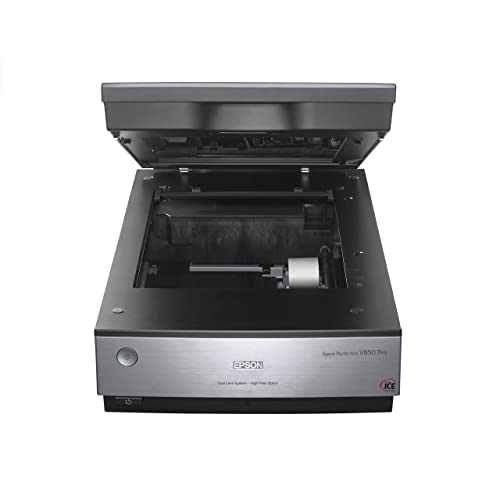
- 6400 dpi resolution for detailed photo scans
- 4.0 Dmax helps retain shadow detail
- Dual-lens system for optimized scanning
Best For: Serious photo scanning and enlargements
Compact Home Pick

- 4800 dpi optical resolution
- Compact, lightweight USB-powered design
- One-click faded-photo color restoration
Best For: Everyday home photo and document scanning
Best Slim Flatbed

- 4800 x 4800 dpi scanning
- USB Type-C data and power
- Auto scan and PDF buttons
Best For: Home photo and document scanning
Best for Film Archives

- Scans prints, slides, and negatives
- 6400 x 9600 dpi resolution
- Includes dust and scratch removal
Best For: Digitizing film and high-resolution photos
Best Portable Sheetfed

- Compact 3-ounce design
- 15 ppm single-sided scanning
- Works with Windows and MacOS
Best For: Portable scans of photos, receipts, and documents
Best for High-Volume Photo Archiving – FastFoto FF-680W
If you have boxes of prints to digitize, the Epson FastFoto FF-680W is one of the most capable photo scanners here. It can batch-scan up to 36 photos and scan at up to one photo per second at 300 dpi, while duplex scanning captures handwritten notes on photo backs in the same pass.
Best For: Families and archivists digitizing large photo collections quickly while preserving notes and other memories.
Pros:
- Batch-scans up to 36 photos and reaches up to one photo per second at 300 dpi
- Handles photos up to 8 x 10 inches, panoramas, postcards, and Polaroid photos
- Includes enhancement tools such as color restoration, red-eye reduction, de-skew, cropping, and rotation
- Offers Wi-Fi, USB, OCR document scanning, and backup to Dropbox or Google Drive
Cons:
- Its larger 11.7 x 11.7 x 6.9-inch footprint may require dedicated desk space
- The standard sheet capacity is listed as 10 despite support for larger photo batches
The FF-680W is a strong choice when speed, batch processing, and photo-preservation features matter more than compact size. Its flexible resolution options also support quick sharing, archival TIFF files, and enlargements.
Best Simple Flatbed Value – CanoScan LiDE 300
The Canon CanoScan LiDE 300 is a straightforward USB photo scanner for occasional document and image digitizing. Its Auto Scan Mode detects what you place on the scanner, while the 2400 x 2400 dpi optical resolution provides plenty of detail for typical home scanning tasks.
Best For: Home users who want a simple, compact flatbed scanner for photos, receipts, cards, and documents.
Pros:
- Auto Scan Mode automatically detects the type of item being scanned
- Offers 2400 x 2400 dpi optical resolution
- Supports photos, receipts, business cards, and paper
- Uses a simple USB connection and has a slim 1.7-inch height
Cons:
- USB connectivity does not provide wireless placement flexibility
- Its one-sheet standard capacity is less suited to high-volume scanning
The LiDE 300 is best viewed as an uncomplicated flatbed option rather than a batch-processing machine. It fits routine home scanning well, especially if you value Auto Scan Mode and high listed optical resolution.
Best for Fast One-at-a-Time Photos – ePhoto Z300
The Plustek ePhoto Z300 is designed to make photo digitizing faster than using a traditional flatbed. Insert photos one at a time, and it can scan a 4 x 6 photo in about two seconds at 300 dpi, with support for common sizes from 3 x 5 through 8 x 10 inches.
Best For: Users digitizing a sizeable photo collection who prefer simple, one-at-a-time feeding over flatbed placement.
Pros:
- Scans a 4 x 6 photo in about two seconds and an 8 x 10 photo in about five seconds at 300 dpi
- Supports 3 x 5, 4 x 6, 5 x 7, and 8 x 10 photos, plus letter and A4 paper
- Includes image enhancement tools for restoring faded pictures
- Uses a CCD sensor and offers 300 or 600 dpi settings
Cons:
- Photos must be inserted one at a time
- USB connectivity limits placement flexibility
- Its listed 19.3-inch depth may need substantial desk space
The ePhoto Z300 is a practical middle ground for people who want faster photo scanning without the larger batch-feeding design of the Epson. Its supported photo sizes and restoration tools add useful flexibility for family archives.
Best Compact Wireless Multi-Use Scanner – ScanSnap iX1300
The ScanSnap iX1300 is a compact photo and document scanner for spaces where a full-size unit would be inconvenient. It supports USB and Wi-Fi, scans up to 30 pages per minute in duplex mode, and can handle photos, cards, thick items, and documents with automatic image corrections.
Best For: Small desks and households that need one scanner for photos, documents, receipts, cards, and cloud workflows.
Pros:
- Compact 4.5 x 11.7 x 3.3-inch design fits small workspaces
- Scans up to 30 pages per minute with double-sided scanning
- Automatically performs de-skew, color optimization, and blank-page removal
- Connects by USB or Wi-Fi and supports computers, mobile devices, cloud services, and Chromebook scanning
Cons:
- Its listed scanner type is document and receipt rather than a photo-focused model
- Compatibility requirements vary by operating system and device
- The standard sheet capacity is 20, so larger batches may require refilling
The iX1300 makes sense when photo scanning is only part of a broader digitizing routine. It is especially appealing for compact workspaces and mixed media, with ScanSnap Home helping organize scanned photos, receipts, business cards, and documents.
Professional Detail Pick – Epson Perfection V850 Pro
For photographers and archivists who want highly detailed photo scans, this Epson photo scanner combines 6400 dpi resolution, a CCD sensor, and a dual-lens system. Its 4.0 Dmax is designed to preserve smooth tonal gradations and fine shadow detail.
Best For: Serious photo scanning, enlargements, and users prioritizing color and shadow detail.
Pros:
- 6400 dpi resolution for detailed scans
- 4.0 Dmax supports smooth gradations and shadow detail
- Dual-lens system selects the appropriate lens for scanning results
- Supports Windows and Mac operating systems listed in the specifications
Cons:
- Large and heavy at 20.9 pounds
- USB connection requires a computer setup
- Its professional features may be more than casual users need
The V850 Pro is the strongest fit here when maximum scan quality matters more than compact size or quick batch handling. Its substantial footprint and specialized capabilities make it better suited to a dedicated scanning workspace.
Fast Batch Scanning Pick – Canon imageFORMULA RS40
If you need to digitize a large collection efficiently, the Canon imageFORMULA RS40 is a practical photo scanner with an automatic feeder. It scans both sides of photos and documents simultaneously and can handle up to 40 items per minute.
Best For: Families and home users scanning mixed photo and document collections in batches.
Pros:
- Automatic feeder holds up to 60 items
- Scans both sides simultaneously at up to 40 items per minute
- Handles photos, Polaroids, receipts, cards, IDs, and documents
- Includes photo enhancement and document-editing software
Cons:
- Maximum listed optical scanning resolution is lower than the Epson flatbed models
- USB connection requires a computer
- Automatic-feeder design may be less suitable for delicate originals that need flatbed handling
The RS40 emphasizes speed and flexibility rather than maximum optical resolution. Its feeder, bundled software, and broad media support make it especially useful for organizing varied household paperwork and photo collections.
Compact Home Pick – Epson Perfection V19 II
The Epson Perfection V19 II is a compact, USB-powered photo scanner for everyday home and office use. Its 4800 dpi optical resolution supports clear scans, while one-touch buttons and Easy Photo Fix simplify routine scanning and restoration.
Best For: Home users who want an affordable-feeling, space-saving scanner for photos, artwork, and documents.
Pros:
- 4800 dpi optical resolution for detailed scans
- Compact 1.5-inch-high design and 3.1-pound weight
- Easy Photo Fix restores color to faded photos with one click
- Removable high-rise lid accommodates books and thicker materials
Cons:
- Flatbed holds one sheet at a time
- USB-powered operation requires a computer connection
- Does not offer the automatic batch feeding of the Canon model
The V19 II is a straightforward choice for occasional photo scanning, artwork, and document projects. Its small footprint and simple controls are appealing when convenience and storage space matter more than high-volume throughput.
Best Slim Flatbed – Canon CanoScan LiDE 400
Canon CanoScan LiDE 400 Slim Scanner, 7.7" x 14.5" x 0.4", Document & Photo Scanner, Black
Check Price On AmazonThe Canon CanoScan LiDE 400 is a practical choice among photo scanners for anyone who wants detailed scans in a slim, easy-to-use flatbed design. Its 4800 x 4800 dpi resolution, image-restoration features, and USB Type-C connection make it well suited to everyday photos and documents.
Best For: Home users scanning photos, letters, and multi-page PDFs while saving space.
Pros:
- 4800 x 4800 dpi resolution helps preserve photo detail.
- Color restore and dust-removal features can improve older images.
- USB Type-C combines data and power in one cable.
- EZ buttons support auto scanning and searchable, editable PDFs.
Cons:
- USB-connected operation limits placement flexibility.
- Its standard sheet capacity is one page.
- Designed for documents and photos rather than film or slides.
The LiDE 400 offers a strong balance of image quality, compact dimensions, and simple controls. It is a particularly sensible pick for routine photo archiving when film scanning is not required.
Best for Film Archives – Epson Perfection V600 Photo
The Epson Perfection V600 is one of the more versatile photo scanners for digitizing prints, negatives, and slides. Its 6400 x 9600 dpi maximum resolution, built-in transparency unit, and restoration tools make it suited to preserving and enlarging older photographic media.
Best For: Photographers and families converting 35mm, medium-format film, slides, and prints into high-resolution files.
Pros:
- Built-in transparency unit scans mounted slides, negatives, and medium-format film.
- 6400 x 9600 dpi supports enlargements up to 17 x 22 inches.
- DIGITAL ICE helps remove dust and scratches.
- ReadyScan LED technology avoids warm-up time.
Cons:
- Its flatbed design is larger and heavier than portable scanners.
- USB 2.0 connectivity may feel slower than newer interfaces.
- More features may be unnecessary for users scanning only occasional documents.
The V600 is the strongest fit here for mixed photo and film collections. Its specialized holders and restoration software add meaningful value for archival projects, though the larger footprint makes it less convenient for small workspaces.
Best Portable Sheetfed – HP HPPS100 Mobile Scanner
The HP HPPS100 is a compact option among photo scanners for quick, single-sided scans while traveling or working in a small office. It connects over USB, scans at up to 15 pages per minute, and supports photos, receipts, cards, and documents through HP WorkScan software.
Best For: Commuters, mobile professionals, and small businesses scanning individual pages, receipts, and photos.
Pros:
- Lightweight 3-ounce design is easy to carry.
- 15 ppm simplex scanning supports small- to medium-batch jobs.
- Handles media from 2 x 2.9 inches up to 8.5 x 14 inches.
- HP WorkScan includes auto-scan, cropping, editing, and image cleanup tools.
Cons:
- It scans one side at a time.
- Its listed resolution is 300 dpi, lower than dedicated photo flatbeds.
- USB power and connectivity are required.
The HPPS100 prioritizes portability and workflow speed over archival photo detail. Choose it for convenient everyday scanning of loose photos and paperwork, rather than large-format enlargements or film preservation.
How We Picked the Best Photo Scanners
We focused on scanners suited to real home, office, and archival projects rather than judging resolution alone. Our evaluation considered optical scan quality, color accuracy, feeding options, software, connectivity, scanning speed, and the types of originals each machine handles best.
Because photo collections vary widely, this roundup includes flatbed scanners for delicate or unusual originals, sheet-fed models for large batches, and versatile document scanners that can also process photographs. We also considered duplex scanning, wireless operation, film support, and practical file-management features.
Quick Comparison
| Best For | Recommended Type | Key Advantage |
|---|---|---|
| Large photo collections | Automatic document feeder | Fast batch processing |
| Delicate or valuable prints | Flatbed scanner | Gentle, controlled handling |
| Detailed enlargements | High-resolution flatbed | Strong image detail |
| Photos and paperwork | Duplex document scanner | Flexible everyday workflow |
| Travel or limited desk space | Compact sheetfed model | Easy portability |
Key Buying Factors for Photo Scanners
Flatbed Versus Automatic Feeder
Flatbed scanners are usually the safer choice for fragile, curled, thick, or irregularly sized photographs. They also provide more control when positioning originals. Automatic document feeders are much faster for loose prints and paperwork, but originals should be clean, flat, and sturdy enough to pass through rollers.
Resolution and Image Quality
For ordinary reprints and online sharing, a true optical resolution around 300 to 600 dpi is often sufficient. Higher resolutions are useful when cropping, restoring, or enlarging images, although they create larger files and do not automatically improve a low-quality original. Look for good color handling and dust- or scratch-reduction tools as well as headline dpi figures.
Speed, Duplex Scanning, and Software
If you are digitizing hundreds of prints, feeder capacity and real-world pages-per-minute performance matter more than maximum resolution. Duplex scanning helps with two-sided documents, while automatic cropping, rotation, blank-page removal, and searchable PDF creation can save substantial editing time.
Connectivity and Compatibility
USB is dependable and often simplest for a single computer. Wi-Fi is more convenient for shared household or office use, but setup and network compatibility should be checked. Confirm that the included software supports your operating system and desired formats, particularly if you need OCR, cloud workflows, or photo-restoration features.
Who Should Buy Which Photo Scanners?
Choose a high-speed feeder model if you have boxes of loose prints and want to finish the project quickly. Select a flatbed photo scanner for irreplaceable family pictures, artwork, negatives, or originals that should not pass through rollers. A high-resolution professional model makes the most sense for photographers, restorers, and anyone planning large enlargements.
For mixed home use, a compact document-and-photo scanner offers a useful balance of convenience and flexibility. If desk space, storage, or travel is the priority, choose a smaller USB sheetfed unit and scan only clean, standard-size originals. Whichever model you select, organize files with consistent names and back them up in at least two locations.