
When it comes to enhancing your classroom’s lab experience, choosing the right PCR thermal cycler is essential. The GTC‑96E and the Mini Thermal Cycler PCR (MTC‑16) stand out as top contenders, offering both affordability and reliability. Each model has unique features that cater to different educational needs. To make an informed decision, consider various factors that can impact your teaching environment and student engagement. Let’s explore what sets these models apart.
GTC‑96E PCR Gradient Thermal Cycler

The GTC‑96E PCR Gradient Thermal Cycler is an ideal choice for educational institutions looking to enhance their molecular biology curriculum. This advanced system features a 96-well gradient block and high precision DNA amplification capabilities. With its innovative semiconductor heating technology, you’ll experience uniform temperature distribution, minimizing edge effects. The 5″ full-touch color TFT display offers an intuitive interface, making it easy to visualize temperature curves and manage runs. Plus, the integrated gradient calculator streamlines experimental setups by refining annealing temperatures. Secure user management and an adaptive heated lid guarantee peak performance, making the GTC‑96E a reliable addition to your lab.
Best For: Educational institutions aiming to enhance their molecular biology curriculum with high precision DNA amplification technology.
Pros:
- Advanced semiconductor heating technology ensures uniform temperature distribution and minimizes edge effects.
- User-friendly 5″ full-touch color TFT display facilitates easy programming and real-time visualization of temperature curves.
- Integrated gradient calculator optimizes experimental setups by refining annealing temperatures across wells.
Cons:
- Initial setup and programming may require a learning curve for new users.
- Higher cost compared to basic thermal cyclers may be a consideration for budget constraints.
- Limited to 96-well format, which may not be suitable for larger scale experiments without additional units.
Mini Thermal Cycler PCR (MTC‑16)
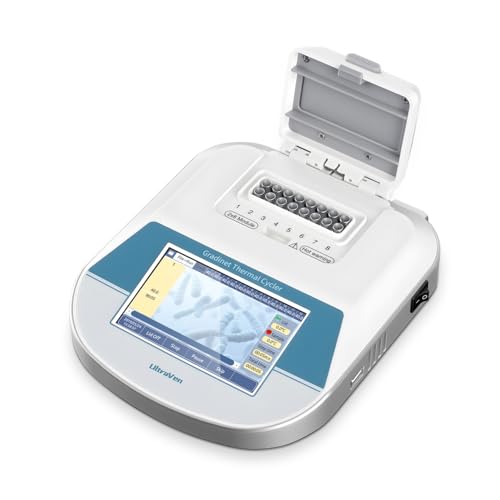
Designed with educators and students in mind, the Mini Thermal Cycler PCR (MTC‑16) offers a compact and portable solution for hands-on learning. Weighing just 3.2 kg, it fits perfectly on tight lab benches and is ideal for mobile setups. With fast cycling speeds of up to 5 °C/sec for heating and 4 °C/sec for cooling, you get precise results with temperature accuracy of ±0.2 °C. The 5-inch TFT touch screen makes file management easy, while its standalone operation means you don’t need an external PC. Plus, it stores over 100 files, accommodating a variety of experimental needs effortlessly.
Best For: The Mini Thermal Cycler PCR (MTC‑16) is best for educators and students seeking a compact and efficient tool for hands-on learning in molecular biology.
Pros:
- Compact design fits easily on tight lab benches and is portable for mobile setups.
- Fast cycling speeds and high temperature accuracy ensure precise and reliable results.
- User-friendly interface with a touch screen and standalone operation eliminates the need for an external PC.
Cons:
- Limited capacity of 16×0.2ml tubes may not suffice for larger experiments.
- The weight of 3.2 kg might still be considered heavy for some users in field applications.
- Potential learning curve for users unfamiliar with touch screen interfaces and advanced settings.
Factors to Consider When Choosing Pcr Thermal Cyclers for Education
When you’re choosing PCR thermal cyclers for education, there are several key factors you need to take into account. Think about the capacity and throughput, as well as the temperature accuracy, to guarantee reliable results. Additionally, a user-friendly interface, portability, and heating and cooling speeds can greatly impact your teaching experience.
Capacity and Throughput
Choosing the right PCR thermal cycler for educational purposes hinges on understanding capacity and throughput. First, think about how many samples you’ll be processing simultaneously. Cyclers vary from 16 to 96 wells, impacting your efficiency in a classroom setting. If you’re working with larger classes or multiple samples, a 96-well cycler might be best. For smaller groups or individual projects, a 16-well model could suffice. Next, consider the speed of the cycler; faster models allow for quicker temperature changes, letting you conduct more experiments in less time. Additionally, look for features like protocol storage, which simplifies workflow. Finally, if you’ll be moving the cycler between locations, compact designs enhance portability, making your educational experience smoother.
Temperature Accuracy
Temperature accuracy is essential in PCR thermal cyclers, as even slight deviations can lead to unreliable results. You should look for models that maintain a standard of ±0.2 °C, ensuring precise amplification of DNA samples. Inconsistent temperatures can wreak havoc on your experiments, so high temperature uniformity across the block is critical for reliable outcomes. Many modern cyclers use advanced semiconductor technology to achieve even temperature distribution, reducing edge effects and enhancing overall accuracy. Additionally, real-time temperature monitoring during the cycling process helps maintain accuracy, allowing for immediate adjustments if needed. Accurate temperature control is fundamental for optimizing annealing temperatures, which greatly impacts the PCR process’s efficiency and your educational outcomes.
User-Friendly Interface
A user-friendly interface in PCR thermal cyclers can greatly enhance the educational experience, making it easier for students and educators alike to navigate complex protocols. Look for models featuring a full-touch color display, which allows intuitive navigation and easy programming, catering to users of varying skill levels. Real-time visualization of temperature curves and run status helps you monitor the amplification process effectively. The ability to edit files quickly and access protocols through a streamlined interface saves time and minimizes errors. Additionally, features like user login and authority management guarantee secure access in a classroom setting. Storing over 100 protocols allows you to switch between experiments effortlessly, fostering an efficient and engaging learning environment.
Portability and Design
When considering PCR thermal cyclers for educational settings, portability and design play a crucial role in guaranteeing an effective learning environment. You’ll want a model that weighs around 3.2 kg or less, making it easy to transport and fit on crowded lab benches. Look for features like aluminum casing, which enhances heat dissipation and guarantees efficient operation in various settings. A thermal cycler that operates standalone, without needing an external PC, simplifies setup and use during lessons. Additionally, compact models that accommodate standard tube formats, such as 0.2 ml tubes, are particularly beneficial, as they guarantee compatibility with common lab supplies. This combination of portability and thoughtful design can greatly improve the learning experience.
Heating and Cooling Speeds
Portability and design set the stage for effective learning, but heating and cooling speeds are what really enhance the educational experience with PCR thermal cyclers. A cycler’s heating speed, ideally reaching up to 5 °C/sec, allows for efficient cycling and shorter experiment times. Cooling speeds, typically around 4 °C/sec, guarantee quick temperature drops, vital for smooth shifts between denaturation and annealing steps. Maintaining temperature accuracy within ±0.2 °C is fundamental for reliable and reproducible DNA amplification results. Additionally, uniform temperature distribution across the block prevents variations in amplification efficiency between wells. By utilizing advanced semiconductor heating technology, you can achieve improved heating and cooling performance, minimizing edge effects and leading to better experimental outcomes in your classroom.
Protocol Storage Options
Choosing the right PCR thermal cycler involves considering various factors, and protocol storage options are essential for enhancing the educational experience. Look for models that can store over 100 protocols, ensuring easy access for students and reproducibility in experiments. This capability streamlines lab sessions, letting students focus on experimentation rather than setup. Advanced thermal cyclers often include integrated gradient calculators that automatically optimize annealing temperatures, making protocol development more efficient. An easy-to-use interface with quick editing features allows for modifications tailored to diverse educational needs and experimental variations. By prioritizing these protocol storage options, you’ll create a more effective and engaging learning environment for your students.
Security Features
As you explore PCR thermal cyclers for educational settings, it is important to evaluate the security features that protect sensitive data and protocols. Look for models with user login systems and role-based permissions, ensuring only authorized personnel can access critical information. Password protection is significant, as it safeguards your stored protocols and experimental data from unauthorized modifications. Choosing a thermal cycler that can store over 100 protocols will help maintain data integrity and streamline experimental management. Additionally, some devices offer adaptive features, such as heated lids that adjust pressure, enhancing performance and ensuring ideal contact during experiments. Implementing a secure multi-user system promotes accountability and controlled access, making your educational environment safer and more efficient.