
A particle counter can help you investigate dust, check filtration changes, or document airborne particles in a controlled space. But a handheld PM2.5 monitor and a cleanroom-oriented counter answer different questions.
These 10 options span straightforward indoor air checks and more detailed particle-size counting. Start with what you need to measure—and whether you need a quick reading or a record you can use later.
Best 10 Particle Counters for Air Testing Picks for 2026
Best for Field Logging
Temtop Professional Handheld Particle Counter

- Counts 0.3, 0.5, and 1.0 µm particles
- Tracks PM2.5, PM10, temperature, and humidity
- 32GB storage with USB data transfer
Best For: Portable facility and workshop inspections
Best for Cleanroom Checks

- Particle channels span 0.3 to 10 µm
- Specified 2.83 L/min (1 CFM) pump
- Stores 5,000 records for USB export
Best For: Cleanroom, HVAC, and filter-testing records
Best for Timed Data Logs
Temtop Airing 2000 Handheld Counter
- Adjustable 1–60 minute logging intervals
- 32GB memory with USB flash-drive export
- Counts three particle sizes plus PM readings
Best For: Repeat checks with scheduled data logging
Best for Custom Sampling
PerfectPrime AQ9600 Dust Counter

- Lists 0.3, 2.5, and 10.0 µm sizes
- Adjustable sample time and frequency
- 9 V DC battery sold separately
Best For: Configurable spot checks and sampling cycles
Best for Report-Ready Sampling
Professional 3-Size Particle Counter

- 0.3, 2.5, and 10 µm detection
- 999-record storage and PDF reports
- Tripod mount for hands-free sampling
Best For: Cleanroom checks with report archiving
Best for Rechargeable Field Checks

- 999 stored records and data curves
- Battery or external USB power
- Verify conflicting size and packing details
Best For: Portable spot checks after confirming specifications
Best for Six-Channel Cleanroom Checks

- Six sizes from 0.3 to 10 µm
- Count and mass-concentration modes
- On-device PDFs and audible alarm
Best For: Detailed cleanroom inspections and documentation
Best for Long-Term Tracking
WapoRich T7-TC8100 Particle Counter
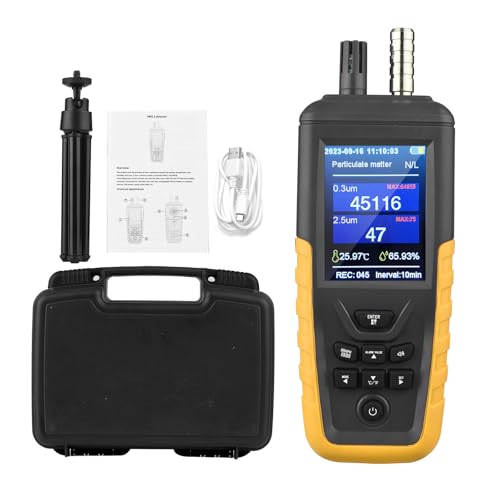
- Counts 0.3, 2.5, and 10 µm particles
- Stores 999 records with USB PDF export
- Includes alarms and a tripod
Best For: Fixed-point air monitoring over time
Best for Straightforward IAQ Checks
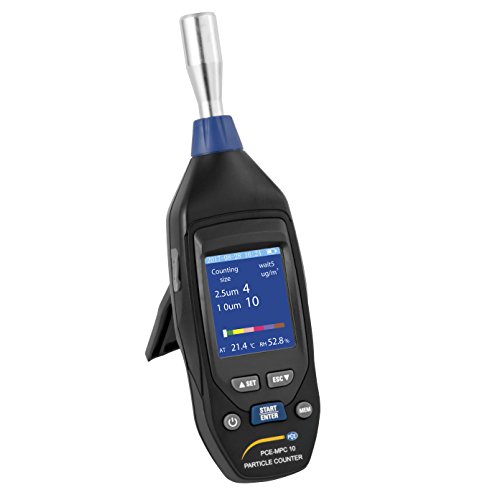
- Measures PM2.5 and PM10
- Reads temperature and humidity
- Lists 5,000-data logging and USB
Best For: Indoor PM2.5/PM10 checks
Best for Multi-Channel Sampling

- Lists six particle sizes from 0.3 to 10 µm
- Stores 5,000 detailed records
- Includes a calibration certificate
Best For: On-site multi-channel particle checks
Best for Field Logging – Temtop Professional Handheld Particle Counter
For buyers comparing particle counters for air testing, this Temtop handheld combines pump-suction particle counting at 0.3, 0.5, and 1.0 µm with PM2.5, PM10, and TSP readings. Temperature and humidity measurements add context during facility or workshop inspections.
Best For: Field users who need portable measurements and substantial onboard data storage.
Pros:
- Measures three particle-size channels alongside PM2.5, PM10, and TSP.
- Includes temperature and humidity readings.
- Has 32GB of storage, USB data transfer, and a supplied calibration certificate.
Cons:
- Particle-counting channels are limited to 0.3, 0.5, and 1.0 µm.
- Specified continuous battery operation is over four hours, so longer sessions may require charging.
The combination of handheld operation and generous storage makes it a practical choice for repeated site checks; confirm that its three counting channels cover your testing requirements.
Best for Cleanroom Checks – CEM DT-9881 Particle Counter
Among particle counters for air testing, the CEM DT-9881 suits buyers who need particle-size coverage through 10 µm. Its specified 2.83 L/min (1 CFM) pump, color display, and exportable records support cleanroom, HVAC, and filter-testing work.
Best For: Cleanroom and HVAC users who need multiple counting channels and saved test records.
Pros:
- Lists particle channels from 0.3 to 10 µm.
- Uses a specified 2.83 L/min (1 CFM) pump-suction sensor module.
- Stores up to 5,000 records and supports export via USB flash drive.
- Includes a calibration certificate and carrying case.
Cons:
- At a listed 4.88 pounds, it is less convenient to carry than lighter handheld options.
- Its 5,000-record limit may call for regular exports during extensive testing.
Choose this model when its wider stated size range and defined sampling flow matter more than keeping the kit lightweight.
Best for Timed Data Logs – Temtop Airing 2000 Handheld Counter
This Temtop option stands out among particle counters for air testing when you want user-set logging intervals. It counts 0.3, 0.5, and 1.0 µm particles, reports PM2.5, PM10, and TSP, and records temperature and humidity.
Best For: Users making repeat indoor or industrial checks who want adjustable logging intervals.
Pros:
- Combines three particle-count channels with particulate mass readings.
- Offers automatic logging at user-set intervals from 1 to 60 minutes.
- Provides 32GB of internal memory and USB flash-drive export.
- Its 3500mAh battery is specified for over four hours of continuous monitoring.
Cons:
- Does not list particle-count channels above 1.0 µm.
- Extended unplugged sessions may require a recharge after the specified operating period.
The adjustable logging schedule is its clearest reason to buy, especially when you want to compare readings over time rather than rely on a single spot check.
Best for Custom Sampling – PerfectPrime AQ9600 Dust Counter
PerfectPrime AQ9600, PM 0.3/2.5/10 Μm Air Quality Particle/Dust Detector/Counter
Check Price On AmazonFor buyers considering particle counters for air testing, the PerfectPrime AQ9600 offers a straightforward way to set sampling time and frequency. It lists 0.3, 2.5, and 10.0 µm particle-size measurements, with counts displayed in pieces per liter.
Best For: Users who need configurable sampling cycles and the AQ9600’s listed particle sizes.
Pros:
- Supports sampling times from 1 second to 59 minutes, 59 seconds.
- Allows 1 to 99 samples or continuous sampling.
- Lists configurable alarm levels and includes a power adapter.
Cons:
- The 9 V DC battery is not included.
- Only three particle-size measurements are listed.
Its appeal is sampling flexibility. Check that pieces-per-liter reporting and the specified size selections match the way you plan to document results.
Best for Report-Ready Sampling – Professional 3-Size Particle Counter
Among particle counters for air testing, this handheld model suits buyers who need readings for 0.3, 2.5, and 10 µm particles alongside temperature and humidity. Its 3.2-inch color screen shows live results and historical trends during on-site checks.
Best For: Cleanroom inspections and filter checks that require saved records and PDF reports.
Pros:
- Samples at 1 L/min and measures PM2.5 concentrations from 0 to 1,000 µg/m³.
- Stores up to 999 records and supports one-click PDF reports with USB transfer to a PC.
- Tripod mounting allows hands-free, longer-duration sampling.
Cons:
- Lists three particle sizes, so it offers fewer size channels than a six-channel counter.
- Exporting data to a PC requires a USB connection.
Choose it when straightforward field sampling and report handling matter more than a broader set of particle-size channels.
Best for Rechargeable Field Checks – TC-8100 Dust Particle Counter
For buyers comparing particle counters for air testing, the TC-8100 combines laser-scattering particle detection with temperature, humidity, and AQI-grade readings. Its 3.2-inch color display shows live measurements and data curves for spot checks.
Best For: On-site particle checks where rechargeable operation and a visible measurement history are useful.
Pros:
- Stores up to 999 measurement records and displays data curves.
- Runs on a rechargeable battery or a separate external USB power supply.
- Includes a backlit color display and an audible alarm.
Cons:
- The supplied description is inconsistent about supported particle sizes: the title lists 0.3, 2.5, and 10 µm, while the feature text names only 0.3 and 2.5 µm.
- Its packing list calls the device a CO2 meter, so confirm the exact product specifications before ordering.
This is a portable option for routine checks, but the conflicting listing details make specification verification especially important.
Best for Six-Channel Cleanroom Checks – TC-8200 Handheld Counter
If you need more particle-size detail from particle counters for air testing, the TC-8200 measures six sizes from 0.3 to 10 µm. It offers particle-count and mass-concentration modes, plus temperature and humidity readings for cleanroom work.
Best For: Cleanroom teams that need six-channel readings, threshold alerts, and inspection reports.
Pros:
- Measures 0.3, 0.5, 1.0, 2.5, 5.0, and 10 µm particles.
- Generates PDF reports on the device and stores up to 999 records.
- Has an audible threshold alarm, tripod mount, and claimed runtime of more than nine hours.
Cons:
- PDF transfer and archiving on a PC require a USB connection.
- Its cleanroom-classification claim should not replace checking your site’s validation requirements.
The wider channel selection and alerting make this the strongest fit of the three for detailed cleanroom checks, provided its specifications meet your inspection protocol.
Best for Long-Term Tracking – WapoRich T7-TC8100 Particle Counter
For buyers comparing particle counters for air testing, this WapoRich model combines 0.3, 2.5, and 10 µm particle counts with PM2.5/PM10 concentration, temperature, and humidity readings. Its logging and on-screen trends make it useful when a single spot reading is not enough.
Best For: Tracking air conditions over time at a fixed point in a home, office, or workplace.
Pros:
- Stores up to 999 records and exports historical data as a PDF via USB.
- Customizable audible alarms and a color pollution indicator make changes easier to notice.
- Includes a tripod for hands-free monitoring and a rechargeable battery rated for over nine hours.
Cons:
- Counts particles in three size channels, fewer than the CEM model in this roundup.
- USB export is specified as PDF, which may not suit buyers who need spreadsheet-ready data.
Choose this one if alarms, trend viewing, and a supplied tripod matter more to you than a wider range of particle-count channels.
Best for Straightforward IAQ Checks – PCE-MPC 10
The PCE-MPC 10 is a straightforward option among particle counters for air testing when your focus is indoor PM2.5 and PM10 alongside temperature and relative humidity. A 2-inch color display puts those readings in a compact instrument.
Best For: Indoor air-quality checks focused on PM2.5, PM10, temperature, and humidity.
Pros:
- Measures PM2.5 and PM10 as well as temperature from 0 to 50°C and humidity from 0 to 100% RH.
- Has a 2-inch full-color LCD with graphics.
- The product title specifies a 5,000-data logger and USB connectivity.
Cons:
- Only 2.5 and 10 µm particle-size channels are specified; no 0.3 µm channel is listed.
- The supplied notes do not specify alarms or a calibration certificate.
This is the practical pick if the listed indoor-air measurements cover your needs; check the finer-channel models if smaller particle counts are essential.
Best for Multi-Channel Sampling – CEM DT-9880
For particle counters for air testing in cleanrooms, workshops, or other controlled spaces, the CEM DT-9880 offers multiple particle-size channels, a 2.8-inch color display, and stored sampling records. It also comes with a calibration certificate, according to the supplied product notes.
Best For: On-site checks where finer particle-size counts and documented readings matter.
Pros:
- The listed channels include 0.3, 0.5, 1, 2.5, 5, and 10 µm particle sizes.
- Stores up to 5,000 records with date, time, counts, humidity, temperature, and sample volumes.
- Includes a calibration certificate, carrying case, and USB export options.
- Supports up to 20 minutes of video.
Cons:
- The notes say seven particle sizes but enumerate only six; verify the channel list before buying.
- At 1.25 pounds, it may be less convenient to carry than a lighter instrument.
The broader listed size range and record detail make this a strong candidate for more involved sampling, provided you confirm the exact channel specification.
How We Picked the Best Particle Counters for Air Testing
We compared the 10 listed models by their stated particle-size channels, intended use, portability, and features such as pump sampling, photo capture, and additional environmental readings. The selection includes both PM-focused meters and instruments that report particle counts across several size bands. We did not independently test accuracy or verify that any model meets a particular cleanroom standard; confirm specifications, calibration options, and included accessories with the seller before ordering.
Quick Comparison: Which Type Fits Your Job?
For a quick indoor air check, start with a PM2.5/PM10-oriented option, such as the PCE-MPC 10 or a Temtop handheld PM monitor. If you need to distinguish smaller particles or compare several size bands, look at models listing 0.3 µm detection, including the PerfectPrime AQ9600 and other multi-channel counters in this roundup. For cleanroom-style work, the CEM DT-9881, CEM DT-9880, and six-channel handheld option warrant a closer look at sampling, records, and reporting. A broad channel list alone does not establish suitability for compliance testing.
Key Buying Factors for Particle Counters for Air Testing
Counts Versus PM Readings
Particle counts describe how many particles an instrument detects in specified size ranges, typically at a stated sampling volume. PM2.5 and PM10 readings describe estimated mass concentration. Check which result the device displays; a PM reading is not interchangeable with a count when a procedure calls for one.
Particle Sizes and Sampling
Choose channels that match the question you are asking. A 0.3 µm channel may matter for controlled-environment checks, while PM2.5 and PM10 can be more approachable for general air-quality trends. Compare sampling method, airflow specification, sample duration, and any required warm-up or zero-count procedure. A stated pump-suction design may be useful when you need repeatable sampling, but verify the actual flow rate and maintenance requirements.
Records, Calibration, and Practical Use
If readings must be shared or audited, check for timestamped logs, export options, and clear documentation—not just a color screen or photo feature. Also check calibration availability, battery runtime, carrying accessories, and whether temperature, humidity, or gas measurements are relevant. Additional sensors do not replace a dedicated instrument when your testing protocol specifies one.
Who Should Buy Which Particle Counters for Air Testing?
Homeowners and facilities staff tracking dust or filter changes can prioritize an easy-to-read, portable PM meter and take readings at consistent locations and times. HVAC troubleshooters comparing spaces may benefit from more size channels and a documented sampling routine. Cleanroom operators and quality teams should begin with their required test method, then verify flow rate, channel thresholds, calibration documentation, and data handling before considering any candidate. If the result will support regulatory or contractual decisions, confirm the instrument’s suitability with the responsible testing professional.