
The best oscilloscopes for home workshops make it easier to troubleshoot power supplies, Arduino projects, audio circuits, automotive electronics, and general bench equipment. The right choice depends less on headline bandwidth alone than on usability, safety, channel count, and the signals you expect to measure.
Our selection includes affordable handheld models, combination oscilloscope-multimeters, and higher-performance two-channel instruments. Use the guide below to match features and specifications to your workspace and projects.
Best 10 Oscilloscopes for Home Workshops Picks for 2026
Budget Bench Pick
Hantek DSO2D15 150MHz 2-Channel Oscilloscope

- 150MHz bandwidth and two channels
- Arbitrary waveform output
- Serial protocol trigger and decode support
Best For: Economical home benches and general electronics commissioning
Portable Touchscreen Choice
FNIRSI 1013D Plus 100MHz Oscilloscope

- 7-inch touchscreen display
- Two channels with 100MHz bandwidth
- Battery-powered design with waveform storage
Best For: Portable troubleshooting and touchscreen-based measurements
Protocol Analysis Pick
Siglent SDS1202X-E 200MHz Oscilloscope
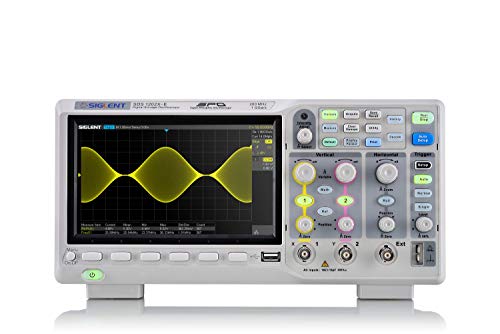
- 200MHz bandwidth and two channels
- Up to 1GSa/s real-time sampling
- Decodes six common serial bus types
Best For: Embedded projects and longer serial-bus captures
All-in-One Handheld
FNIRSI 2C53T 50MHz Scope, Meter and Generator

- Three tools in one compact unit
- 4.5-digit multimeter with broad measurement functions
- 50kHz signal generator with 13 waveforms
Best For: Portable automotive, school, and general electronics work
Best Overall
RIGOL DS1202Z-E 200MHz Digital Oscilloscope

- 200 MHz bandwidth with two channels and 1 GSa/s sampling
- Up to 24 Mpts memory and 30,000 wfms/s capture rate
- Serial decoding plus USB and LAN connectivity
Best For: Feature-rich home electronics benches and embedded troubleshooting
Best Portable Value
HANMATEK HO52 Handheld Oscilloscope
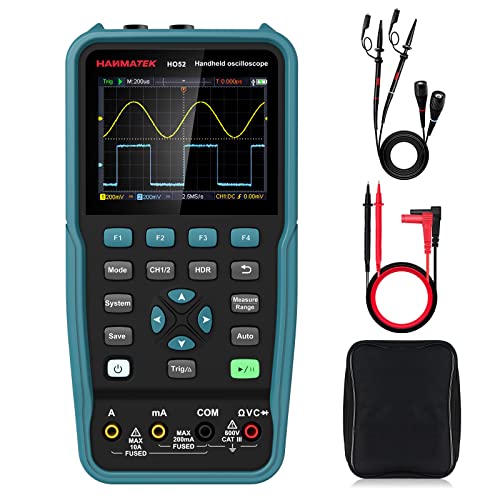
- 50 MHz bandwidth with two channels and 250 MSa/s sampling
- Built-in multimeter with voltage, current, resistance, and capacitance tests
- USB-C charging and image/CSV waveform storage
Best For: Portable home-workshop, automotive, and general troubleshooting
Best Multifunction
FNIRSI DPOS350P 4-in-1 Oscilloscope

- 350 MHz, two-channel scope with 1 GSa/s sampling
- Built-in spectrum analyzer and frequency response analyzer
- DDS generator with 14 waveforms and 1 Hz resolution
Best For: Advanced signal analysis, analog design, and portable lab work
Best Pocket Pick
FNIRSI DSO152 Handheld Oscilloscope

- 200 kHz bandwidth and 2.5 MS/s sampling
- One-key automatic waveform setup
- Lightweight design with about four-hour battery life
Best For: Portable maintenance and basic electronics troubleshooting
Most Versatile
ZT-703S 3-in-1 Handheld Oscilloscope

- Oscilloscope, multimeter, and signal generator in one
- Up to 50 MHz bandwidth in high-speed mode
- 25,000-count multimeter with broad measurement functions
Best For: DIY users seeking a multifunction handheld bench tool
Best for Field Diagnostics
HANMATEK HO11 Handheld Oscilloscope

- 10 MHz bandwidth and 48 MSa/s sampling
- 1,800 mAh battery with Type-C charging
- Color display and three edge-trigger modes
Best For: Portable waveform diagnostics and intermittent-signal troubleshooting
Budget Bench Pick – Hantek DSO2D15 150MHz 2-Channel Oscilloscope
For shoppers comparing oscilloscopes for home workshops, the Hantek DSO2D15 is a cost-conscious two-channel option with 150MHz bandwidth. It also adds arbitrary waveform output, multiple trigger modes, and serial protocol support for a broad range of electronics work.
Best For: Home workshop users who want an economical bench instrument for embedded systems, communications, education, and general commissioning tasks.
Pros:
- 150MHz bandwidth with two channels
- Supports arbitrary waveform output
- Includes 14 trigger modes and five serial protocol trigger/decode options
Cons:
- Its economy positioning may not suit users seeking a more advanced professional platform
- Its listed dimensions make it less compact than handheld alternatives
The DSO2D15 is a sensible choice when capability and price matter more than portability. Its waveform output and protocol features give a home bench more flexibility than a basic entry-level scope.
Portable Touchscreen Choice – FNIRSI 1013D Plus 100MHz Oscilloscope
The FNIRSI 1013D Plus brings a large touchscreen and portable format to the oscilloscopes for home workshops category. With two channels, 100MHz bandwidth, built-in storage, and a rechargeable battery, it is designed for flexible testing away from a fixed bench.
Best For: Hobbyists who value portability, touchscreen operation, waveform storage, and quick visual measurements.
Pros:
- 7-inch, 800 × 480 touchscreen display
- 1 GSa/s sampling rate and 100MHz × 2 bandwidth
- Stores up to 1,000 screenshots and 1,000 waveform datasets
- Built-in 6,000mAh battery provides up to four hours of use
Cons:
- Battery runtime is listed at up to four hours
- Its portable design provides less fixed-bench presence than larger instruments
Choose this model if an uncluttered touchscreen interface and easy carrying are priorities. Its Lissajous and FFT views add useful exploratory tools for comparing signals and estimating harmonic content.
Protocol Analysis Pick – Siglent SDS1202X-E 200MHz Oscilloscope
For more demanding oscilloscopes for home workshops, the Siglent SDS1202X-E combines 200MHz bandwidth with two channels and up to 1GSa/s real-time sampling. Its long record length and built-in serial bus tools make it particularly relevant to digital and embedded troubleshooting.
Best For: Experienced home users working with embedded systems, serial buses, and longer waveform captures.
Pros:
- 200MHz bandwidth with two channels
- Up to 1GSa/s real-time sampling
- Record length up to 14Mpts
- Serial triggering and decoding for IIC, SPI, UART, RS232, CAN, and LIN
Cons:
- It is a more substantial bench instrument than handheld options
- The supplied notes do not list battery operation or portability features
The SDS1202X-E stands out when protocol work and capture depth are central to a home lab. Its 200MHz bandwidth and broad serial decoding support make it a strong fit for more involved electronics projects.
All-in-One Handheld – FNIRSI 2C53T 50MHz Scope, Meter and Generator
The FNIRSI 2C53T is a compact multifunction instrument for home workshops that need more than an oscilloscope. It combines a two-channel, 50MHz scope with a 4.5-digit multimeter and a signal generator in a handheld body.
Best For: Hobbyists, students, and automotive or general electronics users who want several test tools in one portable unit.
Pros:
- Combines oscilloscope, multimeter, and signal generator functions
- Two channels, 250MSa/s sampling, and automatic measurements
- Multimeter measures AC/DC voltage, current, resistance, capacitance, and continuity
- Signal generator outputs 13 waveforms up to 50kHz
Cons:
- Its 50MHz scope bandwidth is lower than the other listed bench models
- The 1Kpts record depth is limited compared with instruments offering much longer captures
- The 2.8-inch display is smaller than the 7-inch touchscreen option
The 2C53T is compelling when space, portability, and tool consolidation matter most. It sacrifices bandwidth and display size for a practical combination of measurement, generation, and scope functions.
Best Overall – RIGOL DS1202Z-E 200MHz Digital Oscilloscope
For home workshops that need serious bench capability, the RIGOL DS1202Z-E combines 200 MHz bandwidth, two channels, deep memory, and a fast waveform capture rate. Its 7-inch display, serial-bus decoding, and LAN/USB connectivity make it a strong choice for electronics debugging and embedded projects.
Best For: Home workshops, electronics troubleshooting, embedded bring-up, and users who want a full-featured desktop scope.
Pros:
- 1 GSa/s sampling and up to 24 Mpts of memory support detailed, longer captures.
- Up to 30,000 waveforms per second can help expose intermittent glitches.
- Supports RS232/UART, I2C, and SPI triggering and decoding.
- USB, LAN, recording/playback, and Pass/Fail output support organized bench workflows.
Cons:
- Its desktop form factor is less convenient to carry than a handheld scope.
- The extensive feature set may be more than a beginner needs for basic measurements.
The DS1202Z-E is the most capable conventional bench instrument in this group. Choose it when memory depth, serial decoding, and documentation-friendly connectivity matter more than portability.
Best Portable Value – HANMATEK HO52 Handheld Oscilloscope
The HANMATEK HO52 is a practical option for home workshops that need an oscilloscope and multimeter in one compact tool. It offers two-channel, 50 MHz scope operation alongside standard electrical tests, with USB-C charging and saved waveform exports for basic analysis.
Best For: Portable troubleshooting, automotive work, students, and hobbyists who want scope and multimeter functions together.
Pros:
- Combines a two-channel, 50 MHz oscilloscope with an independent multimeter.
- Battery-powered design weighs about 2.6 pounds and supports USB-C charging.
- Includes automatic measurements, cursor functions, auto setup, and self-calibration.
- Can save images, settings, reference waveforms, and CSV waveform data.
Cons:
- Its 250 MSa/s sampling rate and 8K-dot recording length are more limited than the desktop RIGOL’s.
- The 3.5-inch screen is smaller for inspecting complex waveforms.
- It has lower bandwidth than the other two options.
The HO52 prioritizes convenience over maximum analysis depth. It is a sensible pick when space, battery operation, and built-in multimeter testing are especially useful in a home workshop.
Best Multifunction – FNIRSI DPOS350P 4-in-1 Oscilloscope
The FNIRSI DPOS350P stands out among oscilloscopes for home workshops by combining a 350 MHz, two-channel scope with spectrum analysis, a frequency response analyzer, and a DDS signal generator. Its touchscreen, 1 GSa/s sampling, and 8,000 mAh battery make it suited to both bench and field work.
Best For: Advanced hobbyists and engineers working on filters, signal integrity, EMI checks, loop stability, and waveform generation.
Pros:
- Offers 350 MHz bandwidth, 1 GSa/s sampling, and 50,000 wfms/s refresh.
- FFT spectrum analysis includes harmonic markers and 2D/3D waterfall views.
- Frequency response analysis supports gain, phase, and Bode-plot work from 10 Hz to 50 MHz.
- Built-in DDS generator provides 14 standard waveforms and 1 Hz frequency resolution.
Cons:
- At about 3.56 pounds, it is less lightweight than the smaller HANMATEK.
- Its advanced functions may be unnecessary for simple voltage and waveform checks.
- The listed memory depth is 47 Kpts, so it is not a deep-memory alternative to the RIGOL.
The DPOS350P is the most versatile option here for users who want analysis and signal-generation tools in one device. Its breadth is especially valuable when a home workshop handles analog design or signal-integrity projects.
Best Pocket Pick – FNIRSI DSO152 Handheld Oscilloscope
For home workshops needing a compact troubleshooting tool, the FNIRSI DSO152 is a straightforward choice among oscilloscopes for home workshops. It combines a 200 kHz bandwidth, 2.5 MS/s real-time sampling, automatic setup, and a built-in rechargeable battery in a lightweight handheld design.
Best For: Portable maintenance, automotive diagnostics, and basic electronics education.
Pros:
- Compact 10.2-ounce design with a built-in 1,000 mAh battery.
- One-key AUTO setup simplifies waveform viewing.
- Supports Auto, Normal, and Single trigger modes.
- Type-C port supports charging, data transfer, and firmware updates.
Cons:
- Its 200 kHz bandwidth is intended for lower-frequency work.
- The 2.8-inch, 320×240 display is relatively small.
The DSO152 is best when portability and ease of use matter more than advanced bandwidth. Its finished, ready-to-use design and roughly four-hour battery life make it practical for quick checks around a home workshop.
Most Versatile – ZT-703S 3-in-1 Handheld Oscilloscope
The ZT-703S stands out among oscilloscopes for home workshops by combining a dual-channel oscilloscope with a digital multimeter and signal generator. Its high-speed mode reaches 280 MSa/s and 50 MHz bandwidth, while its 25,000-count multimeter adds useful measurement flexibility.
Best For: DIY electronics users who want one handheld instrument for waveform, electrical, and signal-generation tasks.
Pros:
- Combines oscilloscope, multimeter, and signal generator functions.
- Dual-channel design supports comparison of signals.
- High-speed mode provides up to 280 MSa/s sampling and 50 MHz bandwidth.
- Multimeter measures resistance, capacitance, continuity, diodes, and current.
Cons:
- High-speed mode uses more power.
- Its broad feature set means the manual is important for setup and troubleshooting.
This is a strong all-in-one option for a home bench where space and budget favor a multifunction instrument. Choose it if the added multimeter and signal-generator modes are as valuable to you as oscilloscope measurements.
Best for Field Diagnostics – HANMATEK HO11 Handheld Oscilloscope
For users comparing oscilloscopes for home workshops that may also be used away from the bench, the HANMATEK HO11 offers a useful balance of portability and capture capability. It provides 10 MHz bandwidth, 48 MSa/s sampling, a color display, and an advanced edge-triggering system.
Best For: Fieldwork, intermittent-signal troubleshooting, and home workshop diagnostics requiring a larger battery.
Pros:
- 48 MSa/s sampling rate with 10 MHz bandwidth.
- Supports Auto, Normal, and Single edge-trigger modes.
- 1,800 mAh rechargeable battery with Type-C charging.
- X1 and X10 probe attenuation supports inputs from ±40 V to ±400 V.
Cons:
- Its 10 MHz bandwidth is more limited than higher-bandwidth alternatives.
- It is a measurement-focused oscilloscope rather than a multifunction meter or generator.
The HO11 is a practical middle ground for waveform diagnostics, especially when battery capacity and a clear full-color display are priorities. Its trigger options should also help when signals are fluctuating or intermittent.
How We Picked the Best Oscilloscopes for Home Workshops
We compared these oscilloscopes by the specifications and features that matter most in a home workshop: bandwidth, sample rate, memory, channel count, display quality, controls, portability, included accessories, and added functions such as multimeters or signal generators. We also considered how easily each type fits common tasks, from checking low-frequency sensor outputs to examining switching waveforms and digital communication signals.
Specifications should be treated as a starting point rather than a guarantee of real-world performance. Probe quality, grounding, firmware, triggering, and the quality of the user interface can all affect measurements. Before buying, confirm the latest specifications, included probes, warranty, and electrical safety information.
Quick Comparison
| Best For | What to Prioritize | Typical Choice |
|---|---|---|
| Basic repairs and learning | Simple controls, autoset, clear display | Entry-level handheld or compact bench scope |
| Arduino and embedded projects | Two channels, reliable triggering, adequate memory | 50–100MHz two-channel model |
| Switching power and faster digital circuits | Higher bandwidth, sample rate, and waveform detail | 150–200MHz bench oscilloscope |
| Automotive troubleshooting | Portability, multimeter functions, battery operation | Handheld combination instrument |
| Signal creation and testing | Built-in DDS or signal generator | Multi-function oscilloscope |
Key Buying Factors for Oscilloscopes for Home Workshops
Bandwidth and Sample Rate
Bandwidth determines the highest-frequency signal detail the oscilloscope can display accurately. For audio, microcontrollers, and general hobby electronics, 50–100MHz is often sufficient. Choose 150–200MHz or more when working with fast switching edges, motor drives, communications hardware, or high-speed digital circuits. A higher sample rate helps capture those transitions, but it matters only when paired with suitable bandwidth and memory.
Channels, Triggering, and Memory
Two channels are especially useful for comparing an input and output, clock and data, or voltage and current. Look for stable edge triggering, pulse-width options, and adjustable trigger levels. Deeper memory can preserve longer events at higher time resolution, while basic scopes may be adequate for repeating waveforms and simple faults.
Form Factor and Extra Functions
Bench models usually offer larger screens, easier controls, and better long-session usability. Handheld scopes save space and work well around equipment, vehicles, or field repairs, especially when battery powered. Integrated multimeters and signal generators can reduce the number of tools on your bench, but do not assume combination functions match the performance of dedicated instruments.
Safety and Accessories
Check the input voltage limits, probe ratings, grounding arrangement, and whether the instrument is isolated before connecting it to mains-powered equipment. Standard oscilloscope ground clips can create a short circuit if attached incorrectly. Use properly rated probes and consider differential or isolated measurement equipment for non-isolated power electronics.
Who Should Buy Which Oscilloscopes for Home Workshops?
Beginners and occasional repairers should favor a straightforward, affordable model with autoset, readable waveforms, and two channels. Makers working with microcontrollers, sensors, and audio will benefit from a 50–100MHz scope with dependable triggering and a responsive display. Users troubleshooting switching supplies, faster digital buses, or motor-control electronics should move toward a 150–200MHz instrument with stronger acquisition performance.
If portability is more important than screen size, choose a battery-powered handheld model; this is particularly convenient for automotive and appliance work. Buyers who want one compact tool for basic voltage checks, waveform inspection, and test-signal generation may prefer a combination unit. For a permanent electronics bench, however, a dedicated two-channel bench oscilloscope is usually easier and more comfortable to use.