
The best oscilloscopes for electronics repair make it easier to see noise, timing errors, ripple, and intermittent signals that a multimeter can miss. This roundup covers compact handheld tools, multifunction meters, and higher-bandwidth bench-style options.
Use the buying guide below to match bandwidth, sampling speed, inputs, triggering, portability, and included test functions to the type of repair work you do most often.
Best 10 Oscilloscopes for Electronics Repair Picks for 2026
Versatile Repair Bench
FNIRSI 2C53T 3-in-1 Oscilloscope

- 50MHz two-channel scope with 250MSa/s sampling
- Built-in multimeter and 50kHz signal generator
- Portable, rechargeable design with waveform storage
Best For: Repair users wanting one handheld instrument for scope, meter, and generator tasks
Protocol Testing Pick
Hantek DSO2D15 150MHz Oscilloscope

- 150MHz bandwidth with two channels
- Arbitrary waveform output included
- Five serial protocol triggers and decodes
Best For: Bench users working with embedded systems, communications, and serial protocols
Large Touchscreen Choice

- 100MHz two-channel scope with 1GSa/s sampling
- 7-inch touchscreen with cursor measurements
- FFT, Lissajous, and extensive waveform storage
Best For: Repairers prioritizing a large display and hands-on waveform analysis
Compact Three-Tool Value
YP101A 3-in-1 Handheld Oscilloscope
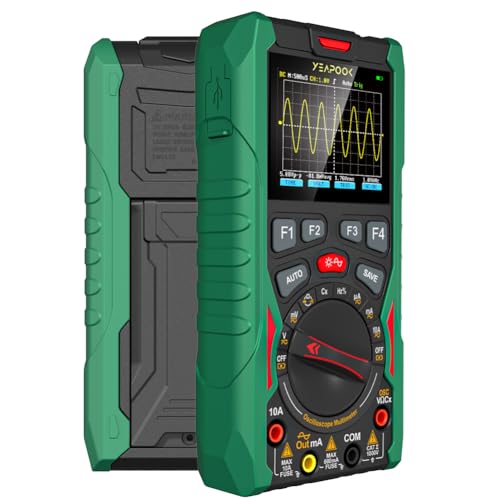
- 12MHz scope with 6000-count multimeter
- Integrated signal generator and one-key mode switching
- 250g body with over eight hours of stated use
Best For: Beginners and mobile repair work involving routine low-frequency checks
Best Value Benchtop Scope
Hantek DSO2C10 100MHz 2-Channel Oscilloscope

- 100MHz bandwidth and two channels
- Arbitrary waveform output
- Serial protocol triggers and decodes
Best For: Bench testing and embedded electronics repair
Best All-in-One Handheld
FNIRSI DST-210 3-in-1 Oscilloscope Multimeter

- 10MHz scope with 48MSa/s sampling
- 19,999-count digital multimeter
- DDS generator with 13 waveforms
Best For: Portable electronics and automotive diagnostics
Best Budget Pocket Scope
BTMETER Mini 250kHz Handheld Oscilloscope

- Compact 100g rechargeable design
- One-touch AUTO setup and three trigger modes
- 2.8-inch LCD for basic waveform viewing
Best For: Beginners and low-frequency field testing
Best Portable Starter
FNIRSI DSO152 Handheld Oscilloscope

- 200 kHz bandwidth and 2.5 MS/s sampling
- One-key automatic setup and three trigger modes
- Lightweight design with about four-hour battery life
Best For: Portable maintenance, automotive checks, and basic waveform troubleshooting
Best Integrated Signal Tool
10MHz Handheld Oscilloscope with DDS Generator

- 10 MHz bandwidth with 48 MS/s sampling
- DDS generator offers 14 waveforms up to 50 kHz
- Stores, scales, and exports captured waveforms
Best For: Repairers needing portable scope and signal-generator functions
Best All-in-One Repair Meter
ZT-702S Oscilloscope Multimeter

- 10 MHz scope with 48 MS/s sampling
- 9999-count multimeter with temperature and capacitance testing
- 2000 mAh battery and built-in square-wave output
Best For: Automotive, industrial, and household repair workflows needing scope and meter modes
Versatile Repair Bench – FNIRSI 2C53T 3-in-1 Oscilloscope
For shoppers comparing oscilloscopes for electronics repair, the FNIRSI 2C53T combines a two-channel, 50MHz oscilloscope with a multimeter and signal generator. Its automatic measurements, waveform storage, cursor measurements, and built-in battery make it a practical handheld option for bench or field work.
Best For: Automotive repair, electronics troubleshooting, students, and hobbyists who want multiple test tools in one portable device.
Pros:
- Combines a 50MHz, two-channel oscilloscope, 4.5-digit multimeter, and signal generator.
- Offers 250MSa/s sampling, cursor and math functions, persistence, XY mode, and automatic measurements.
- Includes waveform storage and export, reference-waveform comparison, a 3000mAh battery, and a storage case.
Cons:
- The oscilloscope record depth is listed as 1Kpts.
- The signal generator output reaches 50kHz, which is lower than the oscilloscope bandwidth.
The 2C53T is especially appealing when portability and tool consolidation matter more than deep memory or laboratory-scale signal generation. Its broad multimeter range and repair-oriented accessories add useful flexibility.
Protocol Testing Pick – Hantek DSO2D15 150MHz Oscilloscope
The Hantek DSO2D15 is a conventional two-channel digital storage oscilloscope for buyers seeking oscilloscopes for electronics repair and development. Its 150MHz bandwidth, arbitrary waveform output, and protocol-focused trigger and decode features suit more involved troubleshooting than a basic entry-level scope.
Best For: Embedded systems, communications work, commissioning, education, and repair benches that benefit from serial protocol analysis.
Pros:
- Provides 150MHz bandwidth across two channels.
- Supports arbitrary waveform output.
- Includes 14 trigger modes plus triggers and decoding for five serial protocols.
Cons:
- At 4.2 pounds, it is less portable than the handheld options in this roundup.
- The supplied notes do not list integrated multimeter or battery features.
This model makes the most sense when protocol triggering and decoding are central to the job. Its bench-style design is better suited to a dedicated workspace than quick field repairs.
Large Touchscreen Choice – FNIRSI 1013D Plus 100MHz
For electronics repairers who prefer a larger interface, the FNIRSI 1013D Plus pairs two channels and 100MHz bandwidth with a 7-inch touchscreen. Its 1GSa/s sampling rate, cursor measurements, FFT viewing, and waveform management make it useful for inspecting signals without relying only on graticule readings.
Best For: Users who want touchscreen operation, large waveform viewing, and analysis features in a portable oscilloscope.
Pros:
- Offers two channels, 100MHz bandwidth, and a 1GSa/s sampling rate.
- 7-inch, 800×480 touchscreen supports gesture operation and direct cursor measurements.
- Provides FFT viewing, Lissajous display, and storage for up to 1,000 screenshots and 1,000 waveform sets.
Cons:
- The listed battery runtime is about four hours.
- It is larger and heavier than the most compact handheld models, at 2.31 pounds.
The 1013D Plus is a strong fit when screen visibility and hands-on navigation are priorities. Its storage and visualization tools also help when documenting or comparing repair findings.
Compact Three-Tool Value – YP101A 3-in-1 Handheld Oscilloscope
The YP101A is a compact option for shoppers seeking oscilloscopes for electronics repair without carrying separate instruments. It combines a 12MHz oscilloscope, 6000-count multimeter, and signal generator, with one-key mode switching and more than eight hours of stated continuous use.
Best For: Beginners, DIY electronics, home-appliance repair, car maintenance, and technicians who value low weight and simple operation.
Pros:
- Combines an oscilloscope, multimeter, and signal generator in a 250g handheld body.
- One-key switching and automatic measurements make it approachable for beginners.
- Rechargeable 1500mAh battery supports more than eight hours of continuous use, according to the supplied notes.
Cons:
- The 12MHz bandwidth and 50MSa/s sampling rate are modest for higher-frequency work.
- Storage is limited to 100 multimeter data sets and 10 waveforms.
The YP101A favors convenience and portability over advanced scope performance. It is a sensible starter or service tool for routine low-frequency checks where an integrated meter and generator are valuable.
Best Value Benchtop Scope – Hantek DSO2C10 100MHz 2-Channel Oscilloscope
The Hantek DSO2C10 is a practical economy choice among oscilloscopes for electronics repair when you want a benchtop instrument with 100MHz bandwidth and two channels. It also adds arbitrary waveform output, multiple trigger modes, and serial protocol support for broader troubleshooting and development work.
Best For: Bench testing, embedded systems work, communications projects, and electronics repair on a budget.
Pros:
- 100MHz bandwidth with two channels.
- Supports arbitrary waveform output.
- Offers 14 trigger modes plus five serial protocol triggers and decodes.
- Suitable for communication, aerospace, embedded systems, education, and research applications.
Cons:
- Less portable than the handheld models in this roundup.
- Its economy positioning may make it less feature-rich than higher-end laboratory instruments.
Choose the Hantek when bandwidth and versatile triggering matter more than pocket portability. Its two-channel layout and protocol features make it the strongest fit here for more involved bench diagnostics.
Best All-in-One Handheld – FNIRSI DST-210 3-in-1 Oscilloscope Multimeter
The FNIRSI DST-210 combines a 10MHz oscilloscope, digital multimeter, and DDS signal generator in one rechargeable handheld unit. For oscilloscopes for electronics repair, that combination can reduce the number of tools needed for circuit diagnosis, signal testing, and automotive work.
Best For: Field service, automotive diagnostics, and repair tasks requiring scope, meter, and signal-generator functions.
Pros:
- Combines a 10MHz, 48MSa/s oscilloscope with a 19,999-count multimeter.
- Measures voltage, current, resistance, capacitance, frequency, diode, and temperature.
- DDS generator provides 13 waveforms up to 50KHz.
- Rechargeable 3000mAh battery, Type-C charging, and waveform image export support mobile work.
Cons:
- Its 10MHz scope bandwidth is lower than the Hantek model’s 100MHz bandwidth.
- The signal generator’s adjustable amplitude is limited to 0.1V–3.0V.
The DST-210 is the most versatile option for technicians who value consolidation. It is especially appealing when a repair job calls for ordinary electrical measurements and basic waveform generation alongside oscilloscope testing.
Best Budget Pocket Scope – BTMETER Mini 250kHz Handheld Oscilloscope
The BTMETER Mini is a compact entry-level option among oscilloscopes for electronics repair and education. Its 250kHz bandwidth, one-touch auto setup, and simple trigger controls are suited to observing common low-frequency analog and digital signals without carrying a full-size bench scope.
Best For: Beginners, classroom work, basic low-frequency troubleshooting, and portable toolkit use.
Pros:
- Pocket-sized design weighs approximately 100g and measures 103 × 73 × 25mm.
- One-touch AUTO setup with AUTO, Normal, and Single trigger modes.
- 2.8-inch 320×240 LCD provides a clear view of waveforms.
- Rechargeable battery provides up to three hours of portable operation.
Cons:
- 250kHz bandwidth and 2.5MSa/s sampling limit it to basic, lower-frequency testing.
- Input range is ±40V in X1 mode, or up to ±400V in X10 mode when the probe supports it.
- It lacks the multimeter and DDS generator functions included with the FNIRSI.
The BTMETER makes sense when portability, simplicity, and price-conscious basic testing take priority. For faster signals or more advanced repair diagnostics, its limited bandwidth should be considered carefully.
Best Portable Starter – FNIRSI DSO152 Handheld Oscilloscope
For shoppers comparing oscilloscopes for electronics repair, the FNIRSI DSO152 is a compact option for basic waveform troubleshooting and portable service work. It combines a 200 kHz bandwidth, 2.5 MS/s real-time sampling rate, automatic setup, and a built-in battery in a lightweight handheld design.
Best For: Portable electronics maintenance, automotive checks, education, and straightforward analog or digital signal observation.
Pros:
- Compact 10.2-ounce handheld design with a 2.8-inch, 320×240 display.
- One-key AUTO setup and baseline calibration simplify measurements.
- Supports Auto, Normal, and Single trigger modes.
- Offers about four hours of battery life and USB-C charging.
Cons:
- Its 200 kHz bandwidth and 2.5 MS/s sampling rate are suited to basic work rather than higher-frequency testing.
- The supplied notes do not indicate advanced analysis features beyond the listed trigger, display, and setup functions.
The DSO152 makes the most sense when portability and simple operation matter more than broad bandwidth. Its automatic controls and finished, ready-to-use design can be especially practical for field repairs and learning.
Best Integrated Signal Tool – 10MHz Handheld Oscilloscope with DDS Generator
Among oscilloscopes for electronics repair, this handheld kit stands out by combining waveform measurement with a DDS signal generator. Its 10 MHz bandwidth, 48 MS/s sampling rate, automatic controls, and portable 2.8-inch display support a wider range of bench and field checks than a basic pocket scope.
Best For: Repairers who want an oscilloscope and signal source in one battery-powered handheld kit.
Pros:
- 10 MHz bandwidth and 48 MS/s sampling rate support more demanding testing than the listed basic version.
- DDS generator can output 14 waveform types up to 50 kHz.
- Provides Auto, Normal, and Single triggering, plus infinite afterglow and level display.
- Supports waveform storage, scaling, data export, and USB-C charging or data transfer.
Cons:
- The 2.8-inch screen may feel restrictive for examining detailed waveforms.
- Battery life is listed at about four hours, so extended sessions may require recharging.
- The supplied notes do not specify the accuracy or output limits of every generator waveform.
This model is a strong fit when generating a test signal is as important as viewing one. The integrated functions reduce the amount of equipment needed for troubleshooting, while the automatic setup keeps routine measurements approachable.
Best All-in-One Repair Meter – ZT-702S Oscilloscope Multimeter
For electronics repair technicians who regularly switch between waveform inspection and electrical measurements, the ZT-702S combines a 10 MHz oscilloscope with a 9999-count auto-ranging multimeter. It also adds temperature, capacitance, frequency, diode, continuity, and current measurements in a single handheld instrument.
Best For: Automotive, industrial, household, and low-voltage troubleshooting where oscilloscope and multimeter functions are both needed.
Pros:
- Combines a 10 MHz, 48 MS/s oscilloscope with a one-button multimeter mode.
- Multimeter measures AC/DC voltage, AC/DC current, resistance, capacitance, frequency, temperature, diodes, and continuity.
- Offers a 2.8-inch IPS color display, waveform storage, data export, and adjustable backlight.
- Includes a 3V/1 kHz square-wave output and a 2000 mAh rechargeable battery.
Cons:
- At about 700 g and 6.97 × 3.5 × 1.57 inches, it is less pocket-friendly than smaller handheld scopes.
- The listed oscilloscope bandwidth is 10 MHz, which may not suit higher-frequency circuits.
- Its many measurement functions may add complexity for users seeking only a simple oscilloscope.
The ZT-702S is the most versatile choice of these three for repair workflows that alternate between viewing signals and checking component values. Its broader meter feature set and larger battery favor extended, multipurpose troubleshooting over minimal-pocket portability.
How We Picked the Best Oscilloscopes for Electronics Repair
We focused on specifications and features that directly affect troubleshooting: bandwidth, sampling rate, channel count, display usability, trigger modes, input limits, portability, and built-in functions. The selection includes models suited to circuit boards, power supplies, embedded systems, automotive diagnostics, and occasional field work.
Multifunction units were also considered because an integrated multimeter or DDS signal generator can reduce the amount of equipment needed for basic diagnosis. However, added functions do not automatically replace a dedicated bench oscilloscope, particularly when you need deeper memory, cleaner controls, or multiple simultaneous signals.
Quick Comparison
| Type | Typical strengths | Best suited to |
|---|---|---|
| Bench-style digital scope | Higher bandwidth, larger displays, more conventional controls | PCB repair, power electronics, regular workshop use |
| Handheld scope | Portable operation and battery-powered troubleshooting | Field service, automotive work, cramped spaces |
| Scope-multimeter combination | Waveform viewing plus voltage and continuity checks | General-purpose repair kits |
| Compact entry-level scope | Low cost and simple signal checks | Low-frequency circuits and beginner use |
Key Buying Factors for Oscilloscopes for Electronics Repair
Bandwidth and Sampling Rate
Bandwidth determines the highest-frequency signal the scope can display accurately, while sampling rate affects how well it captures waveform detail. A 10–12 MHz model can suit low-speed automotive, audio, and basic control circuits. For faster digital electronics, switching supplies, and clock signals, 100 MHz or more provides greater headroom. Do not judge sampling rate alone; the scope’s memory depth and operating mode also influence real-world capture quality.
Channels, Triggering, and Input Protection
Two channels are useful for comparing an input and output, clock and data, or reference and suspected fault. Look for Auto, Normal, and Single trigger modes when diagnosing intermittent problems. Confirm the maximum input voltage, probe attenuation settings, grounding arrangement, and category ratings before connecting to automotive or mains-related circuits. Many compact scopes are intended for low-voltage isolated work rather than direct mains measurements.
Portability and Extra Functions
A handheld unit is valuable when access is limited or repairs happen away from the bench. Touchscreens can speed navigation, while physical controls may be faster for repeated adjustments. Integrated multimeters and signal generators are convenient for routine work, but check their accuracy, frequency range, waveform options, and whether using one function disables another.
Who Should Buy Which Oscilloscopes for Electronics Repair?
Choose a higher-bandwidth bench-style model if you repair diverse circuit boards, work with faster digital signals, or want a primary workshop instrument. A 100–150 MHz option offers useful headroom for general electronics repair.
Choose a handheld multifunction scope if you service vehicles, appliances, or equipment in the field and value an all-in-one kit. For low-frequency diagnostics and simple waveform checks, a 200 kHz to 12 MHz compact model can be adequate and easier to carry.
Beginners should prioritize straightforward controls, automatic setup, safe probes, readable displays, and clear documentation over the largest specification numbers. Before buying, verify that the included probes and accessories match your voltage range and repair environment.