
Choosing the right filter can make faint emission and planetary nebulae stand out far more clearly against a washed-out sky.
This roundup of nebula filters for telescopes focuses on contrast, compatibility, and real-world value for visual observers and astroimagers.
Best 10 Nebula Filters for Telescopes Picks for 2026
Best for Contrast Boost

- Boosts contrast on emission nebulae
- Helps reduce mercury and sodium light pollution
- Sized for 2-inch filter threads
Best For: Observers who want clearer nebula views with a 2-inch UHC filter in mixed sky conditions.
Best Moon Contrast Filter
Celestron 1.25-Inch Moon Filter

- Cuts glare on the Moon for easier detail spotting
- Fits most 1.25-inch eyepieces quickly
- Also helps with bright planets and snow/sand viewing
Best For: Observers who want a simple glare-reduction filter for lunar and bright-object viewing.
Best Budget
Astromania 1.25" UHC Nebula Filter

- Improves contrast on emission nebulae
- Blocks common light pollution sources
- Fits standard 1.25-inch eyepieces
Best For: Observers who want an easy 1.25-inch UHC filter for brighter nebula detail and darker skies.
Best for Celestron Origin
Celestron Origin Nebula Filter

- Tailored for the Celestron Origin 6-inch RASA
- Passes H-alpha, H-beta, and OIII for brighter nebula detail
- Blocks light pollution and sky glow for higher contrast
Best For: Celestron Origin owners imaging emission nebulae from light-polluted skies.
Best for Moon & Planet Contrast
NEEWER 10-Pack Telescope Filter Set

- UHC filter helps cut light pollution for nebula viewing
- Variable polarizers reduce glare on bright targets
- 10-piece kit adds lunar and planetary flexibility
Best For: Observers who want one budget-friendly filter kit for the Moon, planets, and basic nebula contrast.
Best for Light-Polluted Skies
SVBONY SV220 2" Dual-Band Nebula Filter

- Passes H-alpha and O-III nebula lines for stronger contrast
- Blocks much of skyglow and stray light for city imaging
- Built for one-shot color astrophotography with 2" M48 threads
Best For: Color-camera astrophotographers shooting nebulae from urban or moonlit skies.
Best for O-III Contrast

- Boosts contrast on emission and planetary nebulae
- Passes only the O-III lines for a narrower, cleaner view
- Good choice for 1.25" eyepieces in bright or dark skies
Best For: Visual observers who want a narrowband filter for sharper nebula contrast on 1.25" eyepieces.
Best for One-Shot Color Cameras
SVBONY SV220 7nm Dual-Band Nebula Filter

- 7nm SII/OIII dual-band narrowband filter
- Optimized for one-shot color astrophotography
- OD5 cut-off helps reject light pollution
Best For: Astrophotographers using a one-shot color camera on emission nebulae in light-polluted skies.
Best for Broad-Spectrum Nebula Imaging
SVBONY SV260 2'' Multi-Bandpass Filter
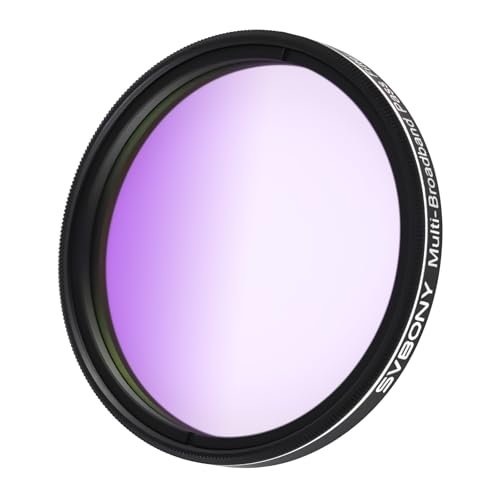
- Broad multi-bandpass design for deep-sky imaging
- 90% transmittance helps keep stars bright
- OD4 cutoff improves contrast in suburban skies
Best For: Astrophotographers who want a versatile 2-inch filter for nebulae and mixed deep-sky targets.
Best Dual-Band for OSC
SVBONY SV220 7nm Nebula Filter

- 7nm dual-band H-alpha and O-III design
- Cuts moonlight and artificial light pollution
- Helps simplify OSC nebula processing
Best For: One-shot color astrophotographers imaging emission nebulae in bright or light-polluted skies.
Best for Contrast Boost – Astromania UHC Filter 2 Inch
If you’re comparing nebula filters for telescopes, this Astromania 2-inch UHC filter is a practical pick for boosting contrast on emission nebulae and reducing the effects of skyglow. It’s designed to darken the background while helping targets like Orion, Lagoon, and Swan nebulae stand out more clearly, especially in light-polluted locations.
Best For: Observers who want a straightforward UHC filter for improving nebula visibility in 2-inch eyepiece setups, from urban skies to darker sites.
Pros:
- Improves contrast on many extended nebulae, making faint structure easier to see
- Blocks common mercury and sodium-vapor light pollution
- Works at both light-polluted and dark-sky locations
- Individually inspected and marked with transmission info for key emission lines
Cons:
- Only fits 2-inch filter threads
- Won’t help much on galaxies, clusters, or broadband targets
- Benefits are strongest on emission nebulae, not every deep-sky object
For shoppers focused on nebula filters for telescopes, this is a sensible contrast-enhancing option rather than a general-purpose astronomy filter. It’s most useful if you already know you want better nebula visibility and have a 2-inch-compatible setup.
Best Moon Contrast Filter – Celestron 1.25-Inch Moon Filter
If you’re shopping for nebula filters for telescopes, this Celestron 1.25-inch Moon Filter is a simple accessory that helps tame brightness rather than isolate deep-sky wavelengths. It reduces glare on the Moon, makes high-contrast details easier to see, and can also improve comfort when viewing very bright planets or bright terrestrial scenes.
Best For: Observers who want an easy-to-use filter for the Moon, bright planets, and general high-glare viewing on a 1.25-inch eyepiece setup.
Pros:
- Reduces lunar glare and improves contrast for more comfortable viewing
- Works on most 1.25-inch eyepieces and threads on quickly
- Useful for bright planets, snow, and sand glare as well as the Moon
Cons:
- Not a true nebula or deep-sky filter for emission objects
- Only fits 1.25-inch eyepiece setups
This is a practical pick if you want a low-cost contrast helper for lunar viewing, but it is not the right choice when comparing specialized nebula filters for telescopes. Its strength is straightforward glare reduction, making it a handy accessory for beginners and casual observers.
Best Budget – Astromania 1.25" UHC Nebula Filter
If you want one of the most useful nebula filters for telescopes without jumping to a more specialized setup, this Astromania UHC filter is designed to darken the background sky and make emission nebulae stand out more clearly. It can be especially helpful on smaller telescopes and under light-polluted skies, where extra contrast often makes the biggest difference.
Best For: Observers who want a simple 1.25-inch UHC filter for improving contrast on bright emission nebulae like Orion, Lagoon, and Swan.
Pros:
- Boosts contrast by blocking common artificial light sources like mercury and sodium-vapor lamps
- Works well on many extended nebulae and can reveal detail that is hard to see unfiltered
- Fits standard 1.25-inch eyepieces for easy use with compact telescope setups
- Individually inspected and marked with transmission data for the O-III and H-beta lines
Cons:
- It is not a universal filter for every deep-sky object
- Best results depend on viewing nebulae that emit strongly in the targeted bands
- Effects may be subtle in very dark skies or on very faint targets
For observers comparing nebula filters for telescopes, this is a practical UHC option that focuses on improving visibility rather than adding complexity. It is a solid pick if you want brighter-looking nebula structure and darker background contrast from a standard 1.25-inch accessory.
Best for Celestron Origin – Celestron Origin Nebula Filter
If you want nebula filters for telescopes that are tuned for a specific imaging system, this Celestron Origin Nebula Filter is built to improve contrast on emission targets by passing H-alpha, H-beta, and OIII while suppressing light pollution and sky glow. It is a practical add-on for Origin owners shooting from brighter suburban or urban locations.
Best For: Celestron Origin users who want a fast, easy-to-install narrowband filter optimized for emission nebula imaging.
Pros:
- Designed specifically for the Celestron Origin 6-inch RASA and its fast f/2.2 optics
- Boosts contrast by transmitting key nebula wavelengths while blocking unwanted sky glow
- Simple drop-in installation with no extra adapters required
- Works especially well for common emission nebula targets like M42, M8, and NGC 7000
Cons:
- Only compatible with the Celestron Origin system, not a general-purpose telescope filter
- Best suited to emission nebulae rather than galaxies or star clusters
For Origin owners, this is one of the most purpose-built nebula filters for telescopes you can buy: it preserves the wavelengths you want, suppresses the background you don’t, and fits the optical train without fuss. The tradeoff is narrow compatibility, but the image-quality payoff is strong if your priority is imaging emission nebulae.
Best for Moon & Planet Contrast – NEEWER 10-Pack Telescope Filter Set
If you’re comparing nebula filters for telescopes, this NEEWER 1.25-inch set is a practical all-in-one option for adding contrast across planets, the Moon, and brighter deep-sky targets. It combines color filters, variable polarizers, a UHC filter, and lunar filters, so you can experiment with different viewing conditions without buying each filter separately.
Best For: Beginners or hobbyists who want one affordable filter kit for planetary viewing, Moon detail, and basic nebula contrast enhancement.
Pros:
- Includes a UHC filter for reducing light pollution and improving nebula visibility
- 10-piece kit covers planets, lunar observing, glare reduction, and contrast tuning
- Variable polarizing filters help dim bright objects without changing focal length
- Good value if you want a single starter set instead of buying filters one by one
Cons:
- 1.25-inch fit only, so it won’t work with every eyepiece setup
- Color filters are more useful for planets than for serious deep-sky nebula work
- Results depend heavily on telescope aperture and local sky conditions
For observers who want flexible nebula filters for telescopes alongside useful planetary and lunar accessories, this set offers broad coverage rather than one specialized premium filter. It’s a solid pick if you want to test what improves your view before upgrading to more advanced pieces.
Best for Light-Polluted Skies – SVBONY SV220 2" Dual-Band Nebula Filter
If you want one of the more practical nebula filters for telescopes for city imaging, the SVBONY SV220 is built to pull out H-alpha and O-III detail while suppressing skyglow and stray light. Its 7nm dual-band design makes it a strong fit for deep-sky astrophotography with one-shot color cameras, especially when you need more contrast without making post-processing harder.
Best For: Astrophotographers using color CMOS/CCD cameras who shoot nebulae from light-polluted areas or under moonlit skies.
Pros:
- Dual-band H-alpha and O-III transmission helps isolate key nebula emission lines
- High out-of-band rejection improves contrast in bright suburban or urban conditions
- Designed for one-shot color cameras, making it easier to get usable deep-sky frames
- 2" M48 threaded, anodized aluminum build with waterproof optical glass
Cons:
- Not suitable for smart telescopes
- Not recommended for telescopes with focal ratio f/4 or faster
- More specialized for astrophotography than general visual observing
For buyers comparing nebula filters for telescopes, the SV220 stands out for extracting emission detail in difficult skies rather than acting as an all-purpose filter. If your priority is sharper nebula contrast with a color camera, this is a focused and capable option.
Best for O-III Contrast – Astromania 1.25" O-III Filter
If you want one of the more targeted nebula filters for telescopes, this Astromania 1.25" O-III filter is built to boost contrast on emission objects by passing only the key oxygen lines. It can make the Veil, Ring, Dumbbell, and Orion Nebula stand out more clearly, especially under light-polluted skies or when the Moon is washing out detail.
Best For: Visual observers who want a narrowband filter for sharper nebula contrast on 1.25" eyepieces.
Pros:
- Strong contrast boost for gaseous and planetary nebulae
- Passes the O-III emission lines while blocking most other visible light
- Anti-reflection coatings help reduce glare and ghosting
- Works in both dark skies and urban light pollution
Cons:
- Limited to 1.25" eyepieces
- Very narrow filter can dim star fields and non-nebula targets
- Not a general-purpose filter for all deep-sky viewing
For observers focused on emission nebulae, this is a practical, high-contrast option among nebula filters for telescopes. Its strength is specificity: when the target matches the filter, the view can improve dramatically.
Best for One-Shot Color Cameras – SVBONY SV220 7nm Dual-Band Nebula Filter
If you want one of the more practical nebula filters for telescopes for shooting emission targets in light-polluted skies, the SVBONY SV220 is built around a 7nm SII/OIII dual-band design. It lets one-shot color cameras capture strong nebula contrast without juggling multiple filters, and it’s especially useful when the Moon or nearby streetlights would normally wash out detail.
Best For: Astrophotographers using a one-shot color camera who want to isolate emission nebulae, planetary nebulae, and supernova remnants.
Pros:
- 7nm dual-band SII/OIII design suits emission nebula imaging
- High transmission and OD5 cut-off help suppress skyglow and streetlight interference
- Works well for one-shot color cameras without needing multiple filters
- Useful in bright moonlight and heavily light-polluted conditions
Cons:
- Not ideal for broad natural-color deep-sky imaging
- Single 1.25" format may not fit every imaging train
- Best results are target-specific rather than universal
This is a strong pick if your goal is contrast on emission targets rather than all-purpose imaging, and it stands out among nebula filters for telescopes for its OSC-friendly dual-band approach.
Best for Broad-Spectrum Nebula Imaging – SVBONY SV260 2'' Multi-Bandpass Filter
If you’re comparing nebula filters for telescopes and want a more versatile option for emission nebulae, the SVBONY SV260 is built around a multi-bandpass design that passes broad light while cutting common light pollution. It’s aimed at imaging sessions from suburban locations, where a filter needs to balance contrast, color retention, and overall signal throughput.
Best For: Astrophotographers who want a single 2-inch filter for reflection nebulae, galaxies, and mixed deep-sky targets from light-polluted skies.
Pros:
- Multi-bandpass design helps improve contrast on a wide range of targets
- 90% light transmittance supports brighter, more natural-looking star fields
- OD4 cutoff depth offers strong suppression of unwanted light
- 2-inch format fits many common telescope imaging setups
Cons:
- Not as specialized as narrowband filters for the most intense nebula rejection
- Primarily useful for imaging, not a general all-purpose visual filter
- Requires a compatible 2-inch filter wheel or threaded setup
For buyers shopping nebula filters for telescopes, the SV260 stands out as a flexible middle-ground choice: strong enough to tame suburban glare, but broad enough to preserve more natural color and target detail than aggressive narrowband options.
Best Dual-Band for OSC – SVBONY SV220 7nm Nebula Filter
If you want one of the more practical nebula filters for telescopes for one-shot color imaging, the SVBONY SV220 is built to boost contrast while cutting moonlight and artificial glow. Its 7nm dual-band H-alpha and O-III design is aimed at making emission nebulae stand out more clearly without adding a lot of extra post-processing work.
Best For: One-shot color astrophotographers who image emission nebulae from light-polluted sites or under bright moon conditions.
Pros:
- Dual-band H-alpha and O-III passbands help isolate nebula signal
- Reduces light pollution and improves contrast in bright skies
- Can simplify processing for OSC deep-sky imaging
- Useful for city imaging and full-moon sessions
Cons:
- Not ideal for broadband targets like galaxies or star clusters
- 1.25-inch size may not fit every imaging train without adapters
For astrophotographers focused on emission targets, this filter is a strong fit among nebula filters for telescopes because it emphasizes nebula detail while suppressing background glare. It is especially appealing if you want cleaner, higher-contrast results from a color camera with less time spent fighting light pollution in post.
How We Picked the Best Nebula Filters for Telescopes
We prioritized filters that offer meaningful contrast gains on emission nebulae, predictable bandpass performance, and practical compatibility with common 1.25-inch and 2-inch setups. We also considered whether a filter is better suited to visual observing or one-shot color imaging, since Nebula Filters for Telescopes are not interchangeable across every use case.
Quick Comparison
In general, UHC-style filters are the most flexible choice for mixed observing, O-III filters are stronger for many planetary and supernova remnants, and dual-band narrowband filters are the best fit for color cameras under heavy light pollution. Broadband and multi-band filters tend to preserve more star field detail, while specialty lunar filters belong in a separate category for Moon and bright-object viewing.
Key Buying Factors for Nebula Filters for Telescopes
Filter Type and Target
Match the filter to the object. UHC filters are a balanced starting point for many bright nebulae, O-III filters emphasize oxygen emission, and dual-band filters isolate H-alpha and O-III for imaging. If you mainly observe the Moon or planets, a nebula filter usually is not the right tool.
Diameter and Compatibility
Check whether your eyepieces, diagonal, or imaging train use 1.25-inch or 2-inch threading. The best optical performance means little if the filter does not fit cleanly or if you need adapters to use it.
Visual Versus Imaging Use
Some filters are designed to maximize visual contrast through the eyepiece, while others are tuned for camera sensors and longer exposures. If you shoot with a one-shot color camera, a narrow dual-band model is often more useful than a general-purpose visual filter.
Light Pollution and Sky Conditions
In brighter suburban skies, narrower bandpasses usually provide a stronger improvement. Under darker skies, broader filters may preserve more natural star fields and still add useful contrast. Transmission, cutoff quality, and halo control all matter.
Who Should Buy Which Nebula Filters for Telescopes?
Beginners who want one versatile option should start with a UHC-style filter. Observers who chase faint planetary nebulae or supernova remnants may prefer an O-III. Astrophotographers using color cameras should look first at dual-band Nebula Filters for Telescopes, while those wanting a less aggressive view of star fields may prefer a multi-bandpass design. Choose the filter that matches your telescope, your camera, and the kind of nebulae you actually observe most often.