
Choosing the right water tester can make a big difference in accuracy, speed, and confidence. The best multiparameter water quality meters help you measure several key indicators with one device, saving time and reducing guesswork.
Whether you need a handheld field meter, a lab-ready instrument, or a smart tester for routine checks, this roundup focuses on practical options for different budgets and use cases.
Best 10 Multiparameter Water Quality Meters Picks for 2026
Best for Seven-Parameter Testing
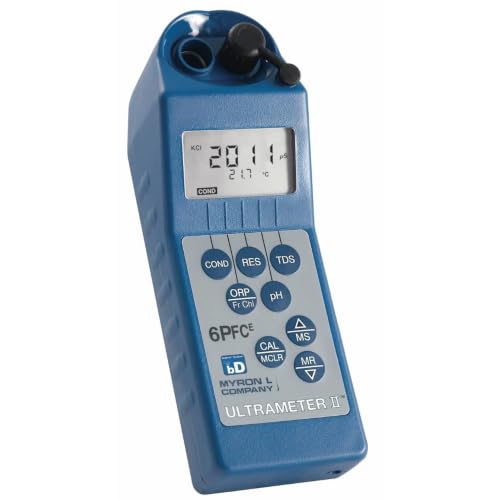
- Seven measurements in one handheld meter
- Accurate, professional-grade testing
- Fast operation with auto-ranging and temp compensation
Best For: Water treatment, lab, and field users who need broad, reliable water testing in one meter.
Best for App Logging
9-in-1 Smart Water Tester with APP Monitoring
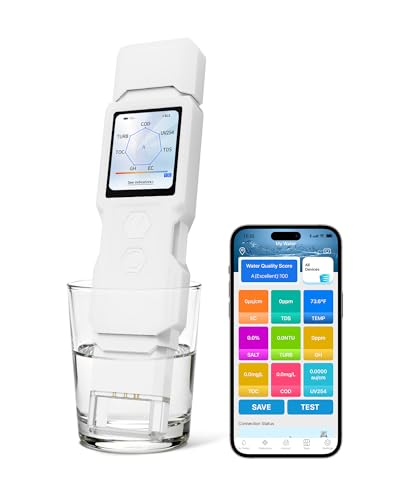
- 9-in-1 testing with turbidity, hardness, TDS, EC, salinity, TOC, COD, UV275, and temp
- Bluetooth app sync saves readings and generates trend charts
- Portable IP67 pen-style design with auto-calibration and ATC
Best For: Users who want broad water testing plus app-based history tracking.
Best for Rugged Field Testing
Hach DR900 Multiparameter Handheld Colorimeter
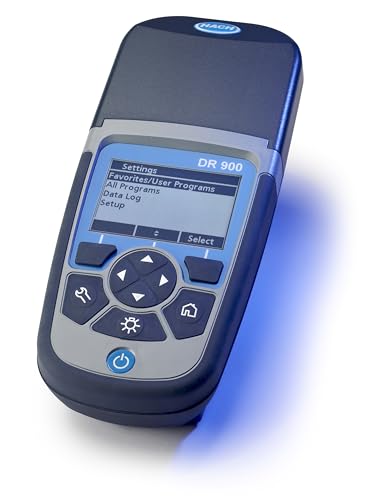
- 48 parameters and 90+ methods for flexible water testing
- Rugged, waterproof, dustproof, and shock-resistant build
- Stores 500 results and exports data via USB
Best For: Field teams and lab users who need a durable handheld water testing meter with broad method coverage.
Best Multi-Parameter Probe Support
AZ-86031 5-in-1 Water Quality Meter

- Measures pH, conductivity, TDS, salinity, and dissolved oxygen
- Supports interchangeable probes with color-coded connectors
- Useful for aquaculture, pools, labs, and water treatment work
Best For: Users who want a versatile meter platform for multiple water testing tasks.
Best for Hardness-Only Testing
Hach Total Hardness Test Kit, Model 5-EP
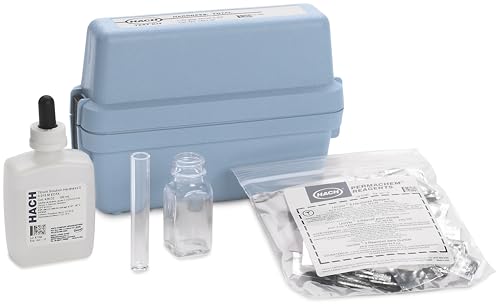
- Accurate drop count titration for hardness
- Portable carry case with included tools
- Simple setup for quick on-site testing
Best For: Users who need a portable, no-fuss kit for hardness-only water checks.
Best for Multi-Parameter Field Testing
HORIBA U-52 10m Cable Multiparameter Meter

- Measures pH, ORP, DO, conductivity, salinity, TDS, seawater gravity, temp, and turbidity
- 10m / 33 ft cable helps with remote and field sampling
- Suited to professional environmental and marine testing
Best For: Field technicians and researchers who need one meter for broad onsite water testing.
Best for Organic Contaminant Screening

- 6 parameters including TOC, COD, UV275, TDS, EC, and temperature
- App logging helps track trends and compare water sources
- Four-level display makes readings easy to interpret quickly
Best For: Users who want a portable, app-connected tester for broader home, RV, or well-water screening.
Best for Field Testing
HORIBA U-52 Multiparameter Water Quality Meter
- Wide parameter coverage for multi-spot testing
- 2 m cable improves field handling
- Suitable for freshwater and seawater work
Best For: Field teams and professionals who need a versatile all-in-one meter for on-site water testing.
Best Multi-Function Tester

- 5 water tests in one handheld meter
- ATC helps stabilize temperature-sensitive readings
- Works for pools, spas, hydroponics, and drinking water
Best For: Home users and hobbyists who want one affordable meter for general water testing across multiple uses.
Best for Multi-Parameter Testing
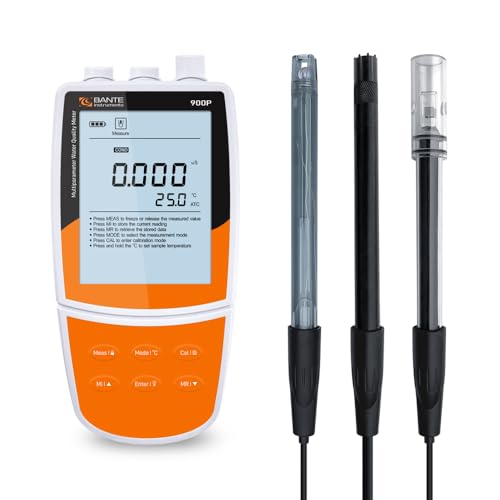
- Measures pH, ORP, ions, conductivity, TDS, salinity, resistivity, and DO
- Multi-point calibration with auto-recognition and electrode diagnostics
- Stores up to 500 readings for organized field or lab work
Best For: Technicians and water-testing users who want one portable meter for many measurements.
Best for Seven-Parameter Testing – Myron L Ultrameter II 6PIIFCE
If you need a professional-grade option among multiparameter water quality meters, the Myron L Ultrameter II 6PIIFCE stands out for combining seven measurements in one handheld tool. It is built for fast, repeatable checks in water treatment, industrial, lab, and field settings, with auto-ranging and automatic temperature compensation to simplify daily testing.
Best For: Water treatment teams, labs, and field users who want one meter that covers pH, ORP, conductivity, TDS, resistivity, FCE, and temperature.
Pros:
- Measures seven key water parameters in a single device
- High-accuracy performance with four-electrode conductivity technology
- One-handed operation with auto-ranging and automatic temperature compensation
- Non-volatile memory and long battery life support regular use
Cons:
- More specialized than a basic handheld meter
- Likely more capability and cost than casual users need
- FCE measurement may be unnecessary for simple general testing
For buyers comparing multiparameter water quality meters, this model is a strong fit when accuracy, versatility, and professional workflow matter more than price or simplicity. Its broad parameter coverage makes it especially useful when you want fewer instruments without sacrificing measurement depth.
Best for App Logging – 9-in-1 Smart Water Tester with APP Monitoring
If you want one handheld tool that covers more than basic spot checks, this smart tester is a strong fit for buyers comparing multiparameter water quality meters. It combines turbidity, hardness, TDS, EC, salinity, TOC, COD, UV275, and temperature testing in a compact pen-style design, while Bluetooth app syncing makes it easier to track readings over time without manual notes.
Best For: Homeowners, aquariums, pools, hydroponics, and field users who want app-based records plus broad water testing coverage.
Pros:
- 9-in-1 testing covers many common water quality checks in one device
- Bluetooth app support stores results and charts trends automatically
- Compact, IP67-rated design is easy to carry and use on the go
- Auto-calibration and ATC help simplify routine testing
Cons:
- Advanced feature set may be more than casual users need
- App-based workflow may not suit buyers who prefer fully manual tools
- Premium capabilities likely place it above basic water testers
Overall, this model stands out among multiparameter water quality meters for users who value broad test coverage and digital recordkeeping in one portable tester. It is especially appealing if you need frequent readings across different water sources and want a clearer long-term view of water quality changes.
Best for Rugged Field Testing – Hach DR900 Multiparameter Handheld Colorimeter
If you need one of the most dependable multiparameter water quality meters for fieldwork, the Hach DR900 is built for fast, accurate testing in harsh environments. It combines broad method coverage with a tough, portable design, making it a practical choice for routine compliance checks, remote sampling, and on-the-go water analysis.
Best For: Technicians and teams that need a rugged handheld colorimeter for reliable water testing in the field or lab.
Pros:
- Supports over 90 methods across 48 parameters for broad testing coverage
- Waterproof, dustproof, and shock-resistant for tough jobsite conditions
- Stores up to 500 results and exports data easily via USB
- Compact and lightweight for sampling in remote locations
Cons:
- More specialized than basic test kits and overkill for casual home use
- Requires compatible methods and reagents for each test type
For buyers comparing multiparameter water quality meters, the DR900 stands out when durability, portability, and documented results matter more than a simple entry-level setup. It’s a strong fit for teams that need repeatable readings and easy recordkeeping in demanding conditions.
Best Multi-Parameter Probe Support – AZ-86031 5-in-1 Water Quality Meter
If you need one of the more flexible multiparameter water quality meters for field work or lab checks, the AZ-86031 stands out for its ability to handle pH, conductivity/TDS/salinity, and dissolved oxygen with different probe setups. It’s a practical choice when you want one meter platform that can adapt to multiple testing jobs without buying separate instruments.
Best For: Aquaculture, water treatment, pool maintenance, and lab users who need a single meter system with interchangeable probes.
Pros:
- Supports pH, conductivity, TDS, salinity, and dissolved oxygen measurements
- Can work with multiple probes, with color-matched connectors for easier setup
- Large LCD helps display readings clearly for faster on-site checks
- Probe caps add extra protection in harsher measuring environments
Cons:
- Requires the right probe for each measurement type, so it’s more complex than a single-function meter
- Best suited to buyers who will actually use its multi-probe flexibility
The AZ-86031 is a strong fit if you want multiparameter water quality meters that can cover several common water checks from one platform. Its modular probe design makes it especially useful for professionals who need versatility and consistent readings across different applications.
Best for Hardness-Only Testing – Hach Total Hardness Test Kit, Model 5-EP
If you need a focused, reliable way to measure water hardness without stepping up to full multiparameter water quality meters, this Hach kit is a practical choice. It uses a drop count titration method for straightforward hardness checks, making it well suited to field use, quick spot testing, and routine on-site verification.
Best For: Users who want a simple, portable hardness-only test kit for field checks, maintenance work, or basic water quality evaluation.
Pros:
- Accurate drop count titration method for hardness measurement
- Compact carry case makes it easy to transport and store
- Includes reagents, measuring tools, and clear instructions
- Straightforward setup supports quick on-site testing
Cons:
- Measures hardness only, not a full set of water parameters
- Manual titration is less comprehensive than digital meter-based systems
- Requires consumable reagents for continued use
This kit is a strong fit when hardness is the main question and you want a dependable, portable method instead of multiparameter water quality meters. It keeps the process simple while still delivering useful results for basic water monitoring and maintenance decisions.
Best for Multi-Parameter Field Testing – HORIBA U-52 10m Cable Multiparameter Meter
If you need multiparameter water quality meters that can handle a broad set of readings in one handheld unit, the HORIBA U-52 is built for serious field work. It measures key water quality values like pH, ORP, dissolved oxygen, conductivity, salinity, TDS, seawater gravity, temperature, and turbidity, making it a practical choice for environmental sampling and onsite checks.
Best For: Field technicians, researchers, and marine or environmental users who need one meter for multiple water quality measurements.
Pros:
- Measures a wide range of water quality parameters in one device
- 10m / 33 ft cable adds flexibility for field and remote sampling
- Useful for freshwater, wastewater, and seawater applications
- Made in Japan with a precision measuring focus
Cons:
- More specialized and expensive than basic single-parameter meters
- Bulky package dimensions suggest it is not the most compact option
- Likely overkill for casual home or hobby use
For buyers comparing multiparameter water quality meters, the HORIBA U-52 stands out for its broad measurement range and long cable, which make it better suited to field and professional use than quick home testing. It is a strong pick when versatility and onsite coverage matter more than portability or simplicity.
Best for Organic Contaminant Screening – 6-in-1 Water Tester with App
This 6-in-1 tester is a strong option if you want more insight than basic TDS pens provide. Among multiparameter water quality meters, it stands out for combining TDS, EC, TOC, COD, UV275, and temperature readings in one portable device, plus app-based logging for tracking changes over time.
Best For: Homeowners, RV users, and well-water testers who want a clearer picture of possible organic contamination and overall water quality without a lab setup.
Pros:
- Measures six parameters, including TOC, COD, and UV275 for broader water analysis
- App support makes it easy to log, compare, and export readings over time
- Four-level color display simplifies results at a glance
- Compact pen-style design is easy to carry for home, camping, or RV use
Cons:
- Organic contamination indicators are useful screening tools, not lab certifications
- Requires calibration and the companion app to get the most value
If you want one of the more feature-rich multiparameter water quality meters for everyday screening, this model delivers a practical mix of fast readings, trend tracking, and broader contamination awareness than a standard TDS tester.
Best for Field Testing – HORIBA U-52 Multiparameter Water Quality Meter
The HORIBA U-52 is a practical pick for buyers who need multiparameter water quality meters with broad sensing capability in one rugged package. It covers key readings like pH, ORP, dissolved oxygen, conductivity, salinity, TDS, seawater gravity, temperature, and turbidity, making it well suited to environmental and marine monitoring workflows.
Best For: Field teams, researchers, and water-quality professionals who need an all-in-one handheld meter for multi-parameter spot checks.
Pros:
- Measures a wide range of parameters in one instrument
- 6 ft / 2 m cable adds flexibility for field use
- Precision-oriented design with Japanese manufacturing
- Good fit for freshwater and seawater testing needs
Cons:
- Larger and heavier than compact entry-level meters
- May be more than casual users need for simple testing
- Premium, professional-focused option
For teams comparing multiparameter water quality meters, the U-52 stands out for its broad measurement range and field-ready format rather than a stripped-down, budget-first design. It makes the most sense when you need dependable multi-parameter readings across varied water conditions.
Best Multi-Function Tester – 5-in-1 pH Meter & TDS Tester
If you want one of the most practical multiparameter water quality meters for everyday checks, this 5-in-1 tester covers pH, TDS, EC, salinity, and temperature in a single handheld device. It is a sensible pick for buyers who need quick readings across drinking water, pools, spas, hydroponics, or RO/DI systems without juggling multiple tools.
Best For: Home users and hobbyists who want one affordable meter for general water testing across multiple uses.
Pros:
- Combines five water test functions in one meter
- Automatic temperature compensation helps improve reading consistency
- Useful for drinking water, aquariums, pools, spas, and hydroponics
- HOLD function makes readings easier to record
Cons:
- Not as specialized as dedicated lab-grade instruments
- Requires careful calibration and maintenance for best results
For shoppers comparing multiparameter water quality meters, this model stands out for packing several common measurements into a simple, portable tester. It is a strong all-around choice when convenience and broad coverage matter more than advanced professional features.
Best for Multi-Parameter Testing – Bante 900P Portable Meter
If you need one instrument that can handle a broad range of field and lab checks, the Bante 900P stands out among multiparameter water quality meters. It measures pH, ORP, ion concentration, conductivity, TDS, salinity, resistivity, dissolved oxygen, and temperature, while adding calibration tools and endpoint auto-read for more reliable routine testing.
Best For: Technicians, educators, and water-testing users who want a versatile portable meter for multiple water quality measurements in one device.
Pros:
- Measures pH, ORP, ions, conductivity, TDS, salinity, resistivity, and dissolved oxygen
- Multi-point calibration with automatic recognition and electrode diagnostics
- Auto-read endpoint lock plus automatic temperature compensation
- Expanded memory stores up to 500 data sets
Cons:
- More advanced than a basic handheld meter
- May be overkill if you only need one or two water tests
For buyers comparing multiparameter water quality meters, the Bante 900P is appealing because it combines broad measurement capability with calibration and data-handling features that support consistent day-to-day use. It is a practical pick when you want one portable meter to cover several testing workflows.
How We Picked These Multiparameter Water Quality Meters
We focused on measurement range, sensor quality, portability, durability, ease of calibration, and how well each device fits real-world testing needs. The strongest picks cover common priorities like pH, conductivity, TDS, salinity, dissolved oxygen, and temperature, while some models add specialized functions such as ORP or app-based logging.
Quick Comparison: Which Type Fits Your Needs?
If you need a broad lab or field solution, choose a full-featured handheld meter with replaceable probes and strong data stability. If you want quick household checks, a simpler digital tester may be enough. Smart testers with app connectivity are best for tracking trends over time, while colorimetric systems are useful when you need parameter-specific testing beyond basic probe readings.
Key Buying Factors for Multiparameter Water Quality Meters
Measurement Parameters
Match the meter to the water issues you actually want to track. For general water quality, pH, TDS, EC, and temperature are common starting points. For aquaculture, pools, or environmental monitoring, dissolved oxygen, salinity, and ORP can be important too.
Accuracy and Calibration
Look for clear calibration options and stable readings. A meter that is easy to calibrate tends to stay reliable longer, especially if you test often or switch between different water sources.
Probe Design and Portability
Separate probes, multi-probe setups, and cable length all affect usability. Longer cables help in tanks, wells, and field sampling, while compact handheld designs are better for quick spot checks.
Durability and Data Handling
Waterproof or rugged housings matter if you test outdoors or in messy environments. If you need records, choose a model with app support, memory storage, or export features.
Who Should Buy Which Multiparameter Water Quality Meters?
Homeowners and hobby users should prioritize simple operation and the core readings they use most. Lab staff, aquaculture managers, and field technicians should lean toward more robust Multiparameter Water Quality Meters with better calibration control, stronger durability, and broader parameter coverage. If you need routine trend monitoring, app-connected models can be the most convenient choice.
In short, the best meter is the one that matches your testing goals, environment, and workflow—not just the longest spec sheet.