
In any science lab, safety and accuracy can’t be compromised, especially when dealing with hazardous gases. Multi-gas detectors play an essential role in identifying potential dangers like O2, CO, and H2S. Choosing the right model can enhance your risk management strategies considerably. Let’s explore the top options available, considering their features and what makes them stand out in ensuring a safe working environment for you and your colleagues.
TopTes Guard-101 Gas Detector for H2S, CO, LEL and O2
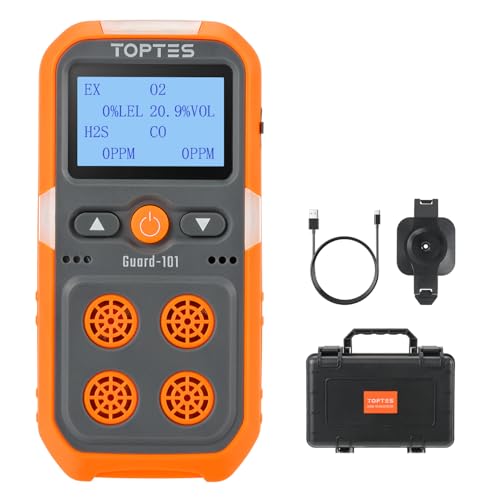
The TopTes Guard-101 Gas Detector is an ideal choice for professionals and researchers in science labs looking for reliable monitoring of hazardous gases like H2S, CO, LEL, and O2. With a rapid detection response time of just 0.5 seconds, you’ll stay ahead of potential dangers. Its robust design, made from high-strength ABS plastic, guarantees it’s waterproof, dustproof, and explosion-proof. You can rely on its impressive battery life of up to 14 hours for continuous use. Plus, the triple alarm system—LED, vibration, and sound—keeps you informed. Trust in its certifications for accuracy and safety in any environment.
Best For: The TopTes Guard-101 Gas Detector is best for professionals and researchers in science labs needing reliable monitoring of hazardous gases like H2S, CO, LEL, and O2.
Pros:
- Rapid detection with a response time of just 0.5 seconds for immediate safety.
- Long battery life of up to 14 hours allows for extended continuous monitoring.
- Robust design featuring waterproof, dustproof, and explosion-proof characteristics ensures durability in various environments.
Cons:
- Initial password protection may be inconvenient for quick access.
- Alarms can be intrusive, as they activate continuously until gas levels normalize.
- The device’s size may not be as portable as smaller gas detectors on the market.
TopTes Guard-863Pro Multi Gas Monitor

For professionals working in demanding environments, the TopTes Guard-863Pro Multi Gas Monitor stands out with its ability to detect four critical gases: H₂S, CO, LEL, and O₂. This compact device weighs just 1.42 pounds and features a vibrant TFT color screen for easy data visibility. You’ll appreciate its quick 0.5-second response time and continuous triple alarm system that guarantees immediate alerts. With an impressive 18-hour battery life and fast 2.5-hour charging, it keeps you safe during long shifts. Plus, you can export data via USB, making it perfect for industrial and emergency applications.
Best For: Professionals in industrial manufacturing, mining, and emergency rescue who require reliable multi-gas detection.
Pros:
- Fast response time of 0.5 seconds ensures immediate detection of hazardous gases.
- Long battery life of 18 hours with a quick 2.5-hour charging capability.
- User-friendly TFT color screen displays real-time data and trends, even in low-light conditions.
Cons:
- Weighs 1.42 pounds, which may be considered bulky for some users.
- Limited to detecting only four specific gases (H₂S, CO, LEL, O₂).
- The initial cost may be higher compared to simpler gas detection devices.
Gas Detector with Pump, 4 Gas Monitor Multi Gas Detector

Designed for professionals in high-risk environments, the Gas Detector with Pump, 4 Gas Monitor guarantees your safety by accurately measuring hazardous gases like CO, O2, H2S, and combustibles. This user-friendly device features a large LCD display, allowing quick access to crucial information. With a response time under 30 seconds, it alerts you through audible, visual, and vibration alarms when air quality is compromised. Plus, its sturdy, waterproof design makes it ideal for various industries, from petroleum to agriculture. With over eight hours of standby time, you can trust this essential tool for personal safety in confined spaces.
Best For: Professionals working in high-risk environments such as petroleum, chemical, and agriculture industries who need reliable gas detection for personal safety.
Pros:
- User-friendly interface with a large LCD display for easy monitoring of gas levels.
- Quick response time of under 30 seconds to alert users of unsafe air quality.
- Durable and portable design, including waterproof and explosion-proof features.
Cons:
- Initial setup requires a password, which may be inconvenient for first-time users.
- Limited battery life of 8 hours may not be sufficient for extended work shifts.
- The sound alarm can be turned off, but this may pose risks if users forget to reactivate it.
Forensics 4 Gas Monitor with Built-in Pump
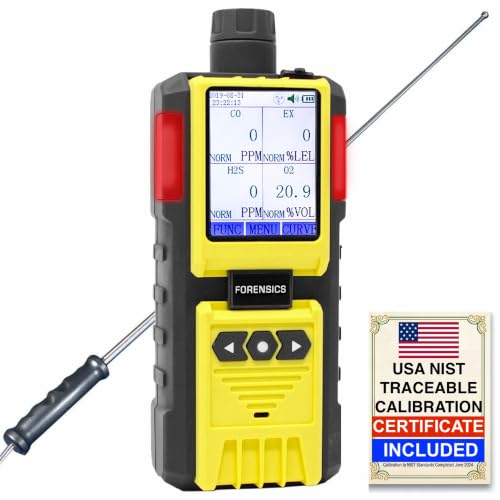
When safety and precision are your top priorities in a science lab, the Forensics 4 Gas Monitor with Built-in Pump stands out as an essential tool. This device detects O2, CO, H2S, and LEL, ensuring you’re aware of gas levels at all times. With high-quality electrochemical sensors and a robust, waterproof design, it’s built for durability. The color display and intuitive graph functions make operation easy. Plus, it stores up to 1200 alarm records, keeping your data organized. With a one-year warranty and NIST traceable calibration, you can trust the Forensics 4 Gas Monitor for your laboratory safety needs.
Best For: The Forensics 4 Gas Monitor is best for laboratory professionals and safety officers who require reliable gas detection for hazardous environments.
Pros:
- High-quality electrochemical sensors provide accurate and reliable gas readings.
- Durable design ensures resistance to water, dust, and explosions, suitable for various working conditions.
- Data management capabilities allow for effective monitoring and storage of alarm records, enhancing safety protocols.
Cons:
- Initial cost may be higher compared to basic gas monitors, which could be a barrier for some users.
- Calibration requirements may necessitate additional time and resources to maintain accuracy.
- Limited sensor types as it only detects O2, CO, H2S, and LEL, potentially excluding other gases of concern.
Forensics Detectors 4 Gas Monitor + Pump

The Forensics Detectors 4 Gas Monitor + Pump is an essential tool for professionals working in confined spaces, such as emergency responders and industrial safety personnel. It effectively detects Oxygen (O2), Carbon Monoxide (CO), Hydrogen Sulfide (H2S), and Combustibles (LEL), ensuring your safety during critical tasks. With a USA NIST Calibration Certificate and a 1-year limited warranty, you’ll trust its quality. Its robust design features high-strength ABS, making it waterproof, dust-proof, and explosion-proof. Plus, adjustable audio, visual, and vibration alarms keep you informed, while digital timestamps log important data for your monitoring needs. Stay safe and accurate with this reliable detector.
Best For: Professionals working in confined spaces, such as emergency responders and industrial safety personnel who need reliable gas detection.
Pros:
- High-quality sensors made in the UK ensure accurate and reliable readings.
- Robust design is waterproof, dust-proof, and explosion-proof, suitable for harsh environments.
- Adjustable alarms with digital logging provide comprehensive monitoring and safety alerts.
Cons:
- The initial cost may be higher compared to basic gas detectors.
- Requires periodic calibration to maintain accuracy, which could be inconvenient.
- Limited warranty period of one year may not be sufficient for some users.
Forensics USA NIST Calibrated 4 Gas Monitor

Forensics USA NIST Calibrated 4 Gas Monitor stands out as an essential tool for laboratory professionals who demand precision and reliability in gas detection. This monitor effectively detects Oxygen, Carbon Monoxide, Hydrogen Sulfide, and Combustibles, ensuring your safety. With high-quality electrochemical sensors and a detection error of ≤±5% F.S., you’ll get accurate readings in under 30 seconds. Its adjustable alarms—audio, visual, and vibration—keep you informed, while the rugged, waterproof design guarantees durability in tough environments. Plus, with a 1-year warranty and NIST traceable calibration, you can trust its performance for your critical applications.
Best For: Laboratory professionals and safety personnel who require precise and reliable gas detection in various environments.
Pros:
- High-quality electrochemical sensors provide accurate readings with a detection error of ≤±5% F.S.
- Adjustable audio, visual, and vibration alarms enhance safety awareness.
- Rugged, waterproof, and explosion-proof design ensures durability in challenging conditions.
Cons:
- USB rechargeable feature may require access to a power source for convenience.
- Initial calibration may be necessary for optimal performance.
- Limited to detecting only four specific gases (O2, CO, H2S, and Combustibles).
TopTes Guard-101 Gas Monitor Multi Detector for H2S, CO, LEL, and O2

Engineers and safety professionals will find the TopTes Guard-101 Gas Monitor an essential tool for detecting hazardous gases like H2S, CO, LEL, and O2. This 4-in-1 device delivers rapid detection within 30 seconds and boasts a long battery life of up to 14 hours. Built from high-strength ABS plastic, it’s waterproof, dustproof, and explosion-proof, making it ideal for various settings. The triple alarm system guarantees immediate alerts through visual, audible, and vibration signals. With a 36-month warranty and lifetime support, the Guard-101 combines reliability and user-friendly features, making it a top choice for safety in any environment.
Best For: The TopTes Guard-101 is best for engineers and safety professionals who require reliable detection of hazardous gases in various environments.
Pros:
- Rapid detection of hazardous gases within 30 seconds.
- Long battery life of up to 14 hours for extended use.
- Waterproof, dustproof, and explosion-proof design enhances durability.
Cons:
- May require regular calibration for optimal accuracy.
- Some users might find the device’s size less portable compared to smaller models.
- Limited to four specific gas types, which may not cover all user needs.
TopTes PT-990 Rechargeable Gas Leak Detector

If you’re looking for a reliable gas leak detector that combines advanced technology with user-friendly design, the TopTes PT-990 Rechargeable Gas Leak Detector is an excellent choice. With a detection range of 0-10,000 ppm, it effectively identifies propane and methane leaks for both industrial and home use. The high-quality Figaro sensor guarantees instant responses in just 0.5 seconds. You’ll appreciate the triple alarm system featuring a 90dB buzzer, visual alerts, and vibration notifications. Plus, the flexible 11-inch gooseneck lets you access tight spaces easily. Enjoy over nine hours of use on a single charge with its convenient USB-C charging port.
Best For: Those seeking a reliable and easy-to-use gas leak detector for both home and industrial applications.
Pros:
- High-quality Figaro sensor ensures quick detection of gas leaks in just 0.5 seconds.
- Triple alarm system provides multiple alerts with a loud 90dB buzzer, visual indicators, and vibrations.
- The 11-inch flexible gooseneck allows for easy access to tight spaces for thorough inspections.
Cons:
- Some users may find the initial cost higher compared to basic models.
- The device’s sensitivity might require calibration for specific environments.
- Limited to detecting only combustible gases like propane and methane, not other types of gases.
ACEGMET 4 Gas Monitor (Personal Rechargeable)
The ACEGMET 4 Gas Monitor is an essential tool for professionals working in hazardous environments, such as confined spaces. It detects carbon monoxide, oxygen, hydrogen sulfide, and combustible gases, ensuring your safety. With real-time readings and a fast response time of under 30 seconds, you’ll receive immediate alerts through visual signals, vibrations, and a loud 120 dB alarm if gas levels rise dangerously. The durable design features a convenient belt clip for easy attachment. Plus, its rechargeable battery lasts up to 10 hours, making it reliable for extended use. Trust ACEGMET for effective personal protection in your workplace.
Best For: Professionals working in hazardous environments, such as confined spaces, who require reliable gas detection for personal safety.
Pros:
- Provides real-time, accurate gas level readings with a fast response time of less than 30 seconds.
- Features a durable design and convenient belt clip for easy attachment during inspections.
- Equipped with a rechargeable battery lasting up to 10 hours for extended use.
Cons:
- Requires periodic calibration to maintain accuracy, which may be inconvenient for some users.
- The sensor’s service life is limited to 15 to 24 months, necessitating replacement.
- May have a learning curve for new users unfamiliar with gas detection technology.
Portable Gas Detector, Gas Clip 4 Gas Monitor
For safety-conscious professionals working in science labs, the Portable Gas Detector, Gas Clip 4 Gas Monitor, stands out with its high-quality electrochemical sensors. It detects combustible gas, oxygen, carbon monoxide, and hydrogen sulfide, ensuring your environment remains safe. Built from durable ABS with an anti-slip grip, it’s waterproof, dust-proof, and explosion-proof. With a quick response time and an accuracy of ≤±5% F.S., you can trust its reliability. The triple alarm mode offers voice alerts and adjustable audio, visual, and vibration notifications. Plus, you get a 1-year warranty, guaranteeing your investment in safety and peace of mind.
Best For: Safety-conscious professionals working in science labs who require a reliable gas detection solution.
Pros:
- High-quality electrochemical sensors for accurate detection of multiple gases.
- Durable construction with waterproof, dust-proof, and explosion-proof features.
- User-friendly alarm system with voice alerts and adjustable notifications.
Cons:
- Requires periodic calibration to maintain accuracy.
- Initial password may need to be modified for enhanced security.
- May be considered bulky for some users needing ultra-portable solutions.
Factors to Consider When Choosing Multi Gas Detectors for Science
When choosing a multi gas detector for your science lab, you’ll want to take into account several key factors. Detection range and sensitivity, response time, battery life, and durability can all impact your safety and efficiency. Don’t forget to check calibration and certification to guarantee you’re getting reliable performance.
Detection Range and Sensitivity
Choosing a multi-gas detector involves careful consideration of detection range and sensitivity, as these factors directly impact your lab’s safety. The detection range specifies the minimum and maximum concentrations of gases your detector can accurately measure, which is essential for effectiveness in different environments. Sensitivity, on the other hand, determines how well the detector identifies low gas levels; many advanced models can detect concentrations as low as parts per million (PPM). Opt for high-quality electrochemical sensors that enhance both sensitivity and accuracy, guaranteeing reliable detection of gases like carbon monoxide (CO) and hydrogen sulfide (H2S). Aim for a detection error margin of less than ±5% Full Scale (F.S.) to ensure precise and trustworthy readings for safety and compliance.
Response Time and Alerts
Although safety is paramount in science labs, the response time and alert systems of multi-gas detectors can make all the difference in emergency situations. A rapid detection capability, ideally around 0.5 seconds, guarantees you’re immediately aware of hazardous gas levels. Look for continuous alarm systems that provide audible, visual, and vibration alerts to effectively notify you of dangerous concentrations. It’s also beneficial if the detector retains alarm records for later analysis, giving you valuable insights into past exposure incidents. Remember, faster response times enhance safety in environments where gas leaks can quickly become critical. Proper alarm functionality is essential too, guaranteeing alerts remain active until gas levels return to safe limits, offering ongoing monitoring during potential exposure.
Battery Life and Charging
Battery life and charging capabilities play an essential role in your selection of multi-gas detectors for science labs. Consider how long the detector can operate on a single charge—most provide between 8 to 18 hours, impacting your fieldwork efficiency. Look for fast charging options; some devices recharge fully in just 2.5 hours, minimizing downtime. The type of battery, like lithium-ion, affects weight and longevity, with higher capacity batteries guaranteeing longer use. Don’t overlook standby time; certain models offer extended durations, keeping them ready for immediate action. Finally, remember that regular maintenance and calibration can enhance battery performance, leading to more efficient power usage and longer life for your detector. Choose wisely to guarantee safety and reliability.
Durability and Design
When selecting multi-gas detectors for science labs, durability and design are paramount to guarantee they can withstand challenging environments. Look for detectors made from high-strength materials like ABS or rubber, which resist impacts, moisture, and dust. A waterproof, dust-proof, and explosion-proof design not only enhances longevity but also assures reliable performance across various applications. User-friendly features, such as back clips or portable casings, make it easier for you to carry and access the detector in different locations. Additionally, prioritize sensors with high accuracy and a response time under 30 seconds for prompt detection of hazardous gas levels. Ascertain the detector offers maintenance features, enabling zero and span calibrations for ongoing reliability and accuracy over time.
Calibration and Certification
Calibration and certification are essential factors to take into account when choosing multi-gas detectors for science labs, as they directly impact the accuracy and reliability of your measurements. Look for models that come with calibration certificates from recognized institutions, ensuring their reliability. Regular calibration is important to maintain detection error rates within acceptable limits, typically ≤±5% F.S., which is critical for safety in hazardous environments. Opt for devices with USA NIST traceable calibration for added assurance of compliance with industry standards. Remember to calibrate not just upon purchase but periodically throughout the detector’s lifespan. Some detectors also offer zero and span calibration options, allowing you to customize settings for ideal performance in varying conditions.