
Choosing a model rocket for an elementary-age student means balancing excitement with manageable assembly, dependable launch equipment, and age-appropriate supervision. The right set can turn a weekend project or classroom activity into a memorable introduction to science and engineering.
These 10 picks include beginner kits, prebuilt rockets, launch-system bundles, and a 12-pack designed for group activities. Check the recommended age, included components, and required supplies before buying.
Best 10 Model Rocket Sets for Elementary Students Picks for 2026
Ready-to-Fly Pick

- Two prebuilt rockets
- Launch pad and controller included
- Flies up to 1,100 feet with a compatible engine
Best For: Beginners ages 10+ who want quick launches
Two-Rocket Build Pick

- Includes two buildable rockets
- Launch system included
- Approximately one hour or less to assemble
Best For: Beginner builders ages 10+
Classroom Value Pick

- Includes 12 individual kits
- Designed for group STEM activities
- Projects flights up to 1,600 feet
Best For: Classrooms, clubs, and youth programs
Single-Project STEM Pick
- Beginner build with one rocket
- Launch pad and controller included
- Assembly takes approximately one hour or less
Best For: Ages 10+ learners starting one hands-on project
Best Intermediate Build

- Ages 10+ intermediate project
- Includes parachute, decals, and instructions
- Up to 1,000-foot projected altitude
Best For: Older elementary students ready for a one-hour build
Best Complete Starter Set

- Two rocket models in one set
- Includes launch pad and controller
- Ages 10+ with 600- and 1,150-foot flights
Best For: Families seeking variety and included launch hardware
Best Classic Design

- Ages 10+ intermediate build
- 16-inch design with wood fins
- Up to 600-foot projected altitude
Best For: Students who enjoy a longer classic rocket project
Best Complete Build-and-Launch Set

- Includes rocket, parachute, pad, and controller
- About one hour of beginner-friendly assembly
- Projected altitude up to 1,150 feet
Best For: Ages 10+ beginners wanting to build and launch
Best No-Build Option

- Fully assembled for quick preparation
- Includes a 12-inch recovery parachute
- Projected altitude up to 1,125 feet
Best For: Ages 10+ beginners who want minimal setup
Best Balanced Beginner Set

- Includes rocket, parachute, pad, and controller
- About one hour of assembly
- Projected altitude up to 1,100 feet
Best For: Ages 10+ beginners wanting a complete starter setup
Ready-to-Fly Pick – Rascal and Hijinks Launch Set
For shoppers comparing model rocket sets for elementary students, the Estes Rascal and Hijinks set is a convenient option for beginners who want to launch quickly. It includes two prebuilt rockets, parachutes, a launch pad, and an electronic launch controller, though engines and other launch supplies are sold separately.
Best For: Beginners ages 10+ who prefer ready-to-fly rockets over an assembly project.
Pros:
- Includes two fully assembled rockets with parachutes.
- Launch pad and Electron Beam Launch Controller are included.
- Projected altitude reaches up to 1,100 feet with a compatible C6-7 engine.
- Supports multiple compatible Estes engine sizes.
Cons:
- Rocket engines, starters, recovery wadding, and four AA batteries are sold separately.
- The 10+ recommendation and required safety procedures may call for adult supervision.
This is the simplest set in the group for getting outside and flying with minimal preparation. Choose it when convenience matters more than the hands-on building experience.
Two-Rocket Build Pick – Pathfinder Beginner Kit
The Estes Pathfinder is a strong choice among model rocket sets for elementary students who want to build before they fly. This two-rocket kit includes parts, decals, parachutes, instructions, and the launch system, with assembly taking approximately an hour or less per beginner project.
Best For: Ages 10+ learners who want a manageable introduction to rocket construction and launching.
Pros:
- Includes two rockets for repeated building and flying opportunities.
- Comes with a Porta-Pad II Launch Pad and Electron Beam Controller.
- Assembly is designed to take approximately one hour or less.
- Each rocket can reach a projected altitude of up to 1,000 feet with a C6-5 engine.
Cons:
- Engines, starters, recovery wadding, and four AA batteries are sold separately.
- Building is required, so it is less immediate than a prebuilt launch set.
Pathfinder balances hands-on STEM learning with the convenience of an included launch system. It is a practical pick for families wanting two beginner projects rather than one.
Classroom Value Pick – Wizard Bulk Rocket Kits
For classrooms, clubs, and larger groups comparing model rocket sets for elementary students, the Estes Wizard bulk pack supplies 12 intermediate building kits. Each kit includes rocket parts, an engine mount, decals, a recovery parachute, and instructions, while launch equipment and flight supplies must be purchased separately.
Best For: Classroom science activities, youth programs, and group rocket-building projects for ages 10+.
Pros:
- Provides 12 individual rocket kits for group use.
- Each kit includes parts, decals, an engine mount, parachute, and instructions.
- Each rocket takes approximately one hour to assemble.
- Projected altitude reaches up to 1,600 feet with a compatible C6-7 engine.
Cons:
- It is an intermediate kit rather than the simplest beginner option.
- Launch pad, engines, starters, recovery wadding, and batteries are sold separately.
- Its bulk quantity may be excessive for a single child or family.
The Wizard bulk pack is best when multiple students need their own construction project. Its higher flight potential and intermediate classification make it more suitable for organized activities than casual first launches.
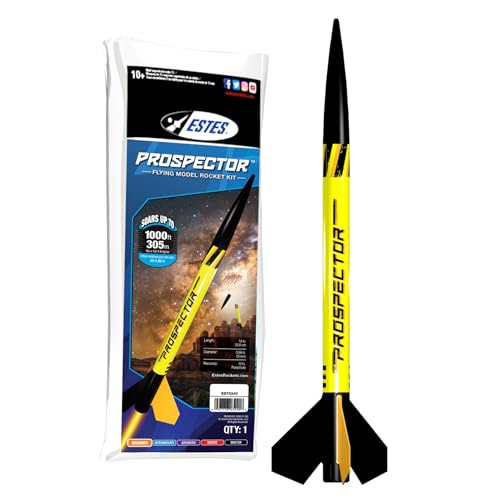
Single-Project STEM Pick – Prospector Beginner Kit
The Estes Prospector offers a focused, hands-on option for shoppers seeking model rocket sets for elementary students. This beginner kit includes rocket parts, decals, a recovery parachute, a launch system, and instructions, with assembly designed to take approximately an hour or less.
Best For: Ages 10+ learners who want one approachable rocket-building and launch project.
Pros:
- Beginner-level kit with assembly estimated at one hour or less.
- Includes the rocket, recovery parachute, launch pad, controller, and instructions.
- Introduces aerospace and physics concepts through hands-on construction.
- Compatible with several Estes engine sizes, including 1/2A6-2, A8-3, and B6-4.
Cons:
- Only one rocket kit is included.
- Engines, starters, recovery wadding, and four AA batteries are sold separately.
- The stated 1,000-foot altitude requires a separately sold C6-5 engine.
Prospector is a straightforward choice for one child’s first build-and-launch experience. It includes the main launch hardware while leaving families to select the appropriate engine and consumable supplies.
Best Intermediate Build – Estes Alpha Rocket Kit
Estes 1225 Alpha Rocket-Building Kit, Intermediate Flying-Rocket-Model Kit for Ages 10+
Check Price On AmazonFor families comparing model rocket sets for elementary students, the Estes Alpha is a hands-on intermediate project for ages 10 and up. It includes the main rocket components, parachute, decals, and instructions, but launch equipment, engines, recovery wadding, batteries, and several building supplies are sold separately.
Best For: Older elementary students ready for a roughly one-hour build and a classic single-rocket STEM project with adult supervision.
Pros:
- Includes rocket parts, parachute, decals, and instructions.
- Reaches a projected altitude of up to 1,000 feet with a compatible C6-7 engine.
- Compact 12.3-inch design supports an engaging build-and-fly activity.
Cons:
- Engines, launch pad, controller, recovery wadding, batteries, paint, glue, and tools are not included.
- Intermediate assembly may require about an hour and adult guidance.
The Alpha is a strong choice when the goal is to build one aerodynamic rocket and extend the activity with painting and launch preparation. Check the required accessories before buying so the student can complete the experience safely.
Best Complete Starter Set – Estes Tandem-X Launch Set
The Estes Tandem-X is one of the more complete model rocket sets for elementary students ages 10 and up because it includes two rocket builds plus a launch pad and controller. Engines, starters, recovery wadding, and four AA batteries are still sold separately, so factor those supplies into the total setup.
Best For: Families wanting two different rocket-building experiences and included launch hardware for a shared STEM activity.
Pros:
- Includes the Amazon and Crossfire ISX rocket models.
- Comes with a Porta Pad II launch pad system and Electron Beam controller.
- Offers two projected flight heights: 600 feet and 1,150 feet with compatible engines.
Cons:
- Engines, starters, recovery wadding, and four AA batteries are sold separately.
- Two builds and different materials may require more time and supervision than a single beginner kit.
Choose the Tandem-X when variety matters more than simplicity. The precolored Amazon model offers an accessible starting point, while the Crossfire ISX adds a more detailed build with laser-cut wood fins.
Best Classic Design – Estes Der Red Max Rocket Kit
Estes 0651 Der Red Max Rocket-Building Kit, Intermediate Flying-Rocket-Model Kit for Ages 10+
Check Price On AmazonThe Der Red Max is an intermediate model for ages 10 and up and a practical option among model rocket sets for elementary students who enjoy a longer construction project. It includes the rocket parts, parachute, decals, and instructions, while engines, launch equipment, recovery wadding, batteries, tools, and paint must be supplied separately.
Best For: Older elementary students who want a classic 16-inch rocket with laser-cut wood fins and about two hours of assembly.
Pros:
- Large, stable design includes laser-cut wood fins.
- Includes recovery parachute, decals, rocket parts, and instructions.
- Projects up to 600 feet with a compatible C6-5 engine.
Cons:
- Intermediate build takes approximately two hours.
- Launch pad, controller, engines, recovery wadding, batteries, and building supplies are sold separately.
The Der Red Max suits learners who prefer a substantial build with traditional wood fins rather than a quick assembly. Its lower projected altitude than the Alpha may be appealing for families prioritizing a classic, stable-feeling project.
Best Complete Build-and-Launch Set – Alpha III
For families comparing model rocket sets for elementary students, the Estes Alpha III is a practical starting point for children ages 10 and up who want to build before launching. The kit includes rocket parts, decals, a parachute, launch pad, and controller, with about an hour of preparation.
Best For: Ages 10+ and beginners who want both a hands-on build and a complete launch system.
Pros:
- Includes the rocket components, parachute, launch pad, and controller.
- Provides a hands-on STEM building experience with decals and instructions.
- Can reach a projected altitude of up to 1,150 feet with compatible engines.
Cons:
- Rocket engines, starters, recovery wadding, and four AA batteries are sold separately.
- Requires an appropriate launch site and adult attention to model-rocket safety procedures.
The Alpha III is the strongest all-in-one option here for beginners who want to assemble their rocket and launch it using the included equipment. Plan for additional supplies and supervised outdoor use.
Best No-Build Option – Athena
Estes 2452 Athena Rocket-Building Kit, Prebuilt Beginner Flying-Rocket Model Kit for Ages 10+, Blue
Check Price On AmazonThe Estes Athena is a convenient choice among model rocket sets for elementary students when the priority is getting to launch day quickly. Designed for ages 10 and up, it arrives fully prepared and needs about 15 minutes of setup before use.
Best For: Beginners who prefer a ready-to-fly rocket rather than a construction project.
Pros:
- Fully assembled, reducing preparation time to approximately 15 minutes.
- Includes a 12-inch parachute for recovery.
- Can reach a projected altitude of up to 1,125 feet with a C6-7 engine.
Cons:
- Launch pad and controller are sold separately.
- Engines, starters, recovery wadding, and four AA batteries are also required separately.
Athena minimizes the building barrier and keeps the focus on the launch experience. Its separate launch-system requirement makes it less complete as a standalone purchase, but it is convenient for households that already have compatible equipment.
Best Balanced Beginner Set – Journey
The Estes Journey offers a balanced introduction to model rocket sets for elementary students ages 10 and up. Children can assemble the rocket in about an hour, then use the included launch pad and controller for a complete beginner-oriented launch setup.
Best For: Beginners seeking a straightforward build-and-launch kit with included launch equipment.
Pros:
- Includes rocket parts, decals, parachute, launch pad, and controller.
- Offers an approximately one-hour assembly project for hands-on STEM learning.
- Reaches a projected altitude of up to 1,100 feet with a C6-7 engine.
Cons:
- Rocket engines, starters, recovery wadding, and four AA batteries are sold separately.
- Requires a suitable launch area and adherence to model-rocket safety guidance.
Journey is a well-rounded choice for families that want the child involved in assembly without sourcing a separate launch system. Its preparation time and projected height fit a typical first-rocket experience.
How We Picked the Best Model Rocket Sets for Elementary Students
We selected these Model Rocket Sets for Elementary Students based on beginner accessibility, included launch equipment, educational value, and suitability for supervised family or classroom use. The list includes both build-it-yourself kits and prebuilt rockets, so shoppers can match the project to a child’s patience, confidence, and available time.
Because most listed kits are recommended for ages 10 and up, younger children should participate only with close adult supervision. A responsible adult should handle launch-site setup, motor installation, countdowns, and recovery checks.
Quick Comparison
| Best For | Look For | Recommended Type |
|---|---|---|
| First launch | Prebuilt rocket and launch system | Rascal and Hijinks or Athena |
| Building practice | Beginner kit with straightforward assembly | Pathfinder, Prospector, or Alpha III |
| Group activities | Multiple kits for a class or club | Wizard 12-pack |
| More advanced projects | Intermediate construction and finishing | Alpha or Der Red Max |
Key Buying Factors for Model Rocket Sets for Elementary Students
Age and Supervision
Start with the manufacturer’s age recommendation, but also consider the child’s ability to follow multi-step instructions. Elementary students typically need an adult to review every construction and launch step, even when the kit is labeled beginner-friendly.
Build Level and Time
Prebuilt rockets reduce assembly and get families to the launch stage faster. Beginner kits offer a better hands-on introduction to construction, while intermediate models may require more careful shaping, gluing, painting, and finishing. For a classroom, a bulk pack can simplify lesson planning and keep every student working on a similar project.
What Is Included
Some bundles include a launch pad and controller, while standalone rocket kits may require separate equipment. Confirm whether you need launch motors, igniters, recovery wadding, glue, paint, or batteries. Factoring in these extras gives a more realistic total cost.
Launch and Recovery Needs
Choose a large, open launch area away from buildings, roads, trees, power lines, and crowds. Check local rules and weather conditions, and use only compatible motors and equipment. A lightweight rocket with a reliable recovery system is generally easier for beginners to track and retrieve.
Who Should Buy Which Model Rocket Sets for Elementary Students?
Choose a prebuilt bundle for a child who wants quick results or may lose interest during a long assembly. Select a beginner building kit for students who enjoy crafts, following instructions, and learning how components work. A bulk pack is the practical choice for teachers, youth groups, and families planning a shared activity. Intermediate kits suit older or more experienced builders who are ready for additional construction and finishing work.
For most first-time buyers, prioritize a complete, beginner-oriented set with launch hardware, then add compatible motors and safety supplies. That combination keeps setup simple while leaving room for the child to learn through repeated launches.