
Choosing one of the best mini milling machines for beginners can make the difference between frustrating guesswork and clean, repeatable results. The right starter machine should be compact, stable, easy to control, and capable of handling the materials you plan to learn on.
In this roundup, we focus on beginner-friendly options for hobby use, model making, light metalwork, and small workshop projects—so you can match the machine to your space, skill level, and budget.
Best 10 Mini Milling Machines for Beginners Picks for 2026
Precision Benchtop Choice
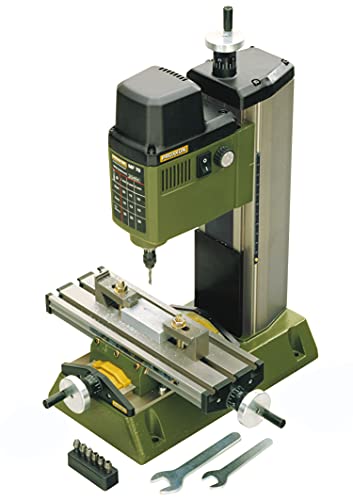
- Cast iron base adds stability for fine work.
- Play-free adjustable slides support accuracy.
- Compact 100W design suits small projects.
Best For: Beginners doing precise hobby, model, or electronics work.
Variable-Speed Workshop Starter
Steel Dragon Tools Mini Milling Machine

- Variable speed helps match different tasks.
- Supports drilling, deep milling, and face milling.
- Includes a 6-piece cutter set and tools.
Best For: Beginners wanting a heavier benchtop mill for light workshop tasks.
Automated Desktop CNC Pick
Carvera Air Desktop CNC Machine

- Auto-probing and leveling reduce setup work.
- Quick tool changer helps multi-step jobs.
- 4th axis expands capabilities for 3D work.
Best For: Beginners who want a guided desktop CNC with advanced features.
Compact Hobby Grinder Mill

- Compact benchtop design fits small workspaces.
- Handles wood, soft metal, and plastic.
- Includes accessories and safety glasses.
Best For: Beginners focused on light hobby and model-making projects.
Garage-Ready Benchtop Mill
Mechmaxx 1.5HP Variable Speed Mini Mill
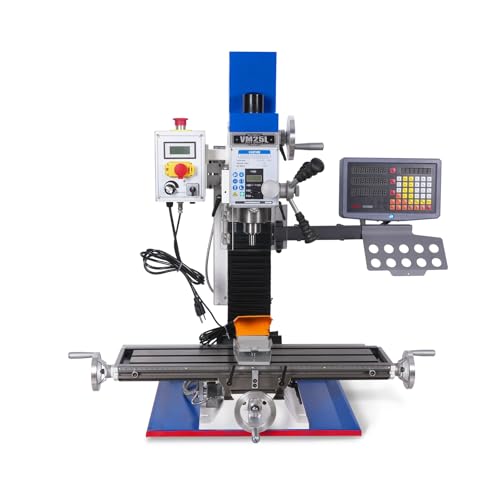
- 1.5 HP brushless motor with low-maintenance operation
- 0-2500 RPM variable speed and R8 spindle
- 7" x 27-1/2" table with 90° head tilt
Best For: Beginners who want a compact but capable garage-shop mill
Compact Metal Mini Mill

- Metal construction with simple, low-complexity assembly
- 0.02mm scale accuracy and hand wheel control
- High 12000 RPM for light soft-metal and wood work
Best For: Hobby users who want a compact, metal-bodied mini mill for light precision projects
Precision Hobby Mill
INTBUYING 600W Variable Speed Mini Mill

- 600W brushless spindle drive with protection features
- 50-2250 RPM variable speed plus micro-feed control
- Integrated cross worktable and included MT2 ER32 chucks
Best For: Beginners who want a feature-rich hobby mill with micro-feed control and broad material compatibility
Precision-First Starter Pick
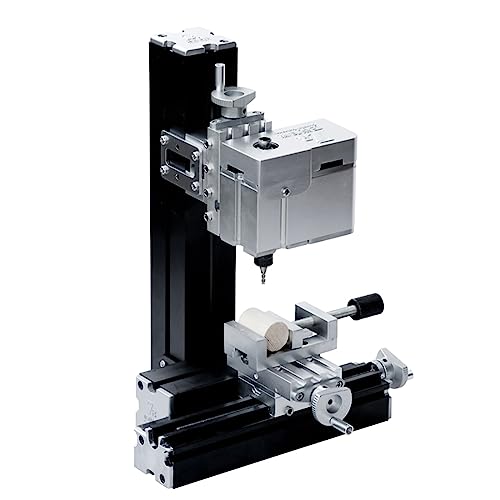
- All-metal body with no plastic parts
- 20,000 rpm motor for small DIY work
- 0.02 mm scale lines for finer adjustments
Best For: Beginners who want a sturdy, precise mini mill for creative small projects
Budget Teaching Tool
Universal Mini Metal Mill W10004M

- Compact size fits workshops, labs, and classrooms
- Works with wood, plastic, and soft metals
- Metal main parts support durability and precision
Best For: Students and hobbyists learning basic milling and turning on small projects
Stable Classroom Choice

- No-plastic body for added durability
- Smooth, quiet belt transmission
- Base clamping helps secure workpieces
Best For: Beginners in schools or maker spaces who want stable, quiet operation
Precision Benchtop Choice – PROXXON MICRO Mill MF 70
If you’re comparing mini milling machines for beginners, the PROXXON MICRO Mill MF 70 is a compact option built for small, accurate work. Its cast iron base, treated aluminum table and column, and play-free adjustable slides make it a practical pick for lab-style projects, model building, jewelry, electronics, and other detail-oriented tasks.
Best For: Beginners who want a small, stable mill for highly detailed hobby and craft projects.
Pros:
- Stable cast iron base helps support precise work.
- All axes are play-free with adjustable slides for better control.
- Balanced special motor is designed for stability at high speeds.
- Includes MICROMOT steel collet set and stepped clamp blocks.
Cons:
- 100-watt output is modest for heavier material removal.
- Best suited to small-scale work rather than larger projects.
Overall, this is a careful, low-size machine aimed at precision rather than brute force. For beginners who value accuracy and a compact footprint, it’s one of the more focused starter-friendly mills in this group.
Variable-Speed Workshop Starter – Steel Dragon Tools Mini Milling Machine
For buyers looking at mini milling machines for beginners, this Steel Dragon Tools benchtop unit offers a more workshop-style setup with variable speed control. It is designed for drilling, deep milling, and face milling, and it includes a 6-piece high-speed steel cutter set so you can start working with the machine right away.
Best For: Beginners who want a benchtop mill with variable speed and included cutters for light workshop use.
Pros:
- Variable speed control gives you more flexibility for different jobs.
- Designed for drilling, deep milling, and face milling.
- Includes a 6-piece cutter set plus useful setup tools.
- Uses a corded electric power source for steady operation.
Cons:
- At 112 pounds, it is not especially easy to move.
- 10 mm drilling and end mill capacity keeps it in the light-duty range.
This is a practical entry point if you want a small benchtop machine with a bit more versatility than a very basic desktop mill. It leans toward light workshop work and is better suited to users who are ready for a heavier machine footprint.
Automated Desktop CNC Pick – Carvera Air Desktop CNC Machine
Among mini milling machines for beginners, the Carvera Air stands out as a desktop CNC system built around automation and guided workflow. It is made for milling, carving, and engraving, and its auto-probing, auto-leveling, quick tool changer, and included Makera CAM software are designed to reduce setup friction for DIY makers.
Best For: Beginners who want a compact CNC mill with automation, software support, and room to grow.
Pros:
- Auto-probing and leveling simplify setup.
- Quick tool changer speeds up multi-step projects.
- Supports a 4th axis for cylindrical and double-sided work.
- Cross-platform software support covers Mac, Windows, Linux, iOS, and Android.
Cons:
- More complex than a basic manual mini mill.
- Small active surface area limits larger parts.
If you want a beginner-friendly path into CNC rather than manual milling, this is the most automated option in the roundup. It is a strong fit for makers who value precision features and software guidance over simplicity alone.
Compact Hobby Grinder Mill – W104MA Mini Milling Machine
If you’re shopping mini milling machines for beginners and want something compact for hobby use, this small benchtop model is aimed at wood, soft metal, and plastic. The machine emphasizes portability and simple control, with a 0.1mm/frame handle scale and a high-speed motor designed for precision DIY, science projects, and model making.
Best For: Beginners who need a small hobby mill for wood, plastic, and soft metal projects.
Pros:
- Compact size suits home workshops and bench space limits.
- Works with wood, soft metal, and plastic materials.
- 0.1mm/frame handle scale supports detailed adjustments.
- Includes safety glasses, tools, accessories, and adapter.
Cons:
- 24W power rating suggests light-duty use only.
- Highly specialized for hobby and project work, not heavy milling.
This machine makes sense for beginners who want a small, straightforward setup for craft-style machining rather than serious workshop production. Its included accessories and compact footprint make it easy to get started on light projects.
Garage-Ready Benchtop Mill – Mechmaxx 1.5HP Variable Speed Mini Mill
If you’re comparing mini milling machines for beginners, this Mechmaxx benchtop mill is a practical step up from tiny hobby units. It combines a 1.5 HP brushless motor, variable speed control, and an R8 spindle with a larger 7″ x 27-1/2″ table, making it better suited to learning on real workpieces without jumping straight to a full-size industrial machine.
Best For: Beginners who want a compact but capable garage-shop mill with more table room and stronger cutting capacity.
Pros:
- 1.5 HP brushless motor for smoother, lower-maintenance operation
- Variable speed from 0-2500 RPM for different materials and tasks
- R8 spindle adds broad accessory compatibility
- 90° head tilt and precision ground ways support versatile, accurate work
Cons:
- Does not include a stand
- Larger size and weight may be less beginner-friendly in small spaces
- More machine than a micro desktop mill, so setup takes more planning
This is a solid choice if you want room to grow into more serious milling while still keeping the footprint manageable. The safety guard features and built-in switch are helpful touches for new users, but the machine is still best for beginners who are ready to work carefully and follow standard milling practices.
Compact Metal Mini Mill – 60W DIY Precision Mini Mill
For shoppers looking at mini milling machines for beginners, this compact DIY mill is best understood as a small precision tool for light soft-metal and woodworking tasks. It offers a very high 12000 RPM top speed, a metal construction, and scale lines claimed to reach 0.02mm accuracy, so it fits best when the work is small and the learning curve is part of the appeal.
Best For: Hobby users who want a compact, metal-bodied mini mill for light precision projects.
Pros:
- Metal construction throughout the main parts for a sturdy feel
- 0.02mm scale line accuracy and hand wheel control for finer adjustments
- Simple jointed design without complex assembly steps
- High 12000 RPM speed for small-format DIY work
Cons:
- Low power compared with larger benchtop mills
- Best suited to soft materials rather than heavy cutting
- The cutter is described as dangerous, so guidance is important for beginners
This is the kind of machine that makes sense if your goal is learning precision basics on lighter materials, not tackling demanding metal removal. Its compact size and straightforward construction are appealing, but beginners should treat it as a specialist hobby tool and use proper supervision and safety practices.
Precision Hobby Mill – INTBUYING 600W Variable Speed Mini Mill
If you’re shopping mini milling machines for beginners and want something with more capability than a tiny desktop unit, this INTBUYING benchtop mill is a strong middle-ground option. It pairs a 600W brushless spindle drive with variable speed from 50-2250 RPM, a micro-feed function, and a cross worktable, giving new users more control for metal, plastic, wood, and other soft materials.
Best For: Beginners who want a feature-rich hobby mill with micro-feed control and broad material compatibility.
Pros:
- 600W brushless motor with overload and overheating protection
- Variable speed from 50-2250 RPM for flexible cutting control
- Micro-feed function with stated 0.01mm accuracy
- Includes MT2 ER32 drill chucks for added convenience
Cons:
- Metric scale only, which may not suit every user
- Heavy 215-pound machine is not easy to move
- Still a serious machine, so beginners will need careful setup and practice
This model is well matched to a beginner who wants room to learn precision work without outgrowing the machine too quickly. The micro-feed and integrated cross worktable are the standout features, making it easier to dial in adjustments while staying within the practical range of a compact benchtop mill.
Precision-First Starter Pick – ZHRUI 36W Mini Metal Mill
If you’re comparing mini milling machines for beginners, this ZHRUI model stands out for its all-metal build, compact footprint, and straightforward manual-style controls. It’s designed for small DIY jobs, model work, and light metal or wood processing, with a 20,000 rpm motor and a 150mm X-axis travel that give new users room to learn basic milling movements.
Best For: Beginners who want an all-metal mini mill with stronger speed and precision features for small creative projects.
Pros:
- All-metal machine body with no plastic components for added rigidity
- High-speed motor up to 20,000 rpm for small-scale milling tasks
- 0.02 mm scale lines on the hand wheels for more precise adjustments
- Safety-focused details like a children-proof design and rounded edges
Cons:
- Best suited to regular and special small parts rather than larger workpieces
- Higher speed and metal construction may feel less forgiving for absolute first-time users
Overall, this is a solid entry option if you want a beginner-friendly machine that still feels sturdy and capable. The electroplated finish, dovetail connections, and built-in motor cooling suggest a more refined starter tool than a basic toy-grade setup.
Budget Teaching Tool – Universal Mini Metal Mill W10004M
For shoppers looking at mini milling machines for beginners, this Universal mini metal lathe/milling setup is aimed squarely at hobby learning and light educational use. It runs through a 12V safe DC transformer and is described as suitable for turning, drilling, boring, threading, and small-scale material shaping, making it a practical entry point for workshops, labs, and student projects.
Best For: Students, hobbyists, and educational makers who need a compact starter machine for light-duty projects.
Pros:
- Compact design that takes up very little workshop or lab space
- Suitable for wood, plastic, and soft metals like pure copper and pure aluminum
- Metal main components improve durability and precision
- 12V transformer adds a safer setup for beginner use
Cons:
- Not intended for alloys or harder materials without slower feed rates
- Low-speed motor requires contacting the seller if you need that option
This model makes sense if your priority is learning the basics without needing a large or highly specialized machine. Its strength is in small projects and teaching environments, while the all-metal construction helps it feel more substantial than many entry-level desktop tools.
Stable Classroom Choice – INTBUYING Mini Drill and Mill
If you’re browsing mini milling machines for beginners, this INTBUYING unit is built around simple, stable operation for schools, youth centers, and model-making spaces. It uses a 12V safe DC transformer, has no plastic parts in the body, and relies on a belt transmission designed for smooth, quiet, and easy maintenance, which can make early practice less intimidating.
Best For: Beginners who want a stable, low-noise desktop machine for educational crafts and model work.
Pros:
- Body has no plastic parts for better stability and durability
- Clamping pliers at the base make it easier to secure workpieces
- Belt drive is smooth, quiet, and easy to maintain
- Strong base plate supports working accuracy
Cons:
- Harder materials require slower speeds and careful handling
- Safety goggles are recommended during use
As a beginner machine, this one leans more toward reliability and classroom practicality than flashy features. The combination of a sturdy base, simple belt drive, and secure clamping setup should appeal to users who want a straightforward machine for learning fundamentals.
How We Picked the Best Mini Milling Machines for Beginners
We prioritized machines that make learning easier: clear speed control, compact footprints, approachable setup, and enough rigidity for light milling and drilling tasks. For Mini Milling Machines for Beginners, usability matters as much as raw power, so we also looked at spindle type, worktable size, and whether the machine suits soft metals, wood, plastics, or mixed-material hobby work.
Quick Comparison
The fastest way to narrow the list is by use case. Desktop CNC-style machines are best if you want guided automation and repeatable parts. Benchtop mill-drill models are better if you want hands-on control and a more traditional milling experience. Smaller hobby mills are easier to place in a garage, classroom, or craft room, while heavier benchtop units usually offer more stability and a broader learning path.
Key Buying Factors for Mini Milling Machines for Beginners
Material Compatibility
Check what the machine can realistically cut. Many beginner units handle wood, plastics, wax, PCB material, and soft metals well, but not every compact mill is meant for harder steels.
Speed Control and Feed
Variable speed is especially helpful when you are learning. It lets you slow down for metal and fine detail work, then speed up for lighter materials. Micro feed or fine control features also make accuracy easier to achieve.
Work Area and Size
A larger table is useful, but only if you have the space and need it. For first-time users, a smaller machine can be easier to align, clean, and understand.
Rigidity and Accuracy
Stability affects finish quality. A machine with a solid frame and less flex will usually produce better results than one that simply advertises higher wattage.
Power Source and Setup
Confirm voltage compatibility, included accessories, and whether the machine needs additional tooling before you can start. Beginner-friendly machines should not require a complicated shop setup.
Who Should Buy Which Mini Milling Machines for Beginners?
If you want the easiest path into CNC-style work, choose a compact enclosed desktop model. If you want hands-on milling and drilling for model making or small repairs, a benchtop mill-drill is usually the better fit. If your projects are mostly light-duty craft, PCB, or educational work, a smaller hobby mill may be enough. For users comparing Mini Milling Machines for Beginners, the best choice is the one that matches your material, available space, and learning style—not the one with the biggest motor on paper.
As a final check, buy for your most common project, not your rarest one. That keeps the machine practical, affordable, and easier to master.