
Choosing the right logic analyzer can save hours when you are tracing UART, I2C, SPI, or other digital signals on a bench project. The best option depends on your channel count, sampling rate, software, and how portable you need it to be.
This roundup of logic analyzers for makers focuses on practical tools that help you capture clean signals, troubleshoot fast, and move from guesswork to reliable debugging.
Best 10 Logic Analyzers for Makers Picks for 2026
Budget Starter Pick
HiLetgo 24MHz 8-Channel USB Logic Analyzer

- 8 channels, up to 24MHz sampling
- Supports UART, I2C, and SPI
- Input range up to 5.25V
Best For: Affordable basic debugging of common digital buses
Midrange Decoder Pick
LA1010 16-Channel 100MHz Logic Analyzer

- 16 channels with 100MHz sampling
- Decodes 30+ protocols like I2C, SPI, UART, CAN
- Works with Windows, macOS, and Linux
Best For: Portable cross-platform debugging with broad protocol decoding
Premium Saleae Pick
Saleae Logic 8 Black 8-Channel Analyzer

- 8 digital/analog inputs
- Up to 100MS/s digital, 10MS/s analog
- Works on Mac, Windows, and Linux
Best For: Fast mixed-signal capture with polished cross-platform software
High-Speed Lab Pick
DSLogic Plus 16-Channel 400MHz Analyzer

- 16 channels with 400MHz buffer sampling
- Dual-mode capture with deep memory
- DSView supports many protocol decoders
Best For: High-speed captures and deep protocol analysis
Premium Multi-Channel Pick
Saleae Logic Pro 8 for Serious Debugging
- 8 digital/analog inputs for flexible capture
- Up to 500 MS/s digital and 50 MS/s analog sampling
- Cross-platform support with broad protocol decoding
Best For: Makers who need advanced, high-speed debugging across digital and analog signals
Best Starter Kit
LONELY BINARY 8-Channel USB Logic Analyzer Kit

- 8 channels at up to 24MHz for common protocols
- Breadboard adapter, breakout board, and clips included
- USB-A and USB-C cables plus storage case
Best For: Hobbyists and students who want a ready-to-use DIY logic analyzer kit
High-Speed Portable Pick
LA2016 16-Channel 200MHz Logic Analyzer

- 16 channels with 200MHz sampling and 1Gbits memory
- Automatic decoding for 20+ protocols
- Works with Windows, Mac OS, and Linux
Best For: Makers who need a portable high-speed analyzer for complex embedded debugging
Pro-Grade Desktop Pick
USB Logic Analyzer, 16 Channels, 400MHz Sampling
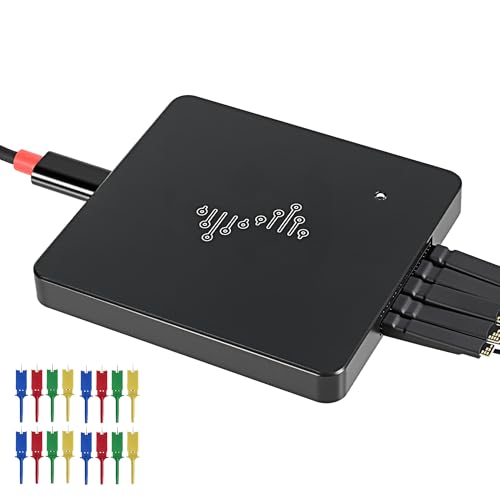
- 16 channels for broader digital debugging
- Stream and buffer modes for flexible captures
- Supports nearly 100 protocol decoders
Best For: Makers who need a higher-channel desktop logic analyzer for deeper protocol work
Portable Beginner Choice
MINIWARE Pocket Logic Analyzer LA104

- Handheld design with built-in color display
- Rechargeable battery for portable use
- Supports SPI, I2C, and UART
Best For: Beginners and hobbyists who want a handheld logic analyzer for quick digital troubleshooting
All-in-One Budget Tool

- Combines five bench tools in one device
- Open-source and cross-platform support
- Compact 20-gram design
Best For: Makers who want a compact all-in-one tool for simple digital testing and broader electronics experiments
Budget Starter Pick – HiLetgo 24MHz 8-Channel USB Logic Analyzer
If you’re looking for entry-level logic analyzers for makers, this HiLetgo unit covers the basics without a lot of extra cost or complexity. It offers 8 channels, up to 24MHz sampling, and support for common digital buses like UART, I2C, and SPI, which makes it a practical choice for simple embedded debugging.
Best For: Makers who want an affordable 8-channel analyzer for routine digital signal checks and common serial buses.
Pros:
- 8 channels with up to 24MHz sampling per channel
- Supports UART, I2C, and SPI debugging
- Wide input range from -0.5V to 5.25V
- Includes an EMI ferrite ring USB cable
Cons:
- Lower channel count than more advanced models
- Sample rate is modest for faster or denser captures
This is a straightforward pick when you mainly need a basic USB logic analyzer for common maker projects. It is best suited to routine digital troubleshooting rather than high-speed or deeply complex analysis.
Midrange Decoder Pick – LA1010 16-Channel 100MHz Logic Analyzer
Among logic analyzers for makers, the LA1010 stands out for balancing channel count, speed, and software support. With 16 inputs, 100MHz sampling, and included PC software for Windows, macOS, and Linux, it is aimed at makers who need broader protocol coverage and easier waveform inspection.
Best For: Makers who want a portable 16-channel analyzer with strong protocol decoding and cross-platform support.
Pros:
- 16 input channels with 100MHz sampling rate
- Supports 30+ protocol decoders including I2C, SPI, UART, and CAN
- Compatible with Windows, macOS, and Linux
- Portable design with included KingstVIS software
Cons:
- Uses USB 2.0, so it is not the fastest interface on paper
- More advanced than basic analyzers, which may be overkill for simple jobs
This model is a solid step up if you need more channels and more protocol visibility than a starter analyzer provides. For many embedded and communication debugging tasks, it offers a useful mix of capability and convenience.
Premium Saleae Pick – Saleae Logic 8 Black 8-Channel Analyzer
If you want a higher-end option in logic analyzers for makers, the Saleae Logic 8 focuses on speed, portability, and software flexibility. It provides 8 digital/analog inputs, digital sampling up to 100MS/s, analog sampling up to 10MS/s, and cross-platform support for Mac, Windows, and Linux.
Best For: Makers who need fast captures, analog and digital inputs, and broad software compatibility.
Pros:
- 8 multi-use digital/analog inputs
- Digital sample rate up to 100MS/s and analog up to 10MS/s
- Cross-platform support for Mac, Windows, and Linux
- Large sample capacity using PC memory
Cons:
- Only 8 inputs, so it is not the best fit for very wide buses
- Premium choice compared with basic USB analyzers
This is a strong choice when you care more about capture quality and workflow than about raw channel count. For many makers, its mix of speed, analog support, and software maturity makes it a dependable bench tool.
High-Speed Lab Pick – DSLogic Plus 16-Channel 400MHz Analyzer
For makers who push beyond basic tools, this DSLogic Plus is built for high-speed logic analyzer work. It offers 16 digital channels, dual capture modes, 400MHz buffer sampling, 256Mbits of on-board SDRAM, and DSView software with nearly a hundred protocol decoders.
Best For: Makers who need very high sample rates, deep capture options, and flexible protocol analysis.
Pros:
- 16 channels with up to 400MHz buffer-mode sampling
- Dual-mode capture for long stream captures or high-speed buffer captures
- 256Mbits on-board SDRAM memory
- DSView works with Windows, macOS, and Linux and supports many decoders
Cons:
- More specialized than basic maker-level analyzers
- High-performance features may be more than needed for simple bus checks
This model is the most capable option in this roundup when speed and capture depth matter. If your projects involve faster digital signals or longer traces, it gives you far more headroom than entry-level USB analyzers.
Premium Multi-Channel Pick – Saleae Logic Pro 8 for Serious Debugging
If you need logic analyzers for makers that can handle deeper debugging, the Saleae Logic Pro 8 is built for fast, flexible capture across digital and analog signals. Its 8 inputs, broad protocol decoding, and cross-platform support make it a strong choice for makers who want a polished tool for SPI, I2C, and more.
Best For: Makers who want a high-end, cross-platform analyzer for detailed digital and analog troubleshooting.
Pros:
- 8 digital/analog inputs for multi-use capture
- Digital sampling up to 500 MS/s and analog sampling up to 50 MS/s
- Decodes SPI, I2C, and 23+ additional analyzers
- Cross-platform support for Windows, Mac, and Linux
Cons:
- More advanced than a basic starter analyzer
- Best value depends on needing higher-speed capture and analog support
The Logic Pro 8 stands out when you want a compact, portable analyzer with serious capture capability and wide software compatibility. For makers who regularly work across multiple buses and want room to grow, it offers a very capable upgrade path.
Best Starter Kit – LONELY BINARY 8-Channel USB Logic Analyzer Kit
For makers looking for logic analyzers for makers that are easy to hook up and ready to use, this LONELY BINARY kit focuses on convenience. It captures 8 channels at up to 24MHz and adds breadboard-friendly adapters, multiple cable options, and a full accessory pack for Arduino, ESP32, and other DIY projects.
Best For: Hobbyists, students, and DIY builders who want a plug-and-play analyzer kit with lots of included accessories.
Pros:
- 8-channel capture up to 24MHz for common serial debugging
- Includes breadboard adapter and breakout board for easier connections
- Comes with USB-A and Type-C cables for broad compatibility
- Accessory kit includes test clips, alligator clips, jumper wires, and storage case
Cons:
- 24MHz is more modest than higher-end analyzers
- Geared more toward DIY and learning than heavy-duty lab use
This kit is appealing if you want a practical, out-of-the-box setup with the pieces needed to start debugging quickly. The included adapters and clip set make it especially handy for breadboards and embedded prototypes.
High-Speed Portable Pick – LA2016 16-Channel 200MHz Logic Analyzer
If your projects demand more channels and deeper capture, this LA2016 is one of the more capable logic analyzers for makers in the lineup. It offers 16-channel analysis, 200MHz sampling, and automatic decoding for more than 20 protocols, making it useful when you need a portable tool that can keep up with complex embedded work.
Best For: Makers and tinkerers who need high-speed 16-channel capture with broad protocol decoding.
Pros:
- 16-channel capture with 200MHz sampling
- 1Gbits deep memory for longer captures
- Automatically decodes 20+ protocols including I2C, SPI, UART, CAN, and JTAG
- Cross-platform support for Windows, Mac OS, and Linux
Cons:
- More complex than a simple entry-level tool
- Portable design is useful, but the feature set is aimed at advanced debugging
The LA2016 is the strongest fit when you want a portable analyzer with plenty of channels and software features to streamline troubleshooting. For makers dealing with multiple buses or timing-sensitive issues, it offers a very capable all-in-one option.
Pro-Grade Desktop Pick – USB Logic Analyzer, 16 Channels, 400MHz Sampling
If you want one of the more capable logic analyzers for makers, this DSLogic Plus is built for heavier digital debugging. It offers 16 channels, dual capture modes, and wide compatibility across Windows, macOS, and Linux, making it a strong fit when you need long captures, higher sample depth, and protocol decoding support.
Best For: Makers who need a higher-channel desktop logic analyzer for deeper protocol work and long captures.
Pros:
- 16 channels give you plenty of room for multi-signal debugging.
- Stream mode and buffer mode support both long-duration capture and high-speed storage.
- Up to 16G sample depth in stream mode and 256Mbits on-board SDRAM add flexibility.
- Supports nearly 100 protocol decoders and is open-source on Github.
Cons:
- It is a desktop USB tool, so it is not as portable as handheld options.
- Best suited to users who can take advantage of its more advanced feature set.
This is a practical choice when basic entry-level analyzers feel limiting. If your projects involve several digital lines at once, the combination of channel count, memory, and decoder support makes it a solid upgrade path.
Portable Beginner Choice – MINIWARE Pocket Logic Analyzer LA104
This pocket-size logic analyzer for makers is aimed at beginners who want something simple to carry and easy to use on the bench or in the field. The LA104 combines a built-in screen, rechargeable battery, and basic protocol support, so you can check digital signals without depending on a computer for every measurement.
Best For: Beginners and hobbyists who want a handheld logic analyzer for quick digital troubleshooting anywhere.
Pros:
- Compact handheld design with a 2.8-inch color display.
- Built-in rechargeable battery makes it easy to use away from a desk.
- 4 channels and up to 100Mhz sample rate cover entry-level testing.
- Supports SPI, I2C, and UART, plus waveform export to a computer.
Cons:
- Only 4 channels, so it is less suited to complex multi-signal projects.
- 8 MB storage is modest compared with larger desktop analyzers.
- Important charging warning during measurement may affect workflow.
For makers who value portability and a self-contained screen, this is a straightforward starter option. It is best when you want quick signal checks and basic serial decoding rather than a feature-heavy lab instrument.
All-in-One Budget Tool – EspoTek Labrador USB Analyzer
The EspoTek Labrador stands out among logic analyzers for makers because it combines several bench tools in one compact, open-source device. Along with logic analysis, it also functions as an oscilloscope, signal generator, power supply, and multimeter, which is useful when you want a versatile setup for general electronics work.
Best For: Makers who want a compact all-in-one tool for simple digital testing and broader electronics experiments.
Pros:
- Combines oscilloscope, waveform generator, power supply, logic analyzer, and multimeter functions.
- Open-source design with support for Windows, Mac, Linux, Android, and Raspberry Pi.
- Compact and lightweight at 20 grams.
- Includes serial decoding on the 2-channel logic analyzer function.
Cons:
- Only 2 logic analyzer channels, so it is not ideal for larger digital buses.
- Logic analyzer speed is limited to 3MSPS per channel.
- Power supply output is modest at 0.75W max.
This is a smart pick if you want maximum utility from a tiny device and can work within its limits. It is more of a multi-tool for makers than a dedicated high-end logic analyzer, but that versatility can be very convenient.
How We Picked the Best Logic Analyzers for Makers
We prioritized the features makers actually use: enough channels for common embedded buses, sampling headroom for reliable capture, usable PC or handheld software, and a form factor that fits hobby labs and small workspaces. We also favored models with broad protocol support and a clear value range, from budget USB units to higher-end desktop and portable options.
Quick Comparison: What Matters Most
At a glance, the main tradeoffs are channel count, sampling speed, memory depth, and software quality. Entry-level units are often fine for slower buses and simple debugging, while higher-end models are better for long captures, mixed-signal troubleshooting, and faster protocols. If you work across projects, portability and cross-platform support can matter as much as raw specs.
Key Buying Factors for Logic Analyzers for Makers
Channel Count
Choose the smallest channel count that still leaves room for expansion. Eight channels works well for many microcontroller tasks, but 16 channels is better if you are monitoring multiple buses or address lines at once.
Sampling Rate and Memory
Higher sampling rates help you see faster edges and avoid missing short events. Memory depth matters just as much for longer captures, especially when you need to observe intermittent bugs or full protocol exchanges.
Software and Protocol Support
Good software can be the difference between a useful capture and a frustrating one. Look for stable decoding tools, easy triggering, and reliable support for common interfaces such as UART, I2C, SPI, and CAN.
Portability and Workflow
USB analyzers are ideal for bench use, while handheld units are useful for field work or quick checks without a laptop dependency. Open-source and all-in-one tools can be attractive if you want flexibility beyond logic analysis.
Who Should Buy Which Logic Analyzers for Makers?
Beginners and budget-conscious hobbyists should look for simple USB models that cover the basics without a steep learning curve. Makers working on faster digital systems should prioritize higher sampling rates and deeper memory. If you value polished software and a streamlined workflow, premium branded analyzers are often worth the extra cost. For compact labs or mobile debugging, a handheld or hybrid tool may be the smartest choice.
In short, the best Logic Analyzers for Makers are the ones that match your signals, your software preferences, and your workflow—not just the highest spec sheet on paper.