
Light pollution filters can improve contrast on nebulae and other deep-sky targets, but the right choice depends on your refractor’s aperture, eyepiece size, and observing location.
We compare 10 popular 1.25-inch and 2-inch options, including UHC, CLS, broadband, and multi-narrowband designs, to help you choose with confidence.
Best 10 Light Pollution Filters for Refractor Telescopes Picks for 2026
Classic Urban Contrast
Celestron UHC/LPR 1.25" Filter
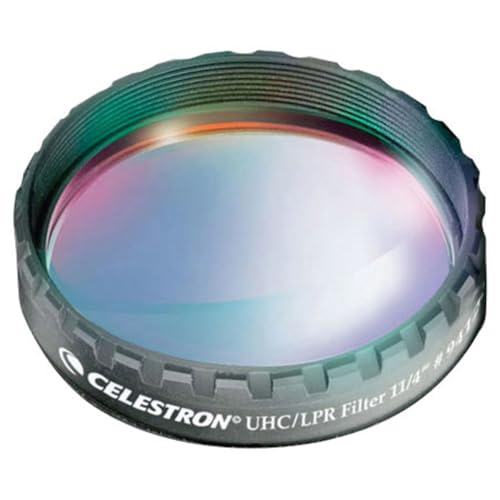
- Reduces selected artificial-light wavelengths
- Supports darker backgrounds and nebula contrast
- Multi-coated glass with a two-year limited warranty
Best For: Visual observing with 1.25-inch telescope accessories
Multi-Narrowband Imaging Pick
SVBONY SV240 1.25" Multi-Narrowband Filter
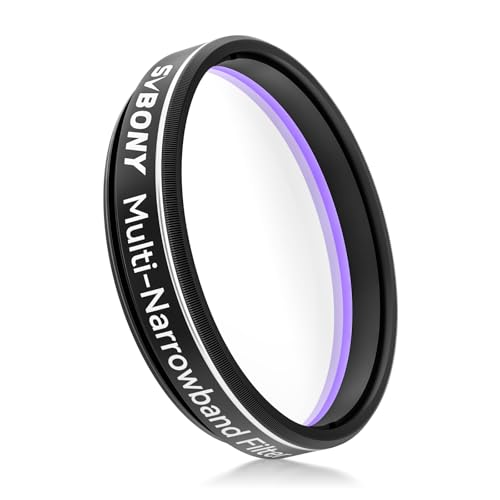
- Passes Ha, OIII, and H-beta emission lines
- Works with OSC cameras for full-color imaging
- Designed for Bortle 1–8 and moonlit conditions
Best For: Deep-sky astrophotography from urban or mixed-sky locations
Stackable UHC Value
FIBONAX Dawn01 1.25" UHC Filter
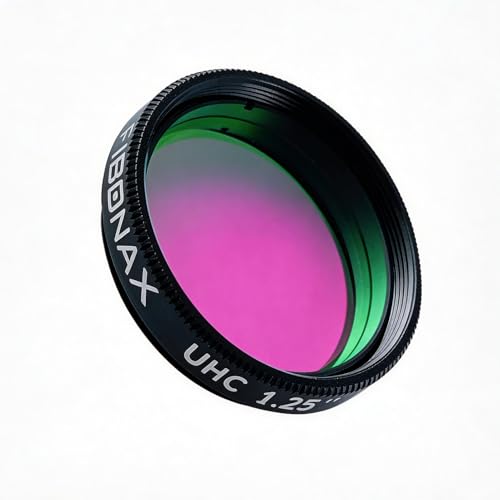
- Suppresses sodium and mercury streetlight glare
- Isolates H-beta and O-III emissions
- Offers dual threads and a storage case
Best For: Versatile urban observing and entry-level astrophotography
Broadband Imaging Specialist
SVBONY CLS 1.25" Light Pollution Filter
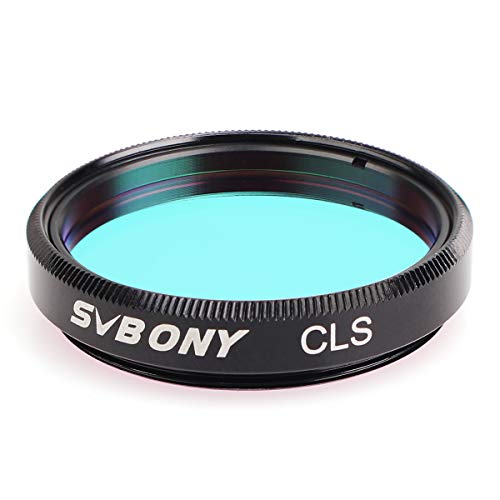
- Transmits major Ha, OIII, SII, and H-beta lines
- Suppresses listed sodium and mercury wavelengths
- Suitable for color CCDs and unmodified DSLRs
Best For: Broadband deep-sky imaging under urban skies
Best Overall
Astromania 2-Inch UHC Nebula Filter

- Reduces selected artificial-light wavelengths
- Enhances emission-nebula contrast
- Multicoated optical glass with 2-inch thread
Best For: 2-inch refractors and emission-nebula viewing
Best for Astrophotography
SVBONY SV260 2-Inch Multi-Bandpass Filter
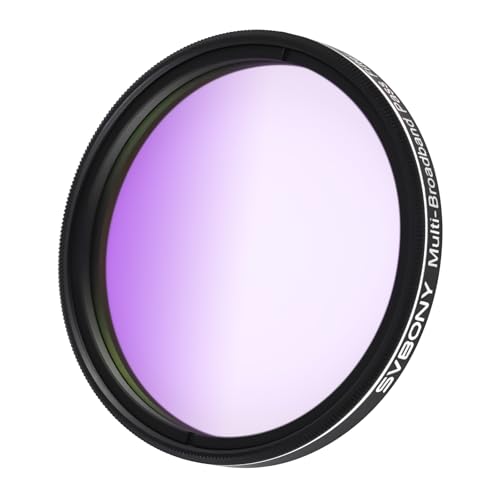
- Five-bandpass light-pollution design
- Over 90% stated peak transmittance
- M48 × 0.75 thread for 2-inch systems
Best For: Star-field and deep-sky astrophotography
Best Budget Fit
Astromania 1.25-Inch UHC Nebula Filter

- Fits standard 1.25-inch accessories
- Improves emission-nebula contrast
- Multicoated optical glass in an aluminum frame
Best For: 1.25-inch refractors and visual nebula observing
Urban Contrast Pick

- 90% transmission of key nebula wavelengths
- Designed to suppress specified artificial-light lines
- Works with visual use, color CCD, and unmodified DSLR cameras
Best For: 2-inch deep-sky observing and imaging in urban skies
Budget Nebula Choice
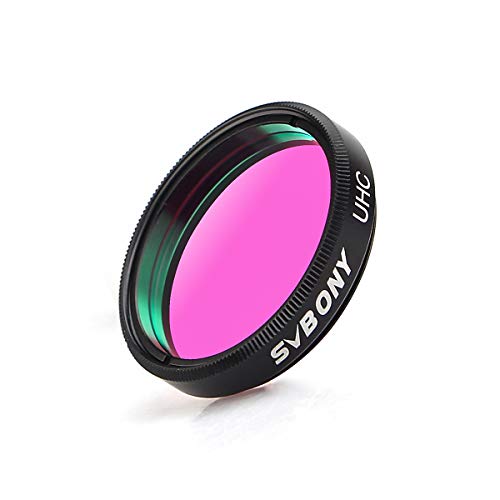
- Improves emission-nebula contrast against a darker sky
- Fits standard 1.25-inch eyepiece threads
- Suitable for observing and astrophotography
Best For: 1.25-inch refractor setups and general nebula viewing
Dedicated Vespera Option

- Designed specifically for the Vaonis Vespera
- 78 mm threading supports a precise fit
- Targets artificial light to improve deep-sky clarity
Best For: Vespera observing from light-polluted locations
Classic Urban Contrast – Celestron UHC/LPR 1.25" Filter
For observers comparing light pollution filters for refractor telescopes, the Celestron UHC/LPR filter is a straightforward visual-use option. Its 1.25-inch threaded format is designed to reduce selected artificial-light wavelengths while helping produce a darker sky background and stronger nebula contrast.
Best For: Visual observers using 1.25-inch telescope accessories in light-polluted areas.
Pros:
- Designed to selectively reduce wavelengths associated with artificial lighting.
- Promotes enhanced nebula contrast and a darker sky background.
- Multi-coated optical glass with high-transmission intent.
- Includes a two-year limited warranty.
Cons:
- Limited to 1.25-inch or 31.75mm threaded setups.
- Positioned primarily for visual use rather than specialized imaging.
- It is not water resistant.
This is a sensible, uncomplicated choice when your main goal is improving visual contrast on nebulae without moving to a more specialized narrowband imaging filter.
Multi-Narrowband Imaging Pick – SVBONY SV240 1.25" Multi-Narrowband Filter
The SVBONY SV240 is a more specialized option among light pollution filters for refractor telescopes, combining multiple narrowband passbands for deep-sky imaging and visual observation. It is designed to retain Ha, OIII, and H-beta signals while supporting full-color imaging with one-shot-color cameras.
Best For: Urban astrophotography with OSC cameras, plus observers targeting a broad range of deep-sky objects.
Pros:
- Passes key Ha, OIII, and H-beta emission lines.
- Designed for imaging under skies from Bortle 1 through Bortle 8.
- Supports full-color OSC imaging without combining separate filter exposures.
- NIR passband may enable imaging of targets that need infrared-capable filtering.
Cons:
- Its multi-narrowband design is more specialized than a basic broadband filter.
- The supplied specifications list camera compatibility rather than a broad range of visual accessories.
- It is not water resistant.
Choose the SV240 when imaging flexibility matters most, especially if you use an OSC camera and regularly work under bright city or moonlit conditions.
Stackable UHC Value – FIBONAX Dawn01 1.25" UHC Filter
The FIBONAX Dawn01 is a practical UHC-style choice for shoppers comparing light pollution filters for refractor telescopes. It targets sodium and mercury streetlight glare, isolates H-beta and O-III emissions, and uses dual M28.5×0.6 threads for stacking compatible filters.
Best For: Beginners and experienced observers who want a versatile 1.25-inch filter for urban nebula, lunar, and general imaging use.
Pros:
- Designed to suppress sodium and mercury streetlight glare.
- Isolates H-beta and O-III wavelengths for stronger nebula contrast.
- Claims light transmission above 90% with multi-coated optical glass.
- Includes a protective storage case and stackable dual threads.
Cons:
- Its UHC emphasis may be less suited to shoppers seeking a broad broadband filter.
- Stacking requires accessories with compatible M28.5×0.6 threads.
- The supplied notes do not specify a longer warranty than one year.
With its stackable frame and broad intended uses, the Dawn01 is a flexible pick for urban observers who want one compact filter for nebulae, lunar details, and selected imaging tasks.
Broadband Imaging Specialist – SVBONY CLS 1.25" Light Pollution Filter
The SVBONY CLS filter takes a broadband approach to light pollution filters for refractor telescopes, aiming to suppress common artificial-light lines while preserving major nebula emissions. It is explicitly suited to color CCD cameras and unmodified DSLRs, as well as deep-sky visual and photographic use.
Best For: Color-camera astrophotographers and urban observers seeking broadband light-pollution suppression.
Pros:
- Designed to transmit major nebula lines including Ha, OIII, SII, and H-beta.
- Targets sodium and mercury light-pollution wavelengths.
- Listed for use with color CCD cameras and unmodified DSLRs.
- Ion-assisted coating technology is intended to improve durability and scratch resistance.
Cons:
- It is a broadband CLS design rather than a multi-narrowband filter.
- Its camera compatibility focus may be less relevant to strictly visual users.
- It is not water resistant.
The CLS is a strong fit when you want to retain a wider range of deep-sky color information while reducing selected urban light sources during imaging.
Best Overall – Astromania 2-Inch UHC Nebula Filter
For observers comparing light pollution filters for refractor telescopes, this 2-inch Astromania UHC filter is a practical choice for improving contrast on emission nebulae. Its optical glass, multicoated lens, and standard 2-inch thread suit refractors with compatible 2-inch focusers.
Best For: Viewing emission nebulae such as Orion, Lagoon, and Swan from suburban skies or enhancing their contrast at dark-sky sites.
Pros:
- Designed to reduce selected wavelengths associated with artificial light.
- Can reveal faint nebular details that may be difficult to see without filtration.
- Multicoated optical glass and an aluminum frame support sharp, clear views.
- Compatible with 2-inch eyepieces and other 2-inch telescope accessories.
Cons:
- Requires a 2-inch focuser or accessory thread.
- Its primary benefit is on emission nebulae rather than every type of deep-sky target.
This is a versatile UHC option for refractor users who want one filter for city, suburban, and dark-sky nebula observing, provided their setup accepts 2-inch accessories.
Best for Astrophotography – SVBONY SV260 2-Inch Multi-Bandpass Filter
The SVBONY SV260 is aimed at photographers seeking light pollution filters for refractor telescopes and astrophotography systems. Its five-bandpass design, stated peak transmittance above 90%, and 300–1000 nm working range are intended to suppress unwanted light while retaining multiple wavelength bands.
Best For: Star-field, galaxy, and reflection-nebula photography with compatible 2-inch astrophotography equipment.
Pros:
- Five-bandpass design targets light-pollution suppression across a broad wavelength range.
- Over 90% stated peak transmittance is designed to minimize light loss.
- OD4 cut-off depth supports stronger blocking of unwanted light.
- M48 × 0.75 thread and 44 mm clear aperture suit compatible 2-inch systems.
Cons:
- Its compatibility is specified around 2-inch astrophotography systems, so adapters may be needed for other setups.
- Designed primarily for imaging rather than simple visual observing.
Choose this filter when retaining color and capturing broadband celestial subjects are priorities. Verify the M48 thread and your camera or adapter configuration before buying.
Best Budget Fit – Astromania 1.25-Inch UHC Nebula Filter
This 1.25-inch Astromania UHC filter is a straightforward option for observers evaluating light pollution filters for refractor telescopes with smaller eyepiece fittings. It selectively reduces some artificial-light wavelengths and is designed to increase contrast on emission nebulae.
Best For: Refractors with 1.25-inch focusers used for visual observation of Orion, Lagoon, Swan, and other emission nebulae.
Pros:
- 1.25-inch thread fits compatible eyepieces and telescope accessories.
- Designed to improve nebular contrast in city, suburban, and dark-sky locations.
- Can bring out faint emission-nebula details that are less apparent without filtration.
- Multicoated optical glass and an aluminum frame support clear views.
Cons:
- Not suitable for setups that require 2-inch filters without an appropriate adapter.
- Most useful for emission nebulae rather than all celestial objects.
For a 1.25-inch refractor setup, this UHC filter offers a compact way to test the benefits of nebula filtration without moving to a larger filter format.
Urban Contrast Pick – SVBONY 2-Inch CLS Filter
For observers comparing light pollution filters for refractor telescopes, this 2-inch SVBONY CLS filter is designed to reduce artificial-light wavelengths while preserving key nebula emissions. Its broad compatibility makes it suitable for visual observing, color CCD cameras, and unmodified DSLR cameras.
Best For: Deep-sky viewing and imaging from urban or suburban locations with 2-inch filter compatibility.
Pros:
- Rated for 90% transmission of major nebula lines, including H-alpha, OIII, SII, and H-beta.
- Claims 0.1% transmission of specified sodium and mercury pollution lines.
- Ion-assisted deposition coating is designed for durability and scratch resistance.
- Coating stability is designed to resist central-wavelength shifts caused by temperature changes.
Cons:
- Requires a 2-inch accessory or compatible 48.5 mm thread.
- It is not water resistant.
This is a feature-rich CLS option when you need a larger-format filter for both visual use and camera-based deep-sky work. Check your refractor’s accessory size before buying.
Budget Nebula Choice – SVBONY 1.25-Inch UHC Filter
This 1.25-inch SVBONY UHC filter is a practical choice among light pollution filters for refractor telescopes, selectively reducing certain artificial-light wavelengths to darken the sky background. It is intended to improve emission-nebula contrast from city, suburban, and even darker observing sites.
Best For: Refractor owners using 1.25-inch eyepieces who want a general-purpose nebula filter for visual observation and astrophotography.
Pros:
- Designed to reduce selected artificial-light wavelengths and improve nebula contrast.
- Suitable for both celestial observation and astrophotography.
- Standard 1.25-inch filter thread fits compatible eyepieces and accessories.
- Uses an optical glass lens with an aluminum frame and multi-coating.
Cons:
- Limited to 1.25-inch accessories rather than 2-inch setups.
- It is not water resistant.
With its standard 1.25-inch format and straightforward UHC design, this filter is an accessible way to boost emission-nebula contrast. Confirm that your eyepiece or diagonal accepts 1.25-inch filters.
Dedicated Vespera Option – Vaonis Light Pollution Filter
Owners of a Vaonis Vespera telescope need a purpose-built accessory, and this filter is designed specifically for that system. Among light pollution filters for refractor telescopes, it stands out for its dedicated 78 mm fit and focus on improving clarity and contrast around artificial light.
Best For: Vespera users observing or capturing faint deep-sky objects from light-polluted locations.
Pros:
- Designed specifically for the Vespera telescope and AC023 system.
- 78 mm threads are intended to provide a secure, precise fit.
- Designed to reduce unwanted artificial light and reveal more detail in faint deep-sky objects.
- Glass-and-plastic construction is built for regular use.
Cons:
- Compatibility is limited to the Vaonis Vespera.
- The supplied details list no coating.
- It is not water resistant.
This is the most straightforward choice for Vespera owners who want a correctly sized, integrated light-pollution accessory. It is less suitable for conventional refractors or universal filter systems.
How We Picked the Best Light Pollution Filters for Refractor Telescopes
We focused on filters suited to visual observing with refractor telescopes and compared their intended use, optical format, filter category, and compatibility. The lineup includes broadband CLS and LPR filters for modest contrast improvement, plus UHC and multi-narrowband models designed to emphasize emission nebulae. We also included both 1.25-inch and 2-inch options because the filter size must match your accessories or be used with a suitable adapter.
Filter performance varies with local sky conditions, telescope aperture, target type, and the brightness and color of nearby lighting. These products are best viewed as contrast-enhancing accessories, not replacements for dark skies.
Quick Comparison
| Filter type | Best for | Typical strengths | Watch for |
|---|---|---|---|
| UHC or multi-narrowband | Emission nebulae | Strong contrast on suitable nebulae | Dimmer stars and less useful on galaxies |
| CLS or broadband | General suburban observing | Moderate contrast with a broader view | Limited benefit under severe light pollution |
| LPR | General light-pollution reduction | Versatile visual use | Results depend heavily on lighting sources |
Key Buying Factors for Light Pollution Filters for Refractor Telescopes
Filter Type and Target
Choose a UHC or multi-narrowband filter if emission nebulae are your priority. A CLS or broadband filter is generally more flexible for casual observing, but it usually produces a subtler improvement. Neither type can restore detail lost to heavy skyglow on every target; galaxies, star clusters, and planets often need different observing strategies.
Thread Size and Optical Path
A 1.25-inch filter fits a standard 1.25-inch eyepiece or diagonal filter thread. A 2-inch filter is intended for 2-inch eyepieces, diagonals, or accessories. If you use both formats, consider where the filter will be installed and whether an adapter could introduce vignetting or prevent convenient use.
Refractor Compatibility
Most standard threaded visual filters work with refractors when the eyepiece and diagonal use matching threads. Confirm the product’s thread specification, especially with proprietary systems such as smart telescopes. The Vaonis option is aimed at Vespera users and should not be assumed to fit conventional eyepiece setups.
Observing Conditions and Transmission
Very narrow filters can make the view darker, particularly through smaller refractors or at higher magnification. Use low to moderate magnification first, allow your eyes to adapt, and compare filtered and unfiltered views. A filter that excels on a bright emission nebula may be disappointing on stars or broadband objects.
Who Should Buy Which Light Pollution Filters for Refractor Telescopes?
- For emission-nebula specialists: Choose a UHC or multi-narrowband model, preferably in the size matching your most-used low-power eyepiece.
- For suburban observers wanting versatility: A CLS or broadband LPR filter offers a gentler, more general-purpose approach.
- For 2-inch observing setups: Select a 2-inch filter to avoid repeatedly moving a 1.25-inch filter between eyepieces.
- For compact smart telescopes: Buy only a filter specifically listed as compatible with your telescope model and mounting system.
- For the darkest skies: A filter may add selective contrast, but investing in travel to darker locations can provide a larger overall improvement.