
Choosing among the best light pollution filters for deep-sky imaging depends on more than the amount of nearby city glow. Your camera’s color response, telescope, target type, and ability to capture narrowband data all affect which filter will produce the cleanest result.
This roundup compares 10 popular broadband, UHC, multi-bandpass, and dual-narrowband filters so you can match the filter’s passband and size to your imaging setup.
Best 10 Light Pollution Filters for Deep Sky Imaging Picks for 2026
Balanced Broadband Control

- Multi-bandpass design targets artificial-light wavelengths.
- About 90% transmission at major nebula lines.
- 2-inch cell with anti-reflection coating.
Best For: General-purpose astrophotography under light-polluted skies
Urban Nebula Specialist

- 7nm H-alpha and O-III dual-band design.
- Targets moonlight and artificial light pollution.
- Made for one-shot color deep-sky imaging.
Best For: Emission-nebula imaging from cities or under moonlight
Simple Visual Contrast Upgrade
- Reduces selected artificial-light wavelengths.
- Designed for darker backgrounds and nebula contrast.
- 1.25-inch multi-coated optical glass filter.
Best For: Visual observing and compatible 1.25-inch camera setups
Dedicated OSC Narrowband Choice

- 7nm dual narrowband H-alpha and O-III filter.
- Designed for bright skies and moonlit conditions.
- Suited to one-shot color emission-nebula imaging.
Best For: OSC emission-nebula photography under severe skyglow
Urban CLS Value Pick
- 90% transmission of major nebula emission lines
- Suppresses common sodium and mercury lighting
- Compatible with color CCD cameras and unmodified DSLRs
Best For: Urban 1.25-inch deep-sky imaging
Advanced Color-Camera Choice

- Quad-band design passes key nebula emission lines
- OD2–OD4 cutoff depth targets light pollution
- Near-IR cutoff to 1000 nm helps reduce IR noise
Best For: 2-inch color-camera astrophotography
Wide-Coverage Starfield Option
- Five-bandpass design with over 90% peak transmittance
- OD4 cutoff depth for stronger light-pollution suppression
- Works across a 300–1000 nm wavelength range
Best For: 2-inch star-field, galaxy, and reflection-nebula imaging
Best Value UHC
Astromania 1.25-Inch UHC Nebula Filter

- Boosts emission-nebula contrast
- Fits standard 1.25-inch accessories
- Useful from city to dark-sky sites
Best For: Affordable nebula viewing and imaging
Best for OSC Astrophotography
SVBONY SV240 Multi-Narrowband Filter
- Passes Ha, OIII, and H-beta lines
- Works with one-shot-color cameras
- Designed for urban and moonlit imaging
Best For: Advanced OSC deep-sky astrophotography
Best Budget UHC
SVBONY 1.25-Inch UHC Telescope Filter
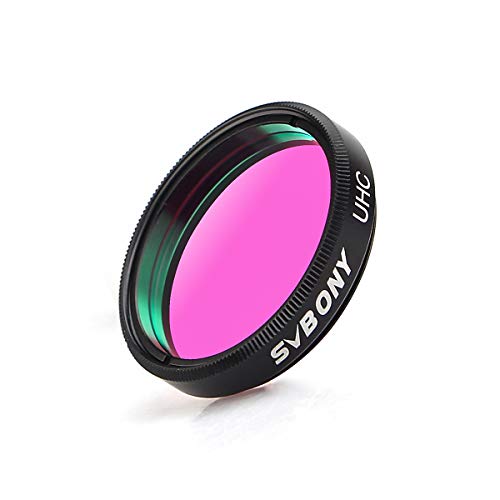
- Improves emission-nebula contrast
- Supports viewing and astrophotography
- Uses standard 1.25-inch threading
Best For: Affordable urban nebula observation and imaging
Balanced Broadband Control – Optolong 2" L-Pro
The Optolong L-Pro is a practical starting point for photographers comparing light pollution filters for deep sky imaging. Its multi-bandpass design targets common artificial-light emission lines while maintaining high transmission at major nebula emission lines, making it suited to broader astrophotography setups.
Best For: Deep-sky photographers who want balanced light-pollution reduction with a 2-inch threaded filter.
Pros:
- Multi-bandpass design reduces selected light-pollution wavelengths.
- Approximately 90% transmission at major nebula emission lines.
- Multi-layer anti-reflection coating and a black anodized CNC-machined cell help limit reflections.
Cons:
- Its broader multi-bandpass approach is less selective than a 7nm dual-band nebula filter.
- Requires a compatible 2-inch or 48mm setup.
- The filter is not water resistant.
The L-Pro offers a versatile middle ground: more general-purpose than a narrowband filter, but still designed to improve control over urban skyglow. Check your camera, lens, or telescope thread size before choosing it.
Urban Nebula Specialist – SVBONY SV220 7nm Dual-Band
The SVBONY SV220 is a focused option for shoppers seeking light pollution filters for deep sky imaging with a one-shot color camera. Its 7nm dual-band H-alpha and O-III design is intended to suppress moonlight and artificial skyglow while increasing nebula-to-background contrast.
Best For: One-shot color camera users imaging emission and planetary nebulae from bright cities or under a full moon.
Pros:
- 7nm dual-band design passes H-alpha and O-III wavelengths.
- Designed for high-contrast deep-sky photography in strong light pollution.
- Can simplify post-processing compared with using multiple separate filters.
Cons:
- Its narrowband focus is primarily suited to emission and planetary nebulae.
- The supplied model uses a 1.25-inch, 31.75mm thread.
- Increasing contrast does not make the nebula intrinsically brighter.
For OSC astrophotographers facing severe skyglow, the SV220 prioritizes selective nebula contrast over broad-spectrum versatility. Confirm that your camera and filter holder accept a 1.25-inch filter.
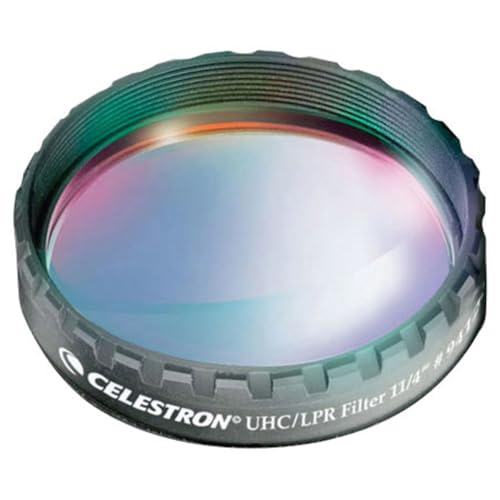
Simple Visual Contrast Upgrade – Celestron UHC/LPR 1.25"
The Celestron UHC/LPR is a straightforward choice among light pollution filters for deep sky imaging, especially when a 1.25-inch accessory must also support visual observing. It selectively reduces wavelengths associated with artificial lighting to produce a darker sky background and improved nebula contrast.
Best For: Telescope users who want a 1.25-inch LPR filter for visual use and compatible camera setups.
Pros:
- Designed to reduce selected artificial-light wavelengths.
- Supports enhanced nebula contrast and a darker sky background.
- Multi-coated optical glass offers high-transmission optical coating.
Cons:
- It is a broader LPR/UHC filter rather than a highly selective 7nm dual-band filter.
- Limited to 1.25-inch or 31.75mm threaded compatibility.
- Not water resistant.
This Celestron is a sensible entry-level-style option when visual observing matters as much as imaging. It is best matched with equipment that already uses the common 1.25-inch format.
Dedicated OSC Narrowband Choice – Optolong L-Extreme 7nm
The Optolong L-Extreme is built for photographers comparing light pollution filters for deep sky imaging with one-shot color cameras. Its 7nm dual narrowband design isolates H-alpha and O-III emission, allowing emission-nebula imaging in bright artificial light or moonlit conditions.
Best For: DSLR, CCD, and CMOS users with one-shot color cameras who primarily photograph emission nebulae.
Pros:
- Combines H-alpha and O-III transmission in one 7nm dual narrowband filter.
- Designed for bright man-made light pollution and moonlit conditions.
- Enables color imaging without combining images from multiple filters.
Cons:
- Its narrowband design is most useful for emission nebulae, not general broadband targets.
- Requires a compatible 2-inch or approximately 48mm setup.
- Not water resistant.
The L-Extreme is the more specialized choice here for OSC emission-nebula work under difficult skies. Its 2-inch format and narrowband purpose make compatibility and target selection important before buying.
Urban CLS Value Pick – SVBONY CLS 1.25-inch Filter
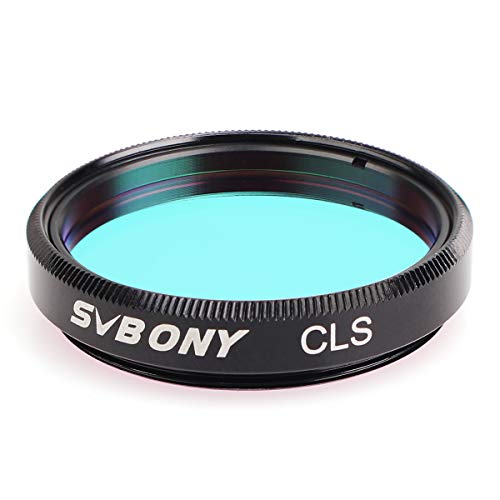
For photographers comparing light pollution filters for deep sky imaging, this 1.25-inch SVBONY CLS filter is a practical broadband option for urban setups. It is designed to reduce common artificial-light wavelengths while maintaining strong transmission of major nebula emission lines, making it suitable for color CCD cameras and unmodified DSLRs.
Best For: Urban deep-sky imaging with 1.25-inch equipment, color CCD cameras, or unmodified DSLRs.
Pros:
- Transmits 90% of key nebula emission lines, including H-alpha, OIII, SII, and H-beta.
- Targets major artificial-light pollution lines from sodium and mercury lighting.
- Ion-assisted deposition coating is designed for durability, scratch resistance, and wavelength stability.
- Includes a 1-year warranty and 30-day no-reason return policy from SVBONY.
Cons:
- Limited to 1.25-inch filter threads and a 28.5 mm thread size.
- Designed for broadband suppression rather than the narrower selectivity of a dedicated narrowband filter.
- Not water resistant.
This SVBONY CLS filter is a sensible entry-level choice when you need broadband light-pollution reduction in a compact 1.25-inch imaging system. Its compatibility with unmodified cameras and emphasis on nebula-line transmission make it especially useful for city and suburban shooting.
Advanced Color-Camera Choice – Optolong L-Quad Enhance
New Optolong Filter 2-inch L-Quad Enhance Filer Professional L-Quad Enhance Filter (L-QEF)
Check Price On AmazonAmong light pollution filters for deep sky imaging, the Optolong L-Quad Enhance is aimed at color-camera users who want stronger suppression and more controlled spectral coverage. Its quad-band design passes key nebula lines while addressing artificial lighting, natural skylow effects, starbursts, and near-infrared noise.
Best For: Color-camera astrophotography systems using a 2-inch filter with targets ranging from Bortle 1 through Bortle 7 skies.
Pros:
- Provides more than 90% transmission at H-beta, OIII, H-alpha, and SII nebula emission lines.
- Uses cutoff depths from OD2 to OD4 to improve resistance to light pollution.
- Near-IR cutoff extends to 1000 nm, helping reduce infrared noise effects.
- Designed to improve contrast, detail, color saturation, and signal-to-noise ratio.
Cons:
- Its 2-inch format requires compatible filter threads or accessories.
- Specified for color cameras, so it may not be the most broadly applicable option for every imaging setup.
- The supplied listing information does not specify a warranty period.
The L-Quad Enhance is the more feature-focused option here for color astrophotographers seeking robust suppression across a wide range of sky brightness. Its strong nebula-line transmission and near-IR control make it a compelling fit for a carefully matched 2-inch system.
Wide-Coverage Starfield Option – SVBONY SV260 2-inch Filter
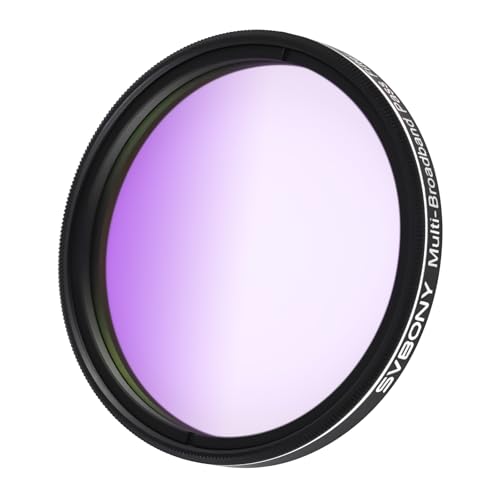
This SVBONY SV260 is a 2-inch multi-bandpass option for photographers evaluating light pollution filters for deep sky imaging across star fields, galaxies, and reflection nebulae. It combines five transmission bands with over 90% peak transmittance and OD4 cutoff depth to balance color retention with stronger suppression of unwanted light.
Best For: 2-inch star-field, galaxy, and reflection-nebula imaging in systems using an M48 × 0.75 filter thread.
Pros:
- Five-bandpass design provides over 90% peak transmittance and minimizes light loss.
- OD4 cutoff depth offers stronger suppression of unwanted light pollution.
- 300–1000 nm working range supports broad wavelength coverage and color reproduction.
- Includes a plastic storage box and is compatible with specified SVBONY astrophotography systems.
Cons:
- Requires a 2-inch, M48 × 0.75-compatible setup.
- Listed compatibility is centered on selected SVBONY systems, including the SV209, SV550, SV226, and SV405CC.
- Not water resistant.
The SV260 stands out when broad coverage and stronger cutoff performance matter more than a compact filter format. Its specifications make it a versatile choice for colorful star-field and deep-sky subjects, provided your imaging train supports the 2-inch M48 thread.
Best Value UHC – Astromania 1.25-Inch UHC Nebula Filter
For observers and beginners exploring light pollution filters for deep sky imaging, this 1.25-inch UHC filter is a practical option for increasing contrast on emission nebulae. Its optical glass lens, multicoating, and standard 1.25-inch thread make it compatible with many refractors, reflectors, and catadioptric telescopes.
Best For: City, suburban, and dark-sky viewing or imaging of emission nebulae such as Orion, Lagoon, and Swan.
Pros:
- Reduces selected artificial-light wavelengths to darken the sky background.
- Can reveal faint nebular detail and boost contrast at both urban and dark-sky sites.
- Uses an optical glass lens, aluminum frame, and multicoated surface.
- Includes a sturdy transparent case and fits standard 1.25-inch accessories.
Cons:
- Designed for 1.25-inch eyepieces and accessories, so it is not a 2-inch filter.
- Its UHC design is especially suited to emission nebulae rather than every type of deep-sky target.
This is a versatile, straightforward UHC choice for improving nebula contrast without moving beyond a common 1.25-inch accessory format.
Best for OSC Astrophotography – SVBONY SV240 Multi-Narrowband Filter
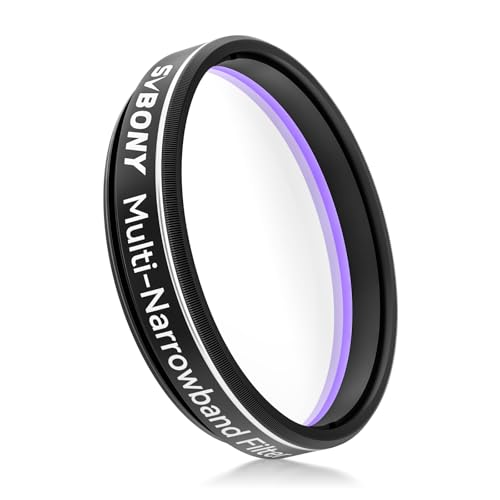
For more advanced light pollution filters for deep sky imaging, the SV240 uses a multi-narrowband design aimed at one-shot-color astrophotography. It passes key Ha, OIII, and H-beta emission lines, while its NIR passband is intended for deep-sky imaging with infrared-capable equipment.
Best For: One-shot-color cameras imaging nebulae and other deep-sky targets under heavily light-polluted or moonlit skies.
Pros:
- Supports full-color imaging with OSC cameras without requiring multiple filters.
- Passes Ha, OIII, and H-beta wavelengths to improve signal-to-noise ratio and contrast.
- Designed for use across skies from Bortle 1 through Bortle 8.
- Includes a plastic storage box and a standard 1.25-inch filter format.
Cons:
- The NIR passband is useful only with infrared-capable imaging equipment.
- It is not water resistant.
- Its multi-narrowband design may be more specialized than a basic visual UHC filter.
The SV240 is the most imaging-focused option here, particularly for OSC users who want a single filter designed for difficult urban or moonlit conditions.
Best Budget UHC – SVBONY 1.25-Inch UHC Telescope Filter
This SVBONY UHC filter is a simple entry point for shoppers comparing light pollution filters for deep sky imaging and visual observation. Its optical glass lens and aluminum frame selectively reduce artificial-light wavelengths, helping darken the background and improve emission-nebula contrast.
Best For: Budget-conscious telescope users who want a general-purpose 1.25-inch UHC filter for city or suburban nebula viewing and astrophotography.
Pros:
- Designed to reduce selected wavelengths associated with artificial light.
- Improves contrast and darkens the sky background around emission nebulae.
- Works for both celestial observation and astrophotography.
- Uses a standard 1.25-inch barrel with a multicoated optical glass lens.
Cons:
- Best suited to emission nebulae rather than all deep-sky objects.
- Only fits 1.25-inch eyepieces and accessories.
- Not water resistant.
With its familiar UHC format and broad telescope compatibility, this filter is a sensible low-cost way to begin experimenting with nebula contrast under light-polluted skies.
How We Picked the Best Light Pollution Filters for Deep Sky Imaging
We selected filters across the main categories used by amateur astrophotographers: broadband light-pollution reduction, CLS, UHC, multi-bandpass, and dual-narrowband H-alpha/O-III models. We considered optical purpose, advertised passband, available size, compatibility with common telescope accessories, and suitability for emission nebulae, star fields, and general deep-sky imaging.
Because filter performance depends heavily on the camera and sky conditions, this list is intended as a practical starting point rather than a universal ranking. A filter that works well with a color camera under suburban skies may be a poor choice for a monochrome setup or a dark-sky location.
Quick Comparison
- Broadband and LPR: Optolong L-Pro and Celestron UHC/LPR options aim to preserve a relatively natural star-field appearance while reducing some artificial sky glow.
- CLS and UHC: SVBONY CLS and the Astromania and SVBONY UHC filters emphasize contrast, particularly for brighter emission nebulae.
- Dual-narrowband: The SVBONY SV220 and Optolong L-eXtreme target H-alpha and O-III emission, making them stronger choices for emission nebulae with compatible color cameras.
- Multi-bandpass: The Optolong L-Quad Enhance, SVBONY SV260, and SV240 offer more specialized band selection for users seeking a balance between emission detail and broader star-field rendering.
Key Buying Factors
Target Type
Dual-narrowband filters are generally most useful for emission nebulae because they isolate H-alpha and O-III wavelengths. Broadband, CLS, and moderate UHC filters are more versatile for mixed targets, open clusters, and situations where retaining natural star color matters.
Camera Compatibility
Check whether your camera is color, monochrome, or modified for enhanced red sensitivity. Narrowband filters can produce strong results with one-shot color cameras, but they may require longer exposures and careful white-balance and color calibration. Verify that your camera, filter drawer, wheel, and telescope do not introduce vignetting.
Filter Size and Mounting
Choose 1.25-inch filters for compatible smaller imaging trains and 2-inch filters when using larger sensors, wide-field optics, or a 2-inch filter drawer. Confirm thread standards and available clearance before ordering.
Passband and Exposure Needs
Narrower passbands usually reject more unwanted light but demand more accurate guiding, longer exposures, and stronger calibration. Very aggressive filtration can also reduce star brightness and make framing or focusing more difficult.
Who Should Buy Which Light Pollution Filters for Deep Sky Imaging?
Choose a broadband or LPR filter if you want a flexible option for suburban imaging and relatively natural-looking stars. Choose a CLS or UHC filter if your priority is improving nebula contrast with a simple, affordable setup. Choose a dual-narrowband model if you primarily photograph emission nebulae from light-polluted skies and use a compatible color camera. Choose a multi-bandpass filter if you want a compromise between selective emission capture and broader target versatility.
Before buying, compare the manufacturer’s transmission curve with your camera’s sensitivity, then confirm the physical size and optical spacing of your imaging train. Even the best light pollution filters for deep-sky imaging cannot replace accurate calibration, good focus, dithering, and as-dark-as-possible skies.