
Artificial skyglow can wash out faint nebulae, reduce star-field contrast, and make astrophotography more difficult even when your focus and exposure settings are right. The best light pollution filters for astrophotography selectively reduce portions of the visible spectrum while preserving useful starlight and deep-sky detail.
This roundup compares broadband, UHC, dual-narrowband, multi-bandpass, and camera-mounted options so you can match the filter to your telescope, camera, target, and observing conditions.
Best 10 Light Pollution Filters for Astrophotography Picks for 2026
Budget Broadband Pick
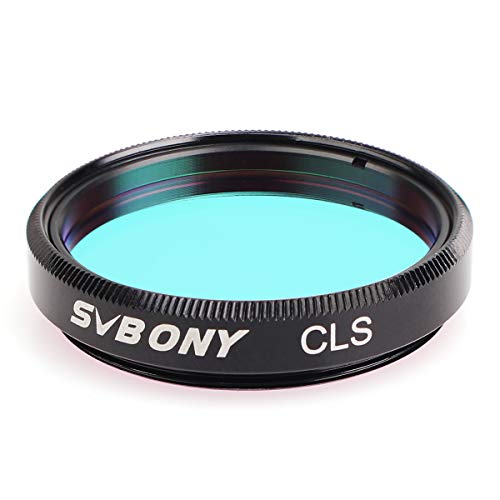
- 90% transmission of key nebula lines
- Targets listed sodium and mercury wavelengths
- Compatible with color CCDs and unmodified DSLRs
Best For: Urban deep-sky imaging with color cameras
One-Shot Color Choice
Optolong L-eXtreme 7nm Dual Narrowband

- Dual 7nm H-alpha and O-III bands
- Designed for bright light and moonlit conditions
- Avoids combining images from multiple filters
Best For: One-shot color emission-nebula imaging
Visual Observation Pick
Celestron UHC/LPR 1.25-Inch Filter
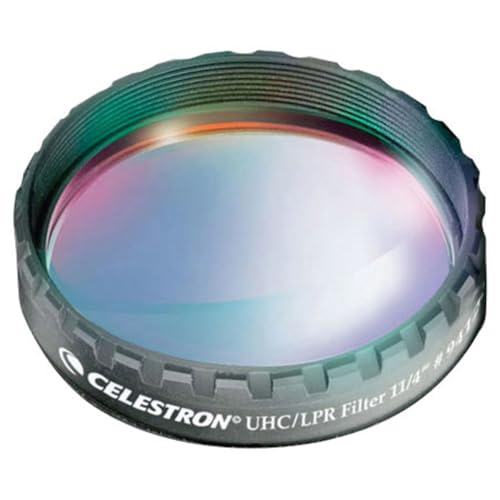
- Reduces selected artificial-light wavelengths
- Designed for nebula contrast and darker backgrounds
- Backed by a 2-year limited warranty
Best For: Visual telescope observing with 1.25-inch equipment
City Imaging Value
SVBONY SV220 7nm Dual-Band Filter

- 7nm dual-band H-alpha and O-III design
- Targets moonlight and artificial-light interference
- Supports high-contrast urban deep-sky imaging
Best For: Emission-nebula imaging with compatible color cameras
Urban Sky Clarity
Walking Way Natural Night Filter

- Reduces urban light sources and haze
- Neodymium glass with 28-layer coating
- For compatible 72mm camera lenses
Best For: Urban astrophotography and night cityscapes with 72mm lenses
Nebula Contrast Pick
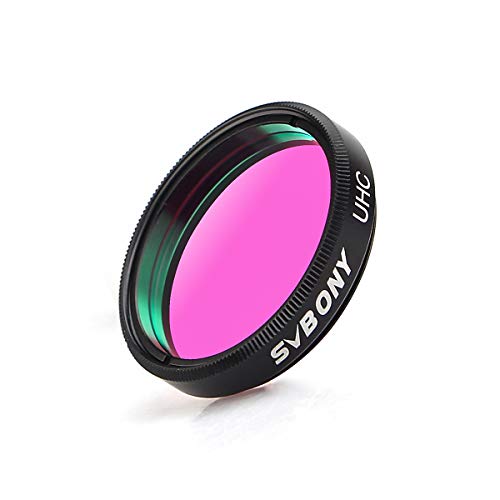
- Selective reduction of artificial-light wavelengths
- Improves emission-nebula contrast
- Fits compatible 1.25-inch telescope accessories
Best For: Telescope nebula viewing and astrophotography
Low-Profile Lens Choice
K&F CONCEPT Natural Night Filter

- Reduces light pollution for clearer night skies
- Ultra-slim frame helps limit vignetting
- 28-layer coatings and no-color-cast glass
Best For: 67mm camera lenses used for night-sky photography
Best for Canon RF Cameras

- RF-mount compatibility for select Canon EOS R cameras
- About 90% transmission at major nebula lines
- Metal frame with multi-layer anti-reflection coating
Best For: Canon EOS R-series astrophotography with RF-mount lenses
Best for OSC City Imaging
SVBONY SV240 Multi-Narrowband Filter
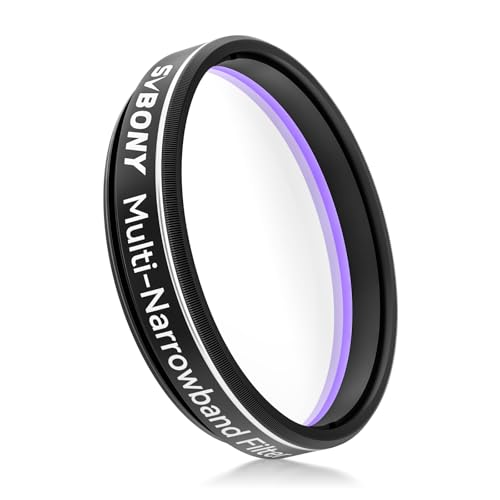
- 1.25-inch format for compatible telescope setups
- Passes Ha, OIII, and H-Beta emission lines
- Designed for OSC imaging in Bortle 1–8 skies
Best For: One-Shot Color deep-sky imaging in urban or moonlit conditions
Best for Wide Star Fields
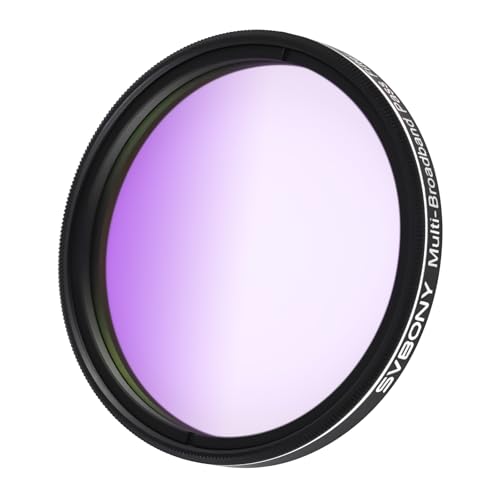
- 2-inch M48 threaded format with 44mm clear aperture
- Over 90% peak transmittance
- OD4 cut-off depth for light-pollution suppression
Best For: Star-field, galaxy, and reflection-nebula imaging with 2-inch systems
Budget Broadband Pick – SVBONY CLS 1.25-Inch Filter
For photographers comparing light pollution filters for astrophotography, this 1.25-inch SVBONY CLS filter is a practical broadband option for urban imaging. It is designed to suppress specified artificial-light wavelengths while maintaining high transmission through several major nebula emission lines.
Best For: Color CCD cameras and unmodified DSLR users photographing deep-sky targets from light-polluted locations.
Pros:
- Claims 90% transmission of key H-alpha, OIII, SII, and H-beta emission lines.
- Designed for very low transmission of listed sodium and mercury pollution lines.
- Ion-assisted deposition and planetary rotation coating processes support coating durability and uniformity.
- Uses a standard 1.25-inch format with a 28.5mm thread.
Cons:
- Broadband CLS filtering is less selective than a dual narrowband filter for emission nebula imaging.
- Its 1.25-inch format may not suit setups requiring a 2-inch filter.
- It is not water resistant.
This is a sensible entry-level choice when you want general light-pollution reduction without committing to a narrowband workflow. Its stated compatibility with color cameras and unmodified DSLRs makes it especially approachable for mixed visual and imaging setups.
One-Shot Color Choice – Optolong L-eXtreme 7nm Dual Narrowband
This Optolong L-eXtreme is a strong option among light pollution filters for astrophotography when your priority is emission-nebula imaging under city glow or moonlight. Its dual 7nm bands target H-alpha and O-III, allowing one-shot color cameras to capture both channels without combining separate filter exposures.
Best For: One-shot color DSLR, CCD, or CMOS camera users imaging emission nebulae in bright conditions.
Pros:
- Combines H-alpha and O-III transmission in a dual narrowband design.
- 7nm bandwidths are intended for imaging through man-made light pollution and moonlit conditions.
- Supports color imaging without requiring multiple filters to be combined.
- Compatible with 2-inch setups and listed DSLR, CCD, and CMOS cameras.
Cons:
- Its narrowband design is specifically most useful for emission nebulae, not all deep-sky subjects.
- The 2-inch format may require additional hardware for 1.25-inch systems.
- It is not water resistant.
Choose this model when selective dual-band capture matters more than broad, general-purpose filtering. It offers a streamlined route to color emission-nebula imaging for users working under challenging light or moon conditions.
Visual Observation Pick – Celestron UHC/LPR 1.25-Inch Filter
For telescope owners seeking light pollution filters for astrophotography and visual observing, the Celestron UHC/LPR filter provides a straightforward 1.25-inch solution. It selectively reduces wavelengths associated with artificial lighting and is intended to improve nebula contrast and darken the sky background.
Best For: Visual telescope use and cameras or telescopes with a standard 1.25-inch or 31.75mm thread.
Pros:
- Designed to reduce selected wavelengths produced by artificial lighting.
- Promotes enhanced nebula contrast and a darker sky background.
- Uses high-transmission optical coating.
- Includes a 2-year limited warranty.
Cons:
- The supplied information emphasizes visual use rather than specialized narrowband astrophotography.
- Its 1.25-inch format is not intended for 2-inch filter holders.
- It is not water resistant.
This is the most natural fit for observers who want a familiar UHC/LPR approach rather than a dedicated dual-band imaging filter. It can also suit compatible camera setups, but its stated strengths center on visual contrast and general light-pollution reduction.
City Imaging Value – SVBONY SV220 7nm Dual-Band Filter
The SVBONY SV220 is built for photographers evaluating light pollution filters for astrophotography in cities or under a bright moon. Its 7nm dual-band H-alpha/O-III design raises nebula-to-background contrast for deep-sky imaging while simplifying processing for compatible one-shot color cameras.
Best For: One-shot color and compatible astronomical camera users pursuing emission or planetary nebula imaging from strongly light-polluted locations.
Pros:
- Dual-band 7nm H-alpha and O-III design targets nebula imaging.
- Intended to reduce interference from moonlight and artificial lighting.
- Can enable high-contrast deep-sky photography in urban environments.
- Its dual-band workflow can reduce the complexity of combining multiple filters in post-processing.
Cons:
- It improves contrast rather than making the nebula intrinsically brighter.
- The supplied compatibility details focus on SVBONY electronic and astronomical cameras.
- Its 1.25-inch format may not fit 2-inch filter systems.
For city-based emission-nebula work, the SV220 offers a focused alternative to broadband filtering. Its narrow dual-band approach is particularly appealing when stronger background suppression and a simpler color-camera workflow are more important than all-purpose use.
Urban Sky Clarity – Walking Way Natural Night Filter
For photographers comparing light pollution filters for astrophotography, the Walking Way Natural Night Filter is a 72mm screw-on option designed to reduce the effect of streetlamps, neon signs, billboards, and urban haze. Its neodymium optical glass and multi-coating are aimed at preserving clear, vivid night-sky images.
Best For: Urban night photography, star trails, auroras, and celestial scenes captured with compatible 72mm lenses.
Pros:
- Designed to reduce urban light pollution and improve night-sky contrast.
- Neodymium optical glass is specified to provide high light transmission without chromatic aberration.
- 28 layers of anti-reflective, water-repellent, scratch-resistant, and oil-proof coatings.
- Includes a protective case for storage.
Cons:
- Compatible with 72mm filter-thread lenses only; the listing also references confirming the lens marking before purchase.
- Its screw-on design may require checking thread compatibility before use.
This is a practical choice when your astrophotography setup uses a 72mm lens and you want a coated glass filter for urban sky and cityscape work. Confirm the filter thread size carefully, since it is not a universal telescope or camera filter.
Nebula Contrast Pick – SVBONY 1.25-inch UHC Filter
The SVBONY UHC is a telescope-focused option among light pollution filters for astrophotography. It selectively reduces certain artificial-light wavelengths to darken the sky background and improve the contrast of emission nebulae, making it suited to city, suburban, and some dark-sky observations.
Best For: Telescope users and astrophotographers seeking improved emission-nebula contrast through a standard 1.25-inch eyepiece or accessory thread.
Pros:
- Designed to reduce artificial light and enhance emission-nebula contrast.
- Standard 1.25-inch, 31.75mm barrel fits compatible eyepieces and accessories.
- Optical glass lens and aluminum frame provide a lightweight 40g design.
- Supplied in a sturdy transparent case.
Cons:
- Designed for telescopes and 1.25-inch accessories rather than camera lenses.
- Not water resistant.
- Its primary benefit is aimed at nebula contrast, so it may be less suitable for general night landscape photography.
Choose this filter if your priority is telescope-based nebula viewing or astrophotography from light-polluted locations. Its 1.25-inch format is convenient for compatible astronomy accessories, but it will not attach directly to a standard camera lens without suitable equipment.
Low-Profile Lens Choice – K&F CONCEPT Natural Night Filter
The K&F CONCEPT 67mm Natural Night Filter is a slim camera-lens option for photographers evaluating light pollution filters for astrophotography. It is designed to reduce pollution and produce clearer night skies while its ultra-slim frame helps limit vignetting on wide-angle and telephoto lenses.
Best For: Night-sky and city-star photography with compatible 67mm lenses, especially when a slim filter frame is useful.
Pros:
- Designed to reduce light pollution for clearer night-sky images.
- Ultra-slim 0.15-inch frame helps avoid vignetting on wide-angle and telephoto lenses.
- 28 multi-layer coatings on both sides provide waterproof, oil-resistant, and scratch-resistant protection.
- AGC optical glass is specified to provide high definition without a color cast.
Cons:
- Compatible with 67mm lens diameters only.
- As a lens-thread filter, it requires the camera lens to have the matching 67mm filter thread.
This is a strong fit for camera users who want a compact, low-profile filter for night scenes and are concerned about edge vignetting. Verify your lens thread size before buying, since the 67mm specification determines compatibility.
Best for Canon RF Cameras – Optolong L-Pro EOS-R Filter
OPTOLONG L-Pro EOS-R Filter Deep Sky Photography and Wide-Field Filter for Canon EOS R/Ra RP R5 R6
Check Price On AmazonFor Canon EOS R-series owners seeking light pollution filters for astrophotography, the Optolong L-Pro is a camera-specific option for RF-mount lenses. Its multi-bandpass design targets light-pollutant emission lines while maintaining high transmission at major nebula emission lines.
Best For: Canon EOS R, Ra, RP, R5, and R6 cameras using RF-mount lenses.
Pros:
- Designed for several Canon EOS R-series cameras and RF-mount lenses.
- About 90% transmission at major nebula emission lines.
- Precise roll-off at light-pollutant emission lines.
- Metal aviation-aluminum frame with multi-layer anti-reflection coating.
Cons:
- Compatibility is limited to the listed Canon EOS R-series cameras and RF-mount lens setup.
- Not water resistant.
The L-Pro is a focused choice when you want a filter matched to a Canon RF system rather than a general telescope accessory. Confirm your camera and lens configuration before buying.
Best for OSC City Imaging – SVBONY SV240 Multi-Narrowband Filter
The SVBONY SV240 is a practical option for photographers looking for light pollution filters for astrophotography with a 1.25-inch setup. Its multi-narrowband design targets Ha, OIII, and H-Beta emission lines and is intended for One-Shot Color cameras in urban or moonlit conditions.
Best For: One-Shot Color cameras and visual observation through compatible 1.25-inch telescope accessories.
Pros:
- Supports imaging of emission nebulae, reflection nebulae, galaxies, and star clusters.
- Designed to work under skies ranging from Bortle 1 to Bortle 8.
- Passes key Ha, OIII, and H-Beta wavelengths to improve contrast and signal-to-noise ratio.
- Includes a plastic storage box and carries a stated one-year accessory warranty.
Cons:
- Uses a 1.25-inch format, so it may not fit larger filter holders.
- Its benefits depend on a compatible camera and telescope setup.
- Not water resistant.
Choose the SV240 if you want a single multi-narrowband filter for color-camera deep-sky work in challenging skies. Its 1.25-inch format should be checked against your existing accessories.
Best for Wide Star Fields – SVBONY SV260 2-Inch Filter
For photographers needing light pollution filters for astrophotography with a larger telescope train, the SVBONY SV260 provides a 2-inch, five-bandpass design. It combines an OD4 cut-off depth with more than 90% peak transmittance across a 300–1000nm working range.
Best For: 2-inch astrophotography systems shooting star fields, galaxies, and reflection nebulae.
Pros:
- 2-inch M48 × 0.75 threaded format with a 44mm clear aperture.
- More than 90% peak transmittance helps limit light loss.
- OD4 cut-off depth is designed to suppress unwanted light pollution.
- Compatible with listed SVBONY systems including the SV209, SV550, SV226, and SV405CC.
Cons:
- Requires a compatible 2-inch filter holder or threaded imaging setup.
- The listed SVBONY systems are not included.
- Not water resistant.
The SV260 suits users who need a larger-format broadband filter for colorful star-field and deep-sky targets. Verify the M48 thread and available clear aperture before adding it to your imaging train.
How We Picked These Light Pollution Filters for Astrophotography
We selected filters across the main categories used by amateur astronomers: broadband light-pollution reduction, UHC-style contrast filters, dual-narrowband filters for emission nebulae, multi-narrowband designs, and filters made for interchangeable-lens cameras. We considered optical purpose, bandpass style, available sizes, compatibility, coating claims, and whether each option suits visual observing, dedicated astronomy cameras, or DSLR and mirrorless systems.
No filter can remove every source of skyglow or replace a genuinely dark location. Performance also depends on the target, telescope aperture, camera sensitivity, local lighting, and post-processing workflow.
Quick Comparison
- Broadband and natural-night filters: Best for modest light pollution, star fields, landscapes, and general-purpose imaging.
- UHC and LPR filters: Useful for improving contrast on many emission nebulae while retaining a relatively natural-looking field.
- Dual-narrowband filters: Strong choices for emission nebulae, especially with one-shot color cameras, because they emphasize H-alpha and O-III wavelengths.
- Multi-narrowband filters: Designed to pass selected emission lines while suppressing more of the surrounding skyglow.
- Camera-specific filters: Made for particular lens mounts or camera bodies and should be checked carefully before purchase.
Key Buying Factors for Light Pollution Filters for Astrophotography
Filter Type and Target
Choose the filter around your subject. Broadband filters are more versatile for star fields, galaxies, clusters, and general night-sky work, but they usually provide less aggressive suppression. UHC filters are a practical middle ground for visual use and emission nebulae. Narrowband filters offer stronger contrast on nebulae but can make ordinary stars and galaxies appear less natural.
Compatibility and Size
Confirm the thread or mounting system before ordering. Telescope filters commonly use 1.25-inch or 2-inch cells, while camera filters may mount to a lens, clip into a camera body, or fit a specific adapter. A filter that is optically suitable is still unusable if it does not match your eyepiece, filter drawer, adapter, or lens system.
Camera and Optical Considerations
Dual- and multi-band filters work best when the camera records the relevant wavelengths efficiently. Check whether your camera is color, monochrome, modified, or unmodified, and account for the telescope’s focal ratio. Very narrow filters can require longer exposures, accurate tracking, and stronger calibration and processing.
Coatings and Build Quality
Look for a well-finished cell, secure threads, clean glass, and coatings that support transmission and durability. Store the filter in its case and avoid touching either optical surface. Be cautious of broad claims about “removing” light pollution; real results vary with the spectrum of local lighting and atmospheric conditions.
Who Should Buy Which Light Pollution Filters for Astrophotography?
Beginners and visual observers should start with a 1.25-inch broadband, LPR, or UHC filter if they want a simple, flexible upgrade. Emission-nebula imagers using a color astronomy camera should consider a 7nm dual-narrowband model. Advanced users who already understand calibration, exposure length, and filter bandpasses may benefit from multi-narrowband options. DSLR and mirrorless photographers should choose a camera-specific filter only after confirming exact body, mount, lens, and adapter compatibility. If your main subjects are galaxies, reflection nebulae, or natural star fields, prioritize a broader filter and consider traveling to darker skies rather than relying solely on aggressive narrowband filtration.