
Choosing among light meters with large displays is easier when you focus on readability, sensor flexibility, measurement range, and the controls you will actually use. A clear screen can make quick lighting checks more convenient, especially in dim rooms or when the meter is held at an awkward angle.
This roundup compares 10 handheld models with features such as backlit or color screens, rotating sensors, lux and foot-candle readings, broad measurement ranges, and fast refresh rates. Use the guide below to narrow the options by workspace, accuracy needs, and budget.
Best 10 Light Meters with Large Displays Picks for 2026
Best Overall
TopTes TS-710 Large Backlit Light Meter

- 2.25-inch backlit LCD with rotating probe
- 0.1–200,000 lux and 0.1–20,000 FC range
- Adds temperature, humidity, MAX/MIN, and hold
Best For: Home, plant, office, and general light testing
Best Compact Option
UNI-T UT383 Large LCD Light Meter

- Backlit four-digit LCD in a compact body
- Measures up to 199,900 lux and 18,500 FC
- Includes hold, MAX/MIN, and 0.5-second sampling
Best For: Portable everyday illuminance checks
Best Split-Sensor Design
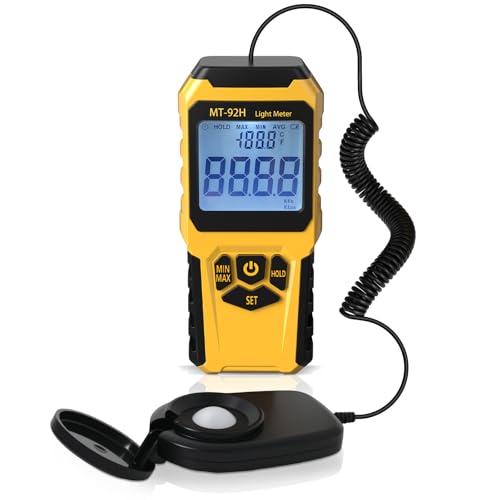
- Separate sensor allows flexible positioning
- 0–200,000 lux range with 0.1-lux resolution
- Switchable backlight plus temperature measurement
Best For: Professional and flexible-position light measurements
Best Simple Wide-Range Meter
S8608 Digital Illuminance Meter

- Large backlit screen with automatic range conversion
- Measures up to 200,000 lux and 18,500 FC
- Includes MAX/MIN, hold, and low-battery indication
Best For: Basic indoor, outdoor, plant, and photography checks
Fast-Reading Pick
Dr.meter 200,000 Lux Light Meter

- 0–200,000 lux range with twice-per-second readings
- Switches between lux and foot-candles
- Peak recording and low-battery alert
Best For: Fast plant, office, factory, and outdoor light checks
Backlit Display Pick
Rotating-Sensor Digital Light Meter

- Large backlit screen for dim environments
- 180-degree rotating sensor
- Measures light and ambient temperature
Best For: Plant, photography, and workplace measurements from varied angles
Feature-Tracking Pick
Color-Screen 200,000 Lux Meter
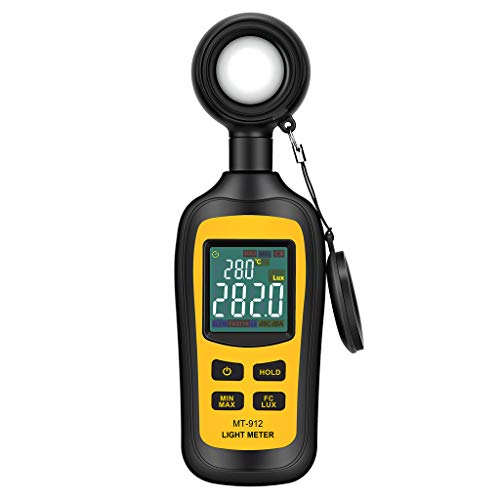
- 4-digit color LCD screen
- MIN/MAX, data hold, and auto power-off
- Measures light and ambient temperature
Best For: Compact home, office, factory, and set-lighting checks
Wide-Range Pick
Mcbazel Digital Illuminance Light Meter

- Measures up to 200,000 lux
- Backlit LCD with data hold
- Lux/FC, max, and minimum readings
Best For: Versatile indoor, garden, and photography measurements
Flexible Sensor Pick

- 360-degree rotating sensor
- Four automatic lux ranges
- Four-digit LCD with hold and min/max
Best For: Angle-sensitive measurements around plants, homes, and workplaces
Environmental Monitoring Pick
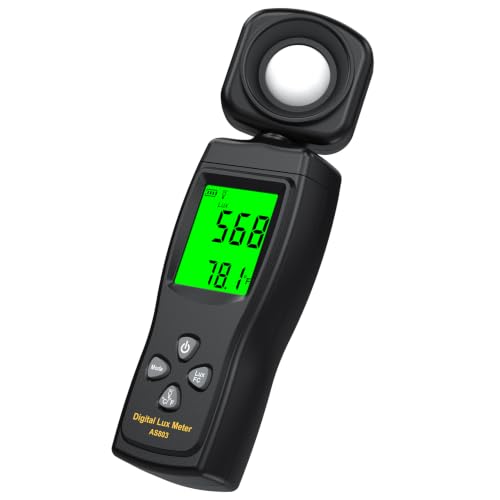
- 0–200,000 lux measurement range
- 180-degree sensor and backlit LCD
- Adds °C/°F temperature readings
Best For: Plant care, photography, and indoor environmental checks
Best Overall – TopTes TS-710 Large Backlit Light Meter
If you want light meters with large displays that are easy to read in dim spaces, the TopTes TS-710 combines a 2.25-inch backlit LCD with a rotating probe. Its broad 0.1–200,000 lux range and 0.1–20,000 foot-candle range make it a flexible choice for checking plants, LEDs, offices, and vehicle headlights.
Best For: Home users, plant growers, and general-purpose light testing.
Pros:
- Large backlit display and 180° rotating sensor support easier readings from different angles.
- Measures both lux and foot-candles across a wide range.
- Also records temperature and humidity, with MAX/MIN and data-hold functions.
- Includes a soft case and three AAA batteries.
Cons:
- The temperature sensor may take time to adapt to a new environment.
- Auto shut-off activates after 10 minutes of inactivity.
The TS-710 is a well-rounded pick when display readability and extra environmental measurements matter as much as light measurement.
Best Compact Option – UNI-T UT383 Large LCD Light Meter
The UNI-T UT383 is a compact choice among light meters with large displays, featuring a backlit four-digit LCD and a 0–199,900 lux measurement range. Its 0.5-second sampling time, data hold, and MAX/MIN functions suit quick checks in workplaces, homes, studios, and outdoor lighting projects.
Best For: Buyers who want a portable, straightforward meter for routine illuminance checks.
Pros:
- Large backlit four-digit LCD is designed for convenient viewing.
- Measures up to 199,900 lux and 18,500 foot-candles.
- Offers 0.5-second sampling, MAX/MIN, data hold, and overload indication.
- Compact design is easy to carry.
Cons:
- Its stated accuracy is ±(4%+8), which is less precise than some alternatives in this roundup.
- The package does not list a carrying case or included batteries.
Choose the UT383 if portability and simple controls are more important than added temperature or humidity measurements.
Best Split-Sensor Design – MT-92H Backlit Light Meter
The MT-92H stands out among light meters with large displays because its separate split sensor allows flexible probe positioning while you read the meter from another location. It measures 0–200,000 lux with up to ±3% accuracy, refreshes every 0.5 seconds, and includes switchable backlighting for dark or bright conditions.
Best For: Professional or hands-on measurements where sensor placement and display visibility are important.
Pros:
- Split-sensor design supports flexible positioning and monitoring.
- Provides 0.1-lux resolution and a 0–200,000 lux range.
- Switchable backlight is intended to remain readable in darkness or sunlight.
- Also measures lux/foot-candles and Celsius/Fahrenheit temperature.
Cons:
- At 188g, it is heavier than some compact meters in this group.
- The notes do not specify MAX/MIN or data-hold functions.
The MT-92H is a practical fit when a separately positioned sensor and high-visibility display are central to the measuring workflow.
Best Simple Wide-Range Meter – S8608 Digital Illuminance Meter
The S8608 is a straightforward option for shoppers comparing light meters with large displays and a broad measuring range. It measures up to 200,000 lux or 18,500 foot-candles, automatically converts ranges, and includes a backlight for indoor, outdoor, plant, and photography-related checks.
Best For: Basic brightness measurements in homes, schools, workplaces, and grow areas.
Pros:
- Large screen and backlight support easier reading.
- Wide range reaches 200,000 lux and 18,500 foot-candles.
- Includes automatic range conversion, MAX/MIN, data hold, and low-battery indication.
- Suitable for indoor and outdoor brightness checks.
Cons:
- The supplied notes do not state an accuracy specification.
- The feature list does not mention temperature or humidity measurement.
If you need broad-range light readings and useful memory functions without extra environmental sensors, the S8608 keeps the feature set focused.
Fast-Reading Pick – Dr.meter 200,000 Lux Light Meter
If you need light meters with large displays for plant care, workplace checks, or outdoor readings, this Dr.meter model offers a broad 0–200,000 lux range and fast response. It also switches between lux and foot-candles and can capture peak readings from brief, intense light sources.
Best For: Gardeners and users who want quick lux or foot-candle readings across indoor and outdoor settings.
Pros:
- Measures from 0 to 200,000 lux with readings twice per second.
- Switches between FC and lux for flexible measurement.
- Peak button records the highest light pulse value.
- Low-battery alert helps indicate when the included 9V battery needs replacement.
Cons:
- Uses a 9V battery rather than the three AAA batteries used by some competing models.
- The supplied notes do not specify a backlit display.
This is a practical choice when fast measurements, peak capture, and unit flexibility matter more than added temperature monitoring or a documented backlight.
Backlit Display Pick – Rotating-Sensor Digital Light Meter
For shoppers seeking light meters with large displays that remain readable in dim conditions, this digital meter combines a large backlit LCD with a 0–200,000 lux range. Its 180-degree rotating probe helps you position the sensor for readings from different angles, while the built-in thermometer adds ambient-temperature information.
Best For: Users measuring plant, photography, workplace, or household lighting in varied angles and lighting conditions.
Pros:
- Large LED backlight screen supports easier reading in darkness.
- Measures up to 200,000 lux with stated accuracy of ±4% rdg ±10 dgt below 10,000 lux.
- 180-degree rotating sensor supports measurements from multiple angles.
- Built-in thermometer also measures ambient temperature.
Cons:
- Requires three AAA batteries.
- The supplied notes do not mention peak-data recording.
This model stands out for display visibility and probe positioning, making it a strong fit when you regularly work in darker environments or need to measure around awkwardly angled fixtures.
Feature-Tracking Pick – Color-Screen 200,000 Lux Meter
This compact option is among the light meters with large displays designed for straightforward monitoring at home, in offices, factories, or on set. It measures up to 200,000 lux, adds ambient-temperature measurement, and provides MIN/MAX, data hold, auto power-off, and low-battery functions.
Best For: Buyers who want a compact meter with a color screen and useful reading-management features.
Pros:
- 4-digit color LCD screen is designed for clear readouts.
- Measures 0–200,000 lux and ambient temperature.
- MIN/MAX and data-hold functions help track or preserve readings.
- Includes auto power-off, low-battery indication, and a two-year warranty.
Cons:
- Requires three AAA batteries.
- Accuracy varies by range, with the stated specification changing above 10,000 lux.
- The supplied notes do not specify a backlight.
Choose this model if you value a compact design and measurement-memory features. Its color display and two-year warranty add convenience for routine light and temperature checks.
Wide-Range Pick – Mcbazel Digital Illuminance Light Meter
If you need light meters with large displays for varied environments, the Mcbazel offers a broad 0–200,000 lux range and a backlit LCD for easier viewing in darker spaces. It also records current, maximum, and minimum readings and lets you hold a measurement on screen.
Best For: Growers, photographers, professionals, and hobbyists measuring light in indoor, garden, school, hospital, or workplace settings.
Pros:
- Measures up to 200,000 lux with stated accuracy of ±3% or ±4%, depending on range, plus 10 digits.
- Backlit LCD, lux/FC switching, data hold, and maximum/minimum readings.
- Automatic shutoff and low-battery indicator help conserve power.
Cons:
- Requires three AAA batteries, which are not included.
- Readings below approximately 2 lux display as zero.
Its extra-wide measurement range and readable backlit display make it a versatile choice when you want one handheld meter for both ordinary indoor checks and much brighter lighting conditions.
Flexible Sensor Pick – DANOPLUS Handheld Lux Meter
The DANOPLUS is one of the more flexible light meters with large displays, pairing a four-digit LCD with a separate 360-degree rotating sensor. Its auto-ranging design covers four lux ranges, while the controls support both routine measurements and quick comparison readings.
Best For: Users who need to position the sensor independently when checking plants, headlights, offices, homes, schools, or industrial spaces.
Pros:
- Four automatic lux ranges span 200, 2,000, 20,000, and 200,000 lux.
- Rotating sensor can be adjusted to a suitable position for measurement.
- Includes data hold, minimum/maximum readings, low-battery indication, and switchable FC units.
Cons:
- The sensor’s stated visible-light range is 400–700 nm.
- Its four-digit LCD is clear but less detailed than a display with additional digits.
The rotating sensor is the main reason to choose this model: it can make awkward-angle readings easier while the broad range and automatic selection keep operation straightforward.
Environmental Monitoring Pick – Ohcans AS803 Light Meter
For shoppers comparing light meters with large displays, the Ohcans AS803 combines a backlit LCD with a 0–200,000 lux range and a 180-degree rotating sensor. Its fast 0.5-second sampling is useful for checking changing lighting, and it adds temperature readings for basic environmental monitoring.
Best For: Plant growers, photographers, film and camera users, and anyone monitoring both illumination and temperature in indoor spaces.
Pros:
- Measures 0–200,000 lux with stated accuracy of ±4% plus 10.
- 180-degree rotating sensor and backlit LCD support flexible, low-light use.
- Offers temperature in °C/°F, data hold, maximum/minimum recording, and three measurement modes.
Cons:
- Requires three AAA batteries, although they are included.
- Its 180-degree sensor rotation is less extensive than a full 360-degree design.
This is the strongest fit if light readings are only part of your task. The added temperature function, quick sampling, and flexible sensor make it particularly practical for plant environments and photography setups.
How We Picked the Best Light Meters with Large Displays
We focused on handheld meters that make readings easy to see and interpret. The selected models offer a large, backlit, color, or otherwise high-visibility display, with many supporting measurements up to 200,000 lux. We also considered sensor positioning, lux and foot-candle support, refresh speed, temperature readings, portability, and practical controls such as data hold, range selection, and backlight functions.
Because specifications and included accessories can vary by seller, verify the current listing for accuracy claims, battery requirements, warranty coverage, and whether a carrying case or batteries are included.
Quick Comparison
| Feature | Why It Matters | What to Look For |
|---|---|---|
| Display | Improves readability during inspections | Large LCD, backlight, or color screen |
| Measurement range | Handles both dim rooms and bright sources | Broad range, ideally up to 200,000 lux |
| Sensor design | Helps position the meter accurately | Rotating or split sensor |
| Units | Matches your workflow and reporting needs | Lux and foot-candles |
| Response speed | Makes changing light easier to monitor | Fast refresh or sampling rate |
Key Buying Factors for Light Meters with Large Displays
Display Visibility
A backlit display is useful in dark rooms, cabinets, studios, and equipment spaces. Color screens can improve glanceability, while a simple large LCD may use less power and remain easier to read in bright conditions. Check whether the backlight is manually controlled or timed to shut off automatically.
Range and Resolution
A wide range is valuable if you will measure offices, workshops, photography setups, plant grow areas, and bright fixtures with the same device. Resolution matters too: finer increments can help when comparing small lighting differences, while broad range is more important for avoiding overload at high brightness.
Sensor Flexibility
Rotating sensors let you keep the display facing you while the detector points toward the light source. Split-sensor designs can be convenient for reaching around obstacles. A fixed sensor may be perfectly adequate for straightforward tabletop or room measurements.
Controls and Extras
Look for data hold, minimum and maximum readings, auto-ranging, unit switching, and an automatic power-off feature. Temperature measurement is useful for environmental checks but should not outweigh display quality and measurement performance if light is your main concern.
Who Should Buy Which Light Meters with Large Displays?
- For general home and office checks: Choose an affordable meter with a broad range, simple controls, and a readable backlit screen.
- For photography and video: Prioritize a rotating sensor, quick refresh rate, lux and foot-candle support, and easy-to-read readings while adjusting lights.
- For plant and grow-light monitoring: Select a model with high maximum lux capacity and consistent positioning; use a dedicated PAR meter if plant-specific PPFD data is required.
- For maintenance and inspections: A split or rotating sensor, data hold, min/max recording, and automatic ranging can make repeated measurements more efficient.
- For occasional users: Avoid paying for extras you will not use. A compact meter with a large display, broad range, and straightforward unit controls is usually sufficient.