
The right light level can make a room more comfortable, improve visibility, and help plants, workspaces, and photography setups perform as intended. A handheld light meter gives you a more useful reading than judging brightness by eye.
We selected 10 digital models with broad measurement ranges, readable displays, and home-friendly controls. The guide below explains which features matter most and how to choose a meter for your rooms, projects, or hobbies.
Best 10 Light Meters for Home Use Picks for 2026
Precision Plant Monitoring
Dr.meter Digital Illuminance Light Meter

- 0–200,000 lux measurement range
- Lux/foot-candle conversion and peak hold
- Fast readings with included 9V battery
Best For: Home growers and general light checks
Wide-Range Angle Reading
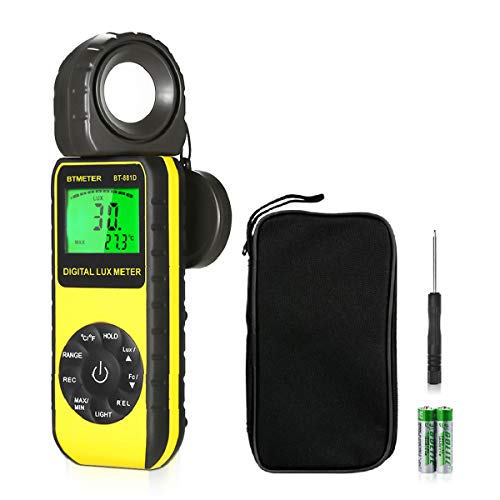
- 0.01–400,000 lux range
- 270-degree rotating sensor
- Stores 33 readings with relative mode
Best For: Wide-range comparisons and angled measurements
All-Around Home Testing

- Backlit display and 180-degree rotating probe
- Measures light, temperature, and humidity
- Includes case and three AAA batteries
Best For: Multipurpose room and plant-area checks
Simple Budget Measurement

- Measures up to 200,000 lux
- Lux/foot-candle support with hold function
- Auto and manual range modes
Best For: Routine indoor light checks
Fast-Reading Pick
MT-92H Split-Sensor Light Meter
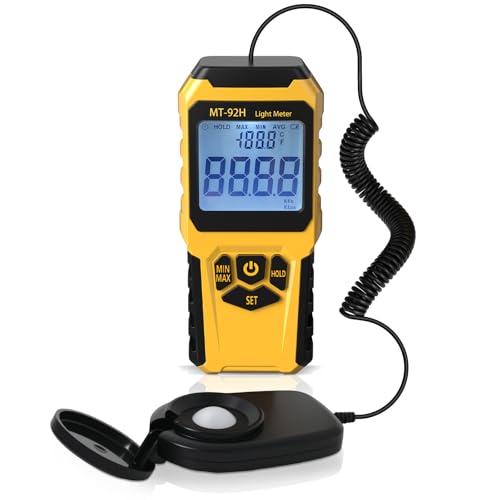
- 0–200,000 lux range with ±3% accuracy
- Separate probe and 0.5-second refresh rate
- Backlit display with lux/Fc switching
Best For: Flexible home measurements and quick-changing light conditions
Simple Wide-Range Choice
S8608 Digital Illuminance Meter

- Automatic ranging up to 200,000 lux
- Large display with lux and foot-candle units
- Hold, MAX/MIN, backlight, and auto-off functions
Best For: General household brightness and lighting checks
Plant-Light Favorite

- 0–200,000 lux range with digital and bar-graph displays
- Hold and MAX/MIN modes for comparing readings
- Includes accessories and a stated two-year warranty
Best For: Home gardening, photography, and portable light checks
Fast LED & Plant Pick
High-Range Rotating-Head Light Meter
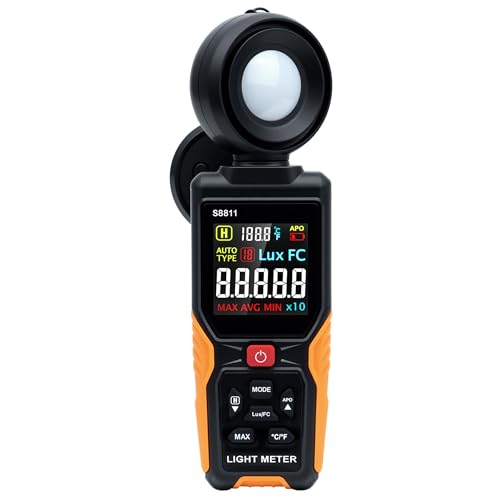
- 8X/s sampling for changing light
- LED correction coefficients
- 270° head and HD color display
Best For: Indoor plants, LED grow lights, and photography
Flexible Home Monitoring Pick
Illuminance Meter with Temperature Sensing
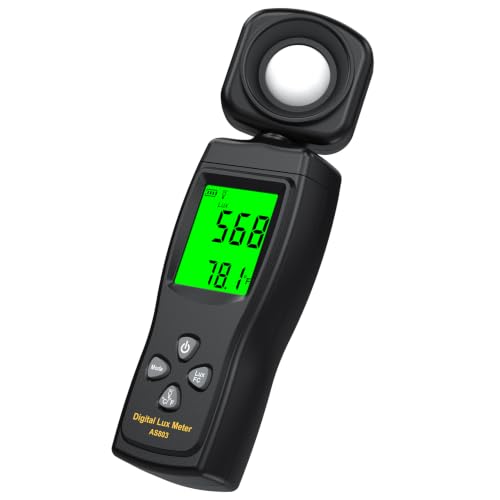
- 0–200,000-lux measurement range
- 180° rotating sensor and backlit LCD
- Adds temperature, hold, and Max/Min modes
Best For: Home growers, offices, and photography setups
Simple Budget-Friendly Pick

- 0–200,000-lux range
- Lux/FC switching and backlit LCD
- Hold, Max/Min, and auto shutoff
Best For: Routine home, plant, and room brightness checks
Precision Plant Monitoring – Dr.meter Digital Illuminance Light Meter
For shoppers comparing light meters for home use, the Dr.meter Digital Illuminance Light Meter offers a broad 0–200,000 lux range and quick readings for checking rooms, workspaces, or plant lighting. Its switchable lux and foot-candle modes make it practical for different measurement preferences.
Best For: Home growers and general indoor or outdoor light checks.
Pros:
- Measures up to 200,000 lux and supports lux/foot-candle conversion.
- Samples readings twice per second for fast feedback.
- Peak-hold function captures brief high-intensity readings.
- Includes a 9V battery and low-battery alert.
Cons:
- Uses a relatively larger 9V battery rather than AAA cells.
- Its feature set is focused on illuminance rather than temperature or humidity.
This is a straightforward choice when you want wide-range light measurements and a dedicated peak-reading function without adding environmental sensors.
Wide-Range Angle Reading – BTMETER BT-881D Light Meter
The BTMETER BT-881D stands out among light meters for home use with a 0.01–400,000 lux range, a rotating sensor, and memory for 33 readings. It is suited to comparing lighting around a home, office, garden, or workspace from different measurement angles.
Best For: Users who need broad-range readings, sensor-angle flexibility, and stored measurements.
Pros:
- Offers an unusually wide 0.01–400,000 lux measurement range.
- 270-degree rotating sensor helps maintain a readable viewing position.
- Responds in about 0.4 seconds with two to three samples per second.
- Records 33 readings and includes a relative comparison mode.
Cons:
- The supplied notes do not indicate that a battery is included.
- It is larger and heavier than some compact home-use meters.
Choose this model if measurement range and data comparison matter more than having the smallest possible device.
All-Around Home Testing – TopTes TS-710 Light Meter
For versatile light meters for home use, the TopTes TS-710 combines a 0.1–200,000 lux range with a large backlit display and a rotating probe. It also measures temperature and humidity, making it useful for checking plant areas, rooms, LEDs, and other visible light sources.
Best For: Home users who want light, temperature, and humidity readings in one handheld meter.
Pros:
- Provides 3%rdg+5dgt accuracy across lux and foot-candle measurements.
- 180-degree rotating probe and 2.25-inch backlit LCD improve usability.
- Measures ambient temperature and humidity in addition to light.
- Includes MAX/MIN recording, data hold, case, and three AAA batteries.
Cons:
- Its maximum range is lower than the BTMETER BT-881D.
- The temperature sensor adapts to new environments over time.
This is a strong multipurpose option for households that want easy-to-read light measurements alongside basic environmental checks.
Simple Budget Measurement – Leaton Digital Luxmeter
The Leaton Digital Luxmeter is a basic choice for shoppers seeking light meters for home use without extra environmental features. It measures up to 200,000 lux, supports lux and foot candles, and offers hold, auto-ranging, and manual-ranging functions for routine lighting checks.
Best For: Simple indoor lighting measurements and users who prefer manual range control.
Pros:
- Measures up to 200,000 lux with stated accuracy of ±4%.
- Offers 0.1-lux resolution and lux/foot-candle units.
- Includes hold, auto-range, and manual-range functions.
- Reads twice per second and provides low-battery detection.
Cons:
- The required 9V battery is not included.
- It lacks the rotating sensor, backlit display, and environmental readings found on some alternatives.
The Leaton is best suited to straightforward light-level checks when you do not need a broader feature set or included power source.
Fast-Reading Pick – MT-92H Split-Sensor Light Meter
For shoppers comparing light meters for home use, the MT-92H stands out with a 0–200,000 lux range, a separate probe, and fast 0.5-second refresh rates. Its switchable backlight and compact design make it practical for checking rooms, workspaces, and other lighting conditions.
Best For: Home users who want quick, flexible readings and a remote split-sensor design.
Pros:
- Measures from 0 to 200,000 lux with listed ±3% accuracy and 0.1-lux resolution.
- Separate sensor probe allows flexible positioning during measurements.
- Switches between lux and foot-candle readings, with a readable backlit display.
- Compact 188-gram body runs on included AAA batteries.
Cons:
- Requires three AAA batteries.
- The feature set may be more than needed for occasional basic checks.
The MT-92H is a strong choice when response speed, positioning flexibility, and readability matter. Its broad range also leaves room for tasks beyond routine indoor measurements.
Simple Wide-Range Choice – S8608 Digital Illuminance Meter
The S8608 is a straightforward option for light meters for home use, with automatic ranging up to 200,000 lux and a large display. It supports indoor and outdoor brightness checks while adding useful hold, minimum/maximum, and backlight functions.
Best For: Households wanting an easy-to-read meter for general indoor, outdoor, or plant-light checks.
Pros:
- Measures visible brightness up to 200,000 lux.
- Automatic range conversion simplifies operation.
- Offers lux and foot-candle units, data hold, and MAX/MIN readings.
- Includes backlight, low-battery indicator, and auto power-off.
Cons:
- The supplied notes do not specify measurement accuracy.
- Uses three AAA batteries.
With a broad range and uncomplicated controls, the S8608 suits everyday brightness comparisons. Its large display and hold function are especially useful when readings need to be viewed or recorded away from the light source.
Plant-Light Favorite – POROMETISTO LT01 Light Meter
For light meters for home use that may also support gardening or photography, the POROMETISTO LT01 combines a 0–200,000-lux range with a digital and analog bar-graph display. Its hold and MAX/MIN modes help compare readings in rooms, greenhouses, and other hard-to-reach areas.
Best For: Home growers and hobbyists who want a portable meter with recording features and a stated two-year warranty.
Pros:
- Measures up to 200,000 lux and 20,000 foot-candles with listed ±(3% + 5 lux) accuracy under standard incandescent lamps.
- Two-readings-per-second sampling and an analog bar graph help show light changes.
- Data hold, MAX/MIN recording, low-battery indication, and auto power-off support routine checks.
- Includes a sensor cap, lanyard, batteries, manual, and two-year warranty.
Cons:
- The listed accuracy qualification is specifically for standard incandescent lamps.
- The product details conflict on battery type: the notes list two AAA batteries in the package but specify two AA batteries as required.
The LT01 is a versatile pick for users who want more visual feedback than a basic numeric display provides. Its compact format and included accessories make it convenient for repeated plant-light or household illumination checks.
Fast LED & Plant Pick – High-Range Rotating-Head Light Meter
If you want light meters for home use that respond quickly to changing illumination, this Mcbazel model is a strong option. Its 8-times-per-second sampling, LED correction coefficients, and 0–200,000-lux range make it well suited to checking grow lights, indoor plants, and photography setups.
Best For: Indoor gardeners, LED users, photographers, and anyone measuring changing light conditions.
Pros:
- Fast 8X/s sampling helps capture flicker and rapidly changing readings.
- LED-specific correction options support white, red, warm, and standard light sources.
- 270° rotating sensor and HD color display improve viewing flexibility.
- Includes data hold, Max/Min/Avg recording, unit switching, and temperature sensing.
Cons:
- Requires three AAA batteries, which are not included.
- The sensor rotates to the right side only.
- Its feature set may be more than casual users need.
Choose this model when quick sampling and flexible sensor positioning matter more than keeping the meter extremely simple. The broad range and plant-focused LED adjustments give it useful versatility for home monitoring.
Flexible Home Monitoring Pick – Illuminance Meter with Temperature Sensing
For light meters for home use that balance broad measurement capability with easy handling, the Ohcans AS803 offers a practical setup. It measures up to 200,000 lux, samples every 0.5 seconds, and adds temperature readings for indoor plant areas, offices, and other spaces.
Best For: Home growers, photographers, office checks, and users who want light and temperature readings in one handheld tool.
Pros:
- Measures from 0 to 200,000 lux with stated accuracy of ±4% +10.
- 180° rotating sensor supports measurements from different angles.
- Backlit LCD and 0.5-second sampling help with low-light and real-time checks.
- Offers temperature in °C/°F, data hold, Max/Min recording, and three measurement modes.
Cons:
- Requires three AAA batteries, although they are included.
- The supplied notes do not specify LED-specific correction coefficients.
- Its larger listed dimensions may be less convenient for compact storage.
This is a well-rounded choice for households that want straightforward light readings plus environmental context. The rotating sensor, backlight, and temperature function make it adaptable across rooms and growing areas.
Simple Budget-Friendly Pick – Backlit 200,000-Lux Meter
If you need light meters for home use for routine brightness checks, this Mcbazel photometer keeps the controls focused on the essentials. It covers up to 200,000 lux, switches between lux and foot-candles, and provides hold, maximum, and minimum readings for plants, rooms, and photography.
Best For: Home users, hobby growers, and anyone wanting a basic meter for indoor brightness comparisons.
Pros:
- Wide 0–200,000-lux range handles both ordinary indoor checks and brighter lighting.
- Switches between lux and foot-candles with a backlit LCD.
- Data hold plus maximum and minimum readings aid note-taking and comparisons.
- Automatic shutoff and low-battery indication help conserve and manage battery power.
Cons:
- Requires three AAA batteries, which are not included.
- Samples up to two times per second, slower than the other listed options.
- Readings below approximately 2 lux display as zero.
This model makes sense when you want broad-range measurements without specialized plant or environmental features. It is a practical entry-level choice for checking whether different home areas meet your lighting goals.
How We Picked the Best Light Meters for Home Use
We focused on practical features rather than marketing claims: measurement range, display readability, sensor positioning, refresh speed, unit options, portability, and ease of use. Most of these meters measure up to 200,000 lux, giving them enough range for ordinary rooms as well as brighter work areas, windows, garages, and hobby setups.
Rotating or separated sensors received special attention because they make it easier to take readings in awkward corners without blocking the sensor with your hand. We also considered backlit displays, hold functions, temperature readings where available, and whether the controls appear straightforward for occasional household use.
Quick Comparison
For a simple, versatile choice, look for a model with a 0–200,000 lux range, a rotating sensor, and a backlit display. A split-sensor design can be more convenient when you need to position the sensor independently from the screen. Models with faster sampling are useful when light changes quickly, such as near windows or under dimmable lamps.
- Best general-purpose setup: Choose a broad-range meter with a rotating head and clear LCD.
- Best for awkward spaces: Consider a split sensor or a head that rotates through a wide angle.
- Best for low-light checks: Prioritize a low minimum reading and a readable backlight.
- Best for frequent measurements: Look for fast refresh rates, data hold, and accessible controls.
Key Buying Factors for Light Meters for Home Use
Measurement Range and Units
Lux is the most common unit for indoor lighting measurements. Foot-candle mode can be useful if your project instructions use imperial units. A wide range provides flexibility, but accuracy and a usable low-light threshold matter more than the headline maximum for most homes.
Sensor Design
A 180- or 270-degree rotating sensor helps you aim the detector toward the light while keeping the display visible. A separate sensor connected by a cable offers even more placement flexibility for shelves, cabinets, desks, and other confined areas.
Display and Controls
Choose a large, high-contrast display if you will measure under dim conditions or from a standing position. A backlight is helpful, but it should be easy to activate without accidentally changing units or resetting the reading. Data hold is valuable when the screen is difficult to view while taking a measurement.
Portability and Power
Most handheld meters are compact and battery powered. Check whether the battery is included, whether the meter powers off automatically, and whether the body can stand on a surface. A protective case or wrist strap is useful if you plan to carry it between rooms or job sites.
Who Should Buy Which Light Meters for Home Use?
Homeowners checking whether rooms are adequately lit should choose a straightforward broad-range model with a clear display. Indoor gardeners should favor low-light sensitivity and a sensor that can reach beneath shelves or around foliage. DIYers and electricians may prefer fast sampling, data hold, and a rotating or split sensor for repeatable readings.
For photography, art, workspace planning, or classroom projects, prioritize consistent readings, easy unit switching, and a display you can read without disturbing the setup. If you only need occasional comparisons between lamps or rooms, avoid paying extra for advanced features you will not use; a simple digital lux meter will usually be sufficient.