
The right light meter can make exposure decisions faster, more repeatable, and less dependent on guesswork. Whether you shoot portraits, film, studio work, or video, the best meter matches your workflow and the type of light you need to measure.
This roundup compares dedicated photography meters with affordable illuminance tools, highlighting important differences in incident, reflected, spot, flash, lux, and cinematic measurement.
Best 10 Light Meter for Photography Picks for 2026
Best All-Around Pick

- Ambient and flash metering to one-tenth stop
- Photo, cine, and HD cine modes
- Compact pocket-sized design
Best For: Stills, flash, and DSLR or mirrorless video
Best Retro-Style Meter

- 35-degree reflective metering
- Tactile three-dial control layout
- USB-C charging with over 20 hours of battery life
Best For: Film-camera users who prefer manual controls
Best Advanced Flash Meter
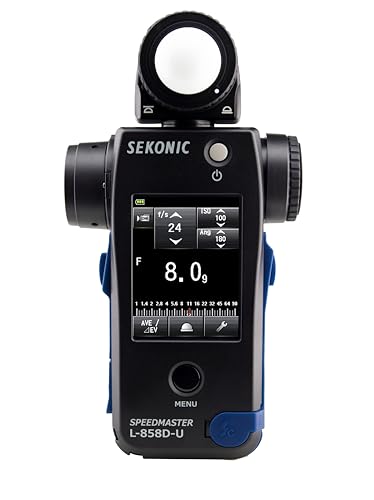
- Incident, flash, and built-in 1° spot metering
- Flash-duration and HSS measurement
- Optional wireless triggering compatibility
Best For: Advanced flash and complex lighting setups
Best Ultra-Compact Film Meter

- 26-gram ultra-light design
- 30-degree metering with multiple priority modes
- OLED display and USB-C rechargeable battery
Best For: Portable film-camera metering
Professional Hybrid Meter
Sekonic LiteMaster Pro L-478D-U
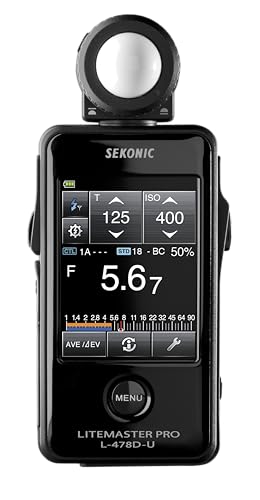
- Incident, ambient, and flash metering
- Touchscreen interface with cine controls
- Optional 5° spot and luminance modes
Best For: Professional photo, studio, and hybrid video work
Compact Utility Meter
UNI-T UT383 Digital Light Meter

- Reads up to 199,900 lux
- Fast 0.5-second sampling
- Backlit display with hold and max/min
Best For: Portable illuminance checks and everyday photography use
Wide-Range Illuminance Tool

- Measures up to 200,000 lux
- Automatic ranging with lux/FC switching
- Backlight, hold, and max/min functions
Best For: Wide-range brightness checks across photo and everyday settings
Wide-Range Pick
BT-881D Rotating-Sensor Light Meter
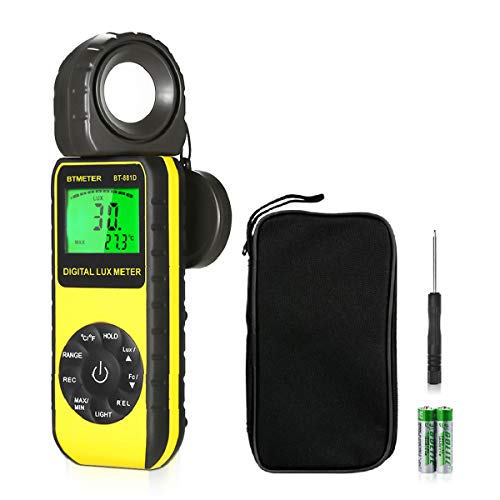
- Measures up to 400,000 lux
- 270° rotating sensor
- Stores 33 readings
Best For: Photography and lighting checks requiring broad range and flexible positioning
Easy-Reading Choice
POROMETISTO LT01 Handheld Meter

- Measures up to 200,000 lux
- Backlit digital and analog display
- Includes hold and MAX/MIN modes
Best For: Portable photography, greenhouse, and indoor lighting measurements
Value Versatility Pick
Mcbazel 200,000-Lux Photometer

- Measures up to 200,000 lux
- Supports LUX and foot-candle units
- Includes MAX/MIN and data hold
Best For: General photography, grow-light, and indoor brightness checks
Best All-Around Pick – Sekonic L-308X-U Flashmate
If you want a versatile light meter for photography, the Sekonic L-308X-U combines incident and reflected readings with dedicated photo, cine, and HD cine modes. Its compact design and tenth-stop accuracy make it practical for stills, flash, and video work.
Best For: Photographers and DSLR or mirrorless videographers who need one compact meter for ambient and flash exposure.
Pros:
- Measures ambient and electronic flash exposures to one-tenth-stop accuracy.
- Supports corded and cordless flash measurement.
- Offers photo, cine, and HD cine modes with broad shutter-speed and frame-rate controls.
- Pocket-sized 4.3-ounce design with automatic LCD backlight.
Cons:
- Requires two AAA batteries.
- Its feature set may be more than needed for basic still photography.
The L-308X-U is a balanced choice when you want reliable exposure readings without carrying a larger professional meter. Its dedicated video modes also give it useful flexibility beyond still photography.
Best Retro-Style Meter – LightMate AirPro
The LightMate AirPro is a compact reflective light meter for photography designed with tactile controls and a classic three-dial layout. Its 35-degree metering angle, half-stop adjustments, and rechargeable battery suit photographers who prefer hands-on exposure control.
Best For: Film-camera users, including Leica photographers, who want physical dials and flexible manual or automatic metering.
Pros:
- 35-degree reflective metering with stated ±0.1 EV accuracy.
- Independent aperture, ISO, and shutter-speed dials with tactile and audible feedback.
- Provides aperture-priority, shutter-priority, manual, and EV modes.
- USB-C rechargeable battery offers more than 20 hours of use.
Cons:
- Reflective metering may be less suitable than incident metering for some lighting setups.
- Its controls and indicators may require familiarization.
- Product details list a rechargeable battery and also reference an included AAA battery, so buyers should confirm the exact power arrangement.
With its metal body and customizable exposure indicators, the AirPro emphasizes tactile operation and shooting flexibility. It is especially appealing if you want a modern meter that visually complements a film-camera workflow.
Best Advanced Flash Meter – Sekonic L-858D-U Speedmaster
For demanding lighting setups, the Sekonic L-858D-U is a feature-rich light meter for photography with incident, spot, and flash-duration measurement. Its broad exposure range and optional wireless compatibility make it suited to photographers who need deeper flash analysis.
Best For: Advanced photographers balancing complex ambient and flash lighting, including high-speed-sync work.
Pros:
- Combines incident ambient and flash metering with a built-in 1° spot meter.
- Measures flash duration, including HSS output, using t.1 and t.5 analysis.
- Handles a broad -5 to 22.9 EV range at ISO 100.
- Supports optional radio modules for compatible wireless triggering and remote power adjustment.
Cons:
- Optional radio modules are required for expanded wireless control.
- The 8.8-ounce body is larger and heavier than compact meters in this selection.
- Its advanced functions may be unnecessary for simple ambient-light readings.
The L-858D-U is the strongest option here for photographers who actively shape flash output and motion-freezing performance. Its spot meter and flash-duration tools provide more analytical control than a basic exposure meter.
Best Ultra-Compact Film Meter – LightMate Lite 2R
The LightMate Lite 2R is an ultra-light light meter for photography made for film-camera setups where space matters. Its 30-degree metering lens, OLED display, rechargeable battery, and adjustable cold-shoe position provide useful control in a very small package.
Best For: Film photographers who want a lightweight accessory with aperture- and shutter-priority metering plus camera-friendly mounting options.
Pros:
- Weighs just 26 grams and uses a compact 30-degree metering view.
- Offers aperture priority, shutter priority, single-trigger, automatic-trigger, and average metering modes.
- Includes exposure compensation, ND filter compensation, and depth-of-field calculation.
- USB-C rechargeable battery provides more than 20 hours of use and over six months of standby.
Cons:
- The feature-rich interface may take time to configure.
- Its ambient-metering design is less focused on flash measurement.
- Product details list a rechargeable battery and an included A battery, so confirm the power specifications before purchase.
The Lite 2R stands out when portability is the priority. Adjustable mounting, a flip display, and film-oriented calculation tools make it a practical companion for compact cameras and everyday analog shooting.
Professional Hybrid Meter – Sekonic LiteMaster Pro L-478D-U
For photographers who need more than a basic exposure reading, the Sekonic LiteMaster Pro L-478D-U is a versatile light meter for photography with incident, ambient, and flash metering. Its touchscreen interface, flash analysis, and optional reflected spot capability suit demanding studio, location, and hybrid photo-video workflows.
Best For: Professional photographers, studio users, and hybrid creators who need advanced ambient, flash, and cine exposure controls.
Pros:
- Measures incident ambient and flash light, including flash-to-ambient analysis.
- Touchscreen color LCD supports fast navigation and clear data visibility.
- Includes cine frame-rate and shutter-angle controls plus illuminance and luminance modes.
- Optional 5° reflected spot attachment expands selective subject metering.
Cons:
- Its advanced feature set may be more than casual photographers need.
- Reflected spot metering requires an optional attachment.
This is the most capable option in the group for photographers and filmmakers who want one meter for exposure, flash balancing, and technical lighting evaluation.
Compact Utility Meter – UNI-T UT383 Digital Light Meter
The UNI-T UT383 is a practical, compact light meter for photography when you mainly need to check illuminance rather than analyze flash exposure. It measures up to 199,900 lux or 18,500 foot-candles and provides quick readings in a portable body.
Best For: Photographers, studios, and general-purpose users who want an affordable illuminance check with lux and foot-candle readings.
Pros:
- Measures from 0 to 199,900 lux or 0 to 18,500 foot-candles.
- Offers 0.5-second sampling, maximum/minimum readings, and data hold.
- Compact design with a large backlit four-digit LCD.
- Includes auto shutdown, overload indication, and a low-battery indicator.
Cons:
- It is an illuminance meter rather than a dedicated incident or flash exposure meter.
- The stated accuracy is ±(4% + 8), so it is better suited to practical checks than highly specialized measurement.
Choose the UT383 if portability and straightforward lux or foot-candle readings matter more than advanced photographic exposure features.
Wide-Range Illuminance Tool – S8608 Digital Lux Meter
The S8608 is a straightforward light meter for photography and general brightness checks, with automatic ranging and measurements up to 200,000 lux. Its large display, backlight, and hold functions make it useful for comparing indoor, outdoor, grow-light, and studio lighting levels.
Best For: Photographers and general users who need a wide-range lux meter for indoor, outdoor, LED, plant-lighting, or film-related brightness checks.
Pros:
- Wide 0-to-200,000-lux measurement range with automatic range conversion.
- Switches between lux and foot-candle units.
- Provides maximum/minimum readings, data hold, backlight, and auto power-off.
- Includes a low-battery indicator and three AAA batteries.
Cons:
- It measures visible illuminance rather than providing dedicated camera exposure or flash analysis.
- The supplied notes do not specify an accuracy rating.
The S8608 is a useful choice when you want broad brightness coverage and simple controls, especially for comparing lighting across varied environments.
Wide-Range Pick – BT-881D Rotating-Sensor Light Meter
If you need a versatile light meter for photography and other lighting checks, the BTMETER BT-881D stands out for its exceptionally broad measurement range. Its 270-degree rotating sensor also makes it easier to take readings from different angles without turning the entire meter.
Best For: Photographers, growers, and users who need a wide lux range, angled measurements, and stored readings.
Pros:
- Measures from 0.01 to 400,000 lux, with 0.01 resolution.
- 270-degree rotating sensor simplifies readings from different positions.
- Fast 0.4-second response with 2–3 samples per second.
- Stores 33 readings and includes a relative measurement mode.
Cons:
- Accuracy varies by measurement range, from ±4% to ±5% plus 10 digits.
- Its broader feature set may be more than casual users need.
The BT-881D is a strong choice when measurement flexibility matters. The rotating sensor, extensive range, and memory functions make it particularly useful for comparing lighting setups or checking lights in multiple environments.
Easy-Reading Choice – POROMETISTO LT01 Handheld Meter
The POROMETISTO LT01 is a practical light meter for photography when you want quick readings in a compact handheld format. Its digital and analog displays, green backlight, and hold function help make readings easier to capture in dim or awkward locations.
Best For: Photographers, indoor lighting assessors, and plant growers who value portability, display visibility, and straightforward controls.
Pros:
- Measures up to 200,000 lux and 20,000 foot-candles.
- Provides digital and analog bar graph readings at two samples per second.
- Green backlight improves readability in dark environments.
- Includes data hold, MAX/MIN recording, batteries, and a two-year warranty.
Cons:
- The listed battery details are inconsistent: the package notes say 2x AAA, while the specifications state 2 AA batteries.
- Accuracy is specified under standard incandescent lamps, so results may vary with other light sources.
With its compact design and useful display features, the LT01 is well suited to routine lighting checks. Its included batteries and warranty also make it convenient to use soon after purchase.
Value Versatility Pick – Mcbazel 200,000-Lux Photometer
The Mcbazel photometer is a compact option for anyone seeking a straightforward light meter for photography, grow lights, or indoor illumination. It combines LUX and foot-candle readings with maximum, minimum, and hold functions for convenient comparisons.
Best For: Hobbyists and professionals who want a compact, backlit meter for photography, plants, and general brightness checks.
Pros:
- Offers a measurement range up to 200,000 lux.
- Switches between LUX and foot-candle units.
- Includes MAX/MIN recording, data hold, backlight, and auto shutoff.
- Sampling frequency reaches two readings per second.
Cons:
- Requires three AAA batteries, which are not included.
- Readings below approximately 2 lux display as zero.
- Accuracy specifications include an additional 10-digit allowance.
The Mcbazel offers a useful balance of range and basic measurement features in a lightweight body. It is a sensible fit for general photography and lighting tasks, provided you account for its low-light threshold and bring your own batteries.
How We Picked the Best Light Meter for Photography
We organized these 10 options around the needs photographers actually have: exposure accuracy, measurement method, readability, portability, battery performance, and special features. Dedicated Sekonic and LightMate models are designed for photographic exposure, while several handheld lux meters are better suited to checking ambient brightness, studio illumination, or general lighting conditions.
We also considered whether a meter supports incident readings, reflected readings, spot measurement, flash analysis, high-speed sync, cine modes, or simple illuminance testing. The best choice depends less on the highest specification and more on whether the meter fits your camera, lighting setup, and working style.
Quick Comparison
| Best For | Look For | Recommended Type |
|---|---|---|
| Everyday still photography | Incident and reflected exposure modes | Compact dedicated meter |
| Portraits and studio flash | Flash measurement and wireless support | Advanced photographic meter |
| Film and interchangeable lenses | Reliable incident readings and simple controls | Portable handheld meter |
| Video and cinema | Frame rate, shutter angle, and cine modes | Cine-capable exposure meter |
| Lighting checks and facilities | Wide lux range and rotating sensor | Digital illuminance meter |
Key Buying Factors for a Light Meter for Photography
Incident, Reflected, and Spot Measurement
Incident meters measure the light falling on your subject and are often the easiest way to achieve consistent exposure, especially for portraits. Reflected meters measure light bouncing from the subject, while spot meters let you evaluate a small area of the frame. A model with multiple modes offers more control in difficult lighting.
Flash and Wireless Capabilities
If you use strobes, check for flash-duration analysis, wireless triggering, or high-speed sync measurement. These features can simplify multi-light setups, but they add cost and complexity that casual daylight photographers may not need.
Display, Controls, and Portability
A bright display and direct physical controls are valuable when working outdoors or moving between subjects. Compact meters are easier to carry, while larger touchscreen or multi-dial models may be faster for studio and production work. Also verify battery type, charging options, and expected runtime.
Lux Versus Photographic Exposure Readings
Lux meters measure illuminance rather than directly providing camera exposure settings. They are useful for comparing lighting levels, evaluating workspaces, and checking continuous lights, but they may not replace a true photographic light meter when you need aperture, shutter-speed, ISO, or flash guidance.
Who Should Buy Which Light Meter for Photography?
Choose a compact dedicated meter if you shoot stills, film, or portraits and want dependable exposure readings without carrying bulky equipment. Choose an advanced Sekonic-style model if you work with studio strobes, wireless systems, high-speed sync, or cinema settings. Cine-focused photographers and videographers should prioritize frame-rate and shutter-angle support.
If your main goal is measuring room brightness or comparing LED output, an affordable digital illuminance meter is usually the better value. Look for a broad lux range, a readable LCD or OLED screen, and a sensor that can be positioned easily. Before buying, confirm that the product reports the measurements you need—photographic exposure values for camera work, or lux and foot-candles for general lighting analysis.