
Large-format 3D printers make it possible to produce bigger prototypes, props, functional parts, and multi-piece projects with fewer print jobs. The right choice depends on more than maximum build volume: speed, material support, automation, chamber temperature, and workflow features matter just as much.
We compare 10 standout options across different budgets and use cases, from fast CoreXY machines and multicolor combos to enclosed printers designed for engineering materials. Use the guide below to narrow the field based on the projects you actually plan to print.
Best 10 Large Format 3d Printers Picks for 2026
Best Multicolor Large-Format Printer

- 350mm cubed build volume
- Up to 16-color printing with four CFS units
- 600mm/s printing and 350°C nozzle
Best For: Large multicolor models and engineering-material projects
Best Industrial-Scale Speed
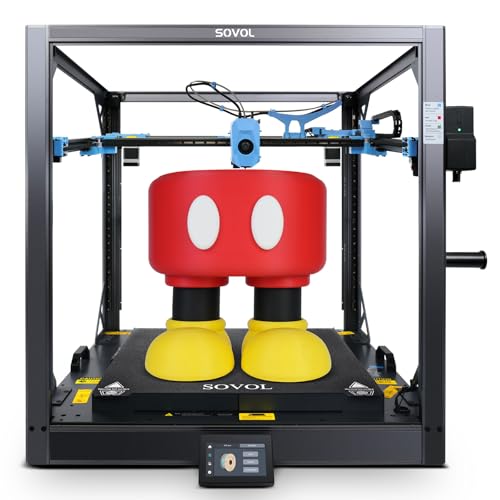
- 500mm cubed build volume
- Up to 700mm/s with CoreXY motion
- Automatic eddy-current bed scanning
Best For: Oversized prototypes, props, and industrial-scale parts
Best Flexible-Filament Value

- 420mm cubed build volume
- Supports 85A–95A TPU
- 500mm/s printing with automatic filament relay
Best For: Large TPU projects, functional parts, and small-batch work
Best Beginner-Friendly Multicolor Workflow

- Up to 600mm/s precision printing
- AMS 2 Pro supports multicolor and filament drying
- Setup in about 15 minutes with AI detection
Best For: Easy multicolor printing and streamlined everyday workflows
Best Overall Large-Format FDM

- 420×420×500mm build volume
- Up to 600mm/s printing
- Optional 4- or 8-color expansion
Best For: Oversized models and functional parts with fewer assembly steps
Best for Engineering Materials
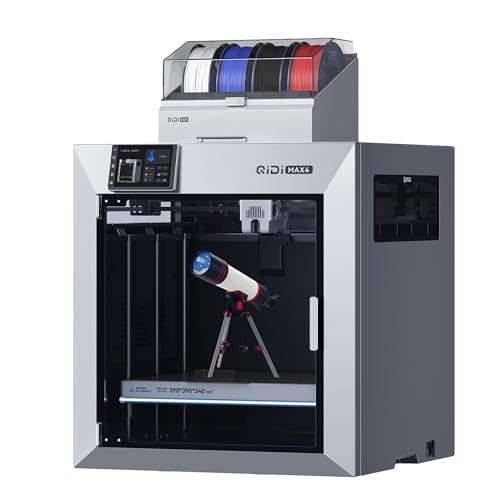
- 390×390×340mm build volume
- 65°C active heated chamber
- Supports abrasive and high-temperature materials
Best For: Large prototypes and demanding engineering-material prints
Best Value Large-Format Option

- 320×320×400mm build volume
- Up to 500mm/s printing
- Automatic leveling and dual-band Wi-Fi
Best For: Accessible large-volume prototyping and batch printing
Versatile High-Speed Pick

- 350 x 350 x 350 mm build volume
- Four-color printing included; expandable to 16 colors
- 65°C chamber and 350°C hotend support varied filaments
Best For: Creators and engineers needing large, colorful, material-flexible prints
Production-Focused Choice

- 400 x 400 x 400 mm build volume
- Up to 700 mm/s with WLAN multi-printer control
- 64-point leveling and 1000W rapid-heating bed
Best For: Print farms and businesses needing large, repeatable production
Enclosed Multicolor Performer
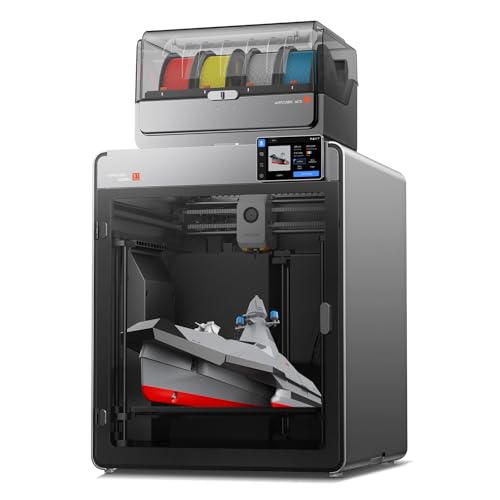
- 350 x 350 x 350 mm enclosed build space
- Up to 600 mm/s with CoreXY construction
- Four colors included, expandable to 16
Best For: Makers wanting fast, enclosed, multicolor large-format printing
Best Multicolor Large-Format Printer – Creality K2 Plus Combo
The Creality K2 Plus Combo is a strong option for shoppers comparing large format 3d printers with multicolor capability. Its 350 × 350 × 350mm build volume accommodates larger models and batches, while the enclosed, temperature-controlled design supports demanding materials.
Best For: Makers who want large prints, automated multicolor workflows, and support for engineering filaments.
Pros:
- Supports up to 16-color printing when four CFS units are connected.
- Large 350mm cubed build volume and fast printing up to 600mm/s.
- Up to 60°C chamber temperature and a 350°C hardened-steel-tip nozzle support materials such as ASA and PPA.
- Dual AI cameras, automatic leveling, and 18 smart sensors add monitoring and automation.
Cons:
- At 70.4 pounds, it is a substantial machine to position and move.
- Its extensive automation and multicolor system may be more than basic single-color users need.
Choose the K2 Plus Combo if color changes, larger parts, and high-temperature material support matter more than a compact footprint. Its rigid frame and dual Z-axis system are also designed to improve stability on demanding prints.
Best Industrial-Scale Speed – Sovol SV08 Max
The Sovol SV08 Max stands out among large format 3d printers for its 500 × 500 × 500mm print space and CoreXY motion system. It is built for oversized parts, prototypes, furniture-scale projects, and props without splitting them into smaller sections.
Best For: Users who need exceptionally large build capacity and fast production for oversized or complex parts.
Pros:
- Very large 500mm cubed build volume for full-scale prototypes and oversized prints.
- Up to 700mm/s speed, 40,000mm/s² acceleration, and a 50mm³/s high-flow nozzle.
- Eddy-current scanning and pressure-sensing touch points automate bed calibration.
- Built-in HD camera supports remote monitoring, time-lapse recording, and Obico integration.
Cons:
- The printer occupies a large 28 × 27.6 × 29.5-inch footprint and weighs 86.8 pounds.
- The optional heated-chamber module is sold separately.
- The 300°C hotend may limit some higher-temperature applications.
The SV08 Max is the capacity-focused choice in this group. Its future heated-chamber upgrade path adds flexibility, but buyers should account for the printer’s substantial space requirements and optional accessories.
Best Flexible-Filament Value – Creality Ender 3 V3 Mega
The Creality Ender 3 V3 Mega is a practical pick among large format 3d printers for makers and small workshops. Its 420 × 420 × 420mm build volume handles large models, cosplay props, and functional parts, while its flexible-filament support broadens its usefulness.
Best For: Makers and small-batch users who want a large build area with TPU capability and straightforward maintenance.
Pros:
- 420mm cubed build volume reduces the need to split large objects.
- Supports 85A, 90A, and 95A TPU for flexible parts and prototypes.
- Up to 500mm/s printing with vibration compensation for high-speed jobs.
- Automatic filament relay, runout and tangle detection, and 81-point leveling support longer prints.
Cons:
- Its large 23.22 × 23.14 × 27.46-inch footprint still requires dedicated space.
- The supplied notes emphasize PLA, PETG, and TPU rather than higher-temperature engineering materials.
For buyers who value a large platform and flexible-filament support without stepping up to the biggest machines, the Ender 3 V3 Mega offers a balanced feature set. Its quick-swap hotend and automated filament management are useful for routine production.
Best Beginner-Friendly Multicolor Workflow – Bambu Lab P2S Combo
The Bambu Lab P2S Combo is a streamlined alternative for shoppers considering large format 3d printers but prioritizing setup speed, precision, and a connected workflow. The combo includes AMS 2 Pro for multicolor and multimaterial printing, plus filament drying up to 65°C.
Best For: Beginners and experienced makers who want fast setup, automated calibration, multicolor printing, and guided software tools.
Pros:
- Prints up to 600mm/s with active flow-rate compensation and a servo extruder.
- AMS 2 Pro enables multicolor and multimaterial printing while drying filament up to 65°C.
- Ready to print in about 15 minutes with automatic calibration and AI failure detection.
- Adaptive airflow can cool prints or maintain a 50°C chamber, with carbon filtration.
Cons:
- The supplied notes do not specify a build volume, so its large-format capacity is less clear than the other listed models.
- Multicolor printing requires the Combo version; the standalone P2S does not support it.
The P2S Combo is best viewed as a workflow-oriented choice rather than a maximum-capacity machine. Its quick setup, software ecosystem, drying system, and automated checks make it appealing when ease of use and consistent results are priorities.
Best Overall Large-Format FDM – Anycubic Kobra 3 Max V2
For shoppers comparing large format 3d printers, the Anycubic Kobra 3 Max V2 stands out with a 420×420×500mm build volume. It is designed for oversized models, functional parts, reliefs, and other projects that would otherwise require multiple pieces.
Best For: Makers who want maximum build volume, fast printing, and the option to add multicolor capability later.
Pros:
- Very large 420×420×500mm print volume can reduce assembly between parts.
- Print speeds up to 600mm/s and acceleration up to 10,000mm/s² support faster output.
- 300°C full-metal hotend supports PLA, PETG, and TPU.
- Auto-leveling, filament detection, power-loss recovery, and AI monitoring support easier operation.
Cons:
- Multicolor printing requires a separately added Anycubic ACE 2 Pro.
- The large 39.6-pound printer requires substantial setup space.
The Kobra 3 Max V2 is a strong choice when print size is the priority. Its combination of a tall build area, high speed, and automated safeguards makes it practical for large models without positioning it as a specialized heated-chamber machine.
Best for Engineering Materials – QIDI Max4 Combo
Among large format 3d printers, the QIDI Max4 Combo is aimed at demanding projects that benefit from an enclosed, actively heated environment. Its 390×390×340mm build volume, 65°C heated chamber, and high-flow hotend support large prototypes, molds, and industrial-style parts.
Best For: Professionals and experienced makers printing large, high-temperature, or abrasive-material projects.
Pros:
- 390×390×340mm build volume accommodates large parts without splitting.
- 65°C active heated chamber supports materials such as ABS-CF, PC, and PPS-CF.
- Closed-loop X/Y motors, 800mm/s speed, and 30,000mm/s² acceleration target precise, efficient printing.
- AI monitoring can detect failures and pause the printer to reduce wasted material.
Cons:
- The Polar Cooler is not included and must be purchased separately.
- At 120 pounds, it is substantially heavier than the other listed options.
- QIDI BOX is required for the advertised 16-color and multimaterial expansion.
The Max4 Combo is the most equipment-focused option here. Its heated chamber and hardened-steel-nozzle compatibility make it better suited to advanced materials, while the substantial weight and optional accessories are important buying considerations.
Best Value Large-Format Option – LONGER LK10 Plus
The LONGER LK10 Plus offers a practical middle ground for shoppers evaluating large format 3d printers. Its 320×320×400mm build volume is spacious enough for large models, multiple parts, prototypes, and batch jobs while keeping the listed machine weight to 30.5 pounds.
Best For: Beginners and makers who want a roomy, fast FDM printer with straightforward automation and remote control.
Pros:
- 320×320×400mm build volume supports large models and multiple parts in one job.
- Up to 500mm/s printing and 10,000mm/s² acceleration can improve productivity.
- Direct-drive extrusion supports PLA, PETG, ABS, TPU, Nylon, and other filaments.
- Automatic leveling, smart Z offset, runout detection, power-loss recovery, and dual-band Wi-Fi simplify operation.
Cons:
- Its build volume is smaller than the Anycubic and QIDI options in this roundup.
- The supplied notes do not specify a heated chamber or a multicolor system.
The LK10 Plus is a sensible choice when you need more capacity than a typical desktop printer without moving to the heavier QIDI platform. Its auto-calibration and connectivity features are especially useful for routine prototyping and batch production.
Versatile High-Speed Pick – Anycubic Kobra S1 Max Combo
For shoppers comparing large format 3d printers, the Anycubic Kobra S1 Max Combo combines a 350 x 350 x 350 mm build volume with a fully enclosed CoreXY design and speeds up to 600 mm/s. Its bundled ACE 2 Pro system also makes four-color printing available out of the box.
Best For: Creators, engineers, and professional makers who want large prints, multi-color capability, and broad filament support.
Pros:
- 350 x 350 x 350 mm build volume supports large models and batch printing.
- ACE 2 Pro enables four-color printing, with expansion up to 16 colors.
- 65°C heated chamber and 350°C hotend support materials including PLA, PETG, TPU, ABS, ASA, and PVA.
- Auto-leveling, filament runout detection, and power-loss recovery help protect long prints.
Cons:
- Its 78.8-pound weight and large 21 x 23 x 19-inch dimensions require substantial space.
- Advanced multi-color and engineering-material features may be more than casual users need.
The Kobra S1 Max Combo is a feature-rich choice when flexibility matters as much as build size. It is particularly compelling for users who expect to switch between colorful creative projects and demanding functional prints.
Production-Focused Choice – Creality Ender 5 Max
The Creality Ender 5 Max stands out among large format 3d printers with its 400 x 400 x 400 mm build volume, CoreXY motion system, and claimed speeds up to 700 mm/s. WLAN multi-printer control and a durable frame make it especially suited to organized, repeat production.
Best For: Print farms, studios, businesses, and users producing oversized prototypes or multiple parts in batches.
Pros:
- 400 x 400 x 400 mm build volume accommodates large models and batch work.
- WLAN multi-printer control supports grouped management for scaled production.
- 64-point auto-leveling and automatic Z-offset simplify calibration.
- 1000W rapid-heating bed and dual-gear extruder support continuous workflows and materials such as PLA, PETG, ABS, ASA, and PA.
Cons:
- At 70.4 pounds, it is not an especially portable printer.
- The production-oriented feature set may be unnecessary for occasional hobby printing.
Choose the Ender 5 Max when maximum workspace and throughput are priorities. Its larger build volume and multi-printer networking give it a practical advantage for users planning repeatable, high-volume workflows.
Enclosed Multicolor Performer – Anycubic Kobra S1 Max Combo
This Anycubic Kobra S1 Max Combo is a strong large format 3d printers option for users who want an enclosed 350 x 350 x 350 mm workspace without giving up speed. The CoreXY structure, 65°C heated chamber, and bundled four-color system target both large prototypes and vivid finished models.
Best For: Makers and engineers printing large, precise parts or hands-free multicolor models with advanced materials.
Pros:
- 350 x 350 x 350 mm volume can handle large enclosures and prototypes in one piece.
- Up to 600 mm/s speed and 20,000 mm/s² acceleration support faster project turnaround.
- ACE 2 Pro provides native four-color printing and can expand to 16 colors.
- 65°C heated chamber, 350°C hotend, and LeviQ 3.0 auto-leveling support demanding workflows.
Cons:
- The 77.8-pound printer needs a sturdy, dedicated setup.
- The enclosed, multicolor design may be excessive for simple single-material projects.
This version is best suited to buyers who value a combination of enclosure, speed, and automated color changes. It offers a broad feature set for large models, engineering materials, and presentation-ready multicolor prints.
How We Picked the Best Large Format 3d Printers
We evaluated the selected models around the factors that most affect real-world ownership: build volume, advertised print speed, extrusion and bed-leveling systems, enclosure or heated-chamber capability, material compatibility, multicolor options, and ease of setup. We also considered whether each printer targets hobbyists, makers, schools, small businesses, or more demanding prototyping work.
Specifications can vary by firmware, material, nozzle, and print profile. Treat maximum speed and build volume as useful reference points rather than guarantees for every model or project.
Quick Comparison
| Priority | What to look for | Best fit |
|---|---|---|
| Maximum size | Build volumes around 400 mm or larger | Props, cosplay, furniture-scale parts, and oversized prototypes |
| Speed | CoreXY motion systems and high advertised acceleration | Frequent printing and shorter production cycles |
| Multicolor | Combo bundles with material-management systems | Display models, educational projects, and colorful functional parts |
| Advanced materials | Enclosure, heated chamber, and suitable hot-end temperature | ABS, ASA, nylon, and engineering prototypes |
Key Buying Factors for Large-Format 3D Printers
Build Volume and Machine Footprint
A larger build area lets you print fewer separate pieces, but it also increases the printer’s physical footprint, power use, and sensitivity to drafts. Measure the complete machine, including door clearance, spool holders, ventilation space, and access for maintenance.
Speed, Motion System, and Print Quality
High-speed printing is most useful when the frame is rigid and the motion system can maintain accuracy. CoreXY designs often suit fast production, while a well-tuned Cartesian printer can still deliver excellent results. Look for automatic calibration, input shaping, flow control, and reliable first-layer detection.
Materials and Temperature Control
PLA and PETG are relatively approachable, but ABS, ASA, nylon, and fiber-filled materials benefit from an enclosure, strong hot end, hardened nozzle, and—especially for difficult materials—a heated chamber. Confirm the printer’s actual temperature ratings and recommended materials before buying.
Automation and Multicolor Workflow
Automatic leveling, filament runout detection, remote monitoring, and recovery features reduce supervision. Multicolor systems add creative flexibility, but they can increase waste, setup time, and maintenance. Choose one when color changes are central to your workflow, not simply because the feature is available.
Who Should Buy Which Large Format 3d Printers?
Choose a very large 400 mm-class machine if you regularly print oversized props, enclosures, prototypes, or replacement parts. A fast CoreXY model is better for users who value throughput and can spend time tuning profiles. Multicolor combo printers suit makers, educators, and creators producing presentation-ready models. An enclosed printer with stronger temperature control is the safer choice for engineering materials and functional parts.
If you are new to large-format 3D printers, prioritize dependable auto-leveling, straightforward software, accessible replacement parts, and a strong community over headline speed. For occasional large prints, a more affordable open-frame model may provide better value than paying for advanced chamber or multicolor features you will rarely use.