
A bigger build area lets you print props, models, organizers, and functional parts with fewer seams. But a large printer also needs more desk space, longer print times, and dependable first-layer adhesion.
These five listings cover enclosed and open-frame FDM options. Because some names appear to overlap, check the exact configuration and seller listing before you buy.
Best 5 Large Format 3d Printers for Hobbyists Picks for 2026
Best for Multicolor Builds
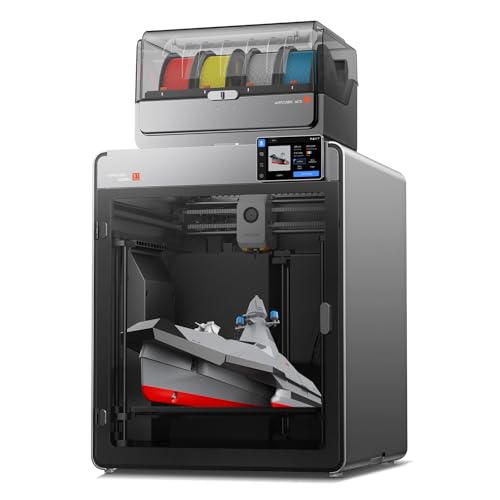
- 350 × 350 × 350 mm build volume
- Four colors included; expandable to 16
- Enclosed CoreXY with heated chamber
Best For: Large, multicolor hobby projects
Best for Long-Print Safeguards

- 350 × 350 × 350 mm enclosed build area
- Runout detection and power-loss recovery
- Hardened steel extruder gears and nozzle
Best For: Large or batch prints with interruption safeguards
Best for Tall Prints

- 320 × 320 × 400 mm build volume
- Up to 500 mm/s stated print speed
- Auto leveling and dual-band Wi-Fi
Best For: Tall models and multi-part print jobs
Best for Taller DIY Prints
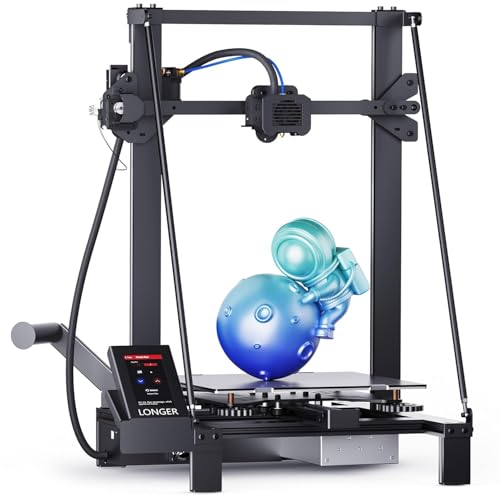
- 300 x 300 x 400 mm build volume
- Filament detection and power-loss resume
- Open-source firmware and TMC2209 driver
Best For: Taller DIY prints and firmware tinkering
Best for Easy Setup

- 300 x 300 x 400 mm build area
- Filament detection and power-loss resume
- Reinforced frame and glass platform
Best For: Roomy home projects with interruption safeguards
Best for Multicolor Builds – Anycubic Kobra S1 Max Combo
Among large format 3d printers for hobbyists, the Anycubic Kobra S1 Max Combo stands out for pairing a 350 × 350 × 350 mm build volume with four-color printing out of the box. Its enclosed CoreXY design lets makers tackle large, detailed projects without splitting them into smaller pieces.
Best For: Hobbyists who want large, multicolor prints and an enclosed printer for a range of filament types.
Pros:
- 350 × 350 × 350 mm build area accommodates large models in one piece.
- Included ACE 2 Pro supports four colors; additional units can expand capacity to 16 colors.
- 65°C heated chamber, 350°C hotend, and LeviQ 3.0 auto-leveling broaden material options and simplify setup.
Cons:
- At 77.8 pounds, it takes planning to move or reposition.
- Expanding beyond four colors requires additional ACE 2 Pro units.
This is a strong fit when multicolor capability matters as much as print size. Its stated maximum speed is 600 mm/s, though the practical appeal is the combination of space, enclosure, and automated color handling.
Best for Long-Print Safeguards – Anycubic Kobra S1 Max Combo
The Anycubic Kobra S1 Max Combo is another option among large format 3d printers for hobbyists who want a 350 × 350 × 350 mm workspace. This listing emphasizes safeguards for lengthy jobs, including filament runout detection and power-loss recovery, alongside its enclosed CoreXY construction.
Best For: Makers printing large functional parts or batches who value print-interruption protection.
Pros:
- Spacious build area handles large models or batches of smaller parts.
- Hardened steel extruder gears and nozzle are designed for wear resistance with abrasive filaments.
- LeviQ 3.0 auto-leveling, runout detection, and power-loss recovery support long print jobs.
- Includes four-color printing through the ACE 2 Pro.
Cons:
- Listed at 78.8 pounds, so it is not easy to relocate.
- Printing in more than four colors requires additional ACE 2 Pro units.
The 65°C heated chamber and 350°C hotend add flexibility for the listed materials, including ABS and ASA. Choose this listing if its extrusion hardware and long-print safeguards are priorities; its stated top speed is 600 mm/s.
Best for Tall Prints – LONGER LK10 Plus
If vertical space tops your list of priorities when comparing large format 3d printers for hobbyists, the LONGER LK10 Plus offers a 320 × 320 × 400 mm build volume. Its 400 mm print height gives tall models room without dividing them into sections.
Best For: Hobbyists making tall models or printing multiple parts in one job.
Pros:
- 400 mm build height accommodates taller designs.
- Klipper firmware supports a stated maximum print speed of 500 mm/s.
- Direct-drive extruder supports listed filaments including PLA, PETG, TPU, ABS, and Nylon.
- Automatic bed leveling, Z-offset calibration, and dual-band Wi-Fi simplify day-to-day use.
Cons:
- Its 320 × 320 mm bed is smaller than the 350 × 350 mm beds of the two Anycubic listings here.
- Its stated 500 mm/s maximum speed is lower than the two Anycubic listings’ 600 mm/s maximum.
At a listed 30.5 pounds, the LK10 Plus is lighter than the other printers in this roundup. It makes the most sense when added build height and direct-drive filament flexibility matter more than maximum bed width.
Best for Taller DIY Prints – Longer LK5 Pro 3
Among large format 3d printers for hobbyists, the Longer LK5 Pro 3 offers a 11.8 x 11.8 x 15.7-inch build volume with extra height for larger DIY projects. Its reinforced triangular frame and glass platform are designed to support stable printing.
Best For: Hobbyists who want room for taller prints and the flexibility of open-source firmware.
Pros:
- 300 x 300 x 400 mm build volume accommodates larger projects.
- Filament detection and power-loss resume help protect long prints.
- TMC2209 driver, open-source firmware, and a stated 180 mm/s printing speed.
Cons:
- Open-frame design leaves the print area exposed.
- Pre-assembled does not mean fully assembled; some setup remains.
This is a practical pick if build height and firmware flexibility matter more to you than a fully enclosed, ready-to-use machine. The listed speed and precision are specifications, not guarantees for every print.
Best for Easy Setup – Longer LK5 Pro
The Longer LK5 Pro is another option among large format 3d printers for hobbyists, pairing an 11.8 x 11.8 x 15.7-inch build area with filament detection and power-loss resume. Those safeguards are particularly useful when a larger project takes longer to finish.
Best For: Home DIY users who want a roomy FDM printer with features that can help recover interrupted prints.
Pros:
- 300 x 300 x 400 mm maximum build size provides space for larger models.
- Filament and power detection can pause prints; power-loss resume continues from the last position.
- Reinforced triangular frame, glass platform, and dual fans support stable printing and cooling.
Cons:
- Open-frame construction does not enclose the print area.
- Some assembly remains despite the pre-assembled listing.
Choose this listing for its combination of print capacity and interruption safeguards. Its stated 180 mm/s speed and 0.1 mm precision are best treated as listed capabilities rather than assured results for every model.
How We Picked the Best Large Format 3d Printers for Hobbyists
We focused on the listed build dimensions, printer style, and features that matter when hobby projects grow beyond a standard build plate. The selection includes a 350 × 350 × 350 mm enclosed option, a 320 × 320 × 400 mm option, and open-frame machines listed at approximately 300 × 300 × 400 mm. Product names alone cannot establish print quality or reliability, so treat specifications and seller claims as starting points to verify, not performance guarantees.
There are five selected listings, but two use the same Kobra S1 Max Combo name and two repeat the LK5 Pro 3 name. They may represent duplicate listings rather than five distinct printer models. Compare the model number, included accessories, warranty, and seller before assuming similarly named offers are different.
Quick Comparison
Most room across the build plate: The listed Anycubic Kobra S1 Max Combo offers a 350 × 350 mm footprint and 350 mm of height. Most listed height: The LONGER LK10 Plus lists 400 mm of vertical space with a 320 × 320 mm plate. Open-frame alternative: The Longer LK5 Pro 3 listings specify roughly 300 × 300 × 400 mm. Check the current product page for exact usable dimensions and what comes in the box.
Key Buying Factors for Large-Format 3D Printers for Hobbyists
Measure the Part and the Space
Start with the largest object you want to print in one piece, then allow room for a brim, supports, and the model’s orientation. Compare all three build dimensions; a taller printer does not necessarily fit a wider prop. Measure the printer’s full footprint, including spool placement, cable clearance, and space to reach the bed.
Plan for Long Prints
Large parts can run for many hours or days. Look for reliable bed leveling, consistent first layers, and a suitable print surface. Resume-printing features can help after an interruption, but they do not prevent failed adhesion or guarantee an invisible join. Before a major print, test your filament and settings on a smaller section.
Check Enclosure, Materials, and Running Costs
An enclosure can help limit drafts and improve temperature consistency, while an open frame may be easier to access and work on. Confirm the materials you intend to use are supported by the printer’s actual hotend, bed, and enclosure specifications. Larger prints also consume more filament and may need sturdier supports, so budget for failed attempts as well as finished parts.
Who Should Buy Which Large Format 3d Printers for Hobbyists?
Choose the Kobra S1 Max Combo listing if you need the widest listed build plate here and want an enclosed format; verify the exact Combo package before paying for extras. Consider the LK10 Plus if tall, single-piece prints are your priority and its 320 mm plate is wide enough. Consider the LK5 Pro 3 if you prefer an open-frame design and its approximately 300 mm square plate fits your projects. If your parts can be split easily or you rarely use the extra space, a smaller printer may be cheaper to run and easier to accommodate.