
The best interactive solar system models turn astronomy into a hands-on activity. Instead of only displaying planets, these kits may use gears, motors, lights, sounds, puzzles, or construction projects to help children understand planetary order and motion.
We compared 10 options across age range, interactivity, assembly, educational value, included materials, and display appeal to help you choose a model that fits your child, classroom, or science project.
Best 10 Interactive Solar System Models Picks for 2026
Best Bilingual Learning Pick
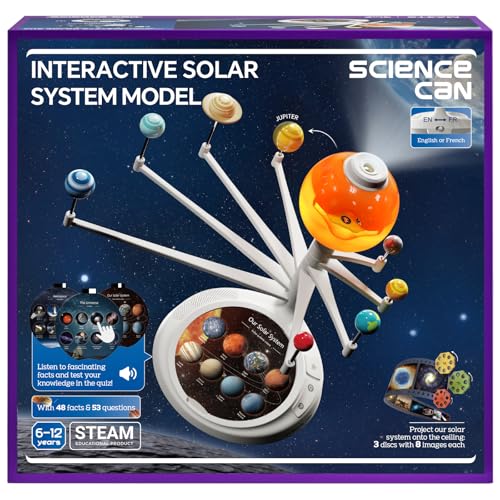
- 48 facts with English and French options
- 53-question interactive quiz mode
- Projects 24 colorful space images
Best For: Bilingual learners ages 6–12 who prefer guided, visual activities
Best Build-and-Experiment Option
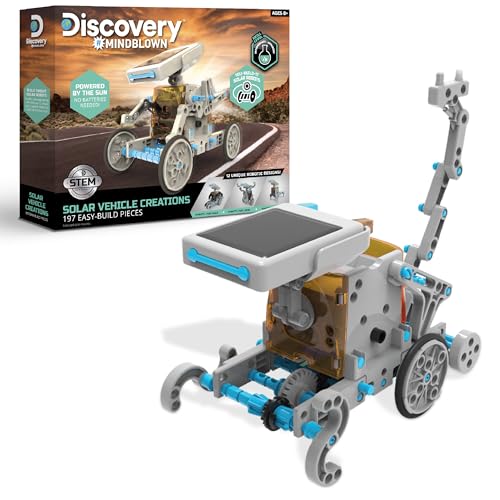
- Build 12 different robot designs
- Solar panel powers a working motor
- Includes 197 pieces for custom creations
Best For: Hands-on builders ages 8+ exploring gears and solar power
Best Motorized Display
GeoSafari Motorized Solar System

- Planets orbit at different speeds
- Projects constellations with a star dome
- Includes eight planets and a 28-page guide
Best For: Ages 8–12 needing a visual home or classroom display
Best DIY Construction Model

- Builds a rotating solar system
- Teaches planets, orbits, day, and night
- Uses eco-friendly, child-safe MDF
Best For: Ages 8–14 who learn through building and mechanical play
Glow-and-Build Favorite
National Geographic Solar System

- Paint and customize all eight planets and the sun
- Movable arms support adjustable displays
- Glow-in-the-dark accents add nighttime appeal
Best For: Kids 8 and up who want a creative astronomy project and room decor
Mechanical STEM Pick
Thames & Kosmos Orbiting Model

- Wind-up motor rotates the planets without batteries
- Explores gear ratios and planetary gears
- Suitable for science-fair and STEM activities
Best For: Learners who want a hands-on mechanical model with moving planets
Classroom Craft Kit
Wookidel 64-Piece Solar System

- Includes foam pieces, paints, brushes, sticks, and flags
- Encourages coloring, assembly, and astronomy learning
- Useful for school projects and family activities
Best For: Kids 6 to 12 completing creative classroom or home astronomy projects
Glow-Build Astronomy
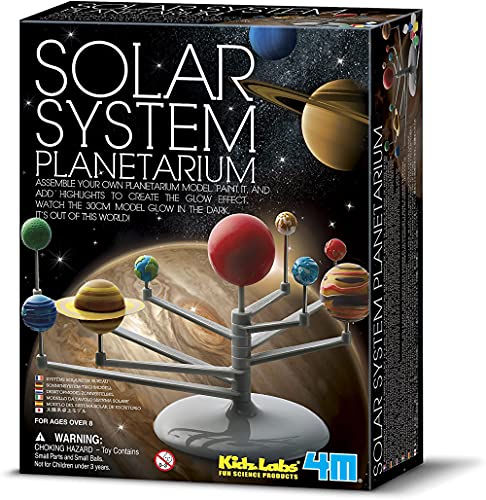
- Assemble, paint, and decorate the planets
- Includes glow paint, chart, and quiz questions
- Recommended for ages 8 and up
Best For: Craft-focused STEM learning and glow-in-the-dark displays
Poster-Mount Space Lab
Crayola Solar System Science Kit

- Paint nine planets and the Sun
- Includes washable paint and learning guide
- Mounts on a 3-foot galaxy poster
Best For: Colorful poster displays and beginner space crafts
Woodland Planet Project

- Build and paint a wood solar system model
- Includes puzzle and planetary fact cards
- Designed for ages 8–12 and science fairs
Best For: Science-fair projects and hands-on model building
Best Bilingual Learning Pick – Talking Solar System Model
For families seeking interactive solar system models with guided instruction, this talking model combines bilingual knowledge cards, quiz play, and planetarium-style projection. It covers 48 space facts, offers 53 quiz questions, and projects 24 colorful space images.
Best For: Kids ages 6–12 who enjoy spoken lessons, quizzes, and visual space exploration in English or French.
Pros:
- Includes 48 facts across three knowledge cards with English and French options.
- Interactive quiz mode provides 53 astronomy questions.
- Three projector disks create 24 full-color space images on walls or ceilings.
- Illuminated sun helps demonstrate how sunlight affects other planets.
Cons:
- Requires three AA batteries, which are not included.
- The plastic model is intended for children and may be less suitable for advanced astronomy study.
This is a strong choice when you want an interactive model that explains concepts aloud and adds a projector for immersive play. Its bilingual format also makes it more versatile for learning at home or in classroom STEM activities.
Best Build-and-Experiment Option – Solar Robot Creation Kit
Although it is robot-focused rather than a traditional planet display, this kit suits children who want interactive solar system models with a stronger engineering component. Its solar panel powers a working motor, while 197 pieces support 12 robot designs and custom builds.
Best For: Builders ages 8 and up who are more interested in solar power, gears, construction, and hands-on STEM challenges than planet facts.
Pros:
- Provides parts and blueprints for 12 different working robots.
- Solar-powered motor introduces practical renewable-energy concepts.
- 197 pieces allow children to create original designs after following the plans.
- Supports problem solving, creativity, motor skills, and STEM learning.
Cons:
- It does not model the planets or teach solar system structure directly.
- The motor works best outdoors on a sunny day, so use depends on adequate sunlight.
Choose this option if “solar” means an opportunity to build and test a functioning mechanism. It is less appropriate for astronomy instruction, but it offers substantial construction value and repeat play through multiple robot designs.
Best Motorized Display – GeoSafari Motorized Solar System
This GeoSafari model is a practical choice among interactive solar system models for children who learn best by watching movement. The inner and outer planets orbit the light-up sun at different speeds, while a replaceable star dome projects constellations onto a wall or ceiling.
Best For: Kids ages 8–12 who want a moving bedroom or classroom display with both planet and constellation activities.
Pros:
- Shows the inner and outer planets orbiting at different speeds.
- Includes swappable sun and star domes for two types of exploration.
- Star dome projects constellations and can function as an auto-shutoff night-light.
- Comes with eight planets and a 28-page, full-color guide.
Cons:
- Requires four AA batteries, which are not included.
- It is a display-oriented model, so it offers less spoken or quiz-based interaction.
The motorized orbit display makes planetary motion easy to observe, while the constellation dome adds a useful second mode. It is a well-rounded pick for families wanting a durable visual aid rather than a build-it-yourself kit.
Best DIY Construction Model – Gear-Driven Planet Model
For children who prefer making their own interactive solar system models, this Smartivity kit uses a gear-driven design to create a rotating planet display. Assembly introduces planets, orbits, day and night, and the basic structure of the solar system through hands-on construction.
Best For: Kids ages 8–14 who enjoy building projects and learning astronomy concepts by assembling and operating a model.
Pros:
- Children assemble a rotating solar system with a gear-driven mechanism.
- Connects construction play with planets, orbits, day, and night.
- Encourages curiosity, creativity, and practical STEM learning.
- Uses eco-friendly, child-safe MDF materials and gift-ready packaging.
Cons:
- Assembly is required, so it may need more time and patience than a ready-to-use model.
- The supplied notes do not specify included fact cards, quizzes, or projection features.
This kit is a good fit when the building process matters as much as the finished display. Its rotating gears provide visible motion, while the assembly experience helps children connect mechanical movement with basic astronomy.
Glow-and-Build Favorite – National Geographic Solar System
For shoppers seeking interactive solar system models with a creative display element, this National Geographic kit combines planet painting, movable arms, and glow-in-the-dark accents. It includes the core supplies and kid-friendly instructions needed to build and decorate all eight planets and the sun.
Best For: Kids ages 8 and up who enjoy hands-on astronomy projects and space-themed room decor.
Pros:
- Includes planets, sun, paints, brush, palette, decals, and an informational poster.
- Movable arms let kids adjust and rearrange the planetary display.
- Glow-in-the-dark accents add an engaging nighttime feature.
- Supports construction, creative, coordination, and problem-solving skills.
Cons:
- The manufacturer recommends it for ages 8 and up, so it may not suit younger children.
- It requires painting and assembly before it can be displayed.
This is a strong choice when you want an interactive model that doubles as a personalized decoration. Its emphasis is on building, painting, and repositioning rather than motorized movement.
Mechanical STEM Pick – Thames & Kosmos Orbiting Model
This Thames & Kosmos kit is a practical option for shoppers comparing interactive solar system models that demonstrate motion. Kids build a rotating display powered by a wind-up motor, while exploring gear ratios, planetary gears, and basic orbital concepts without batteries.
Best For: STEM-focused learners ages 6 to 14 who want a mechanical project for home learning or a science fair.
Pros:
- Wind-up motor sets the planets in motion without batteries.
- Introduces gear mechanics, gear ratios, and planetary gears.
- Includes plastic building pieces, planet stickers, a suction cup, and manual.
- Built-in expansion slot allows for a possible Planet Nine addition.
Cons:
- Listed as an intermediate-difficulty kit, so younger children may need assistance.
- It is a small model and includes fewer decorative supplies than paint-and-build kits.
Choose this model when movement and mechanical learning matter more than glow effects or extensive customization. The wind-up design makes the rotation easy to demonstrate while keeping the activity battery-free.
Classroom Craft Kit – Wookidel 64-Piece Solar System
For families or classrooms looking for interactive solar system models centered on crafting, the Wookidel kit provides foam pieces, paints, brushes, bamboo sticks, flags, and instructions. Children can color and assemble the components while building a more hands-on understanding of the planets.
Best For: Kids ages 6 to 12 working on classroom assignments, family activities, or introductory astronomy projects.
Pros:
- Includes 64 pieces, 12 paint colors, two brushes, a palette, and instructions.
- Foam surfaces are designed to be easy to color.
- Supports hand-eye coordination, focus, artistic skills, and basic science learning.
- Works well for school projects and family activities.
Cons:
- It is a foam craft kit rather than a motorized or repositionable orbital model.
- The manufacturer recommends ages 6 to 12, limiting its fit for older learners seeking advanced mechanics.
This kit is best viewed as an accessible project supply set for painting and assembly. It offers plenty of components for creative learning, but shoppers wanting actual rotating planetary motion should consider a mechanical model instead.
Glow-Build Astronomy – DIY Solar System Planetarium
The 4M Solar System Planetarium is a hands-on choice for families comparing interactive solar system models. Children assemble and paint the planets, add glow paint, and use the included chart and quiz questions to reinforce basic astronomy concepts.
Best For: Kids ages 8 and up who enjoy craft-based STEM projects and a glow-in-the-dark display.
Pros:
- Includes planets, stencils, rods, string, glow paint, and assembly instructions.
- Includes a fact-filled wall chart and 10 sets of Kidz Quiz questions.
- Requires no batteries and supports hands-on STEM learning.
Cons:
- Children must assemble and paint the model, so it requires project time.
- Pluto is not included.
This kit combines art and science in a display children help create themselves. It is a practical pick when you want an interactive solar system model with added quiz and glow features rather than a ready-made decoration.
Poster-Mount Space Lab – Crayola Solar System Science Kit
Crayola Solar System Science Kit, Educational Toy, Gift for Kids, Ages 7, 8, 9, 10
Check Price On AmazonThe Crayola Solar System Science Kit offers an approachable way to evaluate interactive solar system models for younger learners. Kids paint the included planet and Sun hemispheres, then mount them on a large galaxy poster while using the learning guide to explore space topics.
Best For: Kids ages 8 and up who want a colorful solar system craft with a large room-display poster.
Pros:
- Includes nine planet hemispheres and one Sun hemisphere.
- Provides washable paint strips, a brush, stickers, tape, and a learning guide.
- The planets mount on a 3-foot poster for prominent display.
Cons:
- The model uses hemispheres mounted to a poster rather than freestanding spherical planets.
- Painting and mounting require adult or child assembly time.
This is a straightforward craft-and-learn option with supplies included for painting and display. Choose it when a large poster presentation matters more than a hanging or free-standing model.
Woodland Planet Project – Nine Planets DIY Model
The Nine Planets DIY Solar System Model is a project-oriented option among interactive solar system models. Children build and paint a wood model, assemble a puzzle, and use fact cards to study the Sun and the eight planets plus Pluto-era nine-planet presentation described by the kit.
Best For: Kids ages 8–12 preparing a science-fair project or wanting a paintable wood model with fact cards.
Pros:
- Combines a wood model, puzzle, paint, brushes, and fact cards.
- Designed for display in a bedroom, classroom, or science fair.
- Estimated build time is approximately one to two hours.
Cons:
- It requires hands-on construction and painting rather than immediate play.
- The listed included components mention Styrofoam balls, while the product description emphasizes a wood model.
This kit emphasizes making, studying, and presenting a finished project. It suits families looking for an interactive solar system model that can support a school assignment, provided they are comfortable with the included materials and assembly process.
How We Picked These Interactive Solar System Models
We focused on kits that do more than provide static planet pieces. The roundup includes motorized and gear-driven models, build-your-own projects, glow-in-the-dark planetariums, talking models, and activity kits. We considered the recommended age, assembly difficulty, durability, accuracy of the included components, and how clearly each kit supports astronomy or STEM learning.
Because these products serve different purposes, “best” depends on whether you want guided instruction, open-ended construction, a classroom demonstration, or an attractive model for a child’s room. Adult supervision may be useful for younger children, particularly when kits include small parts, tools, batteries, or detailed construction steps.
Quick Comparison
| Model type | Best for | What to look for |
|---|---|---|
| Motorized system | Demonstrating planetary movement | Power source, rotation speed, and assembly requirements |
| Gear-driven kit | Hands-on engineering | Gear quality, build time, and age suitability |
| DIY project kit | Creative STEM activities | Included parts, paint, tools, and instructions |
| Glow-in-the-dark model | Bedroom display and visual learning | Charging method, visibility, and mounting options |
| Fact or talking model | Independent learning | Audio content, controls, and battery requirements |
Key Buying Factors for Interactive Solar System Models
Interactivity and Learning Goal
Choose a motorized or gear-based model if the main goal is to show motion and mechanical relationships. A talking or fact-focused model may be better for children who learn through listening. DIY kits are useful when the activity itself matters as much as the finished display.
Age, Supervision, and Complexity
Check the manufacturer’s age recommendation before buying. Younger children often benefit from larger pieces and simpler assembly, while older children may prefer multi-step construction, gears, puzzles, or engineering challenges. Review whether painting, cutting, glue, batteries, or adult help are required.
Included Components and Power
Confirm what comes in the box. Some kits may require batteries, paint, glue, tools, or additional craft supplies. For motorized models, consider whether the power system is battery-operated, windup, or solar-assisted, and whether replacement parts or consumables are easy to obtain.
Display Quality and Accuracy
If the model will remain on a shelf or in a bedroom, consider its footprint, stability, lighting, and finish. Look for clear planet labeling and an understandable layout. Most children’s models are not to scale, so treat them as learning aids rather than precise astronomical instruments.
Who Should Buy Which Interactive Solar System Models?
Choose a motorized model for a child who wants to see planets move, or for a parent or teacher demonstrating orbital concepts. Gear-driven options suit children who enjoy building mechanisms and solving construction challenges. Glow-in-the-dark planetariums are a strong choice for visual learners and bedroom displays.
For science fairs, homeschool lessons, or family projects, a DIY kit with painting and assembly can provide a longer activity. A talking or fact-based model may be preferable for independent exploration, while a larger multi-piece project kit can work well when siblings or classmates need to share the activity. Before ordering, match the kit’s complexity and required supplies to the child’s patience, skills, and intended use.