
The best illuminated solar system models make astronomy easier to understand by combining physical movement, lighting, and hands-on exploration. They can turn abstract lessons about planets, orbits, and scale into engaging activities for children, teens, and curious adults.
This roundup compares 10 options ranging from motorized classroom-style orreries and talking educational kits to glow-in-the-dark sets, DIY builds, and decorative LED models. Use the guide below to match features, age range, learning goals, and display preferences with the right model.
Best 10 Illuminated Solar System Models Picks for 2026
Best Creative Build
National Geographic Glow-in-the-Dark Solar System

- Paint-and-build kit with all eight planets and the Sun
- Movable arms support adjustable display positions
- Includes glow paint, decals, and a solar system facts poster
Best For: Creative STEM projects and space-themed room décor
Best Orbital Demonstration
Eisco Illuminated Sun, Earth & Moon Model
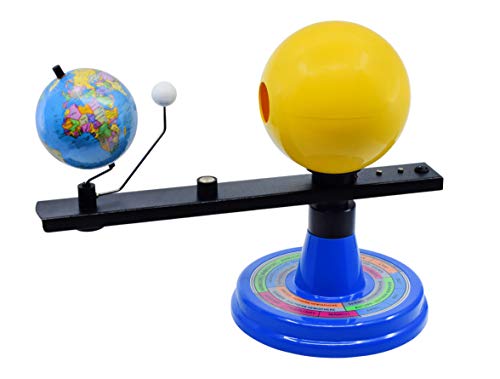
- Gear-driven mechanism demonstrates orbital motion
- Illuminated Sun helps explain light and eclipses
- Month-labeled base and activities support structured learning
Best For: Adult learners, educators, and Sun-Earth-Moon demonstrations
Best Motorized Display
GeoSafari Motorized Solar System

- Shows planets orbiting at different speeds
- Swaps between a light-up Sun and star projector
- Includes eight planets and a 28-page learning guide
Best For: Interactive bedroom or classroom space displays
Best Interactive Learning
Science Can Talking Solar System Model
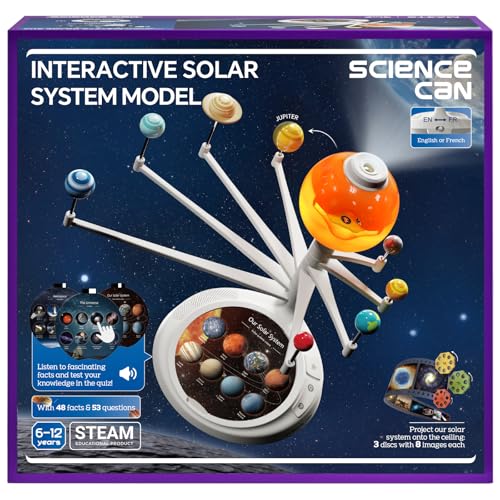
- Teaches 48 facts through bilingual knowledge cards
- Adds a 53-question interactive quiz mode
- Projects 24 colorful space images onto walls or ceilings
Best For: Bilingual astronomy learning and projection-based play
Best Orbital Demonstrator
Sun Earth Moon Model with Light

- Shows rotation, revolution, seasons, and lunar orbit
- Illuminated Sun activates with a button
- Supports introductory astronomy lessons
Best For: Hands-on Sun-Earth-Moon demonstrations
Best DIY Build
Smartivity Gear-Driven Solar System Kit

- Children assemble a rotating planet model
- Teaches orbits, day and night, and solar system structure
- Eco-friendly, child-safe MDF for ages 8–14
Best For: Hands-on DIY STEM learning and gift giving
Decorative Pick

- Laser-engraved 3D planetary design
- Six-color touch-activated lighting
- Compact gift-ready tabletop décor
Best For: Space lovers wanting a decorative night light
Hands-On STEM Pick
Dual-Mode Spinning Solar System Kit
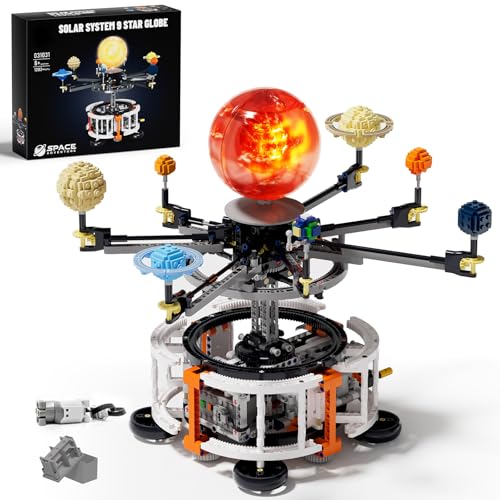
- 1,282-piece buildable astronomy kit
- Hand-crank and automatic rotation modes
- Light-up Sun with eight modeled planets
Best For: Children who enjoy building and observing motion
Best Simple Pick
Talking Solar System Projector

- Projects planets and 24 space images
- Bilingual English and Spanish facts
- Works as a night light or flashlight
Best For: Young learners exploring astronomy at bedtime
Best Creative Build – National Geographic Glow-in-the-Dark Solar System
For families seeking illuminated solar system models with a hands-on project element, this National Geographic kit combines painting, assembly, and glow-in-the-dark display. Kids build all eight planets and the Sun, then use the movable arms to adjust the finished model.
Best For: Kids ages 8 and up who enjoy creative STEM projects and space-themed bedroom décor.
Pros:
- Includes planets, Sun, paints, glow-in-the-dark accent paint, brush, palette, decals, and an educational poster.
- Movable arms make it easy to rearrange the planetary display.
- Supports construction, creativity, hand-eye coordination, and problem-solving skills.
Cons:
- Requires painting and assembly before it can be displayed.
- The glow-in-the-dark effect depends on the included accent paint and exposure to light.
This is a strong pick when the learning experience matters as much as the finished display. It offers more customization than a ready-to-use model, while the included facts poster adds educational context.
Best Orbital Demonstration – Eisco Illuminated Sun, Earth & Moon Model
Among illuminated solar system models, the Eisco orbital model is designed for demonstrating motion and celestial relationships rather than simply displaying planets. Its gear-driven mechanism, illuminated Sun, and month-labeled base make eclipses, moon phases, and Earth’s yearly position easier to explore.
Best For: Adult learners, educators, and STEM demonstrations focused on the Sun-Earth-Moon system.
Pros:
- Gear-driven motion simulates orbital movement for hands-on demonstrations.
- A 12V bulb illuminates the Sun to show the interplay of light.
- Supports eclipse alignment, moon-phase, and calendar-based learning with three included activities.
Cons:
- Recommended for adults ages 18 and up.
- Its focus on the Sun, Earth, and Moon does not provide a full eight-planet display.
- The larger 14-inch format may require dedicated tabletop space.
This model is better suited to structured instruction and demonstration than casual children’s play. Choose it when mechanical movement and eclipse visualization are more important than a broad planetary lineup.
Best Motorized Display – GeoSafari Motorized Solar System
The GeoSafari is a practical choice for shoppers comparing illuminated solar system models with motorized movement. It displays the inner and outer planets orbiting at different speeds, while interchangeable Sun and star domes add either a light-up display or constellation projection.
Best For: Kids ages 8–12 who want an interactive bedroom or classroom space display.
Pros:
- Motorized planets orbit at different speeds for an engaging visual demonstration.
- Swappable Sun and star domes provide a light-up display or constellation projection.
- Includes eight planets and a 28-page guide covering planetary facts and constellation stories.
Cons:
- Requires four AA batteries, which are not included.
- The motorized design offers less hands-on customization than a build-and-paint kit.
This model balances planetary motion with nighttime projection features. It is especially appealing for children who prefer an immediately usable interactive toy over an assembly project.
Best Interactive Learning – Science Can Talking Solar System Model
For families wanting illuminated solar system models with guided learning, this Science Can model adds talking knowledge cards, quiz questions, and a planetarium-style projector. The Sun lights up during play, and the included discs project colorful space images onto walls and ceilings.
Best For: Kids ages 6–12 who benefit from interactive, bilingual astronomy activities and projection play.
Pros:
- Three knowledge cards provide 48 space facts in English and French.
- Quiz mode includes 53 questions to reinforce astronomy concepts.
- Three projector discs provide 24 full-color images for wall or ceiling projection.
- No assembly is required.
Cons:
- Requires three AA batteries, which are not included.
- Its compact model and projector are designed for interactive learning rather than a detailed display model.
This is a versatile option when children are motivated by questions, spoken information, and visual projection. The bilingual content and no-assembly setup make it convenient for home play or classroom activities.
Top Glow Ceiling Pick – 3D Glow Solar System Ceiling Kit
If you want illuminated solar system models that double as playful room decor, this glow-in-the-dark ceiling kit is a practical choice for younger children. It includes nine planets, more than 200 adhesive stars, and a solar system guide, with no batteries required.
Best For: Children ages 5 and up who enjoy space-themed decor and introductory STEM learning.
Pros:
- Includes nine glow-in-the-dark planets and over 200 adhesive stars.
- Stars come in different sizes and are designed to be easy to remove without damaging walls.
- Can function as a night light and includes fascinating planetary facts.
- No batteries are required.
Cons:
- It is a ceiling decor kit rather than a rotating or mechanical model.
- The manufacturer lists a narrow recommended age of 5 years.
This is a strong option when visual appeal and simple space learning matter more than detailed orbital demonstrations. Its compact format and glow effect make it especially suitable for a child’s bedroom.
Best Orbital Demonstrator – Sun Earth Moon Model with Light
Among illuminated solar system models, this Sun-Earth-Moon orbital model focuses on demonstrating movement and basic astronomy concepts. It is designed to show Earth’s rotation, its revolution around the Sun, the Moon’s orbit, seasons, moon phases, and eclipses, with a built-in light activated by a button.
Best For: Learners studying introductory astronomy concepts and families seeking a hands-on educational display.
Pros:
- Illustrates Earth’s rotation, orbit around the Sun, and the Moon’s orbit in one model.
- Can help explain seasons, moon phases, eclipses, and the 24 Solar Terms.
- The Sun lights up when the raised button is pressed after removing the wire.
- Instructions are provided in English.
Cons:
- The notes caution that it is not intended for rigorous astronomy research.
- The listed manufacturer age range is 14–17 years, while the general age description says adult.
- Its focus is the Sun-Earth-Moon system rather than a full planetary model.
This model is most useful when you want a physical demonstration of orbital relationships rather than a decorative full solar system. It offers more instructional motion than a glow-only kit, but expectations should remain at the introductory level.
Best DIY Build – Smartivity Gear-Driven Solar System Kit
For children who prefer building to simply viewing, this illuminated solar system models alternative is a hands-on gear-driven kit. Kids assemble a rotating planet model while exploring orbits, day and night, and the structure of the solar system through construction and play.
Best For: Curious children ages 8–14 who enjoy DIY STEM projects and interactive astronomy activities.
Pros:
- Combines assembly, rotation, creativity, and basic astronomy.
- Encourages learning about planets, orbits, day and night, and solar system structure.
- Made from eco-friendly, child-safe MDF materials.
- Packaged as a gift-ready educational project.
Cons:
- It requires assembly, so it may not suit children seeking an immediately usable model.
- The kit is aimed at ages 8–14 and may be less suitable for younger children.
- The supplied notes do not specify an included light feature.
This is a compelling pick for children who learn best by making and manipulating things. Choose it for construction-focused STEM play, but select another model if illumination is your primary requirement.
Decorative Pick – 3D Solar System Crystal Ball
For shoppers seeking illuminated solar system models as decorative accents, this compact crystal ball combines a laser-engraved planetary design with a touch-activated, color-changing base. Its polished K9 crystal construction and included gift box make it suited to desks, shelves, and gifting.
Best For: Space enthusiasts who want a small tabletop ornament that also functions as a colorful night light.
Pros:
- 3D solar system pattern is laser engraved inside the crystal.
- Six lighting colors provide decorative variety.
- Includes a colored base and gift box.
- Compact 2.36-inch tabletop size fits desks and shelves.
Cons:
- Its small size makes it more of a display piece than a detailed teaching model.
- The notes do not specify a battery or power source.
This is a strong choice when appearance and ambient lighting matter more than hands-on planetary movement or detailed instruction. The touch control and gift-ready packaging add convenience for casual décor and presents.
Hands-On STEM Pick – Dual-Mode Spinning Solar System Kit
This illuminated solar system model is designed for children who want to build and observe planetary motion. The 1,282-piece kit represents the Sun and eight planets, adds a light-up Sun, and supports both hand-crank and motorized movement.
Best For: Kids ages 6 and up who enjoy construction projects, moving models, and introductory astronomy activities.
Pros:
- Models the Sun and eight planets with attention to relative size and color.
- Offers manual hand-crank and automatic rotation modes.
- Includes 1,282 pieces and step-by-step assembly instructions.
- Light-up Sun helps illustrate the central star.
Cons:
- Assembly requires substantially more time and attention than a ready-made model.
- The large 16-by-16-by-14-inch footprint needs dedicated display space.
- The notes describe the lights as manually activated rather than continuously illuminated.
Choose this kit for an interactive building experience rather than quick décor. Its rotating mechanisms and construction format make planetary paths easier to visualize, while the sizable finished model can serve as an educational display.
Best Simple Pick – Talking Solar System Projector
Among illuminated solar system models, this kit stands out for combining a planetary display with projection and audio learning. It projects the eight planets and 24 space images, provides English and Spanish astronomy facts, and doubles as an LED night light or flashlight.
Best For: Young children ages 3 and up who benefit from bilingual, visual, and audio-based astronomy activities.
Pros:
- Projects eight planets onto a wall or ceiling like a small planetarium.
- Includes 24 HD images across three interchangeable slides.
- Offers talking astronomy facts in English and Spanish.
- Can function as a night light or flashlight.
Cons:
- Requires three AA batteries, which are not included.
- Projection clarity depends on adjusting the top focus knob.
- Its plastic educational design may be less suitable as formal décor.
This is the most feature-rich option for bedtime exploration and guided learning. The bilingual audio, slide projector, and night-light function give children several ways to engage with space, though battery costs should be included in the buying decision.
How We Picked These Illuminated Solar System Models
We focused on models that offer a clear connection between physical design and astronomy learning. The selection includes illuminated, glow-in-the-dark, motorized, talking, orbital, building, and decorative options so shoppers can compare different ways to explore the solar system.
We also considered stated age ranges, assembly requirements, interactivity, portability, educational value, and likely use cases. A model for a young child should be simple and durable, while an older student or adult may prefer orbital detail, a more realistic presentation, or a display-friendly design.
Quick Comparison
| Best For | Look For |
|---|---|
| Young learners | Large components, simple controls, bright colors, and durable construction |
| STEM projects | Assembly, gears, motors, or explanations of planetary movement |
| Detailed learning | Sun-Earth-Moon relationships, orbital motion, and labeled planets |
| Bedroom display | Glow effects, LED lighting, compact size, and an attractive base |
| Older students and adults | More realistic proportions, sturdy construction, and orbital accuracy |
Key Buying Factors for Illuminated Solar System Models
Lighting and Visibility
Check whether the model uses LEDs, a light-up sun, glow-in-the-dark surfaces, or a separate illuminated base. LED models generally provide the clearest display, while glow products may need exposure to light before they shine. Consider where the model will be used and whether the lighting is intended for study, decoration, or both.
Movement and Interactivity
Motorized and gear-driven models can demonstrate orbital motion more effectively than static sets. Talking models may support independent learning, but review the controls and content to ensure the explanations suit the intended age. Interactive features are most useful when they reinforce concepts rather than simply add entertainment.
Age, Assembly, and Durability
Follow the recommended age range, especially for kits containing small parts. DIY models can be excellent for project-based learning but may require patience and adult supervision. For frequent handling, prioritize stable bases, securely attached planets, and controls that are easy for children to operate.
Size and Display Requirements
Measure the intended shelf, desk, or ceiling area before buying. Larger orreries offer better visibility but need more space, while compact crystal-ball and tabletop designs work well as decorative pieces. Also check whether batteries, charging, or a power adapter are required.
Who Should Buy Which Illuminated Solar System Models?
Choose a glow-in-the-dark ceiling kit or colorful interactive model for younger children who benefit from visual discovery and simple play. For classroom demonstrations or serious home study, a motorized orrery with clear Sun-Earth-Moon movement is usually more informative.
Older children and teens may get the most value from a DIY gear-driven or building kit because assembling it reinforces mechanical and astronomy concepts. Adults seeking a conversation piece should consider an illuminated orbital model or LED display that balances educational detail with attractive presentation.
Before purchasing, decide whether the main goal is learning, making, playing, or decorating. The best model is the one whose controls, complexity, lighting, and size fit that purpose without adding features the user is unlikely to use.