
Choosing among hygrometers for beginners can feel unnecessarily complicated. The best first device is usually one that displays humidity and temperature clearly, responds consistently, and fits the room or setup you want to monitor.
We’ve compared 10 accessible options, including compact single sensors, multipacks, and a Bluetooth model with app control. Use the guide below to match features, placement, and price with your needs.
Best 10 Hygrometers for Beginners Picks for 2026
Best All-Around Starter
TempPro TP50 Digital Hygrometer

- DRY/COMFORT/WET indicator
- High/low records with 10-second updates
- Tabletop stand and magnetic back
Best For: Simple indoor monitoring across rooms and small enclosures
Best Smart Upgrade
Govee H5075 Bluetooth Hygrometer
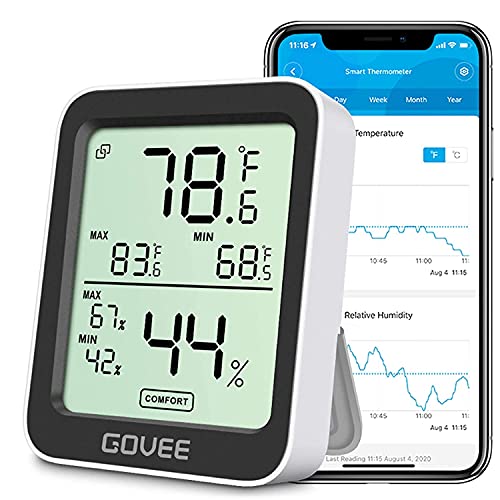
- Bluetooth monitoring up to 164 feet
- App alerts and historical graphs
- Two years of exportable data
Best For: Phone-based monitoring of rooms and sensitive spaces
Best Compact Pick
TempPro TempAir Mini Hygrometer

- Large-digit compact display
- DRY/COMFORT/WET face indicator
- Tabletop, magnetic, or hanging mount
Best For: Small spaces where flexible placement and readability matter
Best Value Multipack
Antonki 2-Pack Room Hygrometers

- Two monitors in one pack
- Large LCD with easy placement
- Wide temperature and humidity ranges
Best For: Monitoring two rooms or enclosures on a budget
Best Starter 3-Pack
TempPro TP49 Hygrometer 3-Pack

- Three units for monitoring multiple rooms
- DRY/COMFORT/WET comfort icons
- 10-second updates and flexible placement
Best For: Beginners who want simple humidity coverage throughout the home
Best for Trend Tracking
SECRUI KR-TH1 Digital Hygrometer

- Stores maximum and minimum readings
- Comfort indicator simplifies interpretation
- Wall, magnetic, or tabletop installation
Best For: Beginners who want to monitor changes over time
Best Single Monitor
TempPro TempAir Digital Hygrometer

- High-and-low records add useful context
- DRY/COMFORT/WET wellness indicator
- Includes batteries and magnetic placement
Best For: Beginners starting with one versatile indoor monitor
Best Multipack Value
6-Pack Mini Hygrometer Indoor Humidity Meter

- Six compact units for monitoring multiple locations
- 10%–99% RH and -58°F–158°F range
- Readings refresh automatically every 10 seconds
Best For: Beginners needing several basic humidity monitors
Best Accuracy on a Budget
JEDEW 4-Pack Digital Hygrometer

- Four monitors with ±3% RH humidity accuracy
- Switches between Fahrenheit and Celsius
- Includes spare LR44 battery and mounting tape
Best For: Beginners monitoring multiple indoor or enclosure locations
Best Compact Precision Pick

- Listed at ±2% RH humidity accuracy
- Fahrenheit/Celsius switching and 10-second refresh
- Tape or embedded installation options
Best For: Beginners monitoring small containers and enclosures
Best All-Around Starter – TempPro TP50 Digital Hygrometer
For shoppers comparing hygrometers for beginners, the TempPro TP50 keeps monitoring straightforward. Its digital display shows temperature, humidity, and a DRY/COMFORT/WET indicator, while high/low records help you compare changing room conditions.
Best For: Beginners who want a simple indoor monitor for a room, fridge, greenhouse, humidor, or other small space.
Pros:
- Humidity comfort icon makes readings easy to interpret.
- Measures humidity within +/-2 to 3%RH and temperature within +/-1°F.
- Refreshes readings every 10 seconds and stores high/low records.
- Can stand on a tabletop or attach magnetically; battery included.
Cons:
- Designed for indoor use.
- Does not include app connectivity or remote alerts.
The TP50 is a practical first hygrometer when you want useful accuracy and flexible placement without adding smart features or setup complexity.
Best Smart Upgrade – Govee H5075 Bluetooth Hygrometer
Among hygrometers for beginners, the Govee H5075 is a good fit if you want readings on a phone as well as on the device. Bluetooth monitoring, customizable alerts, and historical graphs make it easier to track conditions over time.
Best For: Beginners who want remote monitoring for bedrooms, nurseries, wine cellars, basements, or plant areas.
Pros:
- Bluetooth connection supports remote monitoring up to 164 feet.
- Offers temperature accuracy up to +/-0.54°F and humidity accuracy of +/-3%RH.
- Provides preset-range alerts and 20-day graph views.
- Data can be exported for up to two years in CSV format.
Cons:
- Remote features are limited to Bluetooth range.
- Requires app setup for smart alerts and data tools.
The H5075 costs more in terms of setup than a basic display, but its app history and alerts are valuable for beginners who want ongoing insight rather than occasional spot checks.
Best Compact Pick – TempPro TempAir Mini Hygrometer
The TempPro TempAir is one of the more approachable hygrometers for beginners because its compact screen uses large digits and a face icon to show comfort conditions. It also offers three placement options for spaces where a larger monitor may be inconvenient.
Best For: Beginners needing a small, readable monitor for a nursery, craft room, grow tent, RV, office, or greenhouse.
Pros:
- Large, bold digits are designed for easy viewing.
- Shows DRY/COMFORT/WET conditions at a glance.
- Measures humidity within +/-2 to 3%RH and temperature within +/-1°F.
- Includes tabletop, magnetic, and hanging placement options.
Cons:
- Does not offer high/low records or app connectivity in the supplied details.
- Its compact size may mean less display information at once.
This model is a sensible choice when visibility and placement flexibility matter most. It delivers the core information a beginner needs without extra monitoring features.
Best Value Multipack – Antonki 2-Pack Room Hygrometers
For beginners who want to monitor more than one location, the Antonki two-pack offers a simple way to get started with hygrometers for beginners. Each unit displays temperature and humidity on a large LCD and can sit on a surface, attach magnetically, or hang.
Best For: Households that want simultaneous readings in two rooms, enclosures, or storage areas.
Pros:
- Two monitors support side-by-side room monitoring.
- Large digital letters are easy to read from different angles.
- Includes kickstands, magnets, hanging holes, and batteries.
- Covers -58°F to 158°F and 10% to 99% relative humidity.
Cons:
- Humidity accuracy is listed at +/-5%RH, less precise than some single monitors.
- Readings may fluctuate for three to five minutes after startup.
- No app connectivity or remote alerts are included.
The Antonki set is a budget-friendly starting point for comparing conditions in multiple places. Choose it for coverage and convenience rather than advanced data tracking or the tightest stated accuracy.
Best Starter 3-Pack – TempPro TP49 Hygrometer 3-Pack
For beginners comparing hygrometers for beginners, the TempPro TP49 3-pack offers a simple way to monitor humidity and temperature in multiple rooms. Its comfort icons, large digits, 10-second refresh rate, and three placement options make everyday readings easy to understand.
Best For: Beginners who want to monitor several rooms, including bedrooms, kitchens, greenhouses, or offices.
Pros:
- Includes three compact digital hygrometers for monitoring multiple spaces.
- Displays DRY, COMFORT, or WET air conditions at a glance.
- Refreshes readings every 10 seconds with temperature accuracy of ±1°F and humidity accuracy of ±2% to 3%RH.
- Can sit on a tabletop, attach magnetically, or hang on a wall.
Cons:
- The compact display may show less information than a larger room monitor.
- Its operating humidity range begins at 10%RH, according to the supplied specifications.
This is a practical introductory choice when coverage matters more than advanced features. The three-unit format lets beginners compare conditions around the home without buying separate monitors individually.
Best for Trend Tracking – SECRUI KR-TH1 Digital Hygrometer
The SECRUI KR-TH1 is a beginner-friendly option among hygrometers for beginners because it combines straightforward readings with maximum and minimum records. Its comfort indicator and flexible mounting choices help new users put humidity data into context.
Best For: Beginners who want to review recent high and low temperature and humidity readings.
Pros:
- Records maximum and minimum temperature and humidity values.
- Refreshes data every 10 seconds and measures humidity with ±2% to 3%RH accuracy.
- Uses a DRY/COMFORT/WET indicator to make readings easier to interpret.
- Includes wall mounting, magnetic, and tabletop installation options.
Cons:
- The supplied details describe it as a two-count package, so it may be more than needed for a single room.
- The listed operating humidity range is 2% to 97%RH, leaving a small amount outside that range.
Its high-and-low memory makes this a useful step up from a basic instant-read hygrometer. Beginners can see whether conditions are changing instead of relying only on the current measurement.
Best Single Monitor – TempPro TempAir Digital Hygrometer
For beginners seeking hygrometers for beginners, the TempPro TempAir provides a focused single-monitor setup with clear comfort icons and high-and-low records. It also includes a Fahrenheit/Celsius selector and a magnetic back for convenient placement on a counter or refrigerator.
Best For: Beginners who need one versatile monitor for a room, refrigerator, humidor, or other indoor application.
Pros:
- Shows DRY, COMFORT, or WET conditions for quick interpretation.
- Updates temperature and humidity readings every 10 seconds.
- Displays high and low temperature and humidity records.
- Includes three AAA batteries and supports tabletop or magnetic placement.
Cons:
- Only one thermometer is included, unlike the multi-unit options in this roundup.
- The supplied details specify indoor use, so it is not positioned as an outdoor monitor.
This model is a balanced choice for someone starting with one monitoring location. Its records add useful context, while the icon-based display keeps day-to-day operation uncomplicated.
Best Multipack Value – 6-Pack Mini Hygrometer Indoor Humidity Meter
For beginners comparing hygrometers for beginners, this six-pack is a practical way to monitor several locations at once. Each compact unit displays temperature and humidity, refreshes readings every 10 seconds, and includes a battery.
Best For: Beginners who need multiple monitors for rooms, terrariums, jars, incubators, or greenhouse areas.
Pros:
- Six compact thermometer-hygrometer units in one pack
- Measures 10%–99% RH and -58°F–158°F
- Automatic updates every 10 seconds with an easy-to-read display
- Suitable for tabletop placement and multiple specialty uses
Cons:
- Humidity accuracy is listed as ±5% RH
- Temperature accuracy is listed as ±2°F
- Designed for basic monitoring rather than advanced controls or alerts
This is a straightforward starter option when coverage matters more than advanced features. The six-unit format makes it especially useful for checking several enclosures or rooms without buying separate packs.
Best Accuracy on a Budget – JEDEW 4-Pack Digital Hygrometer
This JEDEW four-pack is a beginner-friendly choice for anyone learning how to track indoor conditions. Its LCD display measures temperature and humidity every 10 seconds, and users can switch between Fahrenheit and Celsius.
Best For: Beginners monitoring home spaces, offices, greenhouses, humidors, terrariums, or other enclosures.
Pros:
- Four monitors provide coverage for multiple locations
- Temperature accuracy is listed as ±1°F and humidity accuracy as ±3% RH
- Supports Fahrenheit and Celsius readings
- Includes a spare LR44 battery and double-sided tape
Cons:
- Operating temperature range starts at 32°F
- Uses LR44 button cells, which may require replacement
- Freestanding design may offer fewer placement options than a wall-mounted unit
Compared with many basic starter meters, the listed accuracy and included spare battery are useful advantages. Choose it when you want several compact monitors with simple setup and unit conversion.
Best Compact Precision Pick – 2-Pack Mini Hygrometer
For beginners who want a small, precise humidity monitor without a large display or complicated controls, this two-pack keeps the essentials simple. It refreshes readings every 10 seconds and switches between Fahrenheit and Celsius.
Best For: Beginners monitoring small spaces such as jars, humidors, reptile tanks, guitar cases, cars, or 3D-printer material containers.
Pros:
- Listed humidity accuracy of ±2% RH
- Temperature accuracy is listed as ±1°F
- Supports Fahrenheit and Celsius readings
- Can be installed with double-sided tape or an embedded opening
Cons:
- Only two units are included
- Compact format may be less suitable for reading from across a room
- Uses an LR44 button cell with a stated life of up to 10 months
This is a strong fit when compact size and the tighter listed humidity accuracy matter most. Its simple installation options also make it flexible for containers and other small monitoring areas.
How We Picked the Best Hygrometers for Beginners
We focused on the features that matter most when you are buying your first humidity monitor: clear readings, straightforward operation, useful temperature data, practical placement options, and value. The selection includes basic displays for bedrooms and living spaces, multipacks for monitoring several areas, and a connected model for users who want readings on a phone.
We also considered whether each format suits common beginner uses, including indoor comfort, plant care, instrument or storage monitoring, greenhouses, and reptile enclosures. A simple device can be the better choice when you only need an at-a-glance reading, while app control or multiple sensors may justify a higher price for more involved setups.
Quick Comparison
| Type | Best for | Main advantage | Potential limitation |
|---|---|---|---|
| Single digital hygrometer | One room or enclosure | Simple, affordable monitoring | Limited coverage |
| Multipack | Several rooms or storage areas | Monitors multiple locations | More units require more batteries and placement |
| Bluetooth hygrometer | Remote checks and tracking | App access and recorded data | More setup and connectivity dependence |
| Mini hygrometer | Small spaces, cases, and cabinets | Compact footprint | Smaller display may be harder to read |
Key Buying Factors for Hygrometers for Beginners
Humidity and Temperature Range
Confirm that the stated measurement ranges cover your intended environment. Indoor room monitoring typically has modest requirements, while greenhouses, reptile habitats, and storage spaces may experience wider swings.
Readability and Placement
Choose a large, high-contrast display if you want quick checks from across a room. Mini models work well in cramped locations, but their compact screens can be less convenient. Consider whether the unit can stand on a surface, attach to a wall, or sit inside a cabinet.
Accuracy and Consistency
No household hygrometer is perfectly exact. Look for consistent readings and, when possible, compare a new unit with another trusted monitor. For sensitive applications, place sensors away from direct sunlight, vents, heaters, and damp surfaces.
Battery Life and Maintenance
Check the battery type and whether replacements are easy to find. Multipacks can reduce the cost per sensor, but they also increase maintenance. Keep sensors clean and allow them to adjust to a new location before judging their readings.
Smart Features
Bluetooth monitoring is useful when you want historical data, alerts, or readings without entering the room. If you only need a visible number, a basic display is generally easier and more economical.
Who Should Buy Which Hygrometers for Beginners?
For a first bedroom or living-room monitor: Choose a straightforward single digital model with an easy-to-read screen and temperature display.
For several rooms: A two-, three-, four-, or six-pack offers broader coverage and makes it easier to compare humidity throughout your home.
For cabinets, cases, and small enclosures: Pick a mini hygrometer, provided its display is readable in the location you plan to use.
For plants, greenhouses, or reptiles: Prioritize suitable measurement ranges, dependable placement, and multiple sensors when conditions vary across the habitat.
For data-focused monitoring: Select the Bluetooth-enabled option if app access and trend history are worth the additional setup. For most beginners, however, the best choice is the model you will check regularly and place correctly.